Bamboo Flooring Cost Sydney: Solid vs Engineered Quotes
Solid or engineered bamboo flooring in Sydney? Compare costs and see how material grade, subfloor preparation, installation and room size can affect your quote.
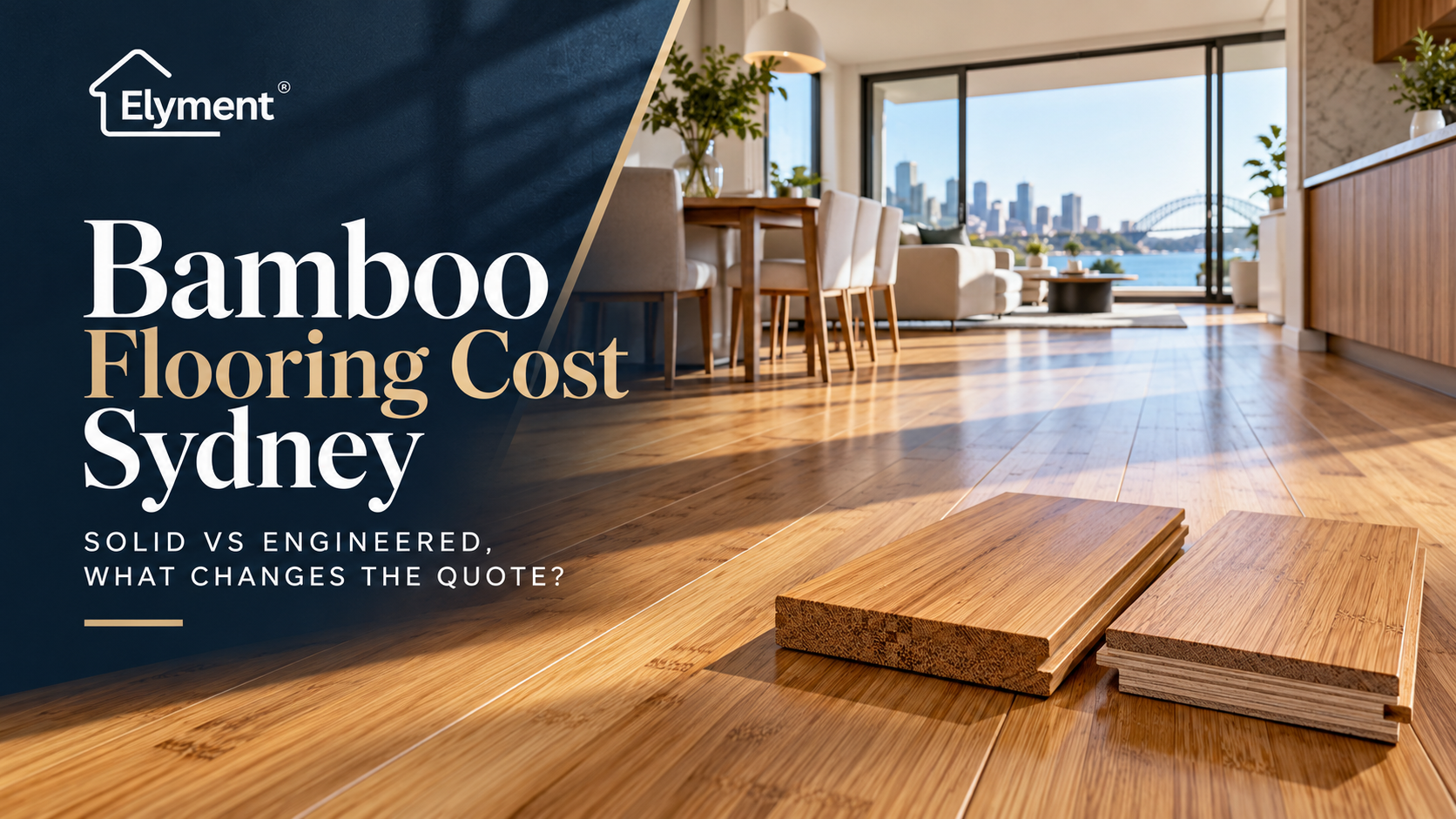
Bamboo flooring costs in Sydney depend on board construction, product specifications, installation method and the condition of the existing floor. Solid strand-woven and engineered bamboo can require different installation systems, but neither is automatically cheaper. Sydney homeowners should compare complete quotations covering materials, removal, subfloor preparation, underlay or adhesives, trims and installation. Strata properties may also require flooring approval and acoustic documentation before work begins.
ELYMENT Insights | Flooring & Renovation Planning | Sydney, NSW | 30 October 2026
The Expensive Difference Between a Flooring Price and a Finished Floor
Two Sydney flooring quotations can describe what appears to be the same renovation while specifying materially different products and installation systems.
Both may offer bamboo flooring. Both may quote a price per square metre. Both may promise a completed floor with a similar appearance.
The differences often sit beneath the visible surface.
One contractor may specify solid strand-woven bamboo with a click-lock profile, installed as a floating floor. Another may propose engineered bamboo with a layered construction and a direct adhesive installation.
The first quotation might include standard underlay but exclude concrete preparation. The second might include adhesive and moisture-control materials while excluding removal of the existing flooring.
Comparing the two headline rates without examining their inclusions can produce an unreliable assessment of the project's actual cost.
For Sydney property owners, the relevant financial question is not simply which bamboo board costs less. It is which fully specified flooring system can be installed successfully within the project's budget, site conditions and approval requirements.
Solid and Engineered Bamboo: What Is Actually Being Purchased?
Bamboo flooring terminology can create confusion before quotations are even prepared.
Bamboo is botanically a grass, although manufactured bamboo flooring shares several characteristics with timber flooring.
The Australian Timber Flooring Association (ATFA) identifies strand-woven bamboo, horizontally and vertically laminated bamboo, and engineered bamboo constructions as distinct product forms.
The association's engineered, laminate and bamboo installation specification also recognises both floating and direct adhesive installation systems.
Solid Strand-Woven Bamboo
Solid strand-woven bamboo is manufactured by bonding compressed bamboo fibres into dense boards.
Unlike conventional solid hardwood, the material is not simply cut from a single piece of timber. Its structure is created through a manufacturing process involving bamboo fibres, adhesive and pressure.
Its commercial characteristics depend on factors including:
- Manufacturing process and board density.
- Overall board thickness and dimensions.
- Click-lock or tongue-and-groove profile.
- Factory-applied surface coating.
- Manufacturer-approved installation method.
- Moisture and environmental limitations.
- Residential or commercial warranty conditions.
Strand-woven bamboo can offer substantial surface hardness, but hardness alone does not establish installation suitability, dimensional stability or the product's total project cost.
Engineered Bamboo Flooring
Engineered bamboo typically combines a bamboo wearing surface with a manufactured supporting structure.
Depending on the product, the supporting construction may incorporate multiple bonded layers or an engineered core designed to influence dimensional behaviour.
The composition is not identical across manufacturers.
An engineered bamboo product may contain a strand-woven bamboo surface over a layered backing, while another manufacturer may use a different structural arrangement.
Engineered construction can influence stability, installation compatibility and floor build-up. However, it does not guarantee that a particular product is suitable for every Sydney property.
The manufacturer's technical documentation must establish whether the proposed board can be floated, adhesive-fixed or installed using another approved method.
Construction Comparison
- Board construction
- Solid Bamboo: Compressed strand-woven or laminated bamboo throughout the board.
- Engineered Bamboo: Bamboo surface combined with an engineered supporting structure.
- Core composition
- Solid Bamboo: Generally bamboo-based throughout.
- Engineered Bamboo: Varies by manufacturer and product.
- Dimensional behaviour
- Solid Bamboo: Depends on construction, manufacturing quality and environmental conditions.
- Engineered Bamboo: May offer additional dimensional stability, depending on its design.
- Installation system
- Solid Bamboo: Floating or adhesive-fixed where approved by the manufacturer.
- Engineered Bamboo: Floating or adhesive-fixed where approved by the manufacturer.
- Material pricing
- Solid Bamboo: Depends on grade, density, dimensions, finish and supplier.
- Engineered Bamboo: Depends on surface construction, core, dimensions and supplier.
- Subfloor requirements
- Solid Bamboo: Must satisfy the selected product and installation system.
- Engineered Bamboo: Must satisfy the selected product and installation system.
- Best comparison method
- Solid Bamboo: Review the exact product specification and complete installed cost.
- Engineered Bamboo: Review the exact product specification and complete installed cost.
The distinction matters because the labels "solid" and "engineered" do not provide enough information to determine price, performance or suitability.
Before accepting either quotation, request the exact product name, current technical datasheet and installation instructions.
What Does Bamboo Flooring Cost in Sydney in 2026?
Published pricing provides a useful starting point, provided the figures are not mistaken for a complete project quotation.
A Sydney flooring cost guide updated in October 2026 reports indicative bamboo flooring supply-and-installation prices of approximately $92 to $170 per square metre, including GST.
Its reported mid-range figure is approximately $140 per square metre.
Source: Sydney flooring cost research, October 2026.
These figures describe market estimates. They do not establish a universal price for solid or engineered bamboo, nor do they guarantee that every site-specific requirement is included.
A quotation should establish whether the following components are included, excluded or priced separately.
Bamboo Flooring Cost Components
- Bamboo boards
- What must be confirmed: Exact manufacturer, product, construction, dimensions, finish and ordered quantity.
- Installation labour
- What must be confirmed: Approved fixing method, layout and installation complexity.
- Existing floor removal
- What must be confirmed: Material type, uplift method, adhesive removal and disposal.
- Concrete grinding
- What must be confirmed: Surface preparation, adhesive residue removal and local high-point correction.
- Floor levelling
- What must be confirmed: Measured area, anticipated depth, suitable compounds and preparation requirements.
- Underlay or adhesive system
- What must be confirmed: Product compatibility, moisture protection and acoustic requirements.
- Finishing details
- What must be confirmed: Skirting, scotia, stair nosings, thresholds and transition profiles.
- Site logistics
- What must be confirmed: Delivery, parking, lift access, waste movements and permitted working hours.
- Documentation
- What must be confirmed: Relevant product certificates, strata submissions and installation records.
The installed price per square metre should therefore be treated as one component of the renovation budget rather than the final cost of the project.
The Specification Details That Can Change the Price
Two bamboo products with similar colours and dimensions can have substantially different commercial characteristics.
A meaningful quotation should identify more than the product category.
Board Dimensions and Thickness
Board length, width and overall thickness can influence material pricing, packaging, installation productivity and the finished floor height.
A thicker board is not automatically a better board.
Its performance also depends on the construction, coating, core characteristics and manufacturer's intended application.
In apartments and existing homes, additional thickness may create conflicts with door clearances, fixed joinery or adjoining flooring.
Jointing System
Click-lock bamboo and tongue-and-groove bamboo can require different installation processes.
A system designed for floating installation may have different adhesive, underlay and labour requirements from a product specified for direct fixing.
The selected installation method must be approved for the exact product.
Coating and Surface Performance
Factory-applied finishes vary in coating construction, wear characteristics and maintenance requirements.
Property owners should request relevant performance documentation rather than relying exclusively on descriptions such as premium, commercial-grade or highly durable.
The specification should also identify any relevant slip-resistance, emissions or other performance documentation required for the intended application.
Warranty Conditions
A long advertised warranty does not necessarily provide broad protection against every form of damage.
Warranty conditions may distinguish manufacturing defects, coating performance, installation errors, moisture-related damage and unsuitable environmental conditions.
A quotation should identify who supplies the product warranty, who provides installation workmanship coverage, and how claims will be managed.
Floating or Glue-Down: A Separate Cost Decision
The choice between solid and engineered bamboo should not be confused with the choice between floating and adhesive-fixed installation.
These are separate specification decisions.
Floating Bamboo Flooring
A floating system normally sits over a compatible underlay without being permanently bonded across its full surface to the structural subfloor.
Its cost structure may include:
- Compatible acoustic or standard underlay.
- Any required moisture-control layer.
- Approved board jointing system.
- Perimeter expansion allowances.
- Transition profiles and edge finishing.
- Required subfloor flatness corrections.
Floating installation can reduce adhesive-related labour and material costs in suitable applications.
However, the existing substrate must still satisfy the manufacturer's flatness, cleanliness and moisture requirements.
Direct Adhesive Installation
A direct-stick system uses a compatible adhesive to bond the bamboo flooring to a prepared substrate.
Depending on the selected system, additional work may include:
- Removal of incompatible surface contamination.
- Mechanical concrete preparation.
- Moisture testing and approved moisture management.
- Compatible primers or barriers where required.
- Specified flooring adhesive.
- Adhesive curing and return-to-service allowances.
Direct fixing is not automatically appropriate for every engineered or solid bamboo product.
The full installation assembly must be supported by the relevant manufacturer's instructions.
The operational consequence is significant: a lower board price can be outweighed by the cost of the fixing system required to install it correctly.
How a $25 Difference Per Square Metre Can Disappear
Consider an illustrative Sydney renovation involving 55 square metres of new flooring.
Assume one supply-and-install quotation is $25 per square metre cheaper than another.
On the measured installation area, the apparent saving is:
55 m² × $25 = $1,375
Now assume the cheaper quotation excludes $1,800 of necessary subfloor preparation, while the more expensive quotation already includes equivalent preparation.
That single exclusion exceeds the initial saving by $425.
This example is hypothetical, not a published installation rate or an Elyment project quotation.
Its purpose is to illustrate the importance of comparing equivalent scope and specifications.
In a real project, the comparison must also account for ordered material quantities, waste allowances, underlay, adhesives, removal, trims and applicable GST.
The cheapest advertised rate is not necessarily the cheapest completed floor.
Sydney Strata Buildings Introduce Another Procurement Requirement
Sydney apartment renovations require additional scrutiny because the flooring system can affect neighbouring lots and common-property arrangements.
Replacing carpet with bamboo changes the acoustic characteristics of the flooring assembly.
Under the NSW Government's strata renovation guidance, installing or replacing hard flooring, including removing carpet as part of that change, is generally treated as a minor renovation requiring the applicable approval process.
The guidance also identifies acoustic certification as part of the information required for flooring applications.
The owners corporation's by-laws and the particular scope of work must still be reviewed.
Where structural work, waterproofing or common property is affected, additional approvals or requirements may apply.
The Acoustic System Must Match the Proposal
A quotation stating that acoustic underlay is included does not, by itself, establish compliance with a strata scheme's requirements.
The proposal should identify:
- The nominated bamboo product.
- The complete underlay or adhesive assembly.
- Relevant acoustic test documentation.
- The requirements specified by the strata scheme.
- Who prepares and submits approval documents.
- Whether further testing or certification is required.
A laboratory performance result for one flooring assembly should not automatically be applied to a different board and underlay combination.
Changing products after approval may require the revised proposal to be checked against the original approval conditions.
Access Can Affect the Installation Budget
Apartments can also introduce practical costs unrelated to the bamboo boards themselves.
These may include lift bookings, common-area protection, restricted delivery times, parking arrangements, waste removal pathways and noise restrictions.
A quotation that ignores these requirements can understate the labour and coordination involved.
The Existing Floor Can Determine the Real Installation Scope
Before ordering bamboo flooring, the project team should understand what needs to happen to the existing floor.
An established Sydney apartment may contain carpet, older tiles, adhesive residue, levelling compound or previous flooring installations.
Removing these materials can reveal substrate conditions that were not visible during the initial quotation.
The required preparation may involve:
- Removing the existing flooring and underlay.
- Assessing and removing residual adhesives.
- Controlled concrete grinding.
- Repairing local substrate defects.
- Measuring and correcting unacceptable floor variation.
- Testing moisture conditions.
- Confirming the substrate is suitable for the selected bamboo system.
Suspected asbestos-containing historical materials must not be disturbed or ground until they have been appropriately assessed and any necessary specialist controls or removal arrangements are in place.
Concrete grinding must also be planned with suitable dust and respirable crystalline silica controls.
For project owners assessing these operations, Elyment provides floor removal, concrete grinding and floor levelling support in Sydney.
A more detailed explanation of how substrate acceptance criteria affect preparation quotations is available in Elyment's guide to concrete floor preparation quotations.
The important procurement decision is to identify preparation requirements before treating the flooring installation price as final.
Comparing Quotations on the Same Commercial Basis
A useful procurement comparison separates the finished flooring system from the surrounding renovation activities.
The following information should be requested from each supplier or contractor.
Bamboo Flooring Quotation Comparison
- Product identity
- Required information: Manufacturer, model, colour, construction and technical datasheet.
- Commercial risk if missing: Different products may be compared as though they are equivalent.
- Material quantity
- Required information: Measured floor area, agreed wastage allowance and actual ordered quantity.
- Commercial risk if missing: Material costs may be understated.
- Installation method
- Required information: Floating or direct adhesive installation, supported by manufacturer instructions.
- Commercial risk if missing: Labour and ancillary materials may differ.
- Preparation scope
- Required information: Removal, grinding, levelling, repairs and moisture requirements.
- Commercial risk if missing: Unexpected site variations may arise.
- Ancillary products
- Required information: Underlay, adhesive, moisture system and compatible primers.
- Commercial risk if missing: Important components may be omitted.
- Finishing scope
- Required information: Skirting, thresholds, stairs and transitions.
- Commercial risk if missing: The quoted floor may not include a fully completed finish.
- Project logistics
- Required information: Delivery, storage, access, waste handling and building restrictions.
- Commercial risk if missing: Mobilisation and programme costs may increase.
- Availability
- Required information: Confirmed product range, quantity, colour batch and delivery lead time.
- Commercial risk if missing: Substitutions or programme delays may occur.
- Commercial terms
- Required information: GST, payment terms, exclusions, provisional sums and variation procedure.
- Commercial risk if missing: The apparent total may not represent the final payable amount.
Material quantities deserve particular attention.
The area being installed is not necessarily the same as the area of flooring that must be purchased.
Board lengths, room geometry, layout and pack quantities can create waste and rounding requirements.
One contractor may include the necessary additional material in the quotation.
Another may calculate the price using the net floor area and charge separately for the additional boards.
Both quotations should use an agreed quantity basis before their rates are compared.
Product Availability Should Be Confirmed Before the Programme Is Fixed
A product appearing in a catalogue does not establish that the required quantity is available for a particular Sydney renovation.
Before placing an order, the project team should confirm the selected range with the nominated supplier.
That confirmation should cover:
- Current range and product availability.
- Required quantity and pack allocation.
- Matching colour and manufacturing batches.
- Current product specification and installation documents.
- Delivery location and realistic lead time.
- Handling requirements and responsibility for damaged deliveries.
- Availability of compatible trims and accessories.
This is particularly important when comparing quotations that specify different bamboo constructions.
A proposed substitution should not be approved solely because the replacement has a similar colour or advertised thickness.
Its core construction, installation method, warranty conditions and required accessory systems should be reviewed.
Elyment's involvement in flooring planning should not be interpreted as confirmation that a particular bamboo brand, model or product range is stocked or supplied.
Product selection, availability and procurement arrangements must be confirmed for the individual project.
Four Commercial Decisions Before Installation Begins
1. Establish the Product Specification
Confirm the exact bamboo construction, board dimensions, fixing method, technical documents and intended application.
Avoid selecting products solely from photographs or broad marketing descriptions.
2. Separate Confirmed Work From Unknown Conditions
Obtain a measured scope for removal and preparation.
Where conditions remain concealed, identify provisional allowances, inspection points and how variations will be approved.
3. Resolve Approvals and Trade Responsibilities
Confirm any relevant strata approval, acoustic documentation, access arrangements and responsibility for substrate acceptance.
The flooring supplier, preparation contractor and installer should work from compatible specifications.
4. Confirm the Commercial Commitment
Check material availability, the complete quoted price, GST treatment, payment milestones, warranties and exclusions.
For residential building work covered by NSW home-building legislation, written contract requirements apply when the work exceeds $5,000 including GST.
The NSW Government's home-building contract guidance explains the relevant requirements for residential renovation agreements.
Project owners should ensure that variations are documented and agreed in accordance with the applicable contract and law.
The Financial Decision Is About the Flooring System, Not the Label
Solid and engineered bamboo represent different manufacturing approaches, but neither description provides a complete indication of value.
A well-specified solid strand-woven product may be commercially suitable for one Sydney renovation.
An engineered bamboo product may better suit another project's performance requirements, installation method or floor-height constraints.
The difference cannot be resolved by assuming that one category is universally stronger, more stable or less expensive.
A credible comparison requires the same level of information for both proposals:
- Verified product construction.
- Documented installation compatibility.
- Equivalent project scope.
- Realistic quantities and preparation allowances.
- Relevant NSW and strata requirements.
- Confirmed supplier availability.
- Clear responsibility for completion and warranties.
The decision becomes substantially more reliable when the total cost is considered alongside the evidence supporting the proposed flooring system.
Planning a Bamboo Flooring Renovation in Sydney?
Elyment can review flooring project requirements, including existing floor removal, concrete preparation, levelling, access arrangements and coordination with the intended installation.
Discuss the project scope, preparation requirements and delivery considerations before committing to a final renovation programme.
Request a Flooring Project Review →
The Quote Worth Accepting
The most useful bamboo flooring quotation is not necessarily the one with the lowest advertised square-metre rate.
It is the quotation that identifies the exact product, confirms how it will be installed, accounts for the existing floor and provides a credible pathway to completion.
For Sydney homeowners, strata committees and renovation teams, that level of detail makes the difference between comparing flooring prices and making an informed construction decision.
Sources and References
- Australian Timber Flooring Association (ATFA) — Engineered, Laminate and Bamboo Installation Specification
- ATFA installation specification (PDF)
- What's the Damage — Sydney Flooring Cost Guide, October 2026
- Sydney flooring cost research
- NSW Government — Strata Renovations
- NSW Government strata renovation guidance
- NSW Government — Home-Building Contracts
- NSW Government home-building contract guidance
- Elyment — Flooring Services Sydney
- Floor removal, concrete grinding and floor levelling
- Elyment — Concrete Floor Preparation Quotations
- Flooring Installer Rejected Your Slab? What a Concrete Floor Preparation Sydney Quote Should Include
- Elyment — Contact
- Request a Flooring Project Review
Relevant next actions
Explore the ELYMENT service most closely connected to this article.