Bamboo Flooring Sydney: Carbonised vs Stained Hardness
Colour alone does not determine bamboo floor hardness in Sydney. Carbonising can soften boards, while staining may not. Check hardness ratings before you order.
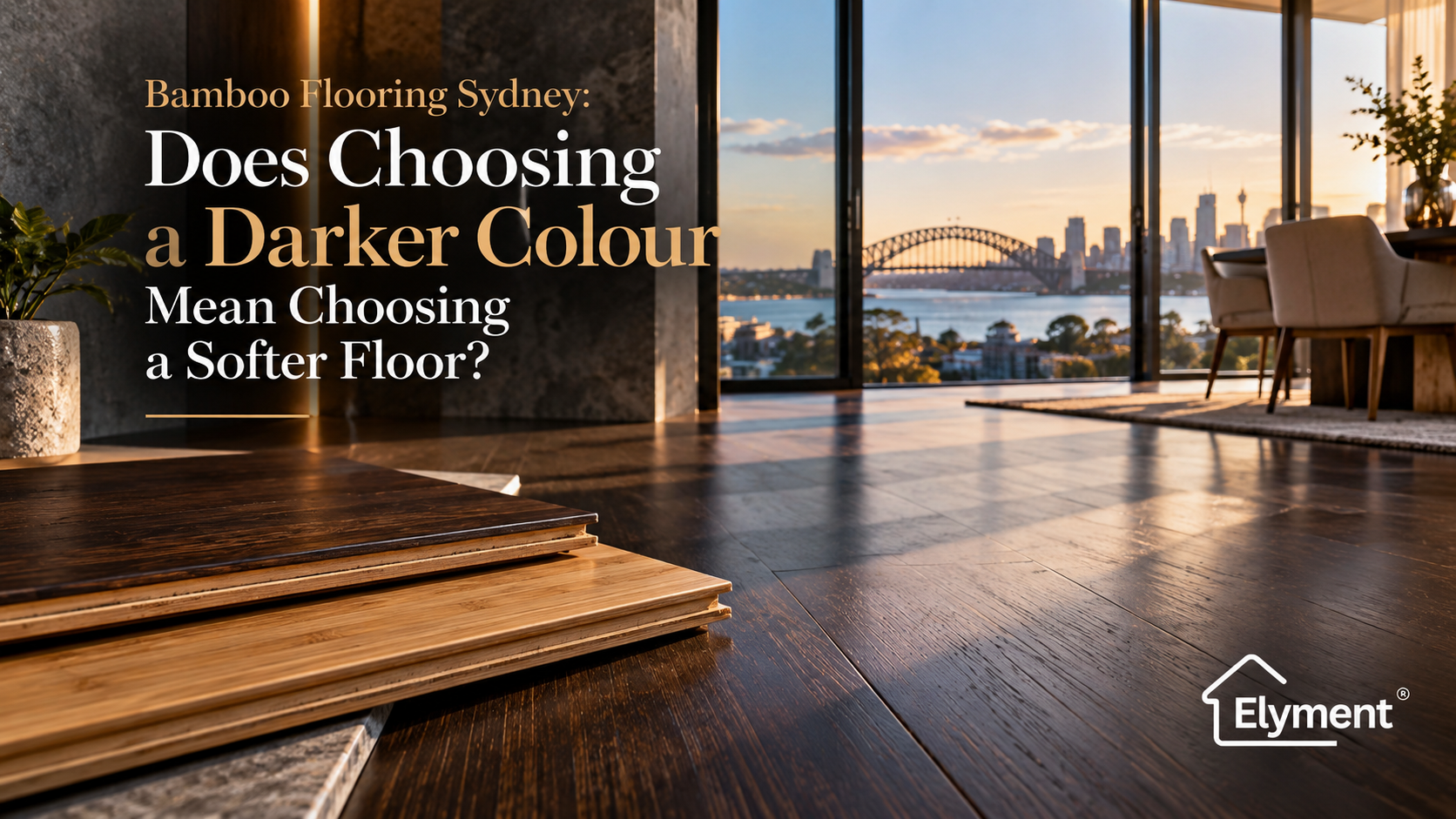
Darker bamboo flooring is not automatically softer. Carbonisation uses heat to darken bamboo and can reduce its hardness, particularly in traditional laminated products. Surface staining changes colour without necessarily altering the underlying bamboo. Strand-woven construction introduces further differences. For Sydney renovations, compare manufacturer-specific Janka hardness ratings, construction, coatings and installation requirements before assuming that a dark bamboo floor is less durable.
Reviewed 19 October 2026 | Elyment Insights
The Colour Decision That Conceals a Material Question
A dark bamboo floor can transform a Sydney apartment. Deep coffee, smoked walnut and charcoal tones provide contrast against pale walls, stone benchtops and contemporary joinery. The appearance can resemble premium hardwood, although the underlying material and manufacturing process are quite different.
For homeowners, architects and renovation managers, the difficulty begins when two similarly coloured bamboo products are treated as technically equivalent.
One might be produced using heat-treated bamboo strips. Another might receive its darker appearance from staining or pigmentation. A third might incorporate compressed strand-woven bamboo over an engineered plywood core.
These products can look remarkably similar in a showroom while having different hardness characteristics, surface coatings, installation systems and prices.
The distinction is important because bamboo flooring hardness cannot be established reliably from colour alone. It must be assessed against the construction and specification of the particular product.
Carbonisation and Staining Are Not the Same Process
The expression "dark bamboo" describes an appearance, not a single manufacturing method.
Carbonised bamboo: colour produced through heat
Carbonisation involves controlled heat treatment, often using steam, to develop darker tones within the bamboo material. The treatment changes the appearance of the fibres rather than simply placing a dark coating over a pale surface.
Depending on processing conditions, carbonisation can also alter the physical properties of the bamboo. Traditional horizontal and vertical laminated products may show reduced hardness when compared with otherwise equivalent natural-coloured products.
This is the origin of the familiar industry advice that carbonised bamboo can be softer than natural bamboo.
However, the extent of any reduction depends on the treatment process and the finished board's construction. It would be misleading to apply one percentage reduction to every carbonised bamboo floor sold in Australia.
Stained bamboo: colour applied through finishing
Stained bamboo follows a different approach. Manufacturers can introduce darker pigments, dyes or coloured finishes to create walnut, espresso or charcoal appearances without relying on carbonisation as the principal colouring method.
Surface staining does not necessarily reduce the hardness of the bamboo beneath it. Nevertheless, the coating system, stain penetration and manufacturing treatment must be considered.
A dark stained floor may also reveal lighter underlying material if the coloured layer is damaged deeply enough. Carbonised bamboo may retain more colour beneath the surface, although the result depends on the product construction.
Neither appearance establishes the floor's actual resistance to dents, scratches or wear.
Three Bamboo Constructions, Three Different Performance Profiles
Bamboo flooring should not be assessed as one uniform product category. The way the bamboo fibres are arranged and manufactured can materially influence the finished board's hardness.
- Horizontal bamboo
- Manufacturing approach: Laminated strips are arranged horizontally, often showing recognisable bamboo nodes.
- Hardness consideration: Carbonisation may reduce hardness compared with an equivalent natural product.
- Vertical bamboo
- Manufacturing approach: Bamboo strips are laminated on edge, producing a finer linear appearance.
- Hardness consideration: Heat treatment can influence material properties; check the actual product rating.
- Strand-woven bamboo
- Manufacturing approach: Bamboo fibres are combined with resin and compressed into dense material.
- Hardness consideration: Often offers substantially greater indentation resistance, with considerable variation between manufacturers.
Engineered bamboo adds another distinction. Some products incorporate a strand-woven bamboo wear layer bonded to a plywood core. Others use different laminated constructions.
The thickness and composition of the surface layer matter because an engineered board's overall thickness is not necessarily the thickness of its usable bamboo surface.
For example, an engineered floor with a 14 mm overall thickness and a 3 mm bamboo surface layer should not be compared directly with a solid strand-woven board simply because both products are 14 mm thick.
What an Australian Supplier's Hardness Specification Actually Shows
A useful example comes from Australian flooring supplier Preference Floors.
Its Verdura X engineered bamboo range incorporates a strand-woven bamboo wear layer over a cross-laminated plywood substrate. The supplier publishes an approximate Janka hardness rating of 15 kN for the range.
The significance is not that every bamboo product achieves this result. Nor does a range-level figure establish the precise hardness of every individual colour.
It demonstrates why an actual Australian supplier specification is more useful than an assumption based on whether the sample is pale, brown or almost black.
The correct comparison is between specific products with identified construction, technical documentation and comparable test results.
What does the Janka rating measure?
Janka hardness measures a material's resistance to indentation under a defined test procedure. A higher rating generally indicates greater resistance to the test indentation.
It does not independently establish:
- Resistance to scratches in the surface coating.
- Resistance to abrasion from sand and grit.
- Protection against moisture-related movement.
- Quality or durability of the locking system.
- Suitability for every residential or commercial environment.
Sydney buyers should also confirm the measurement units and test basis. Some international literature expresses Janka results in pounds-force, while Australian product literature commonly uses kilonewtons.
Two figures should not be compared without checking their units, whether they represent the actual finished product and whether the tests are comparable.
The Real-World Difference Between a Dent and a Scratch
A floor can have excellent indentation resistance and still develop visible scratches.
This becomes particularly relevant in Sydney homes with large glazed living areas, pets, dining furniture and regularly used entrances.
Consider two dark strand-woven bamboo samples with similar published hardness ratings.
One has a smooth, reflective surface. The other has a textured, low-sheen finish. Both may resist indentation effectively, yet everyday scuffing and fine scratches may appear more noticeable on the smooth reflective product.
That difference concerns finish characteristics and visibility, not necessarily a meaningful difference in the bamboo's underlying hardness.
A proper product review should therefore distinguish between substrate hardness, coating performance and appearance under expected household use.
Owners should request coating information, care requirements and warranty limitations rather than treating the Janka figure as a complete durability assessment.
A Sydney Renovation Can Be Delayed by the Wrong Product Assumption
The consequences of selecting bamboo flooring by colour alone can extend beyond product satisfaction.
Consider a hypothetical apartment refurbishment in Chatswood.
An owner approves a dark bamboo sample. The original quotation is based on one engineered strand-woven collection, but a different dark product is proposed after the preferred colour becomes unavailable.
If the substitute has a different construction, thickness, locking profile or approved installation method, the substitution is not necessarily a simple colour change.
It may require renewed checks of the underlay, floor levels, acoustic performance, transitions and installation instructions.
The resulting cost is not necessarily the difference between the two material prices. It may include specification review, revised installation planning, additional preparation or programme disruption.
For renovation managers, the sensible control is a written product-substitution process. Technical equivalence should be established before purchasing or approving replacement materials.
NSW Strata Approval Still Matters, Whatever the Colour
Bamboo flooring installation in Sydney apartments can also raise strata requirements that have little connection with hardness.
Under the NSW Government's strata renovation guidance, installing or replacing hard flooring is generally treated as a minor renovation requiring approval, subject to the circumstances and scheme arrangements.
Relevant applications may require acoustic documentation demonstrating the performance of the proposed flooring system.
A bamboo plank with a high Janka rating does not automatically provide acceptable impact sound insulation.
Acoustic performance depends on the complete floor assembly, including the substrate, underlay, installation method and relevant construction details.
If a product substitution changes the flooring system, existing acoustic evidence may need to be reviewed for applicability.
The owner's approval process, the building's by-laws and the proposed installation assembly should therefore be checked before work is committed.
Five Documents Worth Checking Before the Purchase Order
A more reliable bamboo flooring procurement process starts with documentation rather than showroom appearance.
1. Product identification
Obtain the manufacturer, collection name, product code, colour code and current technical data sheet.
2. Construction and colouring
Confirm whether the board is horizontal, vertical, strand-woven or engineered, and whether the chosen colour is produced through carbonisation, staining or another treatment.
3. Hardness and surface performance
Request the applicable Janka result, its units and test basis, together with available coating information.
4. Installation and substrate requirements
Verify the approved installation method, floor flatness, moisture requirements, underlay compatibility and dimensional limits.
5. Warranty and compliance evidence
Review the current product warranty, applicable fire and slip information, emissions documentation and acoustic reports where required.
Any unresolved specification differences should be addressed before the final material order or a substitute product is authorised.
Elyment's earlier guidance on laser floor surveys and floor levelling explains why the condition of the existing substrate can influence the next stage of flooring work.
Where an existing bamboo floor must first be removed, the demolition and preparation work should be scoped separately. Elyment has also examined bamboo flooring removal costs across Sydney and the effect of access, adhesives and property type.
Product conditioning and installation timing are separate considerations, covered in Elyment's guide to bamboo flooring acclimatisation.
Where the Darker Option Makes Commercial Sense
There is no technical reason to reject dark bamboo flooring solely because of colour.
A high-density, appropriately specified dark strand-woven product may provide excellent indentation resistance and suit a demanding residential environment.
Equally, a natural-coloured bamboo product should not be assumed superior merely because it has avoided carbonisation.
The purchasing decision should consider the expected traffic, surface finish, manufacturer documentation, floor assembly, installation requirements and total project cost.
In Sydney renovation projects, the distinction matters most when a product changes after the original design or quote has been approved.
A cheaper substitute may cost more overall if it requires additional preparation, changes the installation method or no longer satisfies an existing approval.
The Specification Should Decide, Not the Shade
Carbonisation can affect bamboo hardness, but a darker colour is not a universal measure of softness.
Staining, fibre compression, engineered construction and protective finishes all influence how the final flooring product should be assessed.
The relevant comparison is not simply natural versus carbonised bamboo. It is one identifiable product against another, supported by meaningful technical specifications.
For Sydney property owners and renovation teams, establishing that distinction before ordering provides a stronger foundation for material selection, cost control and installation planning.
ELYMENT | SYDNEY PROPERTY OPERATIONS
Confirm the Floor Specification Before Installation
Review flooring suitability, substrate preparation, installation requirements and project coordination before committing to your renovation.
Sources and References
Regulatory and Government Sources
- NSW Government: Strata Renovations and Approvals
Manufacturer and Supplier Sources
- Preference Floors: Verdura X Engineered Bamboo Flooring
Elyment Related Articles
- Elyment: Floor Levelling Sydney — What a Laser Floor Survey Reveals
- Elyment: Why Do Bamboo Flooring Removal Costs Vary Across Sydney Suburbs and Property Types?
- Elyment: Bamboo Flooring Sydney — How Long to Acclimatise
- Elyment: Contact and Project Enquiries
Relevant next actions
Explore the ELYMENT service most closely connected to this article.