Black Friday 2026: Can ChatGPT and Alexa Find a Deal Worth Buying?
Can ChatGPT and Alexa find Black Friday 2026 deals worth buying? Learn how AI shopping tools compare prices, flag misleading discounts and avoid impulse buying.
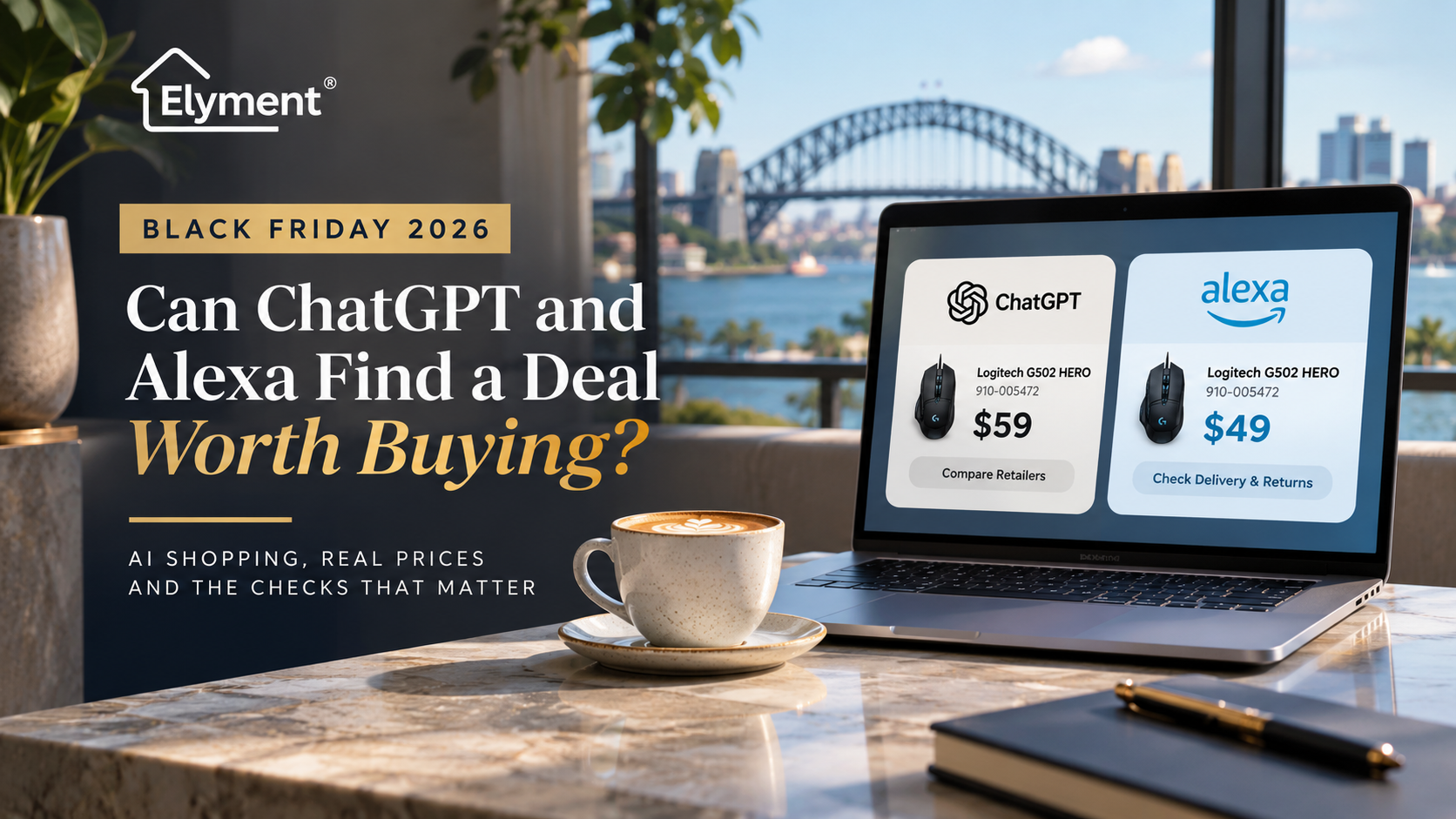
ChatGPT and Amazon's Alexa for Shopping can help Sydney and NSW shoppers discover Black Friday 2026 deals, compare products and evaluate purchasing options. However, an AI recommendation is not proof of a genuine saving. Buyers should independently verify the exact product model, Australian retailer, final delivered price, price history and return conditions before purchasing. The strongest deal is the one that remains competitive after these checks.
ELYMENT Insights | Artificial Intelligence, Business & Technology | Sydney, NSW | 27 November 2026
Black Friday has traditionally rewarded shoppers willing to spend hours comparing retailer websites, monitoring discounts and determining whether an advertised saving represents genuine value.
In 2026, artificial intelligence is increasingly being positioned between the consumer and the retailer. Instead of opening multiple browser tabs, shoppers can describe what they need, establish a budget and ask an AI assistant to identify suitable products.
For Australian households, property owners and small businesses, the appeal is straightforward. A purchasing decision that previously required extensive research could potentially be reduced to a short conversation.
But there is an important distinction between finding a product that appears inexpensive and establishing that it is genuinely worth buying.
That distinction becomes particularly significant during Black Friday, when promotional pricing, temporary discounts, membership benefits, changing stock levels and delivery restrictions can alter the economics of a purchase within hours.
Australia's Black Friday Shopping Experience Is Changing
On 17 November 2026, Amazon announced the wider Australian availability of Alexa for Shopping, its personalised AI shopping assistant accessible through the Amazon Shopping application and desktop website.
The announcement coincided with Amazon Australia's Black Friday promotional period, running from 17 to 30 November.
Australian customers can use the assistant to investigate products, compare specifications, examine historical prices and receive recommendations informed by their requirements and shopping preferences.
Amazon says the service is available to signed-in customers without requiring an Echo device or Prime membership.
Meanwhile, OpenAI's shopping experience within ChatGPT Search enables conversational product discovery, comparisons and retailer research.
The two approaches reflect different starting points. Alexa for Shopping is integrated into Amazon's retail environment, while ChatGPT can be used to investigate purchasing options across multiple information sources.
Neither approach removes the need to verify the commercial terms of an individual transaction.
Internationally, Associated Press reporting on Black Friday shopping highlights how consumers are incorporating AI assistance into product research and purchasing decisions. Australian shoppers, however, must assess those developments against locally available features, retailers and consumer protections.
The Same Shopping Brief for ChatGPT and Alexa
Comparing AI shopping assistants requires more than asking each platform to find its favourite Black Friday deal. Both should receive identical purchasing requirements, including geographic restrictions and the total budget.
Consider a Sydney-based small business seeking a replacement computer mouse for a workstation used for estimating, digital design and administrative operations.
The business requires a dependable wired mouse rather than the cheapest available computer accessory.
Find the best Black Friday 2026 deal for a new Logitech G502 HERO wired mouse, model 910-005472, delivered to Sydney NSW 2000. My maximum budget is AUD $80, including delivery and GST. Compare Australian retailers, identify the seller, confirm the exact model number, provide the final delivered price and explain the return conditions. Exclude refurbished products and overseas variants. Do not purchase anything.
This brief deliberately removes several opportunities for misleading comparisons.
- The exact manufacturer model number is specified.
- The budget includes delivery rather than only the advertised price.
- The destination is an Australian postcode.
- Refurbished and alternative models are excluded.
- The assistant must identify the retailer and return conditions.
- No authority to complete a purchase is provided.
The objective is to obtain a recommendation that can be independently checked, not simply a persuasive product description.
What a Real Australian Retailer Comparison Reveals
Public retailer listings reviewed on 27 November 2026 demonstrate why a shopping assistant's initial recommendation needs further examination.
Australian Black Friday Price Comparison: Logitech G502 HERO Wired Mouse
- Advertised price: $59
- Model verification: 910-005472 confirmed on retailer listing.
- Delivered price status: Delivery charge requires confirmation.
- Advertised price: $61
- Model verification: 910-005472 confirmed on retailer listing.
- Delivered price status: Delivery charge requires confirmation.
Amazon Australia
- Advertised price: $49 reported in Black Friday coverage.
- Model verification: Exact model and seller require direct verification.
- Delivered price status: Checkout verification required.
Prices are a snapshot of publicly accessible listings and reporting on 27 November 2026. They may change without notice. The Amazon price was reported in Australian Black Friday retail coverage and was not independently confirmed at checkout. This comparison is a retailer verification exercise, not a recorded side-by-side performance test of both AI assistants.
At first glance, Amazon appears to offer the lowest advertised price. However, JB Hi-Fi and Scorptec provide publicly identifiable model numbers matching the purchasing brief.
Until the Amazon seller, product variant, delivery charge and return conditions have been confirmed, its reported price cannot establish that it represents the best available transaction.
Similarly, Scorptec identifies a refurbished alternative alongside its new product listing. An AI assistant that extracts the lower refurbished price without recognising the condition of the item would produce a misleading comparison.
These are precisely the kinds of differences that a reliable shopping recommendation must identify.
Why the Delivered Price Matters More Than the Discount
A prominent Black Friday discount can create the impression that a product represents exceptional value, even when another retailer offers a lower final price.
Consider the following illustrative purchasing scenario.
Illustrative Comparison of Advertised and Delivered Prices
Advertised product price
- Retailer A: $49
- Retailer B: $59
Delivery
- Retailer A: $12.95
- Retailer B: $0
Final delivered price
- Retailer A: $61.95
- Retailer B: $59.00
Although Retailer A advertises a product that is $10 cheaper, Retailer B delivers it for $2.95 less.
The example uses hypothetical delivery charges to demonstrate the calculation rather than actual retailer checkout quotations.
For Sydney apartment residents, additional considerations can include parcel security, delivery access, collection arrangements and whether the product will arrive before it is needed.
For businesses, a delayed delivery can undermine the value of a small saving if employees cannot complete their work efficiently.
ChatGPT and Alexa for Shopping: What Australians Can Use
Conversational product research
- ChatGPT: Supported through ChatGPT Search.
- Alexa for Shopping: Confirmed for Australian Amazon customers.
Product specification comparisons
- ChatGPT: Supported, subject to available information.
- Alexa for Shopping: Supported within the shopping experience.
Historical price information
- ChatGPT: Depends on accessible external sources.
- Alexa for Shopping: Amazon advertises up to one year of price history.
Research beyond a single retailer
- ChatGPT: Can investigate multiple retailer websites.
- Alexa for Shopping: Uses Amazon's retail environment and wider product information.
Personalised recommendations
- ChatGPT: Based on the brief and available user context.
- Alexa for Shopping: Can incorporate Amazon shopping history and preferences.
Final delivered price
- ChatGPT: Must be confirmed with the retailer.
- Alexa for Shopping: Must be confirmed against the applicable Amazon checkout.
Return policy verification
- ChatGPT: Requires checking the actual seller's terms.
- Alexa for Shopping: Requires checking the actual seller's terms.
OpenAI acknowledges that merchant price and shipping updates may not immediately appear in ChatGPT shopping results. The company recommends checking the final price, availability, return conditions and warranty information directly with merchants.
Amazon's Australian announcement also distinguishes currently available functionality from features expected to arrive subsequently, including target-price notifications.
Australian users should therefore avoid assuming that every feature demonstrated in the United States or another international market is available through their local account.
Availability should be established through Australian product documentation and the features actually displayed within the relevant application.
The Problem With Black Friday Price History
A product advertised at 50 per cent below its recommended retail price may not be cheaper than it was several weeks earlier.
The reference price could reflect the manufacturer's recommended price rather than the amount most customers recently paid.
Amazon's historical pricing functionality may assist consumers in examining movements over different periods, including 30, 90 and 365 days.
However, price history should be interpreted alongside the identity of the seller, product condition and model number. Historical data for a different variant does not establish that the current item represents good value.
The issue has attracted regulatory attention in Australia.
Ahead of the 2026 sales period, the Australian Competition and Consumer Commission warned retailers about potentially misleading promotional claims, including inaccurate limited-time offers, misleading reference prices and exclusions from supposedly storewide discounts.
AI shopping assistants may help consumers investigate these promotions, but their recommendations can still depend on information originally supplied by retailers.
An assistant repeating a discount claim does not independently establish that the claim is accurate.
Return Conditions Can Change the Value of a Purchase
Two retailers may sell an identical product at similar prices while offering significantly different arrangements for non-faulty returns.
For example, Scorptec's published warranty and returns information describes conditional change-of-mind returns within 30 days, subject to eligibility requirements and approval.
Its customer support guidance also explains that original shipping costs are not refunded for non-faulty returns.
Such conditions can affect the practical value of buying from a particular retailer, especially when shoppers are uncertain about product suitability.
Under Australian Consumer Law, statutory consumer guarantees are separate from voluntary change-of-mind policies.
The NSW Government's consumer guarantees guidance explains that consumers have automatic protections for qualifying purchases. Retailers are generally not required to accept returns simply because a customer changes their mind, although they must honour applicable policies they have offered.
Buying during a promotional event does not automatically remove statutory consumer rights.
From Household Shopping to Business Procurement
The same verification problem extends beyond computer accessories.
A Sydney renovation business may use Black Friday to purchase monitors, storage devices, mobile phones, networking equipment or replacement operational technology.
Artificial intelligence can reduce the time spent identifying suitable options. But the purchasing decision must still account for compatibility, business continuity, delivery schedules, supplier reliability and after-sales support.
A discounted monitor that cannot connect to an existing workstation without additional equipment may ultimately cost more than a compatible alternative.
A portable storage device purchased from an unfamiliar marketplace seller may introduce unnecessary questions about authenticity, warranty coverage and the security of business information.
Elyment's previous examination of Claude Artifacts and desktop business applications explored how AI-enabled technology could support operational workflows.
Its coverage of Meta Muse and AI agent permissions considered the implications of delegating activities to digital assistants.
Black Friday shopping introduces a related but distinct operational question: whether the information produced by an assistant is sufficiently reliable to support a commercial decision.
For businesses considering AI systems and operational workflow development in Sydney, procurement research offers a practical starting point because recommendations can be assessed against measurable commercial outcomes.
A Practical Verification Process Before Buying
Sydney households and NSW businesses can apply the following process to recommendations generated by either shopping assistant.
- Establish the purchasing requirement. Identify what the product needs to accomplish and set an all-inclusive budget before examining discounts.
- Confirm the manufacturer model number. Check the exact model, capacity, colour, regional variant and product condition.
- Open the retailer's original listing. Confirm the seller's identity, stock availability and current advertised price.
- Calculate the complete delivered price. Include GST, shipping charges, applicable fees and any genuine membership-related costs.
- Investigate price history. Compare the offer with recent selling prices rather than relying exclusively on the advertised percentage discount.
- Review returns and warranty conditions. Separate voluntary change-of-mind arrangements from statutory consumer protections.
- Check delivery suitability. Verify the expected arrival date against household needs or business operational requirements.
- Retain a purchasing record. Save the listing, order confirmation and applicable terms for future reference.
Where information remains unavailable, the recommendation should be treated as incomplete rather than automatically accepted.
Which AI Shopping Assistant Is Better?
ChatGPT may be useful when the purchasing decision requires broad research, multiple retailer comparisons and detailed explanations of product trade-offs.
Alexa for Shopping may be particularly useful when investigating Amazon listings, reviewing available historical prices and comparing products within Amazon's shopping environment.
However, these differences describe documented capabilities rather than measured performance in an independently completed head-to-head test.
A meaningful comparison would require submitting the same brief to both platforms, recording their responses and checking each recommendation against the original retailer listing and postcode-specific checkout conditions.
The successful assistant would not necessarily be the one that identified the largest advertised discount. It would be the one that produced the most accurate, complete and commercially useful recommendation.
The Real Test of AI Shopping Is Commercial Accuracy
Black Friday 2026 illustrates an important development in the relationship between artificial intelligence and everyday purchasing.
AI can increasingly assist consumers and businesses with research that previously required extensive manual effort. But convenience should not be mistaken for independent verification.
The final purchasing decision still depends on the same fundamentals: buying the correct product, from an identifiable supplier, at a competitive total price, with acceptable delivery and return arrangements.
For Sydney and NSW buyers, the most valuable AI shopping assistant is not necessarily the one that finds the most impressive discount.
It is the one whose recommendation survives scrutiny.
ELYMENT | TECHNOLOGY & OPERATIONAL DELIVERY
Better Research. Better Purchasing Decisions.
Explore how AI-assisted research, supplier comparisons and structured purchasing workflows could support your business operations across Sydney and NSW.
Discuss Your Business Workflow
AI SYSTEMS • PROCUREMENT WORKFLOWS • OPERATIONAL SUPPORT
Sources and References
AI Shopping and Technology Resources
- Amazon Australia: Alexa for Shopping – AI Shopping Assistant
- OpenAI: Shopping With ChatGPT Search
- Associated Press: Black Friday Shopping Coverage
Australian Retailer Pricing and Product Resources
- JB Hi-Fi: Logitech G502 HERO High Performance Gaming Mouse
- Scorptec: Logitech Gaming Black Friday Sale
- News.com.au: Best Tech and Gaming Black Friday Sales
- Scorptec: Warranty and Returns Information
- Scorptec Customer Support: I Would Like to Return My Product
Government and Consumer Protection Resources
- Australian Competition and Consumer Commission: Warning Against Misleading Storewide or Limited-Time Black Friday Sales Claims
- NSW Government: Consumer Guarantees
Elyment Resources
- Elyment: Claude Artifacts and Desktop Business Applications
- Elyment: Meta Muse and AI Agent Permissions
- Elyment: AI Systems and Operational Workflow Development in Sydney
ELYMENT | TECHNOLOGY & OPERATIONAL DELIVERY
Better Research. Better Purchasing Decisions.
Explore how AI-assisted research, supplier comparisons and structured purchasing workflows could support your business operations across Sydney and NSW.
Optimise Your WorkflowAI SYSTEMS • PROCUREMENT WORKFLOWS • OPERATIONAL SUPPORT