Buying a Sydney Apartment With a Car Space? Check Ownership Before Exchange
Buying a Sydney apartment with a car space? Check title, strata plans and by-laws before exchange to confirm what you own, usage rights, limits and buyer risks.
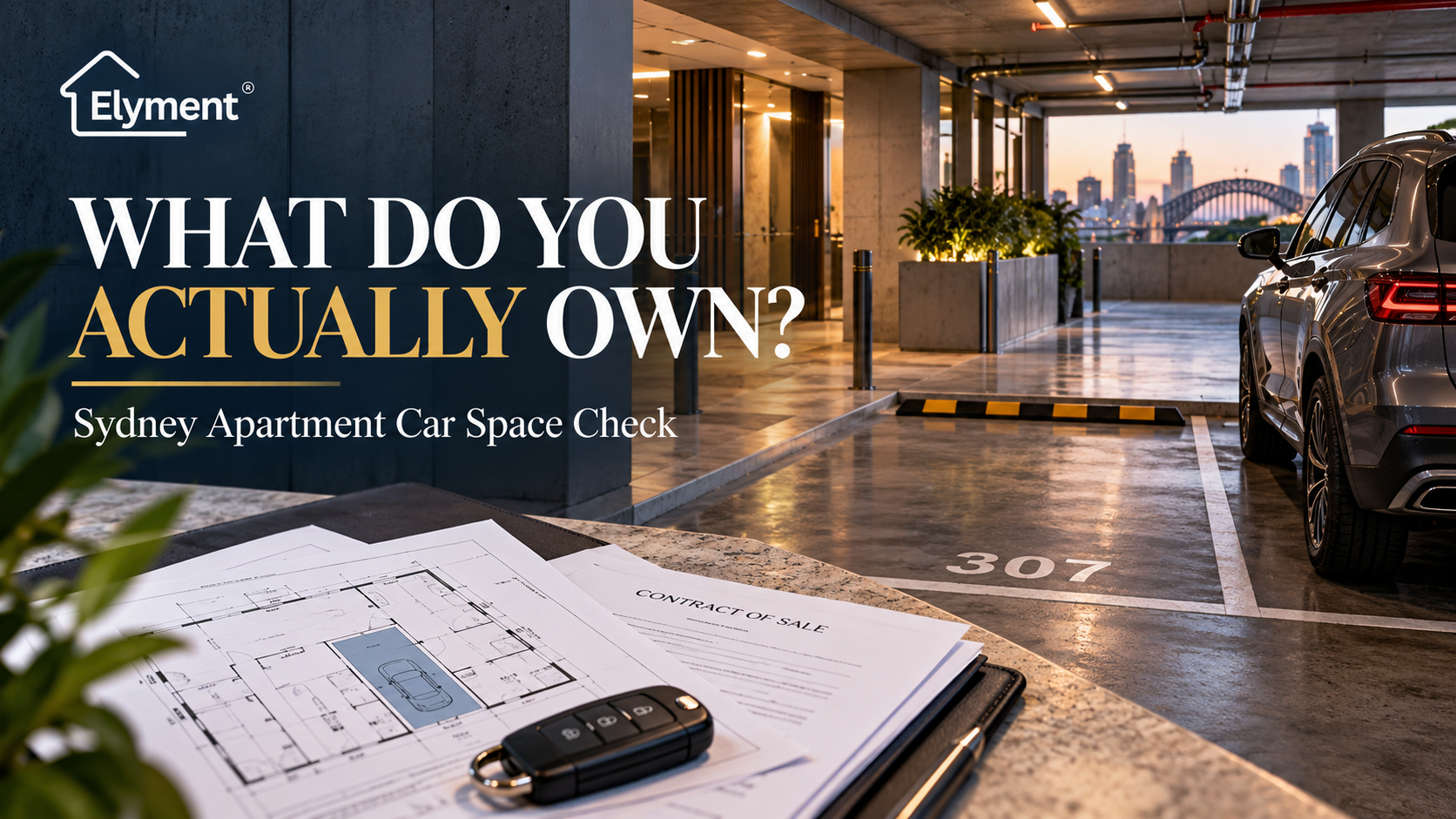
A Sydney apartment advertised with a car space does not always mean the buyer acquires a separately titled parking lot. The space may form part of the apartment lot, be a separate strata lot, remain common property subject to an exclusive-use by-law, or depend on another right. Before exchange, NSW buyers should reconcile the contract, title search, registered strata plan, by-laws and strata records with the bay they physically inspected.
In a Sydney apartment campaign, parking is often reduced to a single line: one secure car space.
Commercially, that description can be important. Parking can influence how a buyer values an apartment, whether the property suits a household with two cars, whether an investment is attractive to tenants and whether an electric vehicle can realistically be charged at home.
Legally, however, the phrase does not answer the most important question: what interest in the parking area is actually transferring to the buyer?
The answer should come from the transaction documents, not the painted number on the concrete, the position shown in an online advertisement or an assumption made during the inspection.
Current NSW Government guidance for strata buyers specifically recommends checking the strata plan to understand what is owned, and the Government's strata parking guidance tells residents to check whether their lot actually includes a parking space.
A Painted Bay Is Not an Ownership Document
The basement may make the arrangement look obvious. A bay is numbered. The selling agent identifies it during the inspection. The remote opens the garage door. The current owner has parked there for years.
None of those facts, standing alone, establishes the legal basis on which the purchaser will use that space after settlement.
In NSW strata schemes, car spaces can be structured in different ways. NSW Land Registry Services guidance shows that car spaces can be defined as parts of strata lots through line boundaries on the registered plan. In other schemes, the parking area may remain common property while a particular lot receives exclusive-use or special privileges through a registered by-law.
The Strata Schemes Management Act 2015 recognises common property rights by-laws that can confer exclusive use or special privileges over specified common property.
The First Job Is to Reconcile the Advertisement With the Contract
A useful pre-exchange review should translate the marketing description into a document trail.
If the listing says Apartment 706 with one secure car space and storage, the review should identify precisely where the apartment, parking and storage appear in the legal documents.
NSW residential sale contracts are ordinarily required to contain prescribed title and plan information. The NSW Government's residential sale guidance confirms that the contract must contain the property title search and registered plan, together with other prescribed disclosure material.
For a strata purchase, this creates an evidence chain that should be read together rather than as isolated pages.
- Read the title reference. Identify the strata lot or lots being sold.
- Read the registered strata plan. Trace where each part of the lot is physically located.
- Check the parking bay. Match the plan to the actual bay inspected in the basement.
- Read the by-laws. Identify any parking restrictions or common property rights affecting the space.
- Review the strata records. Check for disputes, access changes, stacker maintenance issues, EV charging policies or proposals affecting the basement.
- Confirm the contract description. Make sure every relevant lot or right intended to be purchased is captured in the transaction.
This is more precise than simply checking whether the front page of the contract says "car space included".
Elyment's analysis of strata records gaps in Sydney apartment purchases explains why the registered documents and the owners corporation's operational records perform different due-diligence functions.
The Lot Number and the Painted Bay Number May Be Different
One of the easiest mistakes is to assume that every number in a basement performs the same function.
It does not.
An apartment may be marketed as Unit 1203. The strata lot may be Lot 86. Its basement parking component may appear elsewhere on the strata plan as part of Lot 86, while the physical bay is painted with operational number 147.
None of those numbers is necessarily wrong. They may simply be serving different purposes.
The problem arises when no one reconciles them before exchange.
NSW Land Registry Services' guidance on defining car spaces in strata plans illustrates how car-space boundaries are established through the registered plan using dimensions and structural reference points.
This is why a buyer should not treat a painted bay number as a substitute for reading the plan.
Exclusive Use Is Valuable, but It Is Not the Same as Owning the Concrete
A buyer may discover that the apartment does not own the parking area as lot property at all.
Instead, the bay may form part of common property and be allocated to a particular lot under a common property rights by-law.
That arrangement can still provide a meaningful and enforceable right to use the space. The important point is that the buyer should understand the legal character of that right and the conditions attached to it.
A review should identify:
- Which lot receives the exclusive-use or special privilege.
- The exact area covered by the by-law.
- Whether the by-law is registered and current.
- Whether maintenance obligations sit with the owners corporation or the benefited owner.
- Whether costs can be recovered from the benefited owner.
- Whether alterations such as bollards, storage cabinets or chargers are permitted.
- Whether additional approvals would be required for future changes.
The distinction is not merely academic. Ownership, exclusive use and permission to alter the area are three different questions.
Ownership and Practical Usability Should Be Tested Separately
Even where the parking position is legally clear, the space may still create practical problems after settlement.
Sydney apartment basements vary enormously. Older blocks may have narrow bays and low beams. Newer towers may rely on mechanical parking systems. Mixed-use developments may have complicated access controls. Premium apartment buildings can have security systems that make parking highly controlled even where title ownership is straightforward.
A useful inspection therefore goes beyond identifying the bay.
NSW strata parking rules also make an operational distinction between resident spaces, visitor spaces and other common-property areas. A space that happens to be empty during an inspection should never be assumed to be available to the purchaser.
The EV Question Has Made Parking Due Diligence More Important
Ten years ago, many apartment buyers treated parking as a question of dimensions and location.
Electric vehicles have added another infrastructure layer.
Owning the car space does not automatically mean an owner can install cabling through common property, fix a charger to a common wall, draw power from a shared electrical system or modify fire-safety infrastructure.
The parking area, cable pathway, electrical distribution system and wall supporting the charger may sit under different ownership and maintenance arrangements.
Buyers who regard home charging as essential should therefore investigate the building's current charging policy before exchange, not after purchasing an electric vehicle.
Relevant questions include:
- Does the building already have EV charging infrastructure?
- Has the owners corporation adopted a charging policy?
- Are individual chargers already installed?
- How is electricity metered and billed?
- Does the switchboard have capacity for further connections?
- Would cabling need to cross common property?
- Are upgrades being considered as part of the capital works programme?
These are not reasons to reject an apartment. They are reasons to understand the difference between owning a parking space and having the infrastructure required for the intended use.
Strata Records Can Reveal Problems the Plan Cannot
The registered plan tells the buyer what the legal subdivision looks like.
It does not necessarily tell the buyer what has been happening in the basement.
A current strata review may reveal:
- Parking disputes between residents.
- Unauthorised storage in car spaces.
- Water ingress or concrete repairs.
- Security gate failures.
- Proposed EV charging infrastructure.
- Car-stacker servicing problems.
- Changes to access arrangements.
- Insurance claims.
- Special levies for basement remediation.
- Proposed by-law amendments affecting parking.
This is why the contract and the strata report should not be treated as substitutes for each other.
Elyment's review of what Sydney buyers can still miss in NSW strata documentation examines the distinction between statutory certificates and broader records-based due diligence.
Separate Parking Lots Require Particular Attention
A separate parking lot creates a simple but important transaction question: is that lot actually being transferred with the apartment?
If a car space has its own title reference, it should be traced through the contract and settlement documentation rather than being treated as an informal inclusion.
The review should also consider whether the separate lot carries:
- Its own unit entitlement.
- Additional strata levies.
- Council or other charges where applicable.
- Restrictions affecting who may own or use it.
- Easements or access rights needed to reach it.
- Separate insurance or operational implications.
- Different resale or transfer considerations.
A buyer should therefore avoid reducing the enquiry to, "Is parking included?"
A better question is: "Show me the legal basis on which this exact space transfers with this exact apartment."
Off-the-Plan Buyers Need a Final Parking Check
Parking becomes more complicated where the apartment is purchased before the strata plan is finally registered.
Marketing drawings, sales plans and display-suite materials are not substitutes for the final registered position.
NSW's off-the-plan disclosure framework requires detailed disclosure documentation, but the final registered plan remains critical because the development can change during surveying, certification and registration.
Registrar General guidance also notes that, for proposed strata lots, the draft disclosure plan does not necessarily need to identify the location or area of parking and storage areas.
Buyers approaching settlement should therefore review the final registered documents rather than relying solely on the arrangement presented at the sales stage.
Elyment has addressed this separate final-plan issue in its analysis of final registered plans in Sydney off-the-plan settlements.
A Practical Pre-Exchange Car-Space Verification Process
The strongest approach is to create a simple ownership map before the buyer authorises exchange.
- List what was advertised. Record the apartment, car space, storage cage, balcony, courtyard and any other area represented as part of the purchase.
- Identify every title and lot reference. Determine whether the apartment and parking are one strata lot, separate lots or another arrangement.
- Trace the registered plan. Match each legal part of the lot to its physical position in the building.
- Read the by-laws. Check parking controls and any common property rights by-law relevant to the space.
- Review strata records. Look for current disputes, maintenance issues, access changes, parking policies and major basement works.
- Inspect the actual bay. Check dimensions, columns, turning paths, ramps, stackers, water ingress, storage arrangements and access equipment.
- Resolve discrepancies before exchange. If the advertisement, contract, plan, by-law and physical space do not align, obtain clarification through the parties' legal representatives before treating the issue as resolved.
Three Transactions Can Look Identical at the Inspection
Consider three apartments in similar Sydney buildings. Each is advertised with one secure car space.
Apartment A: The Basement Bay Is Part of the Apartment Lot
The registered strata plan shows the apartment on an upper level and a separate basement component marked as part of the same strata lot. The buyer is purchasing one lot with geographically separate components.
The ownership question is relatively direct, although by-laws still control how the parking area and surrounding common property can be used.
Apartment B: The Bay Is Common Property
The parking area is not included within the apartment lot boundaries. Instead, a registered common property rights by-law gives the apartment owner exclusive use of a specified bay.
The buyer should understand both the benefit and the obligations in that by-law, including maintenance responsibilities and restrictions on modifications.
Apartment C: Parking Has Its Own Strata Lot
The apartment and parking space have separate title references.
The buyer needs confirmation that both lots are included in the contract and will be transferred at settlement. The parking lot's own unit entitlement, levies and restrictions also need to be understood.
From the basement, all three situations may look almost identical.
From a conveyancing and ownership perspective, they are materially different.
The Useful Output Is a One-Page Ownership Map
A lengthy contract review is less useful if the buyer still cannot answer a basic question about the property they are acquiring.
For an apartment with parking and storage, a clear review should ideally allow the buyer to summarise the position like this:
That approach turns a complex bundle of plans, title references and by-laws into a practical purchasing decision.
Buyers who need the wider contract position reviewed can also consider a Sydney property contract review before signing so that title, special conditions, strata material and unresolved transaction issues can be assessed before exchange.
SYDNEY & NSW | PRE-EXCHANGE PROPERTY REVIEW
Confirm What Transfers Before the Car Space Becomes an Assumption
Review the contract, title, strata plan, by-laws and outstanding due-diligence questions before exchange so the apartment, parking and storage rights are understood as one transaction.
The Practical Conclusion
A Sydney apartment can be marketed with a car space while the legal structure behind that parking takes several different forms.
The space may form part of the apartment's strata lot. It may have its own title. It may remain common property subject to an exclusive-use or special-privilege by-law. In some schemes, another contractual or operational arrangement may sit behind the right to park.
The buyer's task before exchange is therefore not simply to confirm that a parking bay exists.
It is to connect the physical bay to the legal right that will survive settlement.
That means reading the title, registered strata plan and by-laws together, then checking the strata records and the physical car park for the issues those documents cannot show.
In a Sydney market where parking can materially influence the usefulness and perceived value of an apartment, that is not administrative detail. It is part of understanding what the buyer is actually paying for.
Important: This article provides general information about NSW property and strata transactions. It is not a substitute for legal, conveyancing, financial, valuation, engineering, electrical or strata advice tailored to a particular property.
Sources and References
- NSW Government: Buying a strata property
- NSW Government: Strata parking
- NSW Legislation: Strata Schemes Management Act 2015
- NSW Government: Steps to selling a property
- NSW Land Registry Services: Strata Plans Preparation Guide
- Elyment: How can a strata records gap delay a Sydney apartment purchase?
- Elyment: What buyers could miss in NSW strata reports after the 1 April 2026 certificate changes
- Elyment: Final registered plans in Sydney off-the-plan settlements
- Elyment: Sydney property contract review before signing
- Elyment: Request a Project Review
Confirm What Transfers Before the Car Space Becomes an Assumption
Review the contract, title, strata plan, by-laws and outstanding due-diligence questions before exchange so the apartment, parking and storage rights are understood as one transaction.
Review Before ExchangeRelevant next actions
Explore the ELYMENT service most closely connected to this article.