Buying Two NSW Properties: Could Contracts Be Combined for Stamp Duty?
Buying two NSW properties? Related contracts may be aggregated for transfer duty, changing how much you pay. Check the rules before you exchange both contracts.
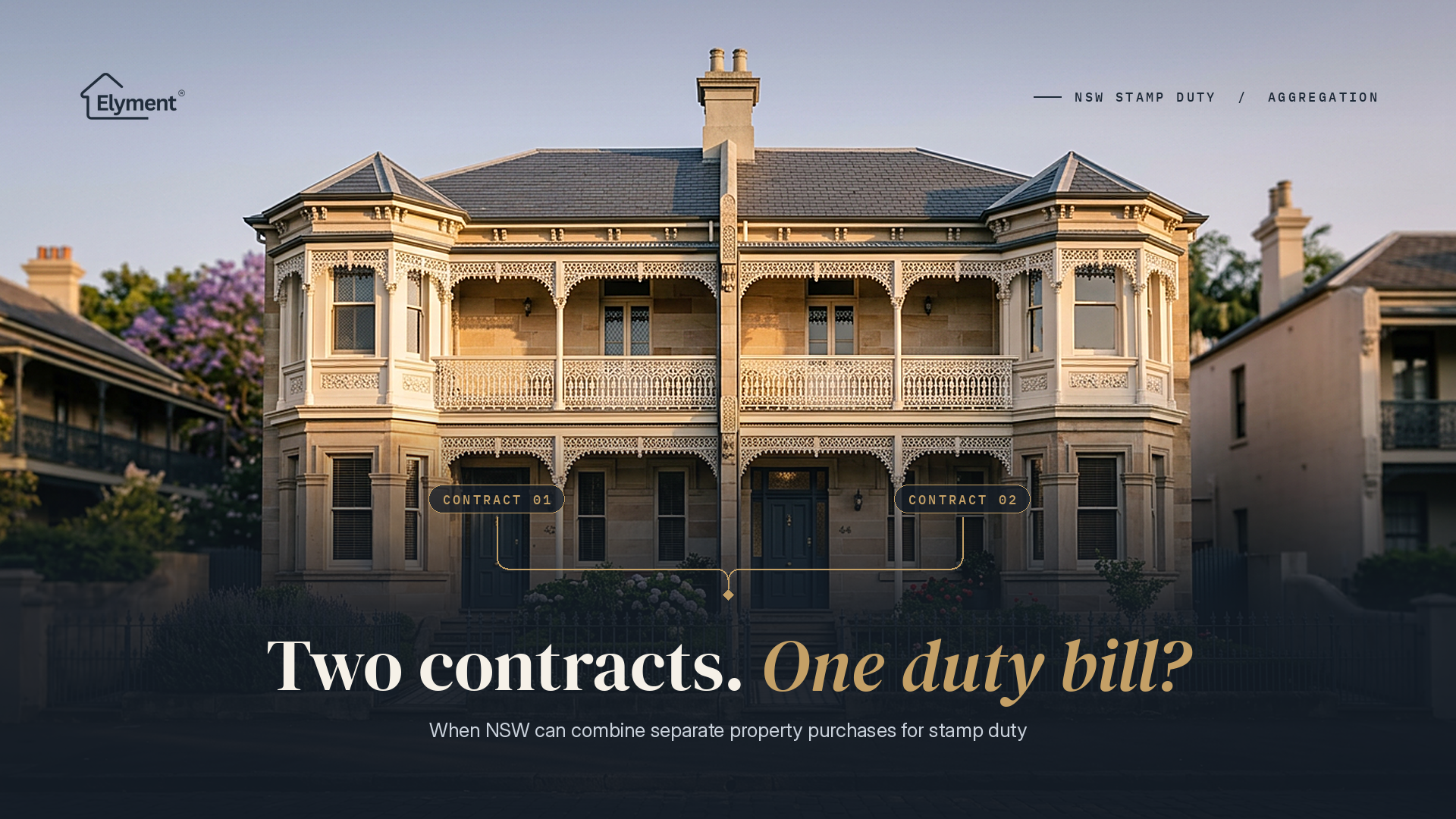
In NSW, two property contracts can be assessed as one for transfer duty when the sellers are the same or associated, the buyers are the same or associated, and the purchases form substantially one arrangement. Interdependency clauses, a development application lodged before exchange, or buying a whole strata block can trigger aggregation. Separate auction purchases, a shared loan or a single deposit alone usually will not. Sydney buyers should test this before exchange.
The Assumption That Catches Buyers Out
Across Sydney, multi-property purchases are no longer confined to developers. Families buy adjoining lots in a new subdivision, investors pick up two units in the same small block, and owners acquire the house next door to widen a site for a future rebuild.
Each purchase usually comes with its own contract, its own deposit and sometimes its own settlement date. It is easy to assume each contract will attract its own duty assessment.
That assumption is not always safe.
Under section 25 of the Duties Act 1997, separate dutiable transactions are to be aggregated and treated as a single dutiable transaction when the legislation's criteria are met.
Revenue Ruling DUT 036v4 states the purpose plainly: duty is assessed on the transaction even where parts of it sit in separate documents or are presented as apparently distinct transactions.
Because NSW transfer duty is charged at rates that rise across value thresholds, set out in Revenue NSW's current thresholds and rates, combining two dutiable values can produce a higher total than two separate assessments.
The question is not whether two contracts exist, but what connects them.
The Three Tests Revenue NSW Applies
Revenue NSW's aggregation guide for property professionals sets out the criteria.
Transactions are aggregated only if all of the following apply:
- The seller side: The transferor is the same, or the transferors are associated persons.
- The buyer side: The transferee is the same, or the transferees are associated persons.
- The arrangement: The transactions together form, evidence, give effect to or arise from what is, substantially, one arrangement relating to all of the property.
Failing any one test is enough to keep the contracts apart.
That is why two purchases from different, unrelated vendors will not be aggregated even if they are tightly linked commercially, and why two purchases from the same vendor may still be assessed separately if nothing beyond the parties connects them.
The Time Limit Has Gone
Before 4 September 2023, transactions had to occur within 12 months of each other to be aggregated.
The Revenue, Fines and Other Legislation Amendment Act 2023 removed that limit.
Under the current ruling, transactions after that date may be aggregated if all three criteria are met, regardless of how much time passes between them.
A gap of 18 months between contracts is no longer, of itself, a reason to assume separate assessments.
Who Counts as an Associated Person
"Associated persons" is defined in the Dictionary to the Duties Act, and it reaches further than many buyers expect.
Revenue NSW's own scenarios include a couple and their three children buying units in the same block, and an individual buying one part of a farm while the trustee of that individual's superannuation fund buys the other.
The definition also has limits, and the ruling illustrates them precisely.
Where a husband and wife buy under one agreement, and the husband's sister and her de facto partner buy under another, the agreements cannot be aggregated.
The wife and her sister-in-law are associated persons, but the wife is not associated with her sister-in-law's de facto partner through that relationship.
Where there are more than two different buyers across the contracts, all of them must be associated.
For buyers structuring purchases through companies or trusts, the same analysis applies to each entity.
Elyment has previously examined how changing the buyer to a company or trust after exchange can trigger extra duty, and how buying from a relative can require a proper valuation.
Aggregation is a separate question: it concerns how several purchases connect, not who sits on one contract.
What Turns Separate Contracts Into One Arrangement
The ruling says the relationship between the transactions must be "an integral and not a fortuitous one".
Buying adjoining land with the intention of integrating it into one holding could be one arrangement, but dealing with properties jointly after purchase is not, of itself, enough.
There must be a further factor.
The ruling lists examples that would constitute one arrangement:
- An interdependency clause, where one contract depends on the other proceeding.
- Agreements over fractional interests in one property.
- Freehold property bought together with the business conducted on it.
- Agreements made under antecedent options over the properties.
- Properties sold subject to a development application or approval.
- Completion conditional on the buyer obtaining development approval over the properties.
- A development application lodged by the buyer before entering into the agreements.
- The purchase of all lots in a subdivision, or all units in a home unit block.
- All land and assets of a primary production business, whether on one title or several.
Revenue NSW notes these examples do not limit when aggregation can apply.
Other factors showing sufficient relationship, connection or interdependence can lead to the same conclusion.
The ruling also says the question is decided when the transactions are entered into, and that transactions might finish up as one arrangement even though they did not start that way.
Why Not Every Multiple Purchase Is Combined
The ruling is equally clear about what does not, on its own, create one arrangement.
Situations That Do Not Automatically Trigger Aggregation
1. Separate Lots Bought at Auction
- Situation: Separate lots bought at auction.
- Revenue NSW position: Not one arrangement, unless one purchase depended on the other.
2. Associated Persons Buying Individual Lots
- Situation: Associated persons buying single lots in a new strata plan or subdivision.
- Revenue NSW position: Not one arrangement where none of the listed factors are present.
3. Exchange of Properties Between Associated Persons
- Situation: An exchange of properties between associated persons.
- Revenue NSW position: Not one arrangement.
4. Single Loan or Mortgage
- Situation: A single loan, facility or mortgage across both properties.
- Revenue NSW position: Not enough if it is the only connecting factor.
5. Single Deposit
- Situation: A single deposit paid for both properties.
- Revenue NSW position: Not enough if it is the only connecting factor.
6. Development Application Lodged After Exchange
- Situation: A development application lodged after exchange.
- Revenue NSW position: Not enough on its own, unless completion is conditional on approval.
Revenue NSW's worked scenarios reinforce the point.
Two adjoining properties offered at auction by the same vendor, with one sold at auction and the other bought by the same buyer by private treaty three days later, were not aggregated.
A son and his parents buying adjoining vacant lots from the same developer, each planning their own home, with no interdependency clause, were not aggregated.
By contrast, one buyer purchasing three adjoining lots to build villas, with an interdependency clause in each contract, was aggregated.
There is also a specific exception in section 25(2) for licensed home builders buying separate allotments of vacant land to build homes for sale to the public, supported by declaration form ODA 023.
Where Project Sequencing Meets the Duty Assessment
For buyers planning works across two sites, the timing of approvals matters as much as the contracts.
Consider an illustrative case: a buyer in the Inner West agrees to purchase two adjoining cottages from the same owner under separate contracts, intending a combined rebuild across both sites.
If a development application covering both sites is lodged before exchange, or completion depends on approval, the ruling points towards one arrangement.
If the application is lodged after exchange and completion is unconditional, that factor alone is not enough.
That is a sequencing decision, and it is usually made by project teams, not conveyancers.
Design consultants, builders and planners working on a multi-site renovation or rebuild should understand that the order of lodgement can affect the duty position, and raise it before any application is filed.
Disclosure and How Aggregated Duty Is Stamped
Aggregation is not only an assessment issue for Revenue NSW.
Section 25(6) places a disclosure obligation on the buyer.
A transferee to whom the section applies must disclose, in writing and at or before lodgement for stamping, the details they know about the property and the consideration for each part.
The maximum penalty for failing to do so is 100 penalty units.
Where an aggregated assessment is made and the instruments are lodged together, the ruling explains that one instrument is usually stamped with ad valorem duty on the combined dutiable value, and each other instrument with fixed duty.
Revenue NSW's footnote records that fixed duty increased to $100 from 1 February 2024.
Because duty deadlines can arrive before settlement, the aggregation question also needs answering early, a point covered in Elyment's analysis of why the transfer duty deadline may arrive before settlement.
A Practical Pre-Exchange Review
Before signing a second contract in NSW, buyers and their advisers can work through a short sequence:
- Map every party. List each seller and each buyer, including companies, trusts and super funds, and test whether they are associated persons.
- Read both contracts together. Look for interdependency clauses, cross-default provisions and conditions that tie completion of one to the other.
- Check option history. Identify any put and call or other options entered before the contracts.
- Confirm approval status. Record whether any development application has been lodged, or whether completion depends on approval.
- Assess the whole holding. Note whether the purchases cover all lots in a subdivision or all units in a block.
- Prepare disclosure. If aggregation applies, budget for duty on the combined value and prepare the section 25 disclosure before lodgement.
Buyers who later renegotiate one contract should also note that changes can affect duty, as explained in Elyment's guide to when NSW stamp duty must be reassessed after a price change.
Elyment's stamp duty conveyancing service in NSW can review both contracts together before exchange.
Buying more than one property in NSW?
Elyment can review linked contracts, the parties involved and your project timing before exchange, so the duty position is understood before it becomes a cost.
The Broader Lesson
Separate contracts do not guarantee separate duty assessments in NSW, and a shared vendor or a family connection does not guarantee aggregation either.
The outcome turns on three linked tests, and on the facts at the time the contracts are signed.
Sydney buyers who map the parties, read the contracts side by side and sequence approvals deliberately are far better placed to avoid an unexpected assessment.
Sources and References
- NSW Legislation: Duties Act 1997, Section 25 – Aggregation of Dutiable Transactions.
- Revenue NSW: Revenue Ruling DUT 036v4 – Aggregation of Dutiable Transactions.
- Revenue NSW: Current Transfer Duty Thresholds and Rates.
- Revenue NSW: Aggregation of Transactions – Property Professionals Guide.
Buying More Than One Property in NSW?
Elyment can review linked contracts, the parties involved and your project timing before exchange, so the duty position is understood before it becomes a cost.
Request a Contract ReviewRelevant next actions
Explore the ELYMENT service most closely connected to this article.