Can You Use Fans to Dry Self-Levelling Compound Faster?
Can fans dry self-levelling compound faster? Learn how airflow affects curing, surface cracking and flooring installation and how to avoid costly drying errors.
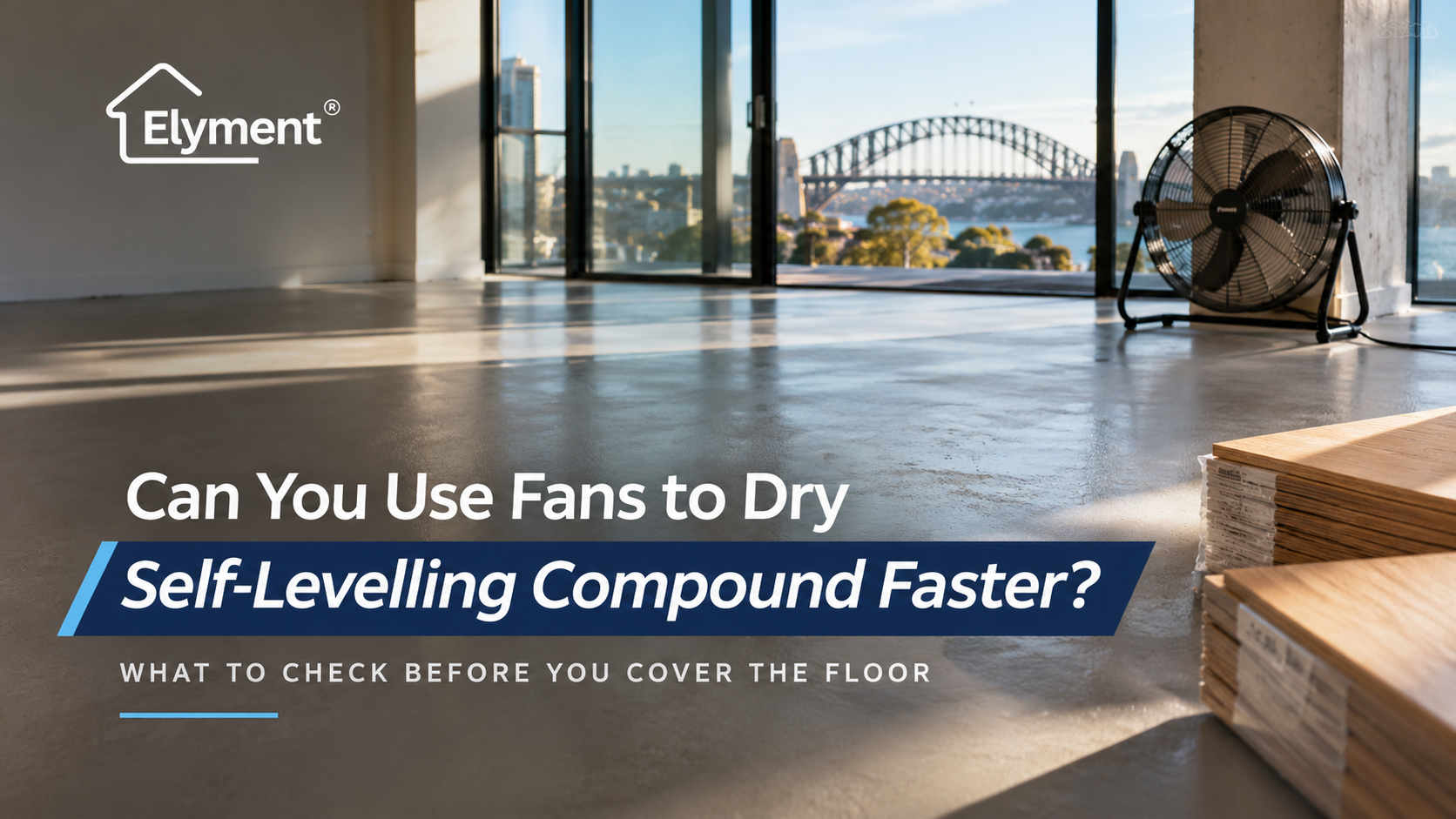
Do not direct fans across freshly poured self-levelling compound to accelerate drying unless the manufacturer specifically permits it. Forced airflow can dry the surface unevenly while the material underneath remains insufficiently cured. For Sydney and NSW renovations, flooring installation should proceed according to the levelling compound manufacturer's instructions, actual site conditions and the requirements of the chosen floor covering, rather than surface appearance or contractor availability.
It is late afternoon in a Sydney apartment. The floor levelling contractor has finished, the engineered timber flooring has been delivered, and the installation team is booked for tomorrow morning.
The freshly levelled surface still appears damp. Concerned about losing another day, the owner considers placing two pedestal fans inside the apartment and leaving them running overnight.
It seems like a reasonable solution. Moving air helps dry clothes, painted surfaces and wet carpets. Why should a cement-based flooring compound behave differently?
The distinction lies in the difference between removing surface moisture and allowing a construction material to develop the properties required for its intended application.
In floor preparation, these are not necessarily the same process. Accelerating one does not guarantee that the other has been completed.
The Problem With Making a Floor Look Dry
Most cement-based self-levelling compounds depend on controlled chemical reactions to develop strength and stability. Water is not simply an unwanted liquid that needs to evaporate as quickly as possible.
It participates in the hydration process that allows the cementitious material to harden. Different formulations also manage excess mixing water in different ways.
Direct airflow can increase evaporation from exposed areas without establishing that the full thickness of the compound is ready to receive flooring.
A fan positioned near a doorway may affect one part of the room considerably more than another. Areas beside windows, thicker sections of compound and sheltered corners may behave differently.
The result can be a floor that appears uniformly grey and dry while its underlying condition varies.
ARDEX Australia's guidance on installing levelling compounds in extreme temperatures identifies premature surface drying and strong draughts as conditions that can contribute to surface defects and inconsistent performance.
Why Walkable Does Not Mean Ready for Flooring
One of the most important distinctions in floor levelling is the difference between permission to walk on a prepared surface and permission to install the final floor covering.
A compound may become sufficiently firm for limited foot traffic well before it is suitable for an adhesive, timber floor or resilient covering.
Understanding Self-Levelling Compound Readiness
Visibly dry
- What it indicates: The surface no longer appears wet.
- What it does not establish: Moisture suitability throughout the flooring system.
Walkable
- What it indicates: Limited pedestrian access may be permitted.
- What it does not establish: Compatibility with the final floor covering.
Surface hardened
- What it indicates: The compound has developed some strength.
- What it does not establish: Full compliance with installation requirements.
Ready for covering
- What it indicates: Applicable product, substrate and finish requirements have been satisfied.
- What it does not establish: Suitability for every alternative flooring system.
These distinctions become particularly important when separate contractors are responsible for substrate preparation and flooring installation.
The levelling contractor may have completed the physical work, but the next contractor still needs a suitable substrate on which to install the specified finish.
What Manufacturer Drying Times Actually Tell You
Self-levelling compound drying time is not a universal waiting period. Manufacturers publish different installation windows according to product formulation, application thickness, environmental conditions and the intended floor covering.
For example, the published technical information for ARDEX K 125 identifies several distinct milestones:
- Pedestrian access after approximately four hours.
- Vinyl installation from 18 hours at a 4 mm application thickness.
- Floating floors and carpet from 18 hours at 4 mm.
- Direct-stick applications from 48 hours.
These are product-specific indicative times, subject to the manufacturer's application and site requirements. They are not general recommendations for other levelling compounds.
The example illustrates why an owner cannot assume that a floor suitable for one covering will also be suitable for another.
Environmental conditions can further change the timetable. ARDEX's Technical Bulletin TB022.005 on self-levelling cements and extreme weather gives an example in which ARDEX K15 requires at least 36 hours of drying at an ambient temperature of 10°C, compared with approximately 18 hours at 20°C.
Turning on a fan does not establish that either published drying window has been satisfied.
Can Fans, Air Conditioning or Dehumidifiers Help?
There is an important distinction between maintaining an appropriate indoor environment and attempting to force a freshly poured floor to dry.
Controlled environmental management may be appropriate where the manufacturer permits it. Improvised drying methods, particularly those directed at isolated sections of the floor, introduce conditions that may not have been considered in the original application specification.
Environmental Control During Floor Levelling
Pedestal fans
- Avoid directing strong airflow across fresh compound unless expressly permitted.
Industrial air movers
- High-velocity airflow may create uneven evaporation and should not be introduced without technical approval.
Air conditioning
- Stable indoor conditions may be appropriate, provided the product requirements are maintained and direct draughts are avoided.
Portable heaters
- Localised heat can create inconsistent drying conditions.
Dehumidifiers
- Use only where compatible with the specified curing and environmental requirements.
Open windows and doors
- Consider outdoor humidity, temperature and the possibility of strong cross-draughts.
The objective is to maintain the conditions under which the specified compound performs correctly, not to remove moisture at the highest possible rate.
Why Sydney Apartments Present a Particular Challenge
Environmental conditions inside Sydney properties can vary considerably, even within the same apartment.
A west-facing living room in Parramatta may become significantly warmer during the afternoon than an adjoining internal hallway. A coastal apartment in Manly may experience humid conditions and strong cross-ventilation when balcony doors are opened.
Older apartments in the Inner West may have limited ventilation, while high-rise properties in North Sydney can experience substantial airflow when external windows and doors are opened together.
These differences matter because room temperature alone does not describe the condition of the substrate.
A concrete slab may remain comparatively cool even after the surrounding air has warmed. Similarly, deeper levelling sections may require a different covering timetable from thin smoothing applications.
This is one reason professional self-levelling compound application in Sydney needs to consider product selection, actual application depth, environmental conditions and the intended flooring system together.
The Decision Changes With the Chosen Floor Covering
Before releasing a newly levelled floor, the project team needs to consider what will be installed above it.
The risks associated with premature installation differ according to the finish and fixing method.
Floor-Covering Readiness Considerations
Direct-stick vinyl
- Principal checks before installation: Moisture suitability, surface integrity and adhesive compatibility.
- Potential consequence of premature covering: Adhesive deterioration, bubbling or debonding.
Engineered timber
- Principal checks before installation: Substrate moisture, adhesive requirements and timber conditioning.
- Potential consequence of premature covering: Dimensional movement or bond problems.
Hybrid and laminate
- Principal checks before installation: Flatness, moisture requirements and specified underlay.
- Potential consequence of premature covering: Moisture-related deterioration or installation defects.
Ceramic and porcelain tiles
- Principal checks before installation: Substrate strength, leveller suitability and adhesive requirements.
- Potential consequence of premature covering: Bond failure or cracking where underlying defects remain.
Carpet
- Principal checks before installation: Moisture suitability and the selected installation method.
- Potential consequence of premature covering: Moisture-related problems or adhesive failure.
Epoxy and microcement
- Principal checks before installation: System compatibility, moisture condition and substrate integrity.
- Potential consequence of premature covering: Blistering, cracking or coating delamination.
Not every levelling compound is suitable beneath every finish. Compatibility must be established before application, rather than assumed on installation day.
Where moisture assessment is required, the appropriate test method and acceptance criteria should be selected according to the applicable flooring system, substrate and relevant installation standards.
The Installer Is Coming Tomorrow: Five Checks to Make Today
When drying appears slower than expected, the most valuable intervention is often a timely conversation between the owner, preparation contractor and flooring installer.
1. Identify the exact levelling compound
Obtain the product name and current technical data sheet. Descriptions such as rapid-set cement or fast-drying leveller are not sufficient to establish covering readiness.
2. Confirm the application depth and completion time
Establish when the pour was completed and identify any significantly deeper sections. The average application thickness may not adequately represent the slowest area to become ready.
3. Review overnight environmental conditions
Consider the expected indoor temperature, substrate temperature, humidity and ventilation. Ask whether the manufacturer permits any proposed environmental adjustments.
4. Confirm the finished flooring requirements
Ask the installer to identify the relevant moisture, surface condition, adhesive and installation requirements for the actual flooring system being installed.
5. Make the installation booking conditional
Where uncertainty remains, establish a confirmation deadline before the installer mobilises. The booking should proceed only after the relevant readiness checks have been satisfied.
A short conversation the previous afternoon may prevent an unnecessary installer call-out, a wasted building-access booking or pressure to proceed over an unsuitable substrate.
What If Fans Have Already Been Running?
Discovering that someone has placed a fan beside the freshly levelled floor does not automatically mean the entire application has failed.
However, it is a change in the drying environment that should be communicated to the preparation contractor.
Record the approximate duration of fan use, its position, whether heat was involved and which sections of the floor received direct airflow.
Before covering, arrange an appropriate assessment if any of the following conditions are present:
- New hairline cracks across the levelling compound.
- Powdery or chalky surface material.
- Areas that remain unexpectedly soft.
- Visible lifting or curled edges.
- Unexplained differences in surface hardness.
- Persistent damp-looking areas after the expected drying period.
These observations are warning signs rather than definitive diagnoses. Similar symptoms can arise from mixing errors, substrate problems, primer incompatibility or other installation conditions.
Elyment's guide to why self-levelling compound develops cracks examines the potential causes of cracking and the checks needed before proceeding.
Owners encountering dust or weak surface material can also consult Elyment's separate guide to powdery and chalky finishes on levelled floors.
Neither condition should simply be concealed beneath new flooring without understanding its cause and significance.
The Commercial Cost of Recovering a Few Hours
Floor levelling frequently sits between several dependent trades. Flooring installation, skirting, painting, joinery and furniture delivery may all rely on the same completion date.
In Sydney strata properties, the disruption can extend beyond labour availability. Lift reservations, contractor access arrangements, parking and permitted working hours may also need to be reconsidered.
Consider an illustrative renovation involving 70 square metres of engineered timber flooring.
The owner faces a possible one-day installation delay because the levelling compound has not satisfied the required covering conditions.
Attempting to recover that day through unapproved forced drying may appear economical. If the floor is subsequently covered and the substrate or adhesive system fails, however, the affected work could involve flooring removal, disposal, further preparation and replacement materials.
The financial comparison is therefore not simply between proceeding today and proceeding tomorrow.
It is between the manageable cost of a controlled scheduling adjustment and the uncertain cost of a concealed flooring defect.
A Better Handover Between Floor Preparation and Installation
For projects involving separate preparation and installation contractors, a documented readiness check can help prevent ambiguity over whether a floor has been released for covering.
A practical handover record may include:
- The levelling compound and primer used.
- The date and time application was completed.
- Recorded or estimated application depths.
- Relevant environmental conditions.
- Any unexpected changes to the drying environment.
- Moisture or substrate assessment results where required.
- The specified finish and installation method.
- Confirmation of outstanding preparation requirements.
This is a recommended project-control measure, not a universal statutory certificate. Its purpose is to ensure that the next trade receives the information necessary to make an informed installation decision.
Elyment's Sydney flooring preparation and project delivery services address the relationship between removal, concrete grinding, floor levelling, substrate verification and installation readiness.
Plan Faster Drying Before the Pour, Not After It
Where renovation schedules genuinely require rapid turnaround, the opportunity to shorten the drying programme begins during product selection and project planning.
Suitable rapid-drying compounds, appropriate environmental conditioning, realistic application depths and coordinated installer bookings can reduce unnecessary delays without introducing unapproved drying methods.
The manufacturer's covering window should inform the installation schedule from the outset.
For broader guidance on the factors affecting installation windows, see Elyment's existing analysis of self-levelling compound drying times.
ELYMENT | SYDNEY & NSW
Confirm Your Floor Is Ready Before Installation Begins
Review substrate preparation, levelling compound requirements, drying conditions and contractor scheduling before committing to the next stage of your renovation.
Request a Floor Readiness Review
The Floor Should Determine the Schedule
Fans may change how quickly moisture leaves an exposed surface. They do not independently establish that a self-levelling compound has developed the required properties or that a moisture-sensitive flooring system can safely be installed.
For Sydney homeowners, builders and strata renovation managers, the priority should be a reliable handover between preparation and installation rather than a surface that merely appears finished.
A flooring booking can be adjusted. Once a defective substrate has been concealed beneath a completed floor, the available options become considerably more expensive.
The most useful measure of progress is not how quickly the floor changes colour. It is whether the specified flooring system can be installed with confidence.
Sources and References
- ARDEX Australia: Installing Levelling Compounds in Extreme Temperatures
- ARDEX Australia: ARDEX K 125 Product and Technical Information
- ARDEX Australia: Technical Bulletin TB022.005 – Self-Levelling Cements and Extreme Weather Conditions
Related Elyment Resources
- Self-Levelling Compound Application in Sydney
- Why Is My Self-Levelling Compound Cracking? A Sydney DIYer's Guide
- Dealing With a Powdery or Chalky Finish on Your Levelled Floor
- Sydney Flooring Preparation and Project Delivery Services
- Self-Levelling Compound Drying Time: How Long Before You Can Lay Flooring?
ELYMENT | SYDNEY & NSW
Confirm Your Floor Is Ready Before Installation Begins
Review substrate preparation, levelling compound requirements, drying conditions and contractor scheduling before committing to the next stage of your renovation.
Check Floor ReadinessRelevant next actions
Explore the ELYMENT service most closely connected to this article.