Carpet Tile Removal Sydney: Can Glue-Free Tiles Cut Costs?
Can glue-free carpet tiles cut removal costs in Sydney? Learn how fixing methods, adhesive residue and subfloor condition affect removal labour and preparation.
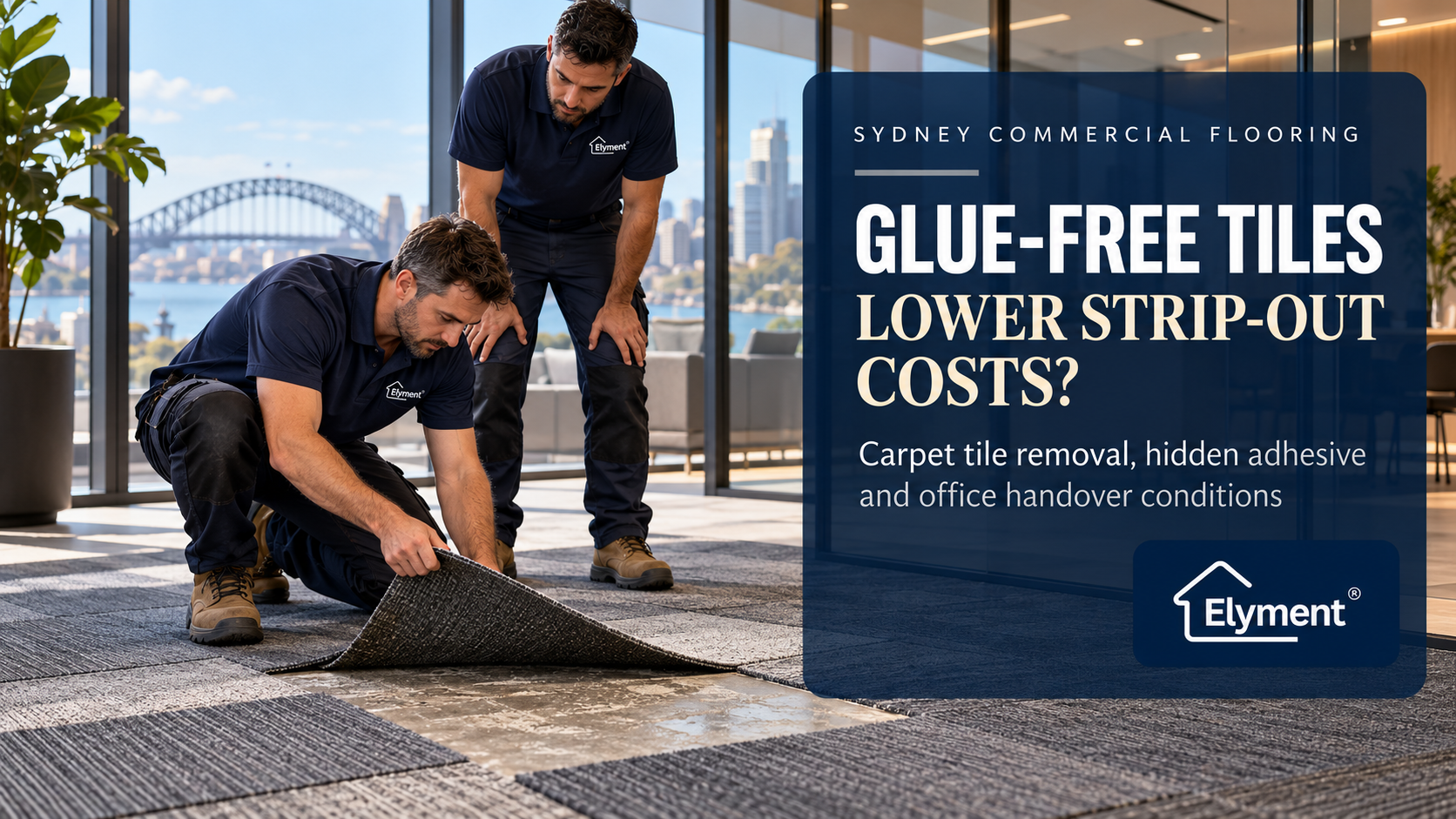
Glue-free carpet tiles can reduce Sydney office strip-out labour because connector-based systems such as TacTiles join neighbouring tiles rather than bonding every tile to the subfloor. Savings are not guaranteed. Older adhesive may remain underneath, while furniture clearance, after-hours access, waste handling and the required substrate condition still affect commercial flooring removal costs. A small trial uplift and a clearly specified handover are essential before comparing quotes.
The Carpet Comes Up Easily. Does the Cost Come Down?
Imagine a commercial office in Sydney's CBD undergoing a tenancy refurbishment. The workstations have been cleared, partitions are being retained, and several hundred square metres of modular carpet tiles are scheduled for removal.
The contractor lifts the first tile. It separates from its neighbours without the resistance normally associated with direct-stick carpet.
For the project manager, that appears to be a promising discovery. Less adhesive resistance could mean fewer labour hours, less aggressive removal equipment and potentially less damage to the substrate.
Yet a faster uplift is not necessarily a cheaper strip-out. There may be older adhesive underneath the apparent glue-free system, sections installed using different methods, difficult loading access or a lease requirement to deliver a particular substrate condition.
The commercial question is therefore not simply whether the tiles are easy to lift.
It is which parts of the removal programme become unnecessary, and which costs remain regardless of how the carpet tiles were originally installed.
How Connector-Based Carpet Tiles Change the Removal Method
Conventional commercial carpet tiles are frequently installed with pressure-sensitive tackifier or another approved adhesive system. The strength and distribution of the bond influence how easily the tiles can be separated from the substrate.
Connector-based systems take a different approach. Interface's TacTiles installation system uses adhesive connectors to join adjacent modular carpet tiles, rather than applying a continuous adhesive layer to bond the whole floor covering to the substrate.
The connectors help the carpet tiles function as a stable assembly. During removal, individual tiles or connected sections can potentially be lifted with relatively little disturbance to the floor beneath.
This distinction is operationally important. A connector-based installation may avoid much of the bond-breaking labour associated with traditional fully adhered carpet.
However, "glue-free" does not mean adhesive-free in every component of the system, nor does it prove that the underlying floor has never been glued.
What Identifies a Connector-Based Installation?
- Small adhesive connectors may be visible at the underside of tile intersections.
- Adjacent tiles may remain connected as they are lifted, rather than each tile being bonded across its underside to the slab.
- The exposed surface may contain comparatively little adhesive residue from the current installation.
- Installation records, product specifications or refurbishment documentation may identify the original system.
None of these observations should be treated as conclusive without checking the complete flooring assembly. A representative trial uplift provides stronger evidence than assumptions based on the visible tile surface.
The Hidden Variable: What Was on the Floor Before?
Sydney commercial offices are frequently adapted for new tenants, workplace layouts and changing occupancy requirements. A carpet-tile system installed during the latest refurbishment may sit over a substrate prepared many years earlier.
That history can materially change the economics of removal.
A current connector-based installation might lift cleanly, exposing an older layer of tackifier, patched levelling compound, localised adhesive repairs or remnants from a previous flooring system.
The new tiles may not be responsible for that residue, but removing them exposes the problem.
In another tenancy, open-plan areas may use connectors while entrances, meeting rooms or perimeter sections rely on conventional adhesive.
This is why identifying the removal method across the whole floor is more useful than identifying it in one corner.
For a closer examination of substrate preparation, Elyment has separately analysed how existing carpet-tile adhesive affects floor preparation and levelling.
The immediate strip-out decision is narrower: establish where adhesive is present, whether it belongs to the current or an earlier installation, and whether its removal is actually required by the agreed handover specification.
Where Glue-Free Tiles Can Save Money, and Where They Cannot
The office carpet removal cost should be assessed across the complete commercial strip-out, not only the time spent lifting the tiles.
Tile uplift labour
- Potential glue-free advantage: Potentially faster separation from the floor.
- Remaining cost exposure: Damaged tiles, retained fixtures and mixed fixing methods.
Mechanical removal
- Potential glue-free advantage: Less need for aggressive carpet-stripping equipment.
- Remaining cost exposure: Older bonded flooring or adhesives may remain.
Substrate damage
- Potential glue-free advantage: Potentially less gouging or disruption during uplift.
- Remaining cost exposure: Existing defects, weak toppings and historical repairs.
Waste removal
- Potential glue-free advantage: Cleaner tiles may be easier to separate for an approved recovery pathway.
- Remaining cost exposure: Handling, transport, waste volume and acceptance requirements.
Building logistics
- Potential glue-free advantage: Potentially shorter time occupying work areas.
- Remaining cost exposure: Lift bookings, loading docks, floor protection and security.
Floor preparation
- Potential glue-free advantage: Possibly reduced fresh adhesive removal.
- Remaining cost exposure: Grinding, repairs, testing or levelling if specified.
The most meaningful savings arise when a clean uplift removes an entire work stage, rather than merely making that stage slightly faster.
For example, eliminating a planned adhesive-scraping pass across a large open area may have a more substantial impact than saving a few minutes on individual tiles.
Conversely, if a complete concrete preparation stage remains necessary, the advantage may be confined to the initial removal labour.
The removal method changes part of the cost equation. It does not automatically change the whole equation.
A Mixed-Installation Office Needs a Different Quote
Consider a hypothetical 240 m² Sydney office being stripped ahead of refurbishment.
An initial inspection identifies three distinct areas:
- 150 m²: Connector-based carpet tiles over an apparently sound substrate.
- 60 m²: Conventional tackifier-bonded carpet tiles.
- 30 m²: Older flooring with uncertain adhesive and substrate conditions.
These quantities are illustrative, not measurements from an actual Elyment project.
Applying one removal rate across the full 240 m² would obscure the labour differences and leave the most uncertain section inadequately defined.
A better procurement approach prices the connector-based uplift separately, identifies the glued area as another work package and provides an inspection or variation allowance for the uncertain section.
Waste handling and access logistics can then be measured against the whole project rather than repeatedly included in each removal rate.
This produces a more defensible comparison between contractors. It also makes it easier to distinguish a genuine labour saving from an omitted preparation allowance.
Loading Docks, Workstations and After-Hours Access
In Sydney CBD, North Sydney, Parramatta and Macquarie Park office precincts, the physical removal process may be straightforward while the logistics remain costly.
A tenancy can contain easily removable carpet tiles but still require scheduled access through a goods lift, protected common areas and restricted loading facilities.
Property managers and project teams should establish:
- Whether furniture, workstations and storage units will be removed before the flooring contractor arrives.
- Whether carpet removal can occur during normal building hours or requires an approved after-hours programme.
- The location, permitted operating hours and booking requirements of the loading dock and goods lift.
- Whether corridor protection, service isolation, security access or additional site supervision is required.
- Whether removed tiles can be stacked safely before collection or must leave the building immediately.
- Whether portions of the office must remain accessible to staff or other contractors.
These costs may remain almost unchanged whether the carpet is connector-based or conventionally glued.
Retained demountable partitions create another consideration. Where carpet extends beneath partition tracks, the uplift may require additional coordination regardless of the fixing method.
Elyment's guide to carpet removal around demountable office partitions examines this separate access problem.
Could Cleaner Carpet Tiles Reduce Disposal Costs?
One possible benefit of a connector-based system is that the removed tiles may be less contaminated by installation adhesive, improving their prospects for reuse or acceptance through an appropriate product recovery programme.
That does not mean every carpet tile can be recycled.
Product composition, backing type, moisture damage, contamination, tile condition and the receiving facility's acceptance criteria all matter.
Project teams should obtain acceptance confirmation before pricing a recovery pathway as if it were guaranteed.
In NSW, the NSW Environment Protection Authority's waste classification guidance establishes the importance of classifying waste correctly and using facilities authorised to receive it.
For commercial flooring removal, a practical waste plan should distinguish between reusable or recyclable carpet tiles, general strip-out waste and any materials requiring separate assessment.
Cleaner uplift can improve the options available. Actual savings depend on handling, transport and the confirmed receiving arrangement.
The NSW Compliance Checks Before Substrate Preparation
Glue-free removal should not be mistaken for permission to proceed directly into grinding or aggressive scraping.
Older commercial premises can contain historical flooring products and substrate materials that were not identified during the most recent refurbishment.
Asbestos and Unidentified Materials
Before disturbing suspect older materials, contractors should review the relevant building information, including the asbestos register where applicable.
The NSW Government's asbestos identification guidance explains that asbestos cannot be reliably identified by visual appearance alone and that commercial refurbishment work must account for asbestos information before disturbing relevant materials.
Unidentified older tiles, underlays, mastics or other suspect materials should trigger an appropriate assessment. They must not simply be ground away.
Silica Dust During Concrete Grinding
If a slab requires mechanical grinding after carpet removal, the resulting work introduces separate dust management requirements.
SafeWork NSW's crystalline silica guidance outlines control measures including dust suppression, local exhaust ventilation, on-tool extraction and suitable respiratory protection.
The selected controls must reflect the actual work, materials and exposure risks.
Carpet uplift, hazardous-material assessment and concrete preparation are different activities. A commercial quotation should not blur their responsibilities or compliance requirements.
What Should the Contractor Actually Hand Over?
A completed carpet removal job can have several legitimate outcomes, depending on what the client has contracted to receive.
The first may be a cleared tenancy with all nominated carpet tiles removed and the waste taken away.
The second may require accessible adhesive and loose remnants to be removed so the underlying substrate can be assessed.
A more demanding specification may require concrete grinding, local repairs or levelling to an independently agreed substrate condition.
These are not interchangeable handover standards.
An office landlord may expect a bare slab at lease end, while a refurbishment contractor may require an assessed surface capable of receiving a later preparation system.
The obligations depend on the relevant contract, lease and scope of work.
Elyment has discussed the distinction in its separate examination of commercial carpet removal and bare-slab make-good requirements.
For connector-based carpet removal, a practical handover record should identify:
- The areas and flooring materials removed.
- Any retained adhesive or connector residue.
- Existing surface defects exposed during uplift.
- Sections requiring further investigation or repair.
- Waste quantities and disposal arrangements.
- Any areas excluded from substrate preparation.
- The inspection and acceptance responsibilities of the next project stage.
A visibly clean floor is not automatically a verified substrate suitable for every subsequent flooring finish.
The Procurement Strategy: Test First, Commit Second
A two-stage scope can help commercial owners, builders and facility managers control uncertainty before the complete office is stripped.
1. Review the flooring history. Obtain available installation records, refurbishment drawings, product information and relevant hazard records.
2. Inspect representative locations. Select trial areas in open-plan zones, entrances, perimeters and spaces believed to have been refurbished at different times.
3. Confirm the removal mechanism. Determine whether the tiles are connector-based, conventionally bonded or installed using mixed methods. Do not disturb suspect materials without the appropriate assessment.
4. Separate the quote into work packages. Identify uplift, labour, waste transport, protected access, adhesive removal, substrate assessment and any approved grinding or levelling as distinct items.
5. Establish an inspection hold point. Following controlled removal, review the exposed substrate before authorising any additional preparation work.
6. Record the accepted condition. Confirm the agreed handover boundary, outstanding defects and responsibility for subsequent work.
This approach does not make every unknown condition disappear. It makes those conditions visible before they become an uncontrolled variation.
For a commercial office with different flooring histories, the value of that information can be greater than an optimistic square-metre removal rate.
Plan the Strip-Out Before the Costs Change
ELYMENT | SYDNEY PROPERTY OPERATIONS
Review carpet tile removal, historical adhesives, building access, waste logistics and substrate preparation requirements before committing to a commercial refurbishment programme.
Request a Commercial Floor Removal Review →
The Cost Advantage Is Real Only When the Scope Confirms It
Glue-free carpet tiles can make Sydney office strip-outs faster and less disruptive when the existing system separates cleanly and the substrate does not require extensive additional work.
But the strongest cost outcome is not necessarily the lowest initial uplift rate.
It is a removal programme that accurately identifies the flooring system, distinguishes historic adhesive from current installation materials, controls building logistics and establishes the required handover condition before work begins.
For landlords, commercial tenants and construction teams, the critical distinction is between saving labour on carpet removal and reducing the total cost of delivering the agreed floor condition.
A connector-based system can help achieve both. It should never be assumed to guarantee either.
Sources and References
Technical and regulatory references
- Interface – TacTiles Carpet Tile Installation System
- NSW Environment Protection Authority – Classifying Waste
- NSW Government – How Do I Know If It's Asbestos?
- SafeWork NSW – Crystalline Silica General Fact Sheet
Related Elyment resources
- Why Can Carpet Tile Glue in Sydney Offices Change the Primer and Levelling Plan Before New Vinyl Goes Down?
- Carpet Removal Sydney Around Demountable Office Partitions: Can Glued Carpet Come Out Without Pulling the Fit-Out Apart?
- Commercial Carpet Removal Sydney at Lease End: What Does Return to Bare Slab Include?
- Elyment – Contact and Commercial Floor Removal Review
ELYMENT | SYDNEY PROPERTY OPERATIONS
Plan the Strip-Out Before the Costs Change
Review carpet tile removal, historical adhesives, building access, waste logistics and substrate preparation requirements before committing to a commercial refurbishment programme.
Request a Strip-Out ReviewRelevant next actions
Explore the ELYMENT service most closely connected to this article.