Ceiling Fan Installation Cost Sydney: Can a Fan Replace Your Existing Light?
Can you replace an existing light with a ceiling fan in Sydney? Check wiring, support and electrician costs before you plan the installation or set your budget.
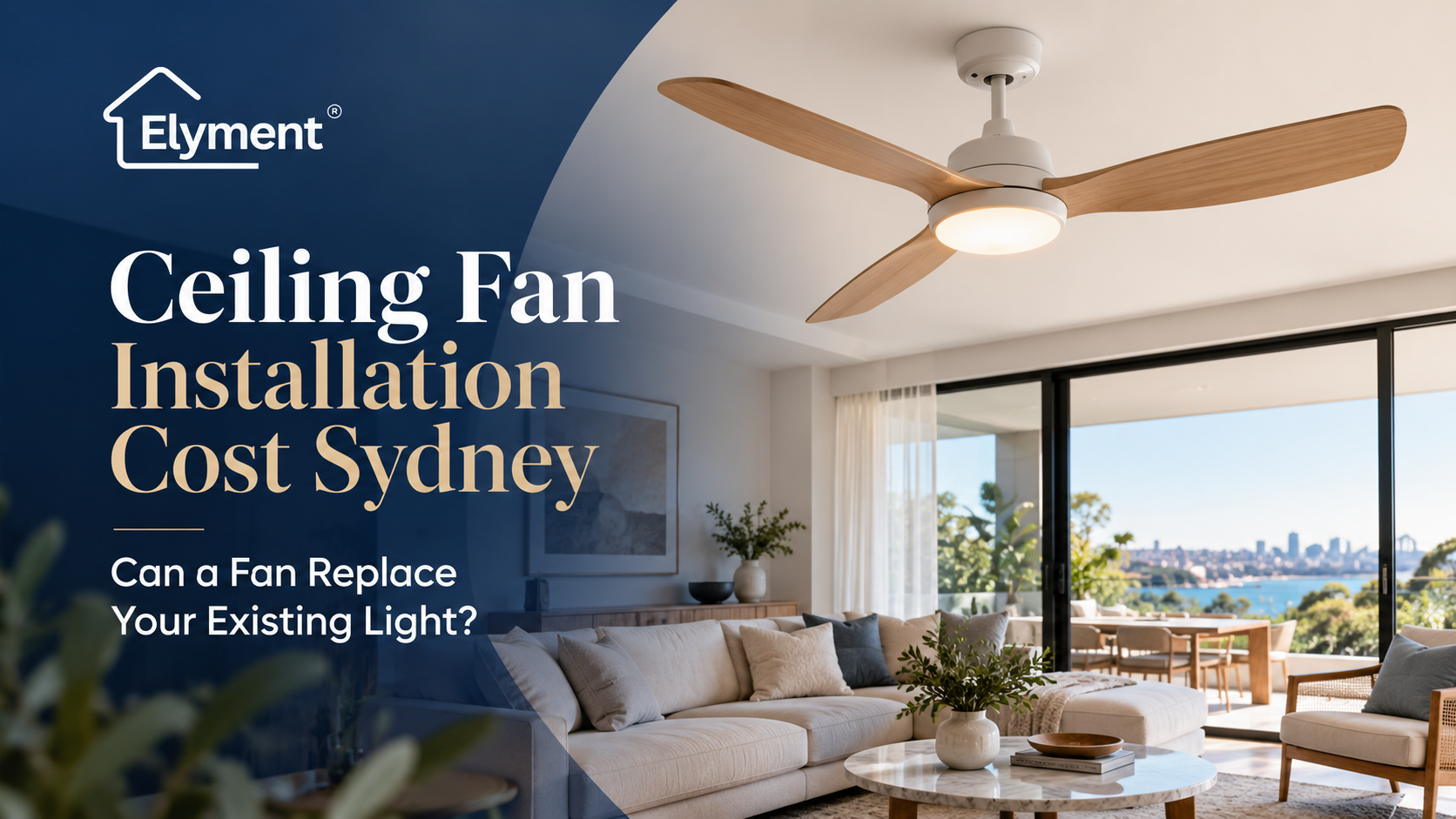
Replacing an existing ceiling light with a fan is often possible in Sydney, but the existing electrical point does not guarantee a straightforward installation. A licensed NSW electrician must assess the wiring, structural mounting support, ceiling height and control compatibility. Indicative labour costs range from $200 to $450 for a light-to-fan conversion, while installations requiring new wiring or additional structural work can cost more.
ELYMENT Insights | Property Improvements & Electrical Installation Planning | Sydney, NSW | 28 October 2026
The Existing Light Point Is Only Part of the Installation
Across Sydney, ceiling fans are being considered as a practical addition to bedrooms, living areas and residential renovation projects. They can improve air movement without requiring homeowners to operate refrigerated air conditioning whenever a room becomes uncomfortable.
For many property owners, the proposed upgrade appears simple.
An existing ceiling light is removed, and a ceiling fan with an integrated light takes its place.
The assumption is understandable. Electrical wiring is already present, the location is established, and the new fitting appears to perform two functions from one position.
However, the feasibility of replacing a light with a ceiling fan depends on more than whether electricity is available.
A conventional light fitting and a rotating ceiling fan impose different demands on the mounting arrangement. The fan also introduces considerations involving vibration, blade clearance, motor controls and compatibility with the existing electrical installation.
Consequently, two apparently identical Sydney bedrooms may require different installation scopes, even when homeowners purchase the same fan model.
The central question is not simply whether a fan can replace the light. It is whether the existing location can safely accommodate the selected fan without additional work.
What Does Ceiling Fan Installation Cost in Sydney?
Installation prices are influenced by the difference between replacing an existing fixture and creating a new installation point.
Sydney electrical contractor Ible Electrical publishes indicative 2026 labour-only ranges for common installation scenarios. These are general market estimates rather than a guaranteed price from Elyment or any individual electrician.
Indicative Ceiling Fan Installation Costs in Sydney
1. Replacing an Existing Ceiling Fan
- Indicative labour cost: $150–$300 per fan.
- Main pricing considerations: Existing support, wiring condition, controls and replacement compatibility.
2. Replacing a Ceiling Light With a Fan
- Indicative labour cost: $200–$450 per fan.
- Main pricing considerations: Structural mounting, wiring suitability, fan-light configuration and controls.
3. Installing a Fan at a New Ceiling Point
- Indicative labour cost: $350–$700+ per fan.
- Main pricing considerations: New cabling, switching arrangements, suitable fixing and ceiling access.
4. High, Sloping or Outdoor Ceiling
- Indicative labour cost: Individual quotation.
- Main pricing considerations: Height, mounting requirements, environmental suitability and access equipment.
Source: Ible Electrical: Sydney Ceiling Fan Installation Guidance.
Indicative 2026 labour ranges only. Fan supply is generally excluded. GST treatment, materials, travel, controls and other inclusions may vary. Obtain a written quotation for the actual property.
These figures reveal why the phrase "ceiling fan installation cost" is not a single, particularly useful pricing category.
A straightforward replacement can involve fewer changes to the building than installing a fan where no suitable wiring or mounting support exists.
An existing light point may reduce the amount of electrical work required, but it does not eliminate the need to assess the proposed installation.
Homeowners comparing quotations should therefore distinguish between the price of fitting a fan and the total cost of making the location suitable for that fan.
Why Structural Support Can Change the Quoted Price
The physical mounting arrangement is one of the most important differences between a light fitting and a ceiling fan.
A conventional ceiling light may be relatively lightweight and fixed using an arrangement appropriate for that particular fitting.
A ceiling fan introduces rotating equipment and associated movement during operation.
Its mounting system must therefore be suitable for the fan's weight, operating forces and manufacturer-specified installation requirements.
An existing light fitting's support should not be assumed suitable simply because it has remained secure for years.
The Ceiling Construction Matters
Sydney homes contain a wide range of ceiling arrangements. Established houses may have accessible roof cavities and timber framing, while apartments and newer developments may incorporate concrete slabs, suspended ceilings or restricted service spaces.
Those differences can influence the installation methodology.
- Timber-framed ceilings: The electrician must establish whether suitable structural support exists at the proposed mounting location.
- Plasterboard ceilings: Plasterboard alone should not be treated as adequate structural support for a ceiling fan.
- Concrete ceilings: Appropriate fixing arrangements and any restrictions associated with the structure must be assessed.
- Suspended ceilings: The supporting structure and the selected fan's installation requirements must be considered separately from the decorative ceiling surface.
If suitable support is unavailable at the existing light position, additional work may be necessary.
Depending on the building, that may require changes to the proposed location, additional structural provision or coordination with another appropriately qualified trade.
This is why structural suitability should be established before a homeowner relies on a fixed installation allowance.
Does Replacing a Light Require New Electrical Wiring?
Not necessarily.
An existing lighting circuit may be suitable for a ceiling fan, provided the installation meets applicable electrical requirements and the selected equipment is compatible.
However, the existence of a working light does not confirm the suitability of every aspect of its electrical arrangement.
A licensed electrician must consider the existing installation, relevant circuit protection, switching arrangements and the fan manufacturer's instructions.
The scope may differ substantially depending on the selected fan.
AC Fans, DC Fans and Control Compatibility
Modern ceiling fans are available with different motor technologies and control systems.
Some AC fans use compatible wall-mounted speed controllers. Many DC models incorporate electronic receivers and manufacturer-supplied remote controls.
These differences matter when replacing a light because the existing wall switch may not provide the control arrangement the homeowner expects.
A remote-controlled fan may reduce the need for certain additional wall-control arrangements, but it does not automatically make the existing wiring suitable.
Similarly, an integrated fan-light combination may require compatible controls for the motor and lighting functions.
The electrician should establish these requirements before the installation scope is finalised.
Property owners should also check whether the selected model provides the lighting output, dimming capability and operating features they require.
Replacing an existing light with a fan that provides inadequate room illumination can create another renovation expense.
Ceiling Access Can Turn a Small Job Into a Larger Project
Access is another reason ceiling fan installation costs vary across Sydney properties.
In a single-storey house with accessible roof space, inspection of the proposed mounting location may be relatively straightforward.
In a multi-storey dwelling, apartment or property with restricted ceiling access, establishing the existing support and wiring arrangement may be more complicated.
A new fan location can also increase the amount of work required if electrical cabling must be routed through inaccessible building spaces.
Relevant cost considerations include:
- Whether there is accessible roof or ceiling space.
- The construction of the ceiling and supporting structure.
- Whether the proposed fan position has an existing light point.
- The distance and accessibility of any required cable route.
- Whether additional access equipment is required.
- Whether ceiling openings or finishes require reinstatement.
- Whether the property is occupied during installation.
The final point is particularly relevant to residential renovation planning.
If structural or electrical access requires ceiling alterations, the project may involve plaster repairs, surface preparation and repainting after electrical work is completed.
Elyment has separately examined the importance of ceiling finish quality in Sydney renovations, including the visual consequences of inconsistent plasterwork and paint finishes.
The broader project-delivery lesson is that a small electrical installation should not be assessed independently of the surfaces that may need to be disturbed.
The Strata Question for Sydney Apartment Owners
Replacing a ceiling light with a fan can introduce additional considerations in strata properties.
Apartment ceilings may form part of common property, and changes to building structures or electrical services may require approval under the scheme's applicable arrangements.
The precise approval pathway depends on the work proposed, the strata plan, applicable by-laws and whether common property or building safety systems are affected.
The NSW Government's strata renovation guidance distinguishes cosmetic work, minor renovations and major renovations.
Changes involving wiring can fall within minor renovation requirements, while alterations to the ceiling, structure or common property may require a different approval pathway.
Consequently, an apartment owner should not assume that a ceiling fan is automatically exempt from approval simply because the existing light position remains unchanged.
Before approving installation, owners should clarify:
- Whether the proposed installation affects common property.
- Whether structural drilling or additional ceiling support is necessary.
- Whether the relevant by-laws require prior approval.
- Whether fire-rated construction or other building systems could be affected.
- Whether contractor access and working hours are restricted.
A straightforward electrical quotation does not replace the need to establish property-specific approval requirements.
Where a fan forms part of a wider apartment refurbishment, it is sensible to resolve strata permissions before scheduling electrical and finishing trades.
NSW Electrical Compliance Is Not an Optional Cost
In NSW, electrical wiring work must be undertaken by, or under the supervision of, an appropriately licensed electrician.
This applies regardless of whether the installation is relatively inexpensive or forms part of a substantial renovation project.
The NSW Government's electrical licensing requirements make clear that electrical wiring work is regulated.
Replacing a hard-wired light with a ceiling fan is therefore not a project that homeowners should undertake as unlicensed electrical work.
Testing and Compliance Documentation
NSW also requires applicable electrical installation work to be tested and documented.
Building Commission NSW's electrical compliance guidance explains the requirements for Certificates of Compliance for Electrical Work, commonly called CCEWs.
From 1 July 2026, CCEWs must be submitted through the BCNSW eCert portal or an approved API. The relevant certificate must be lodged within seven days after the electrical test is completed.
Homeowners can request a copy for their records.
That documentation can be useful for future maintenance, warranty enquiries and property records.
A properly scoped installation quotation should therefore account for the necessary licensed work, testing and applicable compliance responsibilities.
Older Sydney Ceilings Introduce Another Assessment
Ceiling condition is particularly important in established Sydney properties.
Some older homes contain textured ceiling finishes, concealed services or building materials that require additional investigation before work can safely proceed.
Where asbestos-containing material is suspected, the ceiling should not be drilled, cut or otherwise disturbed until appropriate professional assessment has been completed.
The NSW asbestos information service advises homeowners to arrange suitable inspection and testing before renovating buildings that may contain asbestos.
See: NSW Guidance on Asbestos Identification and Testing.
This issue is separate from the normal electrical installation price and may affect both project cost and scheduling.
Elyment has previously examined ceiling preparation before downlight and air conditioning upgrades.
For a fan installation, the important distinction is whether the existing ceiling can accommodate the proposed works without disturbing potentially hazardous materials.
Why Buying the Fan Before the Assessment Can Be Expensive
A ceiling fan is often selected on appearance, blade diameter, advertised efficiency and purchase price.
Those characteristics matter, but installation suitability can be equally important.
A fan that looks appropriate in a showroom may not suit the intended room's ceiling height, slope, structural fixing arrangements or control requirements.
Fan-light combinations also differ in lighting performance, remote functionality and compatibility with existing electrical controls.
In practical terms, choosing the wrong model can lead to:
- Additional mounting accessories or structural work.
- Unexpected electrical alterations.
- Replacement or modification of existing controls.
- Insufficient lighting after the original fitting is removed.
- Product exchanges or installation delays.
For high ceilings, sloping ceilings and outdoor locations, product suitability becomes particularly important.
The more reliable purchasing sequence is to have the intended installation location reviewed by a licensed electrician before committing to a model whose suitability remains uncertain.
What a Proper Ceiling Fan Installation Quote Should Include
Property owners should compare installation quotations based on scope rather than the advertised starting price.
A written quotation should clearly establish what the electrical contractor has allowed for and which circumstances may result in additional charges.
Essential Ceiling Fan Installation Quotation Items
1. Existing Fitting
- What should be clarified? Removal and handling of the existing light or ceiling fan.
2. Mounting Support
- What should be clarified? Whether existing support is suitable or additional structural work is required.
3. Electrical Work
- What should be clarified? Existing wiring reuse, additional cabling, switching and circuit-related alterations.
4. Fan Controls
- What should be clarified? Remote receiver, wall controller, fan-light operation and compatibility.
5. Ceiling Access
- What should be clarified? Roof-space access, height restrictions, equipment and access-related allowances.
6. Making Good
- What should be clarified? Any plasterboard repairs, surface preparation or painting exclusions.
7. Compliance
- What should be clarified? Electrical testing, applicable documentation and licensed contractor responsibilities.
8. Total Price
- What should be clarified? Fan supply, labour, materials, GST, travel and potential variations.
The distinction between an allowance and an included service matters.
For example, a quotation may include fitting a customer-supplied fan at a suitable existing point but exclude reinforcing the ceiling structure.
Another contractor may include additional mounting work within a higher initial quotation.
The second quotation is not necessarily more expensive once the complete scope is considered.
Written assumptions and exclusions make those differences easier to evaluate.
A Practical Sydney Renovation Scenario
Consider a homeowner renovating three bedrooms in an established house in Sydney's Hills District.
Each bedroom currently has a central ceiling light. The owner wants to replace all three fittings with modern ceiling fans incorporating LED lighting.
At first glance, the project appears to involve three identical installations.
An electrical assessment could reveal a different picture.
- Bedroom one: The existing location has suitable access, wiring and structural support for the selected fan.
- Bedroom two: The light point is usable, but additional mounting provision is required.
- Bedroom three: Restricted ceiling access and the preferred control arrangement require further electrical work.
These are illustrative site conditions, not findings from a documented Elyment project.
They demonstrate why pricing three fans by multiplying one advertised installation rate may underestimate the actual work.
If the bedrooms are also being repainted, any necessary ceiling repairs should be planned before the final decorative coating.
Where new flooring is also being installed, early electrical and ceiling work can help avoid unnecessary access over completed finishes.
This is a project coordination issue as much as an electrical installation issue.
What Sydney Homeowners Should Send Before Requesting a Quote
A detailed initial enquiry can help an electrician identify the likely installation scope and determine whether an on-site assessment is necessary.
Useful information includes:
- The Sydney suburb and whether the property is a house, townhouse or apartment.
- The number of fans and rooms involved.
- Whether each location has an existing light, an existing fan or no electrical point.
- Photographs of the proposed ceiling locations and existing wall switches.
- Approximate ceiling heights and whether any ceilings are sloping.
- The selected fan brand and model, if already chosen.
- Whether integrated lighting, remote operation or wall-mounted controls are preferred.
- Known restrictions involving roof access, strata approval or building access.
- Whether ceiling repairs, painting or other renovation works are planned.
Homeowners should request an itemised quotation from an appropriately licensed NSW electrician.
Photographs and product information can assist preliminary assessment, but they do not replace an inspection where structural or electrical suitability cannot be established remotely.
The electrician should confirm the required work, applicable compliance obligations and final installation inclusions before proceeding.
The Renovation Planning Perspective
Ceiling fan installation is generally a relatively contained property improvement.
Its impact becomes more significant when it forms part of a larger renovation involving ceiling repairs, painting, flooring replacement or other finishing works.
In those circumstances, the order of work can influence the final cost.
Electrical assessments should occur before finished surfaces are treated as complete. Necessary structural provision and electrical alterations should be coordinated with the appropriate trades, followed by any ceiling reinstatement and final finishing.
Elyment approaches renovation planning through the coordination of physical works, property requirements and practical delivery considerations.
Property owners can review Elyment's broader property and renovation services when planning connected improvements.
For ceiling fan installation itself, the electrical assessment, electrical quotation and regulated work must remain the responsibility of an appropriately licensed electrical contractor.
The Bottom Line
An existing ceiling light can often be replaced with a ceiling fan in Sydney.
However, having an electrical point in the right position does not automatically mean the ceiling has suitable mounting support, compatible controls or uncomplicated access.
The meaningful cost comparison is between the complete installation scopes, not simply the advertised labour charge for fitting a fan.
Property owners who establish structural suitability, electrical requirements and any strata obligations before committing to installation are better placed to obtain accurate quotations and avoid unnecessary renovation variations.
Planning a Ceiling Upgrade or Wider Renovation?
SYDNEY PROPERTY IMPROVEMENTS
Review your renovation scope, ceiling preparation, finishing requirements and project sequencing before work begins.
Elyment can discuss broader property improvement planning and coordination. For the ceiling fan installation, obtain a site-specific quotation from a licensed NSW electrician.
Discuss Your Renovation Project
Sources and Technical References
- Ible Electrical: Sydney Ceiling Fan Installation Guidance
- NSW Government: Strata Renovation Rules
- NSW Government: Electrical Licensing Requirements
- Building Commission NSW: Electrical Compliance Requirements
- NSW Asbestos Information Service: Asbestos Identification and Testing
Related Elyment Resources
- Elyment: Ceiling Finish Quality in Sydney Renovations
- Elyment: Ceiling Preparation Before Downlight and Air Conditioning Upgrades
- Elyment: Property and Renovation Services
Editorial Note
Installation prices are indicative Sydney-market labour estimates, not fixed quotations.
Electrical and structural requirements must be assessed for the individual property. NSW strata requirements depend on the proposed works and applicable building arrangements.
Information current to 28 October 2026.
SYDNEY PROPERTY IMPROVEMENTS
Planning a Ceiling Upgrade or Wider Renovation?
From ceiling preparation and finishing requirements to project sequencing and contractor coordination, establish the right renovation scope before work begins.
Discuss your broader renovation with Elyment and obtain a separate installation quotation from an appropriately licensed NSW electrician.
Discuss Your Renovation Project