Claude Frontier Academy: Why Anthropic Is Training 10,000 Engineers
Anthropic's $100M Claude Frontier Academy aims to train 10,000 engineers, raising questions about coding skills, AI reliance, job roles and workforce readiness.
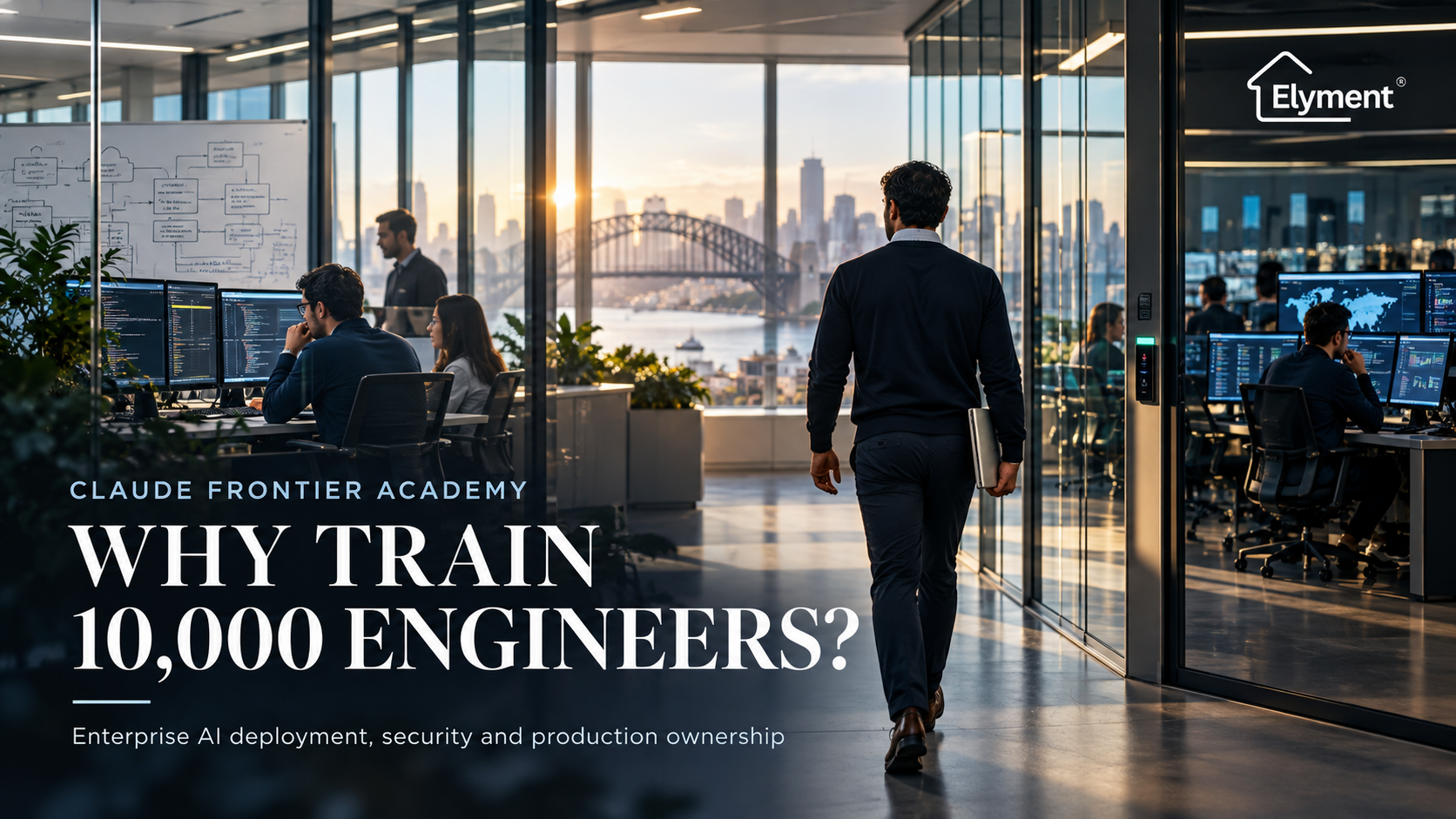
Anthropic is training 10,000 Frontier Deployed Engineers because AI writing code does not solve the harder enterprise problem: deciding what to build, connecting it to real systems, securing it, testing it and owning it in production. For Sydney and NSW organisations, CommBank’s participation is the key local signal. The scarce capability is shifting from code generation to deployment judgement, domain knowledge and accountable operational design.
On 2 October 2026, Anthropic announced a $100 million commitment to create Claude Frontier Academy, with a target of training 10,000 Frontier Deployed Engineers by the end of 2027. The first cohorts include engineers from Accenture, Bain, Capgemini, Commonwealth Bank of Australia, Deloitte, McKinsey, Morgan Stanley and Novo Nordisk.
At first glance, the investment appears to arrive at the wrong moment. Claude and competing frontier models are becoming substantially better at generating, reviewing, refactoring and explaining software. If AI can produce more of the code, why would one of the world's leading AI companies spend heavily training thousands more engineers?
The contradiction is the important part of the announcement.
Anthropic is effectively arguing that code production is becoming less of the enterprise bottleneck. The difficult work is moving towards deciding which business problem deserves automation, connecting models to trusted systems, designing permissions, passing security review, measuring whether the system works, handling exceptions and leaving somebody accountable once the prototype becomes an operating system.
The Better AI Gets At Coding, The More Valuable Deployment Judgement Becomes
Enterprise software has never been valuable simply because somebody successfully produced code.
A functioning application still has to fit a real organisation. It has to retrieve the correct information, recognise which system owns that information, respect access controls, operate within security requirements, survive unusual inputs, integrate with existing platforms and behave predictably when something goes wrong.
Generative AI can compress parts of software development dramatically. That changes the economics of engineering, but it does not eliminate engineering.
Instead, it moves a larger share of engineering value upstream into problem definition and downstream into production control.
Code creation
What frontier AI can accelerate: Generate functions, tests, integrations and documentation.
What an enterprise engineer still has to own: Architecture, suitability, review and maintainability.
Business requirements
What frontier AI can accelerate: Summarise documents and propose workflows.
What an enterprise engineer still has to own: Determine what the organisation is actually trying to achieve.
Data access
What frontier AI can accelerate: Retrieve and reason across authorised information.
What an enterprise engineer still has to own: Define authoritative sources, permissions and prohibited data.
Security
What frontier AI can accelerate: Assist analysis and configuration work.
What an enterprise engineer still has to own: Threat modelling, credentials, privilege boundaries and approval.
Evaluation
What frontier AI can accelerate: Generate test scenarios and analyse results.
What an enterprise engineer still has to own: Decide what constitutes acceptable performance.
Production
What frontier AI can accelerate: Support monitoring, diagnosis and remediation.
What an enterprise engineer still has to own: Release control, incident ownership and rollback decisions.
Business change
What frontier AI can accelerate: Automate parts of an existing process.
What an enterprise engineer still has to own: Redesign responsibilities, handovers and human decision points.
This distinction is increasingly important because the marginal cost of producing another piece of software is falling faster than the organisational cost of deciding whether that software should be trusted.
Claude Frontier Academy Is Not Really A Coding Course
Anthropic's program design makes that clear.
According to the company, participating organisations nominate experienced software engineers and each engineer arrives with a named Claude project they are expected to lead inside their own organisation.
Engineers begin with an intensive in-person program built around a simulated enterprise deployment. The sequence extends beyond building an application. It moves through use-case selection, security review, implementation and eventual handover. Participants are practically assessed before progressing into a 12-week residency where they lead a real deployment with support from Anthropic engineers.
That is materially different from learning a new programming framework.
The Academy is attempting to develop people who can cross organisational boundaries. A Frontier Deployed Engineer may need to understand enough about software architecture, data, cyber security, product design and model behaviour to build the system, while also understanding enough about the organisation to know where the system can safely operate.
Elyment has previously examined the expansion of certified enterprise AI implementation capacity. Claude Frontier Academy introduces a different model. The objective is not only to create more external specialists. It is also to deepen capability inside customers themselves.
Commonwealth Bank Makes This An Australian Operating Story
Commonwealth Bank's involvement makes the announcement immediately relevant to Australian enterprise technology rather than merely another Silicon Valley training initiative.
CommBank says an initial group of 20 engineers will participate in a four-day intensive before moving into the 12-week residency. The training covers a simulated enterprise deployment from requirements and solution design through testing, security review, compliance and production deployment.
That sequence is revealing.
A major Australian financial institution does not need engineers merely because it lacks the ability to produce code. It needs engineers who can introduce increasingly powerful AI systems into an environment where customer information, identity, security, regulatory obligations, resilience and production change all matter.
Anthropic's announcement also cites CommBank's statement that its engineering teams produced up to three times more code changes over the previous year while using AI tools.
But code volume is not the same as business performance.
If AI allows a team to create software faster, organisations can potentially create more features, more integrations, more automated actions and more changes to production systems. That increases the importance of choosing the right changes and controlling the consequences of those changes.
Faster software production therefore creates a second-order management problem: organisations need the review, security, testing, approval and operating capacity to absorb what their engineers can now build.
The Frontier Deployed Engineer Is Really A Boundary Role
The most important characteristic of the emerging role may not be superior prompting or exceptional typing speed.
It is the ability to operate across boundaries that normally separate technology teams from the rest of a large organisation.
- Between the business and engineering: Translating a commercial problem into something that can be reliably automated.
- Between AI and authoritative data: Determining what information a model may access and which systems remain the source of truth.
- Between capability and permission: Separating what an AI system technically can do from what it should be allowed to do.
- Between prototype and production: Introducing evaluations, monitoring, incident procedures and operational ownership.
- Between automation and accountability: Ensuring that a human role remains responsible for decisions that cannot simply be delegated to software.
These boundaries are where many promising AI demonstrations become difficult.
A prototype can be built against clean test data with one enthusiastic team. A production system may have to cope with incomplete records, duplicated customers, outdated documentation, incompatible APIs, staff turnover, changing model versions, cyber security controls and users who behave differently from the demonstration.
This helps explain why real enterprise AI adoption cannot be measured simply through licences, demonstrations or access to a powerful model.
Why 10,000 Engineers Can Still Make Sense When AI Writes More Software
Anthropic's target becomes easier to understand when the unit of work changes.
If engineers were valuable only because organisations required humans to manually produce every line of software, better coding models might logically reduce the number required.
But the Frontier Academy thesis appears to be different.
AI makes software creation cheaper enough that many more business processes can now become candidates for software.
A bank may automate internal operations that previously could not justify a large bespoke development project. A professional-services firm may build specialised agents around knowledge workflows. An insurer may redesign claims administration. A corporate operations team may connect AI to document systems, CRM platforms, finance applications and approval processes.
Each new system creates implementation work.
The paradox is therefore straightforward:
AI can reduce the engineering effort required per software capability while simultaneously increasing the number of capabilities an organisation can afford to build.
That can increase demand for engineers who know where, when and how to deploy the technology responsibly.
The Scarce Skill May Become Organisational Context
Frontier models are available to competitors.
The harder asset to copy is knowledge of how a particular organisation actually works.
An internal engineer may understand which customer database is authoritative, why a compliance team insists on a specific review, which legacy interface regularly fails, which approval cannot be automated and which exception is commercially significant even though it occurs only a few times each year.
That context rarely exists neatly inside one technical specification.
It sits across employees, operating procedures, systems, emails, risk controls and institutional experience.
This is why the Academy's emphasis on engineers from participating organisations is strategically interesting. Anthropic is not only teaching its own implementation staff to enter customers. It is trying to increase the customer's own capacity to combine model capability with proprietary organisational knowledge.
That is a more durable enterprise capability than simply teaching thousands of employees how to prompt Claude.
What Sydney Organisations Can Copy Without Joining The Academy
Most Sydney businesses will not send engineers through Claude Frontier Academy. The operating model behind it is still useful.
- Attach training to a real problem. Do not train employees on AI in isolation. Give the responsible team a named workflow, customer problem or operational bottleneck.
- Identify the business owner before development starts. Someone outside the engineering team should be accountable for the outcome the system is expected to improve.
- Map authoritative information. Document which databases, records and systems the AI may rely upon and which data is outside scope.
- Design permission boundaries. Separate reading, drafting, recommending, updating, initiating and approving. These are not equivalent levels of authority.
- Build evaluation into the project. Test realistic cases, incomplete information, conflicting instructions and failure scenarios before production release.
- Run security and privacy review before the workflow becomes critical. Do not wait until deployment to establish whether the system has excessive access.
- Release gradually. Limit users, permissions or transaction types while evidence is collected.
- Leave an operating owner behind. The project is not complete until somebody can monitor, change, pause and support the system without depending permanently on the original implementation team.
Organisations still deciding which process is suitable for this treatment can begin with an AI readiness assessment for Sydney operations rather than selecting a model before defining the business problem.
In NSW, Governance Has To Become Part Of Engineering
The NSW environment also illustrates why technical training alone is insufficient.
The NSW AI Operational Policy applies to covered NSW Government agencies and requires governance, AI literacy and training arrangements around government AI use.
Private businesses are not automatically governed by that policy, but its operating principle is instructive: capability and accountability have to develop together.
Privacy creates a similar requirement. The Office of the Australian Information Commissioner says privacy obligations apply where AI systems handle personal information and recommends due diligence, human oversight, staff training and ongoing review rather than treating deployment as a one-off technology purchase.
The Australian Signals Directorate's guidance on agentic AI adds another layer. As AI systems receive greater autonomy, organisations need strong identity controls, limited privileges, monitoring and human oversight.
Those are engineering concerns as much as policy concerns.
An AI governance document has limited practical value if the technical implementation gives an agent a credential with broader permissions than the policy intended.
The Board Metric Should Not Be Lines Of Code
If coding becomes dramatically faster, traditional software productivity measures become less informative.
Organisations should be cautious about celebrating the amount of code generated, the number of agents launched or the number of employees trained.
More useful production measures include:
Cycle-time reduction
What it reveals: Whether the workflow actually becomes faster.
Rework and exception rate
What it reveals: Whether automation creates hidden downstream labour.
Human escalation rate
What it reveals: Where the system still requires judgement.
Security or permission incidents
What it reveals: Whether deployment boundaries are working.
Production reliability
What it reveals: Whether the workflow survives real operating conditions.
Outcome quality
What it reveals: Whether speed is being achieved without degrading accuracy.
Operating cost
What it reveals: Whether the new system is commercially sustainable.
Internal ownership
What it reveals: Whether the organisation can operate the system after implementation.
The distinction matters because Anthropic's wider enterprise growth has already shown that businesses are willing to spend on AI when it connects to real work, a shift examined in Elyment's analysis of Anthropic's move deeper into paid enterprise workflows.
Claude Frontier Academy goes one stage further. It suggests model access is no longer enough. Organisations need people capable of turning that access into governed, measurable operating capability.
AI Training Is Becoming Operations Training
This may be the most consequential part of Anthropic's announcement.
Much of the first generative AI training cycle concentrated on individual usage: prompting, summarisation, drafting, coding assistance and personal productivity.
Frontier Deployed Engineering represents a different layer.
The engineer is not merely learning how to use Claude. The engineer is being trained to change how an organisation performs work with Claude inside the operating system.
For Sydney businesses, that makes process design a prerequisite.
A poorly defined approval process does not become well designed because AI can automate it faster. Fragmented data does not become authoritative because a model can search across it. An undocumented exception does not disappear because an agent can make a recommendation.
This is why business process automation in Sydney should begin by mapping the operating process, decision rights, data ownership and exception paths before automation is introduced.
Sydney & NSW | AI Operations & Project Review
Map The Operating Model Before AI Moves Into Production
Review workflow design, data access, security, approval boundaries, evaluation, compliance, handover and operational ownership before an AI pilot becomes a business-critical system.
Why Train 10,000 Engineers When AI Can Write Code?
Because writing the code is becoming only one part of the engineering job.
Anthropic's $100 million commitment is a bet that the next enterprise AI shortage will not simply be people who know how to program. It will be people who can combine frontier-model capability with deep organisational context, security discipline, evaluation, operational judgement and enough authority to take a system from an idea into reliable production.
CommBank's participation makes that shift particularly relevant in Australia. Its engineers are not being sent to learn whether Claude can generate software. They are being trained around the much harder question of how software generated and assisted by frontier AI can be safely absorbed into a major operating organisation.
The more capable AI becomes at writing code, the less defensible it is to treat code generation itself as the scarce skill.
The scarce skill moves towards deciding what should be built, what the system may access, what evidence proves it works, when a human must intervene and who remains accountable after the AI starts doing real work.
That is why training 10,000 engineers can make sense precisely because AI can write more of the code.
Sources and References
- Anthropic: Claude Frontier Academy
- Elyment: IBM and OpenAI Launch a Dedicated Enterprise AI Practice
- Elyment: What Real Enterprise AI Adoption Looks Like
- Elyment: AI Readiness Assessment Sydney
- NSW Government: NSW AI Operational Policy
- Office of the Australian Information Commissioner: Privacy and the Use of Commercially Available AI Products
- Australian Signals Directorate: Careful Adoption of Agentic AI Services
- Elyment: Anthropic's Move Deeper Into Paid Enterprise Workflows
- Elyment: Business Process Automation Sydney
Map The Operating Model Before AI Moves Into Production
Review workflow design, data access, security, approval boundaries, evaluation, compliance, handover and operational ownership before an AI pilot becomes a business-critical system.
Review Your AI Project