Concrete Coating Removal Sydney: What Can a Test Patch Reveal Before a Warehouse Floor Is Stripped?
Learn what a concrete coating test patch can reveal before warehouse floor stripping in Sydney, including adhesion, layers, removal risks and likely costs early
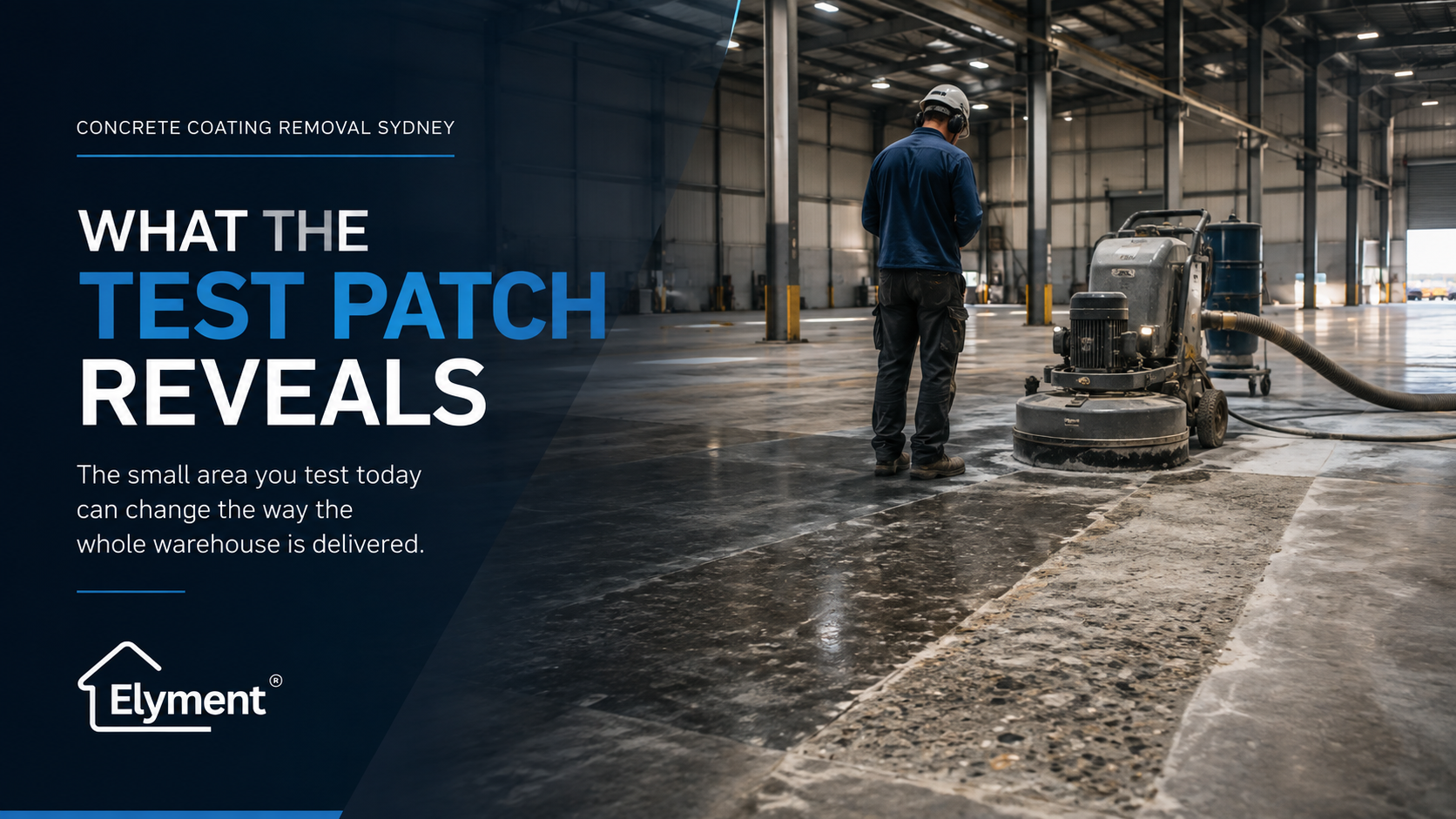
A representative test patch can reveal how strongly an old warehouse coating is bonded, how many layers are present, which grinding or removal method is productive, what condition the concrete is in underneath and whether contamination or previous repairs may change the scope.
For Sydney commercial projects, testing before full stripping can improve quote accuracy, shutdown planning, dust controls, waste allowances and the specification for the floor that follows.
On a 50-square-metre tenancy, an incorrect assumption about an old floor coating may be inconvenient. Across a Sydney warehouse measuring several hundred or several thousand square metres, the same assumption can affect labour, machine allocation, consumables, waste movements, site access and the date on which the building can return to operation.
That is why commercial coating removal should not always begin with a full-scale attack on the floor. Before the main stripping programme is locked in, a controlled test patch can provide information that photographs, floor plans and square-metre measurements cannot.
The patch is not simply proof that a grinder can expose concrete. Its real value is commercial. It can help the contractor, builder, facility manager and property owner understand what the coating is likely to demand once the project scales up.
The Quote Is Only As Reliable As The Floor Assumptions Beneath It
From above, a warehouse coating can appear remarkably uniform. A grey resin floor may look like one continuous system even though its construction history varies across the building.
One bay may contain a relatively thin coating over sound concrete. Another may carry multiple recoats accumulated over successive tenancies. Loading areas may have additional repair products, line-marking paint or thicker protective build-up. Former machinery zones can conceal oil, anchors, patches or localised toppings.
Pricing the whole floor from its visible surface therefore creates a basic information problem. The contractor knows the area but may not yet know the resistance of the material that actually has to be removed.
- Coating releases quickly
- What the project team learns: The proposed tooling may be productive across similar areas.
- Possible commercial effect: Greater confidence in labour and programme allowances.
- Multiple coating layers
- What the project team learns: The visible finish is only the upper part of the removal scope.
- Possible commercial effect: Additional passes, tooling and disposal may be required.
- Coating smears or loads tooling
- What the project team learns: The first removal method may be inefficient.
- Possible commercial effect: Tooling strategy and production assumptions may need revision.
- Weak material beneath the coating
- What the project team learns: Removal may expose unsound topping, patching or laitance.
- Possible commercial effect: Concrete remediation may need to be added to the scope.
- Oil or chemical staining appears
- What the project team learns: Surface preparation may extend beyond mechanical coating removal.
- Possible commercial effect: Further assessment and treatment may be required.
- Sound, consistent concrete appears
- What the project team learns: The downstream flooring team has clearer substrate information.
- Possible commercial effect: Preparation and handover planning becomes more predictable.
A Useful Test Patch Has To Represent The Warehouse, Not The Easiest Corner
The location of the test matters.
A patch beside a quiet wall may be simple to access, but it may reveal very little about the areas that determine the real difficulty of a commercial coating removal project.
For a large Sydney warehouse, the inspection should consider whether different operational zones need separate trials. Relevant locations can include:
- Forklift and pallet-traffic paths
- Former machinery or production zones
- Loading-dock approaches
- Areas beneath removed racking
- Old line-marking locations
- Previously repaired or patched sections
- Oil-stained or chemically exposed areas
- Extensions where the slab may have been poured at a different time
- Areas where a visibly different coating or texture appears
One square metre cannot automatically represent a 2,000-square-metre warehouse when the building has had several uses and several flooring campaigns.
What The Trial Can Reveal About The Removal Method
Warehouse floor grinding is not simply a matter of choosing the largest available machine. Different coatings and substrate conditions can respond differently to mechanical preparation.
A controlled trial allows the removal contractor to observe whether the coating fractures, powders, peels, smears or remains stubbornly bonded. That response can influence the combination of machines, tooling and finishing passes used across the broader floor.
The objective is not to select equipment by appearance. It is to establish a productive process that removes the required material without unnecessarily damaging the concrete or leaving a surface that is unsuitable for what comes next.
This distinction is particularly important where the final floor will receive another bonded system. Elyment's floor preparation and substrate-readiness services treat removal as one stage in a larger handover sequence rather than an isolated demolition task.
The Most Valuable Discovery May Be The Concrete Underneath
Commercial coating removal exposes history.
Once the test area reaches the underlying slab, the project team may discover that the coating was concealing conditions that were impossible to price accurately from the surface.
These can include:
- Old crack repairs
- Levelling compounds or skim coats
- Localised screeds or toppings
- Anchor penetrations
- Spalled concrete
- Surface laitance
- Oil or chemical staining
- Different concrete pours
- Previous grinding or polishing
- Areas where the coating is bonding to another coating rather than directly to concrete
This is where a job described as "strip the epoxy" can become a broader floor-preparation project. The coating may be only one layer in the construction build-up.
Where contamination is suspected, Elyment has separately examined oil stains and paint residues that can interfere with coating adhesion.
For a pre-strip test patch, however, the immediate value is earlier visibility. The owner can decide how the newly exposed condition should be treated before the entire warehouse is opened up.
A Test Patch Can Change The Cost Model Before The Cost Is Locked In
The difference between an inspection and a useful trial is measurement.
A contractor should be able to use the test area to improve the assumptions behind the commercial scope. That does not mean extrapolating one small result blindly across the entire building. It means replacing some unknowns with observable site evidence.
- Removal rate per machine pass
- Why it affects cost: Helps refine labour, machine-days and shutdown requirements.
- Tool consumption
- Why it affects cost: Hard, thick or difficult material can increase consumable use.
- Number of required passes
- Why it affects cost: One-pass and multi-stage removal have very different production rates.
- Edge and detail difficulty
- Why it affects cost: Walls, columns, doorways and fixed equipment require slower work than open floor.
- Waste generated
- Why it affects cost: Influences handling, containment, bins and disposal planning.
- Concrete repair requirement
- Why it affects cost: Changes the scope from removal alone to remediation and preparation.
- Final required surface condition
- Why it affects cost: Determines whether additional grinding or profiling follows bulk removal.
The practical lesson for a property manager or head contractor is that a commercial coating removal quote should distinguish between known quantities and assumptions.
A fixed square-metre figure can look reassuring, but certainty depends on what has actually been inspected.
Sydney Warehouse Projects Have A Downtime Problem As Well As A Flooring Problem
Across Western Sydney and the broader metropolitan industrial market, floor preparation often sits inside a tightly sequenced programme involving outgoing tenants, racking contractors, electricians, painters, fire-service teams, line markers, coating installers and incoming operators.
An underestimated stripping duration can therefore move more than the flooring programme.
It can affect:
- Forklift access
- Stock movements
- Loading-dock availability
- Racking installation dates
- New production equipment
- Fire and emergency routes
- Other fit-out trades
- Cleaning and coating windows
- The date the new operator takes possession of the floor
For this reason, a test patch can contribute directly to operational planning. If it shows the coating will require slower or more intensive removal than expected, the project can be restaged before trades and deliveries are committed.
Large industrial floors may also need to be divided into work zones rather than stripped in one continuous campaign. Elyment's warehouse floor preparation and levelling pathway similarly treats industrial floors in the context of loads, access and final operational use.
The Safety Planning Starts With The Trial, Not After It
Mechanical removal from concrete can create respirable crystalline silica exposure, so a test area should not be treated as exempt from the controls that will apply to the broader operation.
SafeWork NSW's crystalline silica guidance requires businesses undertaking crystalline silica processing to identify the activity, assess its risk and implement appropriate controls. Where the work is assessed as high risk, additional written control requirements apply. Concrete grinding is specifically relevant because disturbing concrete can release respirable silica-containing dust.
Practical controls can include suitable on-tool extraction or other engineering controls, controlled work zones, appropriate housekeeping and respiratory protection where required.
Elyment has separately addressed dust and safety controls within Sydney concrete grinding scopes.
The purpose of the test patch is therefore broader than technical discovery. It can also confirm whether extraction, electrical supply, containment and site access arrangements are workable before full mobilisation.
Removal Waste Should Be Considered Before Hundreds Of Square Metres Are Disturbed
A stripped coating does not disappear when it leaves the slab.
Mechanical preparation produces removed coating material, concrete fines, dust and potentially other residues exposed during the process. The waste stream can differ according to the former use of the warehouse and what is discovered beneath the coating.
The NSW Environment Protection Authority's construction and demolition waste guidance highlights the responsibility of project managers, builders and contractors to understand how construction and demolition waste is managed and disposed of.
A test patch can help estimate the physical volume and nature of the material generated, but visual inspection should not be used to make assumptions about potentially contaminated or hazardous waste. Unexpected material should be assessed appropriately before the scope continues.
The Trial Should Produce A Decision Record, Not Just A Cleaner Square Of Concrete
The strongest test patch is documented.
For a commercial warehouse, the project record can capture:
- Location. Identify exactly where the patch was completed and why the area was considered representative.
- Existing condition. Photograph the coating, wear, line marking, staining and visible repairs before work begins.
- Removal method. Record the principal machine and tooling sequence used.
- Observed coating build-up. Note whether one or several layers became visible.
- Production behaviour. Record whether the material released, powdered, smeared or required repeated treatment.
- Exposed substrate condition. Record concrete soundness, patches, cracking, contamination and other unexpected conditions.
- Required finishing pass. Confirm what further preparation would be needed for the proposed new system.
- Dust and waste observations. Confirm whether the proposed controls and waste strategy remain appropriate.
- Commercial assumptions. Identify which quote allowances can now be confirmed and which remain provisional.
- Approval point. Give the relevant project stakeholder an opportunity to accept the removal benchmark before full production begins.
When The Test Patch Should Trigger A Stop Rather Than A Start
A successful trial does not always end with approval to continue.
Sometimes its greatest value is revealing that the original scope is no longer appropriate. Full stripping should be reconsidered where the test exposes an unidentified material, substantial substrate failure, unexpected contamination, major slab damage or another condition that requires specialist assessment.
Project pressure can make this difficult. The warehouse may already have a handover deadline. Machines may be booked. The incoming floor installer may be waiting.
But continuing across a large floor after the test has invalidated the original assumptions only magnifies the uncertainty.
What A Better Commercial Coating Removal Quote Should Define
For warehouses, factories and larger commercial premises requesting concrete coating removal Sydney pricing, the useful question is not simply, "What is the rate per square metre?"
A more complete quote should clarify:
- The total measured floor area
- Which coating types or build-ups are known and which remain assumptions
- Whether a representative test patch has been completed
- The intended removal benchmark
- Whether line markings, adhesives or separate coatings are included
- How fixed equipment, columns and edges will be treated
- The anticipated mechanical preparation sequence
- Dust and silica-control arrangements
- Site power, loading, access and waste pathways
- Waste removal and disposal allowances
- Whether cracks, anchor holes and damaged concrete are included in the repair scope
- What surface condition is required at handover
- Whether the warehouse will remain partly operational
- The staging and exclusion-zone plan
- Which discoveries will be treated as scope variations
Those details make commercial comparisons more meaningful. Two contractors can quote the same square metres while pricing very different outcomes.
The Test Patch Is An Approval Gate Before Scale Magnifies The Risk
The important thing about a warehouse test patch is not its size.
It is when it happens.
Conducted before the full floor is disturbed, it creates a point at which the property owner, contractor and project team can compare assumptions with actual site behaviour. The coating resistance becomes visible. Tooling can be adjusted. Substrate problems can be documented. Waste and dust controls can be reviewed. Production forecasts can be challenged before they become programme delays.
For Sydney commercial coating removal, that makes the patch part of project governance rather than a demonstration exercise.
The purpose is not to promise that every square metre will behave identically. It is to avoid committing an entire warehouse to an untested assumption.
COMMERCIAL FLOOR PREPARATION · TEST PATCHES · PROJECT DELIVERY
Test The Floor Before The Full Strip Is Locked In
Review coating build-up, substrate condition, removal method, access, dust controls, waste planning and downstream floor requirements before committing a Sydney warehouse to full-scale coating removal.
Request a Floor Preparation Review
Sources and References
- SafeWork NSW: Work safely with crystalline silica and engineered stone
- NSW Environment Protection Authority: Construction and demolition waste
- Elyment: Floor preparation and substrate-readiness services
- Elyment: Oil stains and paint residues that can interfere with coating adhesion
- Elyment: Warehouse floor preparation and levelling pathway
- Elyment: Dust and safety controls within Sydney concrete grinding scopes
Test The Floor Before The Full Strip Is Locked In
Review coating build-up, substrate condition, removal method, access, dust controls, waste planning and downstream floor requirements before committing a Sydney warehouse to full-scale coating removal.
Request a Floor ReviewRelevant next actions
Explore the ELYMENT service most closely connected to this article.