Concrete Sealer Turning White in Sydney: Recoat It or Remove It First?
Concrete sealer turning white in Sydney can signal trapped moisture or coating failures. Know when to recoat, when to strip it first, and avoid costly mistakes.
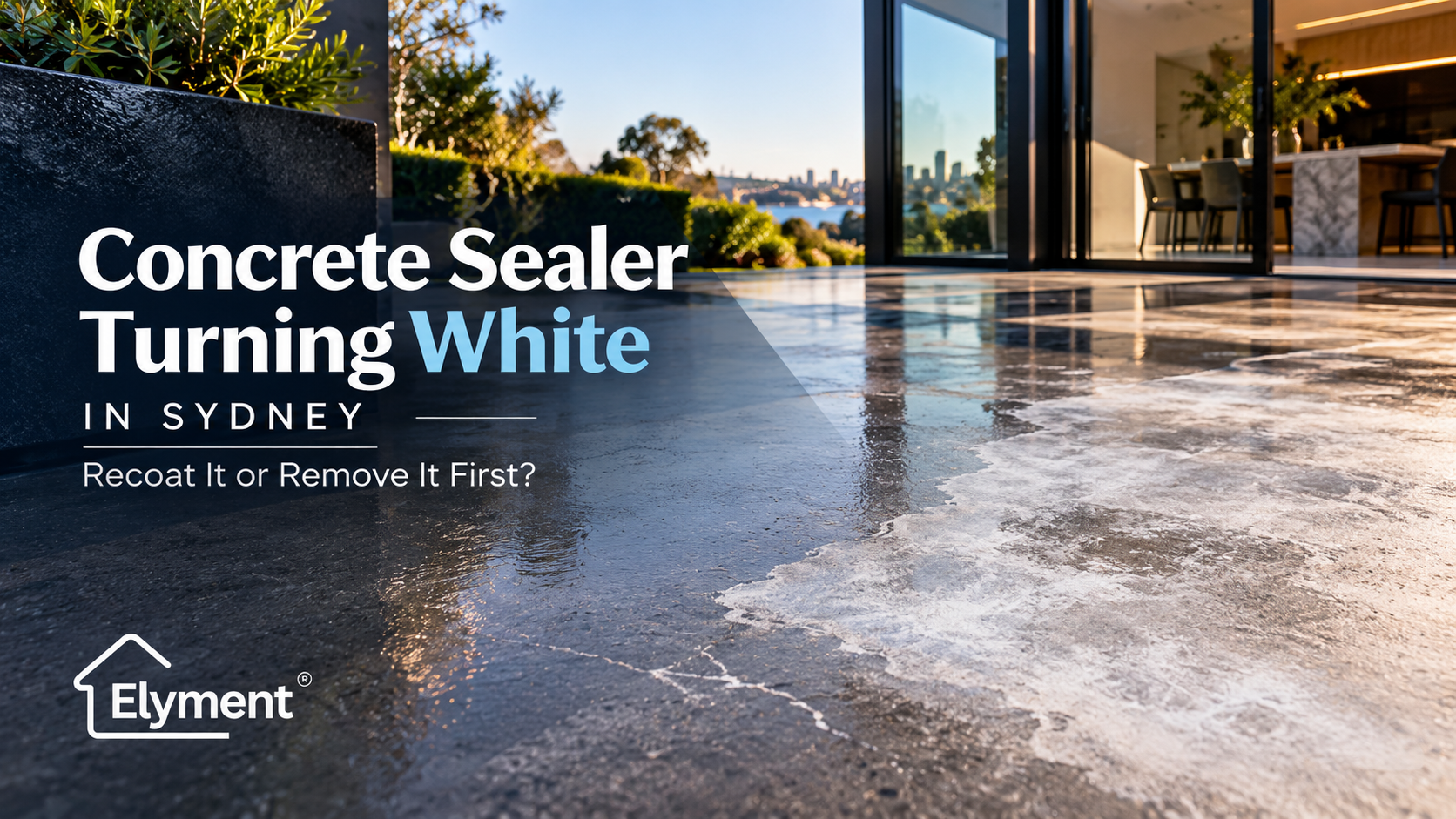
White or cloudy concrete sealer in Sydney is not automatically a reason to apply another coat. Moisture trapped during curing, excessive coating build-up and loss of adhesion can look similar but require different repairs. A stable, compatible coating may be recoverable; a delaminating film generally needs removal. Before committing to concrete sealing, owners should confirm the cause, substrate condition, access requirements and full preparation scope.
ELYMENT Insights | Concrete Sealing & Remedial Floor Preparation | Sydney, NSW | 26 October 2026
The White Haze That Can Turn a Simple Recoat Into a Removal Job
A sealed concrete driveway can look almost flawless when first completed. Its colour appears richer, the surface is easier to clean, and the finish seems to offer the protection originally promised.
Then pale patches appear. Some resemble clouds trapped beneath glass. Others look like chalky streaks or a thin, silvery film.
For Sydney property owners, the immediate temptation is understandable: apply another coat to restore the original finish.
That decision can be expensive if the existing sealer is already failing.
A new application may temporarily improve the appearance while adding more material over an unstable coating. The eventual repair can involve stripping two coating layers rather than one.
The distinction matters across Sydney's exposed concrete courtyards, residential garages, driveways, commercial entrances and strata common areas, particularly where wet weather, repeated washing or previous coating applications complicate the surface condition.
The first commercial decision should therefore be whether the defect can be recovered without complete removal, rather than how quickly another coat can be applied.
Three Different Failures Can Produce a Similar White Finish
1. Trapped Moisture: When the Sealer Turns Milky
Some film-forming concrete sealers become cloudy when moisture is trapped during application or curing.
The appearance may develop after sealing a surface that had not dried sufficiently, applying a coating during unsuitable humidity conditions or exposing a recently coated area to moisture before the film has properly formed.
The problem can be particularly relevant to external Sydney surfaces where rain, surface condensation and washing affect the available application window.
Australian coating manufacturer Nutech Paint describes moisture-related milky whiteness as a condition that may sometimes be corrected through product-specific reactivation while the sealer is relatively fresh. Where recovery is unsuccessful, stripping and resealing may be necessary.
Importantly, moisture trapped during initial curing is not necessarily the same problem as continuing moisture migration through a slab.
If water ingress or persistent substrate moisture remains unresolved, removing the visible coating defect will not necessarily prevent it returning.
2. Excessive Coating Build-Up: When More Protection Becomes a Problem
Multiple applications can leave an increasingly thick surface film, particularly on decorative concrete that has been resealed repeatedly without checking the condition of earlier coats.
Excessive film thickness can interfere with the performance and appearance of some coating systems. It may increase the risk of trapped solvent or moisture, uneven clarity and premature deterioration.
A heavily coated driveway may therefore require more than cleaning and another transparent layer.
Nutech's concrete sealer guidance specifically identifies multiple thick coats as a reason decorative finishes can deteriorate, with stripping ultimately required in some circumstances.
3. Delamination: When the Coating Is Separating From the Concrete
Delamination occurs when the coating loses adhesion to the material beneath it.
The visual evidence can include silvery-white patches, lifting edges, flaking or areas where the surface film becomes increasingly fragile.
Unlike a stable coating suffering from a limited appearance defect, a delaminating system no longer provides a dependable foundation for another application.
Adding fresh sealer over the failing film does not restore the missing bond between the original coating and the concrete.
Where delamination is widespread, the more defensible approach is usually removal of the unsound material, investigation of the substrate and preparation for a compatible replacement system.
First Establish Whether the White Material Is Actually Inside the Sealer
Not every white mark on concrete indicates a failed sealer.
Efflorescence, for example, involves mineral deposits associated with moisture movement through cementitious materials. It may appear as a powdery white residue on the surface or become visible around coating defects.
A surface contaminated by mineral deposits requires a different investigation from a milky film that developed during curing.
The following distinctions provide an initial assessment framework, not a substitute for product identification or professional testing.
Cloudy or milky film shortly after application
- Possible explanation: Moisture or solvent entrapment, or unsuitable curing conditions.
- Likely next step: Confirm product and curing history; assess whether compatible recovery is possible.
Uneven whitening after repeated resealing
- Possible explanation: Excessive coating build-up or incompatibility.
- Likely next step: Identify existing layers and assess removal requirements.
Silvery patches with lifting or flaking
- Possible explanation: Coating delamination.
- Likely next step: Assess bond failure and remove unsound material.
Powdery white deposits or recurring salt marks
- Possible explanation: Efflorescence or moisture-related mineral movement.
- Likely next step: Investigate water source and substrate condition before resealing.
The timing of the defect is also important. Whitening that appears immediately after an application may have a different cause from whitening that develops months later following repeated exposure and wear.
Photographs, previous product records, dates of coating applications and information about recent cleaning can materially improve the assessment.
When Is Recoating a Reasonable Option?
Recoating can be appropriate where the existing coating remains sound, the product chemistry is known or reliably identified, and the proposed new system is compatible with the retained surface.
Even then, compatibility does not remove the need for cleaning, preparation and compliance with the manufacturer's technical instructions.
A limited appearance defect may also be recoverable using a treatment specifically approved for that particular sealer. Such treatments should not be assumed suitable for every acrylic, polyurethane or epoxy system.
Recoating should generally be deferred where:
- The original coating is lifting, peeling or extensively flaking.
- The coating type cannot be identified and compatibility remains uncertain.
- Active moisture ingress or recurring salt deposits have not been investigated.
- Multiple earlier applications have created excessive film build-up.
- The substrate is contaminated, weak or otherwise unsuitable for the proposed finish.
The decisive point is whether the retained coating can provide reliable performance, not whether its colour can be temporarily improved.
Elyment's separate guide to concrete curing and sealing timeframes in Sydney explains why surface age and appearance should not replace product-specific requirements.
What Determines Concrete Sealer Removal Cost in Sydney?
Concrete sealer removal cost is not determined by floor area alone.
Two surfaces measuring 50 square metres can demand materially different preparation scopes if one contains a thin, deteriorated coating and the other has several strongly bonded applications.
The cost of professional preparation and resealing generally depends on the following variables.
Coating Type and Number of Layers
A relatively thin single-pack coating may respond differently to removal equipment than a hard, multi-layer resin system. Some products require mechanical abrasion, while compatible chemical stripping may be considered for specific coatings and circumstances.
Product identification and testing can help avoid selecting an ineffective removal process.
Condition of the Underlying Concrete
Removing the old coating may expose cracks, weak surface material, previous patching or contamination.
If the project requires concrete repairs, additional profiling or moisture remediation, those operations should be separately identified rather than assumed to fall within a basic stripping allowance.
Access, Edges and Obstacles
Open areas suitable for professional machinery are generally easier to prepare than surfaces interrupted by columns, drains, garden edges, garage fixtures or fixed equipment.
Strata buildings can introduce additional requirements involving loading access, lift protection, approved working hours and the movement of equipment or waste through common areas.
Preparation Standard and Replacement Finish
A surface prepared for a decorative clear finish may require different treatment from concrete intended to receive an opaque protective coating.
Visible grinding marks, variations in colour and previously repaired areas may remain apparent beneath a transparent sealer.
Finish approval therefore needs to occur before the preparation method is finalised.
Elyment examines this distinction in its Sydney matte and natural-look concrete sealing guide.
Site Controls, Waste and Programme Requirements
Dust management, removal waste, site protection and restricted working windows all influence the total cost.
An occupied commercial site may also require staged access or work outside normal trading hours.
For these reasons, a meaningful quote should separate coating removal, concrete preparation, repairs, replacement materials and application labour.
A square-metre price without these details may not represent the same deliverable between contractors.
Professional Preparation Is Also a Safety and Compliance Decision
Removing a coating mechanically may involve grinding into concrete, creating a potential exposure to respirable crystalline silica.
SafeWork NSW's crystalline silica guidance requires businesses to assess relevant processing risks and implement effective controls. Additional documented requirements apply where processing is assessed as high risk.
Depending on the work, controls may include suitable on-tool dust extraction, wet suppression, isolation of affected areas, appropriate cleaning procedures and personal protective equipment.
Chemical stripping introduces its own considerations, including product handling, ventilation, protection of adjoining materials and management of stripping residues.
In strata environments, the ownership of the affected surface and proposed method of repair also deserve attention.
NSW Government strata renovation guidance explains that approval requirements depend on the nature of the work and the scheme's by-laws. Mechanical work affecting common property, external areas or waterproofing interfaces should not be assumed to be an unrestricted cosmetic repair.
These considerations should form part of the preparation scope before site work begins.
A Sydney Courtyard Example: The Cost of Choosing the Wrong Repair
Consider a hypothetical 45-square-metre decorative concrete courtyard within a Sydney residential property.
The surface has received several clear-sealer applications over time. White patches are visible across exposed areas, while sheltered sections remain comparatively clear.
The lowest initial quote may involve cleaning and another coat of sealer.
However, if the underlying film has lost adhesion, the new application may produce only a temporary cosmetic improvement.
A properly scoped alternative could require examination of the existing coating, confirmation of whether the affected areas can be recovered, removal of unsound layers, concrete preparation and application of a compatible finish.
If the courtyard is above occupied space, the project team may also need to consider the condition and responsibilities associated with any underlying waterproofing system.
That additional work may make the initial proposal more expensive, but it addresses risks a basic recoat may leave unresolved.
The comparison is therefore between two different outcomes, not simply two prices for the same task.
What a Remedial Sealing Quote Should Make Clear
Before accepting a Sydney concrete sealer removal and resealing proposal, property owners and project managers should seek a scope that answers the essential technical and commercial questions.
- Existing condition: What evidence suggests moisture entrapment, coating build-up, delamination or mineral deposits?
- Retained material: Can any existing coating safely remain, and what evidence supports that decision?
- Removal method: Is mechanical or chemical removal proposed, and why?
- Substrate preparation: What concrete condition must be achieved before the replacement finish is installed?
- Testing: Are coating compatibility, adhesion, moisture condition or trial areas required?
- Exclusions: Are crack repairs, moisture remediation, unexpected coatings and waterproofing work included?
- Site management: Who manages access, protection, waste, dust controls and any relevant strata approvals?
- Completion: What appearance, slip performance, curing restrictions and handover conditions must be achieved?
A documented scope helps distinguish the contractor's confirmed responsibilities from conditions that remain subject to inspection.
It also creates a more reliable basis for comparing quotations without assuming that the lowest removal price includes the complete preparation sequence.
For projects requiring mechanical surface treatment, Elyment's concrete grinding and coating removal services in Sydney provide a relevant preparation pathway.
Do Not Let the Recoat Decision Precede the Diagnosis
White concrete sealer is not one defect with one standard repair.
Moisture-related blushing may sometimes be recoverable. Excessive coating build-up can require removal. Delamination generally calls for eliminating the unsound film before a replacement system is considered.
The more important question for Sydney property owners is whether the proposed work addresses the cause of the whitening and leaves a sound surface for the next coating.
That question determines not only the immediate result but also the commercial risk of paying for the same floor to be prepared twice.
In remedial concrete sealing, the most economical decision is not necessarily the one involving the least work. It is the one based on a defensible diagnosis and a clearly defined completion standard.
ELYMENT | SYDNEY PROPERTY & RENOVATION SERVICES
Review the Surface Before Recoating
Clarify coating condition, removal requirements, substrate preparation, access and project sequencing before committing to another concrete sealing application.
Request a Concrete Sealer Project Review
Technical Guidance and Further Reading
- Nutech Paint: Concrete Sealer & Coating Handbook
- Sherwin-Williams: Concrete Coating Troubleshooting
- SafeWork NSW: Working Safely With Crystalline Silica
- NSW Government: Strata Renovation Rules
Editorial information is general in nature. Product suitability, repair methodology and applicable approvals depend on the particular property, coating system and site conditions.
ELYMENT | SYDNEY PROPERTY & RENOVATION SERVICES
Review the Surface Before Recoating
Clarify coating condition, removal requirements, substrate preparation, access and project sequencing before committing to another concrete sealing application.
Request a Concrete Sealer Project ReviewRelevant next actions
Explore the ELYMENT service most closely connected to this article.