Contract Review Sydney: Do the EV Charger, Security Cameras and Smart-Home Controls Stay With the Property?
Learn how a Sydney contract review clarifies whether EV chargers, security cameras and smart-home controls stay, preventing disputes, replacement cost and delay
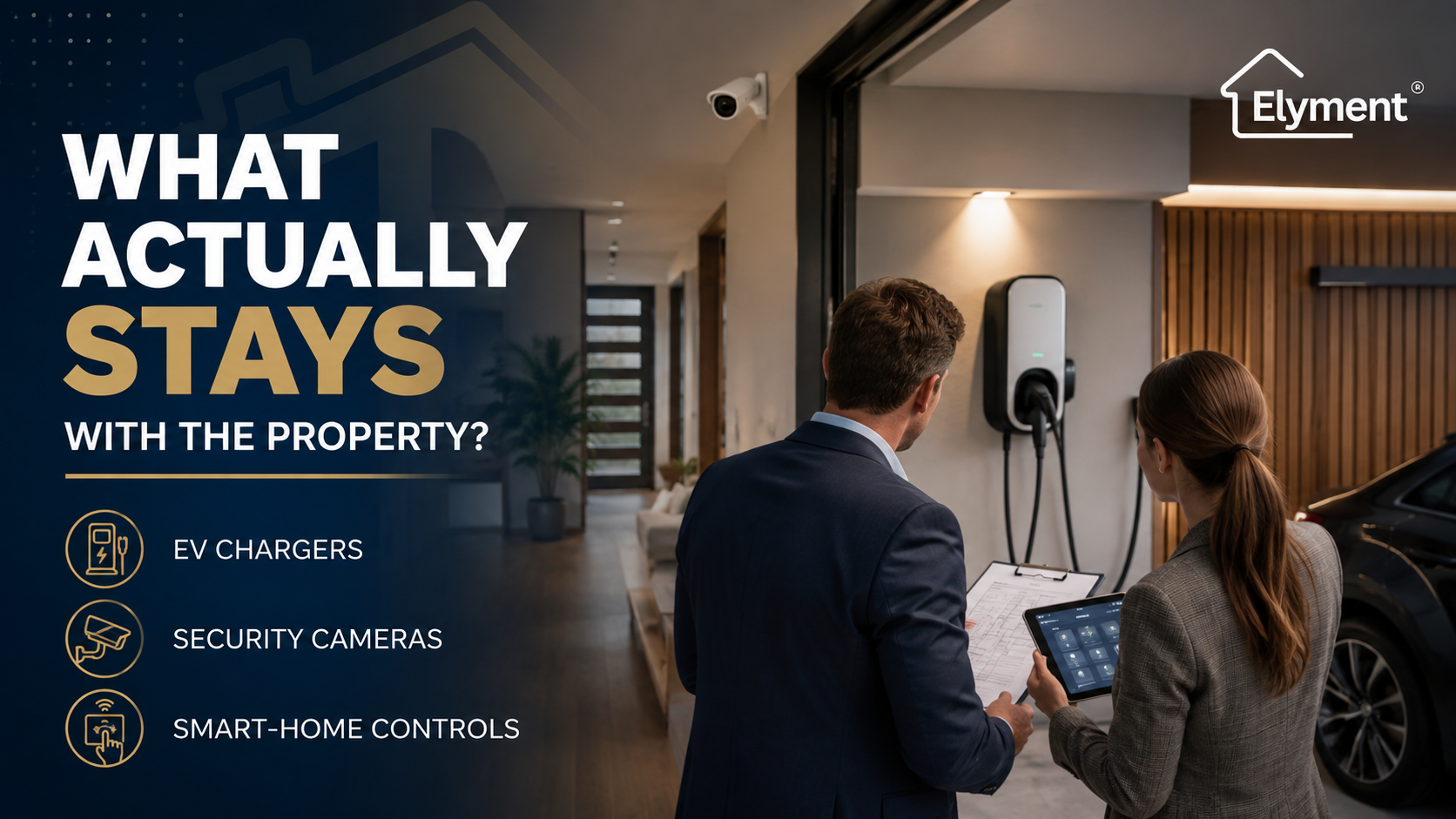
In NSW, an EV charger, security system or smart-home device should not be assumed to stay simply because it is attached to a Sydney property. The contract, fixture status, stated inclusions and exclusions, strata ownership and any negotiated terms can all matter.
Buyers should identify the hardware before exchange and separately confirm controllers, hubs, compliance records, access credentials, subscriptions and account-reset arrangements needed to make the equipment usable after settlement.
The modern Sydney property inspection has acquired a new category of uncertainty. Buyers no longer walk through a home containing only ovens, blinds, air conditioning and light fittings. Increasingly, they are inspecting houses and apartments fitted with wall-mounted electric vehicle chargers, networked cameras, video doorbells, smart thermostats, automated blinds, connected lighting, solar batteries, Wi-Fi controllers and app-operated access systems.
These installations can influence how a property is valued. An EV charger in a garage may save the next owner from arranging electrical work. A professionally installed camera system may appear to form part of the security infrastructure. Smart lighting, automated blinds and climate controls may contribute materially to the experience presented during an inspection.
Yet there is a transactional problem hidden behind the technology: the equipment a buyer sees is not necessarily the same as the equipment, control rights and supporting documentation the buyer will receive.
For buyers seeking a contract review Sydney transaction, this is increasingly an asset-transfer question rather than a simple fixtures-and-fittings question.
The NSW Contract Has Already Started Reflecting the Connected Home
The issue is no longer theoretical. The 2026 edition of the NSW Contract for the sale and purchase of land, published by the Law Society of NSW and the Real Estate Institute of NSW, contains specific inclusion options for an EV charger, internet or TV receiver, solar panels and a solar power battery.
The standard contract defines the property being sold as including the land, improvements, fixtures and stated inclusions, but excluding identified exclusions. That architecture is important because connected-home equipment does not always fit neatly into one category.
A wall-mounted EV charging unit may look permanent. A camera may be screwed into masonry but connected to a vendor's private cloud account. A smart-lighting controller may be wired into the electrical installation while its automation logic sits in an online account. A video doorbell may remain physically attached but become almost useless if its previous administrator does not relinquish control.
NSW Government guidance recommends that buyers review the contract before signing and specifically consider sale inclusions. It also confirms that a contract may identify what is included and excluded from the sale. For modern properties, the practical challenge is making those descriptions precise enough to deal with technology rather than relying on assumptions about what appears physically attached.
Physical Attachment Is Only the First Layer
Whether something is legally a fixture rather than a removable chattel can depend on the circumstances, including how and why it has been attached. Buyers should therefore avoid attempting to determine ownership from appearance alone.
More importantly, connected equipment has created a second issue that traditional fixture analysis does not resolve: operational control.
A buyer may theoretically acquire the physical device but still lack one or more of the components required to use it.
- EV charger
- Physical asset: Wall unit, cable, isolator, wiring and mounting hardware.
- What may sit outside the hardware: App account, RFID cards, load-management configuration, warranty and electrical documentation.
- Buyer issue before exchange: Confirm exactly what remains and whether the charger can be transferred to a new administrator.
- Security cameras
- Physical asset: Cameras, brackets, cabling and possibly local recorder.
- What may sit outside the hardware: Cloud subscription, administrator account, stored footage, NVR password and mobile-app access.
- Buyer issue before exchange: Identify cameras and recording hardware individually and establish a privacy-safe reset process.
- Video doorbell
- Physical asset: Doorbell, transformer, wiring and chime.
- What may sit outside the hardware: Vendor account, cloud recordings and subscription.
- Buyer issue before exchange: Confirm whether the device can be released and registered by the purchaser.
- Smart lighting
- Physical asset: Fixed switches, dimmers, relays and controllers.
- What may sit outside the hardware: Wireless bridge, hub, automation rules and app account.
- Buyer issue before exchange: Confirm whether every controller required for operation remains.
- Smart blinds
- Physical asset: Motors, power supplies and installed blinds.
- What may sit outside the hardware: Remote controls, bridge, programming and app access.
- Buyer issue before exchange: List remotes and hubs rather than assuming they are part of the blind installation.
- Smart thermostat or HVAC control
- Physical asset: Wall controller and connected plant interface.
- What may sit outside the hardware: Installer configuration, account access and building-management integration.
- Buyer issue before exchange: Confirm whether ownership can be transferred without disabling the system.
The EV Charger Is the Clearest Example of Why Wording Matters
The EV charger is especially instructive because it is now expressly contemplated by the current NSW standard contract.
A buyer inspecting a Sydney house may see a dedicated charger fixed to a garage wall and reasonably expect it to remain. The safer transaction process is still to have the inclusion position made explicit.
A useful review goes further than writing "EV charger included". It identifies what the buyer believes that phrase covers.
- The charger itself
- The fixed charging lead, where applicable
- Isolators and permanently installed associated electrical equipment
- Load-management hardware
- RFID cards, keys or physical controllers
- Manufacturer documentation
- Installation and warranty records available to the vendor
- The process for removing the vendor's app account or administrator registration
- Any information needed for the purchaser to establish control after settlement
This distinction matters because buying the physical charger does not necessarily establish its electrical condition, compliance history or compatibility with the buyer's vehicle and energy arrangement.
Building Commission NSW states that electrical wiring work in NSW must be performed by or under the supervision of a licensed electrician and that electrical work is supported by a Certificate of Compliance for Electrical Work. Since 1 July 2026, CCEWs are submitted through the BCNSW eCert system.
A buyer concerned about a fixed EV charging installation can therefore ask what electrical records are available rather than assuming that the charger itself proves the installation history.
Strata Can Turn One Charger Into Three Different Ownership Questions
An EV charger in a freestanding Sydney house and an EV charger in a basement car space can present materially different due diligence problems.
NSW Government guidance on EV charging in residential strata buildings explains that charging installations frequently interact with common-property electrical infrastructure and owners corporation approval processes.
That means a purchaser may need to distinguish between:
- The charging unit: Who paid for and owns the wall-mounted equipment?
- The supporting infrastructure: Does cabling, switchboard equipment, load management or metering form part of common property?
- The right to use the infrastructure: Is use governed by an approval, by-law, sustainability infrastructure resolution, user agreement or cost-recovery arrangement?
The fact that a charger appears inside the buyer's allocated parking area does not answer all three questions.
This is where contract review intersects with strata records. Elyment has previously examined how an embedded network can affect Sydney apartment buyers. An EV charger may sit inside that broader operational environment, particularly where electricity supply, metering or shared charging infrastructure is centrally managed.
Buyers should also check whether previous installation approvals, by-laws or responsibility arrangements are recorded. NSW strata guidance makes clear that common-property alterations and electrical or cabling works may require formal approval depending on the circumstances.
The transfer question is therefore not simply, "Does the charger stay?" It may be, "Does the charger stay, can I legally continue using it, and who will maintain the infrastructure behind it?"
Security Cameras Create a Different Risk: Hardware Can Stay While Control Leaves
Security systems expose the weakness of treating modern inclusions as a physical inventory.
Consider a Sydney home marketed with six exterior cameras. At settlement, all six cameras remain screwed to the building. On paper, the buyer may believe the security system has transferred.
But what if:
- The network video recorder has been removed
- The cameras are registered to the seller's cloud account
- The required subscription ends with the vendor
- The PoE network switch was sitting loose inside a communications cabinet and has disappeared
- The seller still has administrative access
- Stored footage contains personal information belonging to the seller
- Factory resetting the devices removes the configurations needed to reconnect them
The cameras have physically remained, yet the system delivered at settlement is materially different from the system demonstrated during the marketing campaign.
Buyers who regard security equipment as important should identify the system components in the contract or negotiated inclusion schedule instead of relying on the phrase "security system".
That schedule might distinguish cameras, recorder, hard drives, mounting equipment, power supplies, network hardware, screens, remotes and any dedicated controller.
Digital access should then be treated as a separate handover process. A purchaser should not need the seller's personal passwords. The cleaner outcome is generally for the seller to remove their personal account, delete or retain their data as appropriate, release the device from the account where the platform permits it, and allow the buyer to establish a new administrator profile.
Smart Homes Are Increasingly Sold as Systems, Not Collections of Devices
A sophisticated Sydney residence may contain dozens of connected devices but rely on only one or two central controllers.
This creates an asymmetry at sale.
A wall switch may be fixed. The relay it controls may be installed inside an electrical cabinet. The programming may live in a dedicated automation processor. The user interface may run through an app. The automation processor may require an installer to change administrator details.
Remove one apparently minor component and the system can lose substantial functionality.
Buyers should therefore consider the property as an operational system:
- What hardware is fixed?
- What removable hardware is necessary?
- Where are the hubs and bridges?
- Are any controllers hidden inside cupboards or communications racks?
- Which systems depend on an internet service or subscription?
- Does the vendor own the account through which the property is controlled?
- Can administrator ownership be transferred?
- Will an installer be needed to commission the system for the purchaser?
- Are manuals, wiring diagrams or configuration records available?
This is not about turning every contract review into a technology audit. It is about identifying equipment that materially influenced the buyer's decision and ensuring the transaction documents reflect what the parties actually intend to transfer.
The Advertising Photograph Is Not the Asset Register
Buyers frequently rely on what they saw during an inspection, in professional photographs or during an agent demonstration.
That is commercially understandable but legally risky.
The contract is where agreed property inclusions and exclusions should ultimately be resolved. NSW Government guidance advises purchasers to obtain the contract early and have it reviewed before exchange. Changes should be dealt with through the parties and their legal representatives rather than left as informal assumptions.
Elyment's broader analysis of what a conveyancer can check before a buyer signs explains why inclusions form part of pre-exchange contract triage.
Connected assets require a deeper second step: translating an inclusion into an identifiable transfer package.
A Better Pre-Exchange Process Is an Asset Schedule, Not a Generic Promise
For a property with significant connected infrastructure, the buyer can make the issue easier to manage by creating a short asset schedule before exchange.
It does not need to become a technical engineering document. It needs to remove ambiguity.
- Photograph material systems during inspection.
- Record the charger, cameras, controllers, communication cabinets and relevant fixed equipment.
- Identify the complete system.
- Ask what removable hubs, recorders, remotes or controllers are required for the equipment to operate.
- Match the agreed assets to the contract.
- Use the available inclusion fields and, where required, clearly identify additional items.
- Resolve explicit exclusions.
- If the seller intends to take a particular camera, charger, hub, monitor or automation controller, the position should not remain implicit.
- Request relevant records.
- This may include electrical compliance material, installer information, warranties, strata approval documents or equipment manuals.
- Map digital handover separately.
- Determine how personal accounts will be removed, devices reset and buyer administrator access established.
- Verify everything at the final inspection.
- Compare the installed equipment with the agreed list before settlement proceeds.
Why the Final Inspection Now Needs More Than a Walk Through Empty Rooms
NSW Government guidance recommends a final inspection around settlement to confirm that the property remains in the expected condition from exchange.
For connected homes, buyers should add technology to that inspection.
The inspection does not need to become a forensic IT exercise, but it should be systematic where valuable equipment has been agreed as part of the sale.
- Is the EV charger still physically installed?
- Has its fixed lead or controller been removed?
- Are all agreed cameras still present?
- Is the recorder or central controller still in the communications cabinet?
- Are remotes and hubs identified as inclusions available?
- Have wall-mounted smart controls been replaced with cheaper conventional devices?
- Has removal of equipment damaged walls, ceilings or electrical connections?
Elyment has separately examined property condition between exchange and settlement in NSW. The same principle becomes relevant where a vendor removes technology and leaves mounting holes, disconnected wiring, damaged finishes or a system no longer operating as expected.
Problems identified during the final inspection should be raised with the purchaser's solicitor or conveyancer before settlement rather than treated as an informal post-settlement issue.
Renovation Plans Can Make These Inclusions More Valuable Than They First Appear
Connected infrastructure also affects buyers intending to renovate immediately after settlement.
Removing a functioning EV charger, security installation or automation controller can trigger more than replacement cost. Reinstatement may involve electrical work, wall repairs, ceiling access, switchboard modification, new data cabling, strata approvals or reprogramming.
In apartments, the issue can extend into common-property responsibility. Elyment's analysis of common property before a Sydney renovation illustrates why an owner cannot assume every physical component surrounding their lot can be altered independently.
A buyer who plans new flooring, painting, joinery or electrical upgrades shortly after settlement should therefore establish which existing technology will remain before contractors price around it.
Otherwise the renovation scope may be based on a property configuration that disappears before the buyer receives the keys.
CONTRACT REVIEW · PROPERTY INCLUSIONS · HANDOVER PLANNING
Confirm The Connected Assets Before Exchange Locks In The Deal
Review inclusions, exclusions, EV charging infrastructure, strata interfaces, compliance records and practical handover requirements before treating installed technology as part of the purchase.
Request a Property Contract Review
The Practical Test: Can the Buyer Use What They Believe They Are Buying?
The connected home has changed the meaning of a property inclusion.
Historically, a buyer could often verify an inclusion visually. The dishwasher was either present or absent. The curtain remained on the window. The fixed floor covering stayed with the room.
Connected technology introduces a different standard. The hardware may be present while the functionality has effectively left with the vendor.
For Sydney buyers, the most defensible approach is therefore to separate four questions:
- What physical equipment is being transferred?
- What is expressly included or excluded by the contract?
- What approvals, compliance records or common-property arrangements affect it?
- What practical digital handover is required for the purchaser to control it?
The current NSW standard contract's express reference to EV chargers, solar batteries and connected equipment reflects how residential property has evolved. Buyers should allow their due diligence to evolve with it.
A charger on the garage wall, a camera above the front door or a touchscreen in the hallway should not be treated as proof of what will be delivered at settlement.
The stronger transaction is the one in which the buyer, seller and their advisers know exactly what stays, what leaves, what must be reset and what evidence needs to change hands before the property does.
Buyers who need the contractual position clarified before exchange can review Elyment's Sydney contract review before signing service.
Important
This article provides general information about NSW property transactions and project planning. Whether particular equipment is a fixture, inclusion, exclusion, common property asset or transferable digital service depends on the specific property, contract and surrounding circumstances.
Buyers should obtain advice from a NSW solicitor or licensed conveyancer and, where appropriate, qualified electrical, strata or technology professionals.
Sources and References
- Law Society of NSW and REINSW: 2026 Contract for the sale and purchase of land
- NSW Government: EV charging in residential strata buildings
- Elyment: Embedded network in a strata report — what NSW apartment buyers should ask
- Elyment: What a conveyancer can check before you sign
- Elyment: Property condition between exchange and settlement in NSW
- Elyment: Common property before a Sydney renovation
- Elyment: Sydney contract review before signing service
- Elyment: Contact
Note: The supplied HTML refers to NSW Government guidance on contract inclusions, final inspections and strata approvals, as well as Building Commission NSW electrical compliance requirements, but does not embed direct source URLs for those references. No additional links have been invented.
Confirm The Connected Assets Before Exchange Locks In The Deal
Review inclusions, exclusions, EV charging infrastructure, strata interfaces, compliance records and practical handover requirements before treating installed technology as part of the purchase.
Request a Contract ReviewRelevant next actions
Explore the ELYMENT service most closely connected to this article.