Conveyancing Inner West: Proxy Bidding and Auction Contracts
Can someone bid at auction and sign a property contract for you in the Inner West? Learn what authority is needed and how to avoid costly conveyancing mistakes.
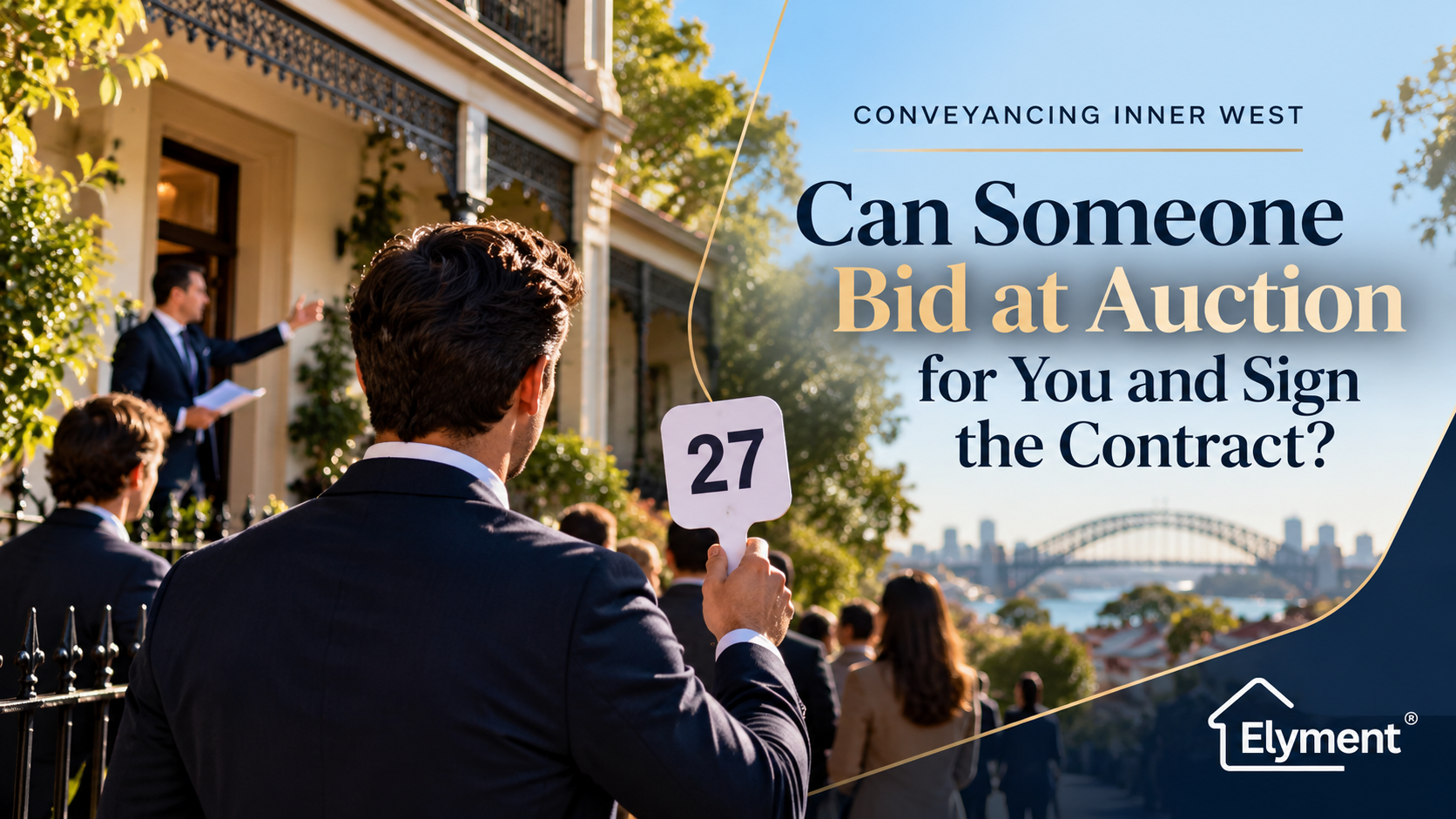
Yes. In NSW, someone can register and bid at a property auction on another person's behalf if the required identification and written bidding authority are provided. However, permission to bid does not automatically establish authority to sign the purchase contract. Inner West buyers should confirm the intended purchaser, the representative's signing powers and the contract arrangements before auction day, particularly because an auction purchase generally has no cooling-off period.
The Person Raising the Paddle May Not Be the Person Buying the Property
At a residential auction in Sydney's Inner West, the person placing the winning bid is not necessarily the person whose name should appear on the purchase contract.
A parent may bid for an adult child. A buyer's agent may represent an investor working interstate. One partner may attend the auction while the other is overseas. A company director may bid for a purchasing entity rather than personally.
These are legitimate purchasing arrangements, provided the applicable registration and legal requirements are satisfied.
The operational risk arises when three responsibilities are treated as interchangeable: bidding, becoming the purchaser and signing a binding contract.
They are not necessarily the same legal act.
Across established Inner West suburbs including Balmain, Newtown, Leichhardt, Marrickville and Ashfield, buyers considering terraces, apartments and investment properties should establish their representative arrangements before the auction begins.
NSW Auction Registration Requires More Than Informal Permission
The NSW Government's property auction guidance explains that people intending to bid at residential and rural property auctions must register with the selling agent and receive a bidder number.
The registration process requires identification information. Where a person intends to bid for another purchaser, the agent must also be shown the appropriate authority.
For an individual purchaser, the written authority to bid must identify that person through:
- The purchaser's name.
- The purchaser's address.
- The identifying number from an acceptable proof-of-identity document.
The representative must also satisfy the applicable bidder registration and identification requirements.
NSW Fair Trading explains that a licensed buyer's agent may be able to rely on their agency authority for registration, while a person acting under an appropriate power of attorney may be treated differently under the registration rules.
For company purchasers, the authority should be on company letterhead, with the relevant Australian Business Number recorded as required.
The critical timing issue is that authority to bid on another person's behalf must be established before bidding. The NSW Government's auction rules for property agents explain that a bidder is otherwise taken to be bidding as a principal.
An informal telephone instruction, family understanding or last-minute message should not be assumed to satisfy the applicable requirements.
A Letter Authorising Bids Is Not Necessarily Authority to Sign
This is the distinction that deserves particular attention during a pre-auction contract review.
A letter stating that a representative may bid for a purchaser establishes the intended bidding relationship when it satisfies NSW auction requirements.
It does not necessarily answer whether that representative can execute the contract of sale on the purchaser's behalf.
Section 54A of the Conveyancing Act 1919 (NSW) addresses contracts for the sale of land, including signing by a party or a person lawfully authorised by that party.
The important question is whether the proposed representative has legally sufficient authority for the particular contract and signing arrangement.
Depending on the circumstances, this may involve a suitable express authorisation, an agency appointment or a power of attorney. A formal power of attorney should not be assumed to be compulsory in every case, nor should an ordinary auction bidding letter be assumed sufficient to authorise every contract signature.
The purchaser's solicitor or conveyancer should establish which authority is appropriate and whether the selling agent and vendor's legal representative accept the proposed execution process before auction day.
The authority should also address what happens if the original purchaser cannot be contacted when bidding finishes.
Who Is Actually Named as Purchaser?
The most expensive misunderstanding may not involve the winning bid itself. It may involve the name inserted into the contract immediately afterwards.
Consider a purchaser who intends to acquire a Marrickville apartment jointly with their spouse but sends a sibling to bid.
The representative successfully registers, places bids and wins the auction.
At the contract-signing stage, the representative discovers that the purchaser details have not been properly confirmed.
Should the contract name the person physically present, one spouse, or both intended purchasers?
That question should have been resolved before registration.
Purchaser identity affects more than the contract heading. It may influence:
- How the purchasers acquire and hold the property.
- Mortgage approval and lender documentation.
- Transfer duty and potential concessions.
- Foreign purchaser or surcharge duty considerations.
- Company, trustee or other entity purchasing requirements.
- Whether a subsequent change in purchaser creates additional legal or financial consequences.
Changing purchaser details after an auction should not be treated as a routine administrative correction. The legal and duty consequences depend on the circumstances and the documents.
For Inner West buyers considering a joint purchase, the conveyancer should confirm the intended names and ownership arrangement before anyone is authorised to bid.
Three Proxy-Bidding Situations That Require Different Checks
Parent or Relative Bidding for an Individual
- Registration concern: Correct written bidding authority and identification details.
- Contract-signing concern: Whether the relative is separately authorised to execute the contract.
Licensed Buyer's Agent Bidding for a Client
- Registration concern: Correct registration and evidence of the agency appointment.
- Contract-signing concern: Whether the engagement actually permits contract execution or requires the client's signature.
Representative Bidding for a Company
- Registration concern: Company identity, ABN and appropriate company authority.
- Contract-signing concern: Correct corporate purchaser details and an authorised execution method.
A further distinction arises when one joint purchaser bids personally. NSW guidance permits only one member of a joint purchasing group to register, but the intended purchasers and arrangements for signing must still be clear.
The relevant paperwork should follow the actual transaction structure rather than simply the identity of the person attending the auction.
The Auction-Day Handover Is Where Authority Becomes Critical
NSW auction conditions contemplate the successful purchaser signing the agreement as soon as practicable after the hammer falls.
For someone using a representative, that creates a short but consequential handover between the auctioneer, selling agent, purchaser, bidder and legal representatives.
The risks are particularly apparent when the actual purchaser is travelling, working overseas or unavailable to receive documents immediately.
A practical pre-auction workflow should settle the following responsibilities:
1. Purchaser: Confirm the intended legal purchaser or purchasers and the maximum authorised bid.
2. Solicitor or conveyancer: Review the proposed contract, ownership structure and scope of any representative's authority.
3. Selling agent: Confirm the bidding registration documents and the proposed contract execution arrangements.
4. Representative: Understand the approved bid limit, instructions and escalation contact.
5. Contract signatory: Be identified in advance, with a legally appropriate and accepted signing method.
6. Deposit payer: Be ready to meet the agreed payment requirements promptly after the auction.
If the purchaser intends to sign remotely, that process should be agreed in advance. The ability to place bids by telephone or through an online platform does not establish that a particular electronic contract-signing arrangement has been authorised or accepted.
The Pre-Auction Review Should Include the Authority Documents
Conventional auction contract reviews focus on title, settlement, special conditions and disclosure documents.
Those matters remain important. Elyment's existing analysis of contract terms that should be negotiated before a NSW auction examines those wider contractual issues.
Where a representative is bidding, however, the review should also address the mechanics of who can commit the purchaser.
A conveyancer or solicitor may need to establish:
- Whether the bidding authority correctly identifies the intended purchaser.
- Whether the proposed representative has adequate authority to bid.
- Whether any separate signing authority is required.
- Whether the named purchaser matches the financing and ownership instructions.
- Whether the vendor's solicitor has agreed to the proposed signing arrangement.
- Whether the representative can act if the purchaser is unreachable.
- Whether the required deposit can be paid through the approved arrangements.
These checks belong alongside the property-specific contract review, not after it.
Buyers who expect another person to arrange payment should also consider Elyment's guidance on NSW auction deposit requirements and bank transfer limits.
A representative's authority to bid or sign should never be confused with permission to operate the purchaser's bank account.
There Is No Ordinary Cooling-Off Period to Repair the Mistake
The immediate nature of auction purchasing increases the significance of the preparation.
Under NSW Government guidance on property contracts and deposits, an ordinary residential cooling-off period does not apply to a purchase made at auction or to a contract exchanged on the same day after a property is passed in.
This makes it especially important not to rely on the assumption that a missing authority document can simply be fixed later.
If a person wins an auction and an authority or execution issue is discovered, the parties may face an immediate legal problem. The exact outcome depends on the bidding circumstances, applicable auction conditions, authority documents and contractual position.
Buyers should seek immediate legal advice rather than assuming the transaction is automatically invalid, automatically enforceable or capable of being cancelled without consequences.
Elyment has separately examined how fast-moving Sydney auctions affect contract review and cooling-off decisions.
Proxy bidding adds a different risk: the correct purchaser may have made the decision to buy without completing the paperwork needed for someone else to carry it out.
A Better Timeline for Inner West Auction Buyers
A well-managed proxy auction arrangement should be completed before the representative receives a bidder number.
Several Days Before Auction
Obtain the sale contract and arrange legal review. Identify the intended purchaser, any joint ownership arrangement, the representative and the proposed contract signatory.
If a company, trustee or attorney is involved, resolve the relevant authority and execution requirements with the legal adviser.
Before Registration
Provide the bidding authority and required identity details to the agent. Confirm that the registered bidding arrangement corresponds with the intended purchaser.
Separately confirm who will sign the contract, whether remote signing is acceptable and what documents must be available.
Before the First Bid
Agree a clear maximum bid and communication procedure. Confirm who can authorise any change and ensure no representative assumes discretion beyond their instructions.
Immediately After a Successful Bid
Follow the pre-agreed contract execution and deposit procedure. Verify that the purchaser details, signing capacity and contractual arrangements are consistent with the instructions already reviewed.
A last-minute signing issue should be referred to the legal representatives immediately, not resolved through an improvised purchaser substitution.
What This Means for Inner West Property Transactions
A residential auction is often discussed as a test of price discipline. For purchasers who cannot attend personally, it is also a test of transaction coordination.
The representative's ability to make a bid is only one part of the process. The purchaser must also be correctly identified, the legal authority must support the intended actions, and the contract must be ready for appropriate execution.
For buyers of Inner West terraces, strata apartments and investment properties, these arrangements sit alongside broader purchase considerations such as title restrictions, building condition, settlement obligations and the feasibility of any planned refurbishment.
The stronger approach is to treat bidding authority and signing arrangements as part of the pre-auction contract review rather than as auction-day administration.
The central distinction is straightforward: someone may be permitted to bid for you without necessarily being authorised to sign the property contract for you.
Prepare the Purchase Before Auction Day
Inner West Property Planning
Discuss your pre-auction contract review requirements, purchaser arrangements and property planning priorities with Elyment Property Services.
Editorial Note
This article provides general information about NSW property auctions and transaction preparation. It is not legal advice. Whether a representative can sign a particular contract depends on their authority and the transaction circumstances. Seek advice from an appropriately qualified NSW solicitor or licensed conveyancer before bidding.
Sources and References
NSW Government Auction and Property Guidance
- NSW Government: Buying Property at an Auction
- NSW Government: Auction Rules for Property Agents
- NSW Government: Contracts and Deposits
NSW Legislation
- NSW Legislation: Conveyancing Act 1919 — Section 54A
Related Elyment Articles and Services
- Auction Contract Review NSW: Which Terms Should Be Negotiated Before You Bid?
- NSW Auction Deposit Rules: What if Your Bank Transfer Limit Is Too Low?
- How Fast-Moving Sydney Auctions Affect Contract Review and Cooling-Off
- Elyment Property Services: Contact
Prepare the Purchase Before Auction Day
Discuss your pre-auction contract review requirements, purchaser arrangements and property planning priorities with Elyment Property Services.
Request a Pre-Auction ReviewRelevant next actions
Explore the ELYMENT service most closely connected to this article.