Conveyancing Northern Beaches: Protected Trees and Extensions
Protected trees may limit extension plans on Northern Beaches homes, adding approval delays and costs. Check restrictions before buying or renovating in Sydney.
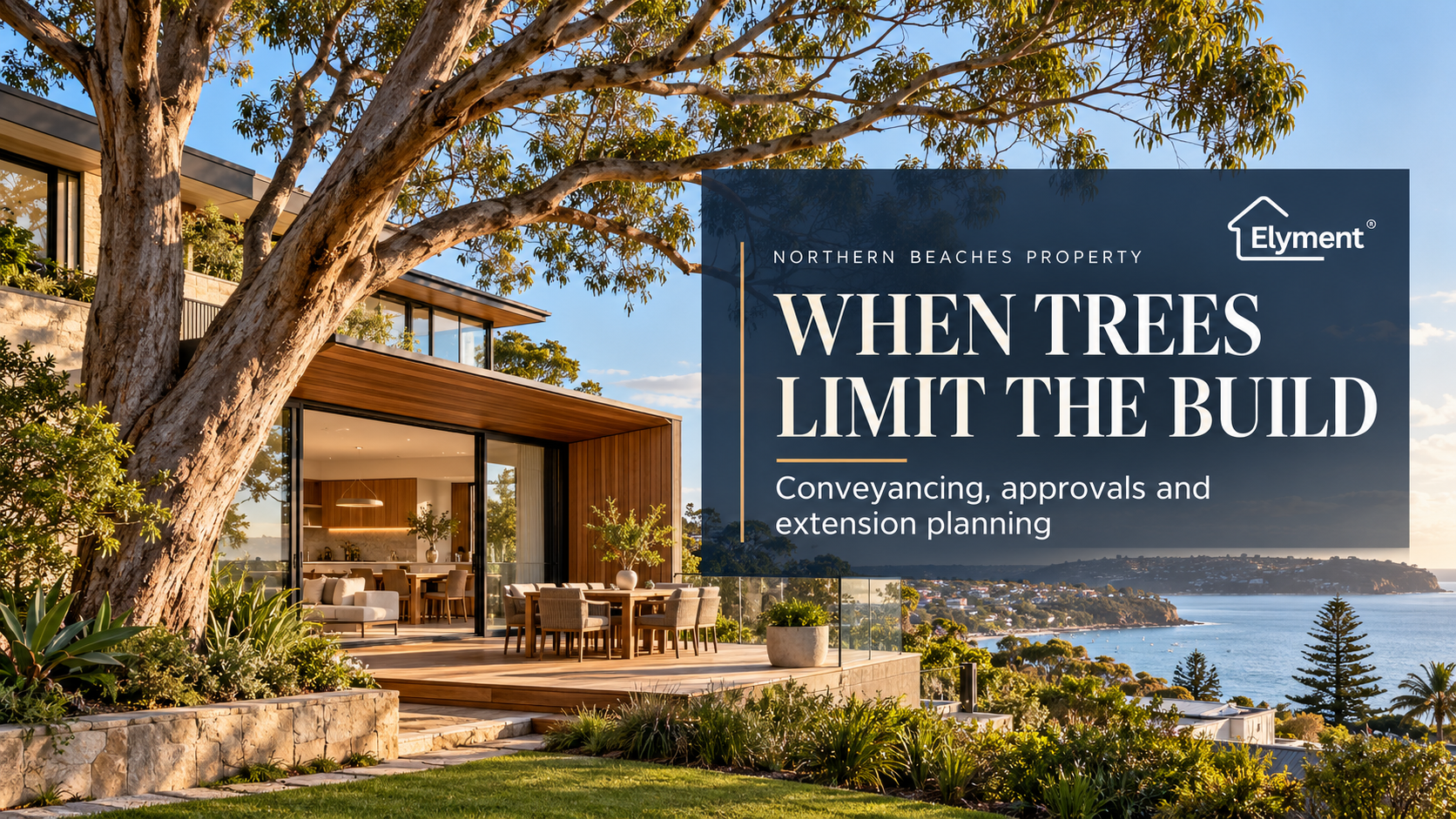
Yes. A buyer planning a Northern Beaches extension or knockdown rebuild may find that an existing tree, its root zone or a condition attached to an earlier development consent limits the proposed building footprint. Northern Beaches Council regulates many tree and vegetation works, and exemptions are conditional. Before exchanging a NSW property contract, buyers should review consent history and planning controls, then obtain arboricultural and planning advice on their proposed design.
Reviewed 18 October 2026.
The Backyard May Be Larger Than the Buildable Area
On Sydney's Northern Beaches, a generous backyard can influence a property's value almost as much as the house itself. For buyers planning a second-storey addition, rear extension or complete rebuild, the apparent space available for construction can become central to the purchase decision.
Yet the distance between the existing dwelling and the rear boundary does not necessarily represent the land available for a new building.
A mature tree may require protection during construction. Its roots may extend into the intended excavation area. Previous development approval conditions may require particular vegetation to be retained. A proposed extension may also affect neighbouring trees or vegetation subject to separate controls.
The result is a property transaction involving two different assessments: whether the buyer can acquire the land, and whether the land can reasonably accommodate the project that makes the acquisition worthwhile.
This distinction is particularly important in established suburbs such as Frenchs Forest, Belrose, Avalon Beach, Mona Vale, Newport and parts of the former Manly, Pittwater and Warringah council areas, where mature vegetation can be integral to residential landscapes.
The relevant controls are property-specific. A visually similar tree in another suburb or on another lot may have a different planning and approval position.
Tree Protection Is Not Simply a Question of Ownership
Owning the land does not create an unrestricted right to remove the trees growing on it.
Northern Beaches Council's guidance on removing and pruning trees on private land identifies the interaction between the NSW biodiversity and vegetation framework, local development controls, applicable exemptions and development-consent conditions.
Council's guidance identifies several circumstances where a permit may be required, including:
- Trees specifically required to be retained by an existing development consent.
- Trees associated with heritage items or heritage conservation areas.
- Certain threatened species, habitat or endangered ecological communities.
- Native vegetation protected under relevant development control plans.
Some tree works may qualify for exemptions, including specified circumstances involving tree height, exempt species, proximity to an existing approved building or documented imminent danger. However, the relevant criteria and any overriding site-specific protections must be checked before relying on an exemption.
A particularly consequential detail is that Council expressly identifies trees required to be retained under development-consent conditions as requiring protection through its permit framework.
This means the buyer needs to investigate more than the present condition of a tree. The historical approval records may explain why it must remain.
An Older Development Consent Can Change a New Owner's Plans
Consider a house previously extended with a new rear living area. When Council approved that work, it may have imposed conditions requiring particular trees to be retained, protected during construction or supplemented by replacement planting.
Years later, the property is sold. The new purchaser wants to demolish the original house and construct a larger residence.
The buyer cannot safely assume that a change of ownership, a fresh architectural design or the age of the earlier approval removes those obligations. The precise wording, legal effect and continuing operation of relevant consent conditions require examination.
The investigation should establish:
- Which development consent originally imposed the tree-retention requirement?
- Which trees were identified on the approved plans?
- Were tree protection, replacement planting or landscape maintenance conditions imposed?
- Does the existing physical site correspond with those plans?
- Would the proposed development require a fresh consent, modification or separate tree approval?
A development consent is not merely a historical record of building approval. Its conditions can matter to the design and delivery of later works.
Buyers investigating older alterations can also consult Elyment's analysis of how existing renovations should be reconciled with NSW council approval records.
The Root Zone Can Matter More Than the Visible Trunk
One of the most common mistakes in early renovation planning is measuring the distance between a proposed extension and a tree's trunk without examining the potential impact on its roots.
Building works can affect a retained tree even when its trunk is outside the construction footprint.
Excavation for footings, soil-level changes, service trenches, retaining walls, heavy machinery and material storage can all affect the root environment. Damage to major roots may compromise stability, while changes to soil conditions can affect long-term tree health.
A suitably qualified consulting arborist can assess the tree and provide relevant information about its condition, structural root zone, tree protection zone and potential impacts from the proposed works.
That assessment should be integrated with the architect's and engineer's preliminary design.
Why the Excavation Method Can Change
A conventional footing layout may conflict with an area of significant roots. Depending on the tree, site conditions and proposed development, the design team may need to investigate alternative structural methods, reduced excavation or a repositioned building footprint.
Those alternatives are not automatically available. They require technical assessment and may still be unacceptable under the relevant planning controls.
This can affect the construction budget long before the buyer selects flooring, cabinetry or finishes.
Four Tree Constraints That Can Change a Property Purchase
1. Mature Protected Tree Near the Proposed Extension
- Potential project impact: Reduced footprint, altered foundations or redesign.
- Pre-purchase investigation: Arborist assessment and concept-design review.
2. Tree Subject to an Earlier Consent Condition
- Potential project impact: Retention obligation or further approval requirement.
- Pre-purchase investigation: Original consent, approved plans and planning advice.
3. Native Vegetation or Sensitive Habitat
- Potential project impact: Additional biodiversity assessment or constraints on clearing.
- Pre-purchase investigation: Council planning controls and ecological advice where relevant.
4. Neighbouring or Street Tree Beside the Building Area
- Potential project impact: Construction access, excavation or design restrictions.
- Pre-purchase investigation: Survey, arboricultural review and relevant authority enquiries.
The most important distinction is between a constraint that can be accommodated economically and one that changes the entire redevelopment proposition.
A Tree Permit, Development Consent and CDC Are Different Pathways
Buyers should not treat all planning permissions as interchangeable.
Standalone Tree Removal
Where tree removal is proposed separately from a development application, Northern Beaches Council's private-land tree management requirements generally determine whether an exemption applies or a permit process is necessary.
Council identifies circumstances where a qualified arborist report is required, particularly for significant trees.
Tree Removal Associated With Development
Where vegetation removal forms part of a larger development application, tree impacts may be assessed as part of that application.
Approval of the building proposal should not be assumed to authorise removing every tree on the lot. The approved plans and conditions determine which works have been authorised.
Complying Development Certificates
The NSW Planning Portal explains that protected trees cannot be removed as part of a Complying Development Certificate.
Its guidance on tree removal and protection for complying development also addresses requirements for trees being retained during construction.
Therefore, a proposed dwelling that otherwise appears suitable for complying development may still encounter substantial tree-related constraints.
Bushfire Clearing Rules
Eligible properties within designated NSW Rural Fire Service 10/50 entitlement areas may have particular vegetation-clearing rights, subject to the scheme's conditions and exclusions.
Northern Beaches Council specifically warns that existing development-approval conditions can restrict reliance on those entitlements.
Buyers should obtain property-specific advice rather than assuming a bushfire-prone location automatically allows clearing for a future building project.
Why the Planning Certificate Is Necessary but Insufficient
A NSW section 10.7 planning certificate can identify important planning matters affecting a property. But it is not a development consent and does not independently establish whether a particular tree may be removed.
Northern Beaches Council also notes that a planning certificate does not confirm whether land is included on the NSW Biodiversity Values Map.
Its section 10.7 planning certificate guidance distinguishes the prescribed Part 2 information from additional information available through a combined Part 2 and Part 5 certificate.
For a buyer relying on substantial future construction, a planning certificate should be read alongside Council's application history, approved drawings, consent conditions, relevant mapping and the property's actual vegetation.
The applicable Northern Beaches planning controls also need to be identified for the specific address. Council's published framework includes separate planning instruments associated with the former Manly, Pittwater and Warringah areas.
A general description of the Northern Beaches planning system is not enough to establish what is permissible on a particular lot.
When a Protected Tree Becomes a Renovation Cost
The financial consequences of protected vegetation are rarely limited to the cost of an arborist's report or tree permit application.
The larger exposure can emerge when an entire construction approach has been costed around a footprint that cannot be delivered as planned.
- Architectural redesign: Repositioning rooms, building walls, windows or access points to accommodate retained vegetation.
- Structural engineering: Investigating alternative footing arrangements or excavation methods where technically appropriate.
- Construction logistics: Changing machinery access, temporary works, storage locations or delivery arrangements.
- Tree protection: Allowing for fencing, monitoring, sensitive excavation methods and any required supervision.
- Planning costs: Specialist reports, additional assessments, redesign submissions or amended approval pathways.
- Project timing: Adjusting the construction programme where investigations or approvals delay commencement.
These costs can interact. A smaller extension may require a different layout, which can affect structural design, internal renovation sequencing and the procurement of construction packages.
For Elyment's wider project-delivery perspective, the relevant lesson is to resolve the design envelope before committing to downstream renovation scopes, including demolition, concrete preparation, flooring installation and finishing works.
An Illustrative Northern Beaches Purchase
Consider a hypothetical house in Frenchs Forest being purchased principally for a major rear extension.
The existing living area opens towards a landscaped garden containing a mature native tree. The buyer's initial concept drawing proposes to extend the kitchen and family room into that garden.
A basic inspection suggests that the new rooms would fit inside the lot boundaries.
Further review reveals that the tree was specifically identified for retention in the consent granted for an earlier addition.
An arboricultural assessment also indicates that the proposed excavation may affect significant roots.
At this point, the buyer has several decisions to investigate:
- Can the proposed layout be redesigned around the tree?
- Would a different structural approach be technically viable?
- What approval pathway applies to the preferred proposal?
- What additional investigations and costs are likely?
- Would a smaller or more expensive extension still justify the purchase price?
The existence of the constraint does not automatically make the property unsuitable. Nor does the buyer's preference for a larger home establish grounds for tree removal.
The commercial decision depends on the technical evidence, lawful alternatives and the buyer's willingness to accept a different outcome.
What Conveyancing Should Establish Before Contracts Are Exchanged
A conveyancer is not a consulting arborist or town planner. However, the buyer's instructions should make it clear where development potential is essential to the transaction.
A practical investigation can follow five stages.
- Define the intended project. Provide a preliminary extension or rebuild concept identifying the proposed footprint, excavation and access requirements.
- Review the available legal and planning records. Examine the contract, title, section 10.7 information and relevant approval history. Request missing consent conditions and approved landscape plans where appropriate.
- Commission targeted site investigations. Engage a qualified arborist, planner or registered surveyor where their expertise is necessary to assess the proposed design.
- Test feasible alternatives. Ask the design team to assess whether the project can reasonably proceed with the relevant trees retained and protected.
- Resolve the transaction response. Obtain legal advice on whether further enquiries, negotiated contract conditions, additional investigation time or another commercial decision is appropriate.
Elyment's earlier guide to Northern Beaches property investigations before exchange covers the broader legal and site-risk framework. Tree-related development feasibility is a more specific investigation within that process.
This becomes especially important where the property is being sold at auction. NSW Government guidance confirms that there is generally no cooling-off period for an auction purchase. Essential specialist checks should therefore be completed before bidding.
The Right Question Is Whether the Project Still Works
Buyers sometimes approach tree protection as an obstacle to be removed after settlement. That can be a costly assumption.
A better approach is to assess the development potential under the controls that actually apply.
The result may be a viable redesign, an alternative construction method, a different approval pathway or a conclusion that the intended project cannot reasonably be achieved.
The important point is to establish the likely consequences while the buyer can still make an informed purchase decision.
Buyers requiring coordinated legal and planning investigations can explore Elyment's Northern Beaches conveyancing services alongside independent arboricultural, architectural and planning advice as appropriate.
Review the Site Before Committing to the Build
ELYMENT PROPERTY SERVICES | SYDNEY & NSW
Align your property purchase, planning constraints, proposed renovation scope and project-delivery requirements before making major commitments.
Request a Property Project Review →
Final Perspective: Development Potential Must Be Demonstrated
A Northern Beaches property can be an excellent purchase while still having significant restrictions on its future development.
A protected tree does not automatically prevent an extension, but neither does the existence of unused backyard space prove that an extension will be approved.
The responsible purchase decision connects conveyancing, Council records, arboricultural assessment and preliminary design before the buyer relies on a future building outcome.
Where extending or rebuilding is central to the acquisition, that investigation belongs before contractual commitment, not after settlement.
Frequently Asked Questions
Can I remove a protected tree after buying a Northern Beaches property?
Not automatically. Removal may require permission, and some proposals may be unacceptable under applicable controls. Existing development-consent conditions, biodiversity protections, heritage considerations and the intended works must be assessed before removal is proposed.
Can an existing tree prevent a home extension?
Yes, where the proposed building footprint, excavation or construction activity conflicts with protected vegetation or relevant approval conditions. However, a qualified design team may be able to identify lawful alternatives that retain and protect the tree.
Does a section 10.7 certificate identify every protected tree?
No. It provides prescribed planning information, but it is not a comprehensive tree survey or development approval. Council consent records, applicable vegetation controls and specialist site investigations may also be required.
Can a complying development certificate authorise protected tree removal?
The NSW Planning Portal states that protected trees cannot be removed as part of a complying development certificate. The applicable approval pathway and tree protection requirements must be separately established.
Should buyers engage an arborist before exchange?
Where a proposed extension or rebuild depends on work near substantial vegetation, a targeted pre-purchase arboricultural assessment may materially improve the decision. The scope should be coordinated with a town planner and the proposed building design.
Editorial Note
This article provides general information about property acquisition, vegetation protection and development planning in NSW. It is not property-specific legal, arboricultural, planning, engineering or environmental advice. Approval requirements and development feasibility depend on the particular site and applicable controls.
Primary References and Further Reading
- Northern Beaches Council: Removing and Pruning Trees on Private Land — Tree management requirements, exemptions, permits and development-consent considerations.
- Northern Beaches Council: Planning Certificate – Section 10.7 — Planning certificate information and available certificate types.
- Northern Beaches Council: Planning Controls — Local planning instruments and development controls.
- NSW Planning Portal: Tree Removal and Protection for Complying Development — Protected tree requirements and restrictions associated with complying development.
Additional reference: NSW Government property-buying guidance concerning contracts, auctions and cooling-off periods, as discussed in the article.
ELYMENT PROPERTY SERVICES | SYDNEY & NSW
Review the Site Before Committing to the Build
Align your property purchase, planning constraints, proposed renovation scope and project-delivery requirements before making major commitments.
Review Your Property ProjectRelevant next actions
Explore the ELYMENT service most closely connected to this article.