Conveyancing Sydney: Contaminated Land Search NSW & EPA Limits
Understand why a clean EPA search may not rule out contaminated land in Sydney conveyancing, including past land use, record gaps, liability and buyer concerns
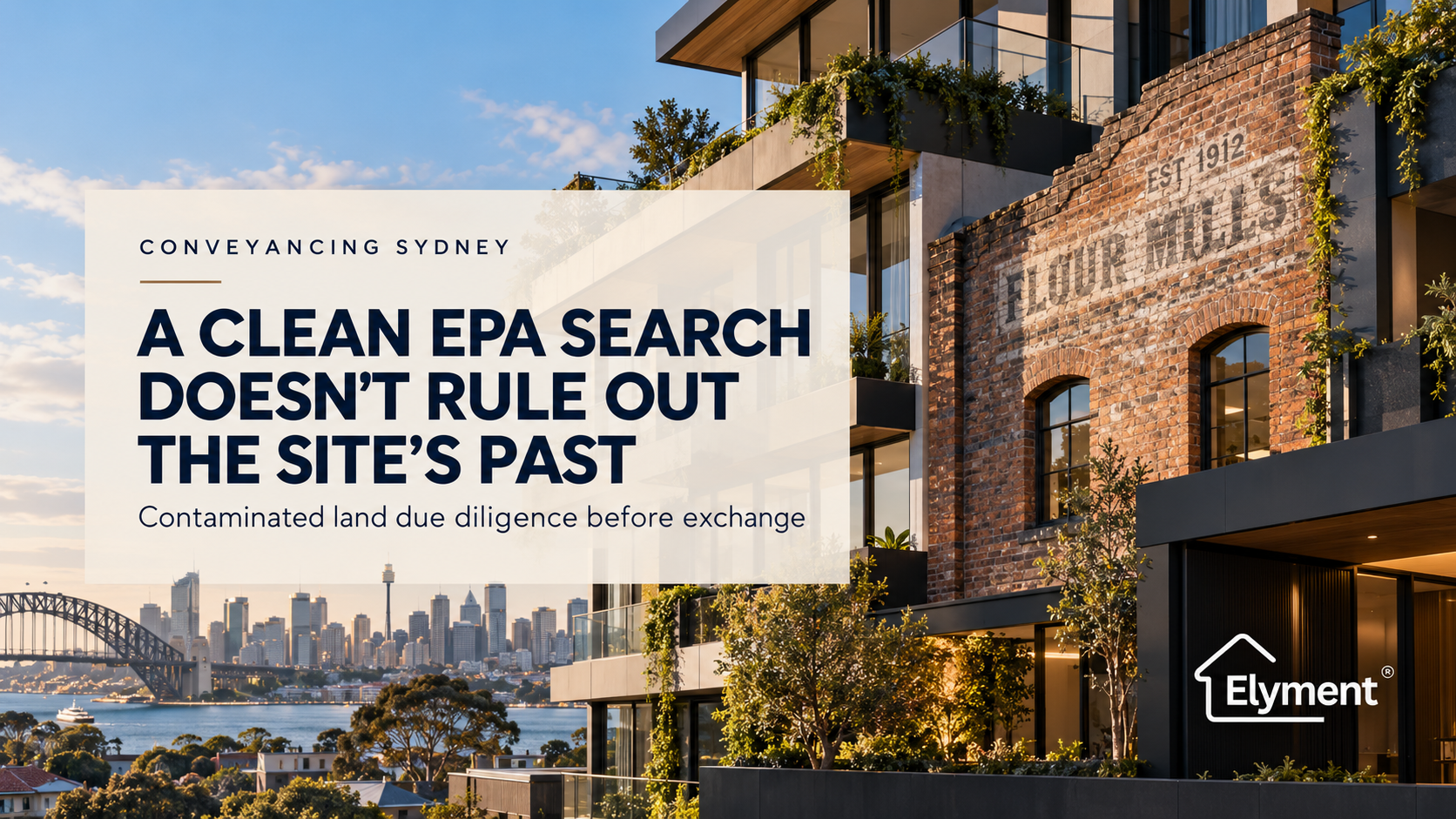
No. A clean NSW EPA contaminated-land search does not prove a Sydney property is uncontaminated. EPA databases record information known to the regulator and particular regulatory actions, not every parcel with historic contamination. Before exchange, buyers should compare the result with previous land uses, Section 10.7 planning information and available council records, then escalate material warning signs to an appropriately qualified contaminated-land consultant.
A negative database result can be reassuring. It is not the same thing as a clean bill of environmental health.
That distinction matters in Sydney because the property now presented as a townhouse development, warehouse conversion, medical suite, childcare site or premium commercial asset may have carried a very different use several decades ago.
The relevant question during conveyancing in Sydney is therefore not simply, "Does the address appear on the EPA search?"
It is: what evidence would reasonably be expected to exist if this land had previously been used for an activity capable of contaminating it, and has that evidence been investigated before the buyer becomes committed?
A Clean EPA Result Answers a Narrower Question Than Many Buyers Assume
NSW has a regulatory framework for contaminated land, but its public databases should not be read as a comprehensive environmental history of every parcel in the state.
The NSW Environment Protection Authority contaminated-land framework distinguishes between land notified to the EPA and land that has become subject to particular regulatory action.
The EPA's list of notified contaminated sites contains land known to the regulator through notifications and other information. The EPA itself makes clear that the list does not contain every contaminated site in NSW.
Separately, the contaminated-land record of notices contains regulatory documents such as orders, notices, approved voluntary management proposals and certain site audit statements relating to land dealt with under the Contaminated Land Management Act.
That creates an important due diligence distinction.
"No EPA record found" is evidence about the database. It is not laboratory evidence about the soil or groundwater beneath the property.
The Information Sources Do Different Jobs
A useful contamination review separates regulatory records, planning records and physical environmental evidence rather than treating them as interchangeable.
- EPA record of notices
- What it may establish: Whether relevant formal regulatory notices, orders or other published documents have been issued for identified land.
- What it should not automatically be taken to prove: That no contamination exists simply because the property does not appear in the record.
- EPA list of notified sites
- What it may establish: Whether land known to the EPA has been notified as potentially contaminated and its broad regulatory status.
- What it should not automatically be taken to prove: That every contaminated parcel in NSW appears on the list.
- Section 10.7(2) planning certificate
- What it may establish: Prescribed planning information, relevant controls and identified constraints affecting the land.
- What it should not automatically be taken to prove: A complete historical investigation of every activity that has occurred on the site.
- Section 10.7(2) and 10.7(5) information
- What it may establish: Additional relevant information held by council may be provided beyond the prescribed matters.
- What it should not automatically be taken to prove: That council necessarily possesses a complete historical environmental file for the property.
- Council planning and property records
- What it may establish: Where available, development applications, previous uses, environmental reports, remediation material, conditions, notices or related correspondence.
- What it should not automatically be taken to prove: The current physical condition of soil, groundwater or vapour without appropriate environmental investigation.
- Contaminated-land investigation
- What it may establish: Site-specific assessment of contamination risk using historical research, inspection and, where appropriate, sampling and analysis.
- What it should not automatically be taken to prove: Broader contractual, title or planning advice outside the consultant's professional scope.
Past Land Use Can Matter More Than the Building Standing There Today
Contamination risk follows what occurred on or around the land, not the architectural quality of the building that now occupies it.
NSW EPA material identifies industrial and agricultural activities, service stations, dry cleaners and chemical storage as examples of activities associated with contaminated-land risk.
Other histories can also justify closer investigation depending on the site, including workshops, manufacturing, waste handling, bulk fuel storage, uncontrolled fill or activities involving potentially contaminating substances.
Consider a hypothetical inner-Sydney parcel that now contains eight high-value residences.
The existing development may be modern, landscaped and fully occupied. An EPA search against the current street address may produce nothing concerning. Yet older planning records could show that the consolidated development site once contained a vehicle workshop or another potentially contaminating use.
That historical fact does not establish that the current property is contaminated.
It does establish a different question: what investigations, remediation or validation occurred when the land was redeveloped?
For a buyer, that can be more useful than repeating the same current-address search through another database.
Redevelopment Can Break the Link Between the Old Site and the New Address
Sydney redevelopment introduces another practical problem: property identity changes.
A former industrial holding can be subdivided. Lots can be consolidated. Street numbering can change. New roads can be introduced. Local government boundaries and suburb descriptions can also change.
The EPA's own contaminated-land search guidance warns that major industrial sites may later appear under different street names, Lot and DP numbers or suburb names.
That means a current-address search should not always be the end of the exercise when the property's history raises a credible concern.
The transaction team may need to connect:
- The current title reference.
- Earlier deposited plans or parcel descriptions.
- Previous street addresses or site names.
- Historic development approvals.
- Former occupiers or businesses, where relevant.
- Earlier environmental or remediation reports.
- The physical area covered by any historical investigation.
This is one reason property due diligence becomes an evidence-matching exercise rather than a collection of isolated certificates.
The Section 10.7 Certificate Is Important, But It Has a Defined Job
The NSW Planning Portal's guidance on Section 10.7 planning certificates distinguishes between a Section 10.7(2) certificate and the broader Section 10.7(2) and 10.7(5) option.
The Section 10.7(2) certificate deals with prescribed planning information, including relevant controls and identified property constraints. The additional Section 10.7(5) component may include other relevant information held by council.
That difference can become significant where contamination history is important to the purchase.
A certificate that contains no obvious contamination notation should not automatically be interpreted as council declaring that the land has never been contaminated.
The more useful question is whether council holds additional material concerning the site's former use, investigation, remediation or redevelopment.
Elyment's earlier analysis of property searches NSW buyers may commission before settlement explains why searches are most useful when they are ordered early enough to affect a decision.
Contamination due diligence makes the timing issue even sharper. An environmental concern identified before exchange can still influence investigation, contractual protection, price, proposed use or the buyer's decision to proceed. The same concern discovered after unconditional commitment can become a cost-management problem instead.
What Council Records Can Add to the Contamination Picture
Council records vary between properties and local government areas, so there is no universal file that will answer every contamination question.
Where relevant material is held, however, a targeted review may identify documents that would never appear in a simple current-address EPA result.
Depending on the property and its development history, potentially relevant records can include:
- Earlier development applications describing historical uses.
- Consent conditions requiring contamination assessment or remediation.
- Preliminary or detailed site investigations.
- Remedial action plans.
- Validation reports.
- Site audit statements or related correspondence.
- Environmental management plans.
- Planning reports identifying previous industrial activity.
- Records associated with subdivision or change of use.
The absence of one of these documents does not itself prove a defect.
The objective is to determine whether the available historical evidence is consistent with the buyer's intended use of the land and the way the property is being represented.
Before Exchange, The Sequence Matters
Where historic contamination is a credible concern, a disciplined pre-exchange process can prevent a negative database search from prematurely closing the investigation.
- Confirm the land being searched. Match the current address to the title, Lot and DP information and, where relevant, earlier parcel descriptions.
- Check the appropriate EPA information sources. Understand the difference between notified land and the formal record of notices rather than treating one search as the entire NSW contamination framework.
- Read the planning certificate in context. Identify what the Section 10.7 material actually says and whether additional council information should be sought.
- Establish the previous land-use story. Look for credible evidence of activities capable of creating contamination rather than relying only on the property's current appearance.
- Follow the red flag into the council or development file. Where the site has been redeveloped, determine whether contamination investigations, remediation documents or validation evidence formed part of that process.
- Escalate technical uncertainty appropriately. If the evidence still indicates a material environmental risk, obtain advice from a suitably qualified contaminated-land professional rather than asking the conveyancing file to answer a scientific question.
The purpose is not to order every possible report for every suburban home.
It is to make the level of investigation proportionate to the history, intended use, value and consequences of getting the assumption wrong.
When the Issue Moves Beyond Conveyancing
Conveyancing can identify the gap. Environmental professionals assess the physical risk.
The NSW EPA publishes guidance on engaging contaminated-land consultants and recognises specialist certification schemes for contaminated-land professionals.
The EPA's contaminated-land reporting framework includes stages such as preliminary site investigation, detailed investigation, remediation planning, validation and ongoing environmental management where those stages are required.
A buyer does not automatically need soil sampling because a property once had a commercial use.
Equally, a conveyancer should not be expected to determine whether an identified contaminant presents an acceptable human-health, ecological or groundwater risk.
The effective handover occurs when the legal and planning review identifies a technical question clearly enough for the right environmental specialist to answer it.
Why the Cost Can Surface Long After Settlement
Contamination can remain commercially invisible until the buyer changes the property.
A building may remain usable in its existing configuration while a future excavation, redevelopment, extension or change of use triggers closer assessment of the land beneath it.
At that point, environmental management can affect:
- Planning and approval strategy.
- Investigation and consultant costs.
- Excavation methodology.
- Soil classification and disposal.
- Remediation requirements.
- Construction sequencing.
- Programme contingencies.
- Future site use.
- The commercial assumptions underpinning redevelopment.
This is why property due diligence in Sydney should connect the legal purchase to the buyer's actual property plan.
A purchaser intending to occupy an existing dwelling has a different risk profile from a buyer intending to demolish, excavate and construct a basement.
A commercial buyer planning a medical facility, childcare operation or sensitive land use may also have different environmental questions from an investor acquiring an existing warehouse for continued use.
The Conveyancer's Real Task Is To Stop False Certainty
An effective contamination review is not about declaring every historical commercial site dangerous.
It is about separating three very different conclusions:
- No relevant EPA result has been located.
- No credible contamination history has been identified from the available evidence.
- The land has been technically assessed and found suitable for the relevant use.
Those conclusions are not interchangeable.
Sydney buyers can expose themselves to unnecessary risk when conclusion one is casually treated as conclusion three.
Elyment's analysis of what a conveyancer can realistically check before urgent exchange makes the same broader operational point: unresolved evidence needs to be identified as unresolved rather than converted into certainty because a deadline is approaching.
A Better Pre-Exchange Decision
A clean EPA search can be useful evidence. It simply needs to be given the correct weight.
For a low-risk residential property with a well-established residential history and no contrary evidence, further contamination investigation may have little practical justification.
For a redeveloped industrial parcel, former service site or property with an uncertain historical use, the same negative EPA result may only be the beginning of the enquiry.
The stronger approach is to connect the EPA result to the planning certificate, previous land use, council-held information and the buyer's intended use before deciding whether the risk is closed.
Buyers who want that wider transaction review can also consider Elyment's residential conveyancing Sydney pathway and property law and conveyancing services for contract, disclosure and pre-exchange risk coordination.
Review the Land History Before the Contract Becomes the Commitment
SYDNEY & NSW | PROPERTY DUE DILIGENCE
Connect EPA results, planning information, historical land use and available council records before unresolved environmental questions become post-settlement project risks.
Sources and References
- NSW Environment Protection Authority: Notified and regulated contaminated land
- NSW Environment Protection Authority: List of notified contaminated sites
- NSW Planning Portal: Section 10.7 planning certificates
- NSW Environment Protection Authority: Engaging contaminated-land consultants
- Elyment: Property searches NSW buyers may commission before settlement
- Elyment: What can a conveyancer check before you sign tonight?
- Elyment: Residential conveyancing Sydney
- Elyment: Property law and conveyancing services
- Elyment: Contact
This article provides general information only and does not constitute legal, planning or environmental advice. Property risks and investigation requirements depend on the individual site and transaction.
Review the Land History Before the Contract Becomes the Commitment
Connect EPA results, planning information, historical land use and available council records before unresolved environmental questions become post-settlement project risks.
Request a Property ReviewRelevant next actions
Explore the ELYMENT service most closely connected to this article.