Cork Flooring Removal Sydney: Scrape or Replace Underlay?
Removing cork flooring in Sydney? Compare scraping glued tiles with replacing underlay, including labour costs, subfloor damage risk and waste removal expenses.
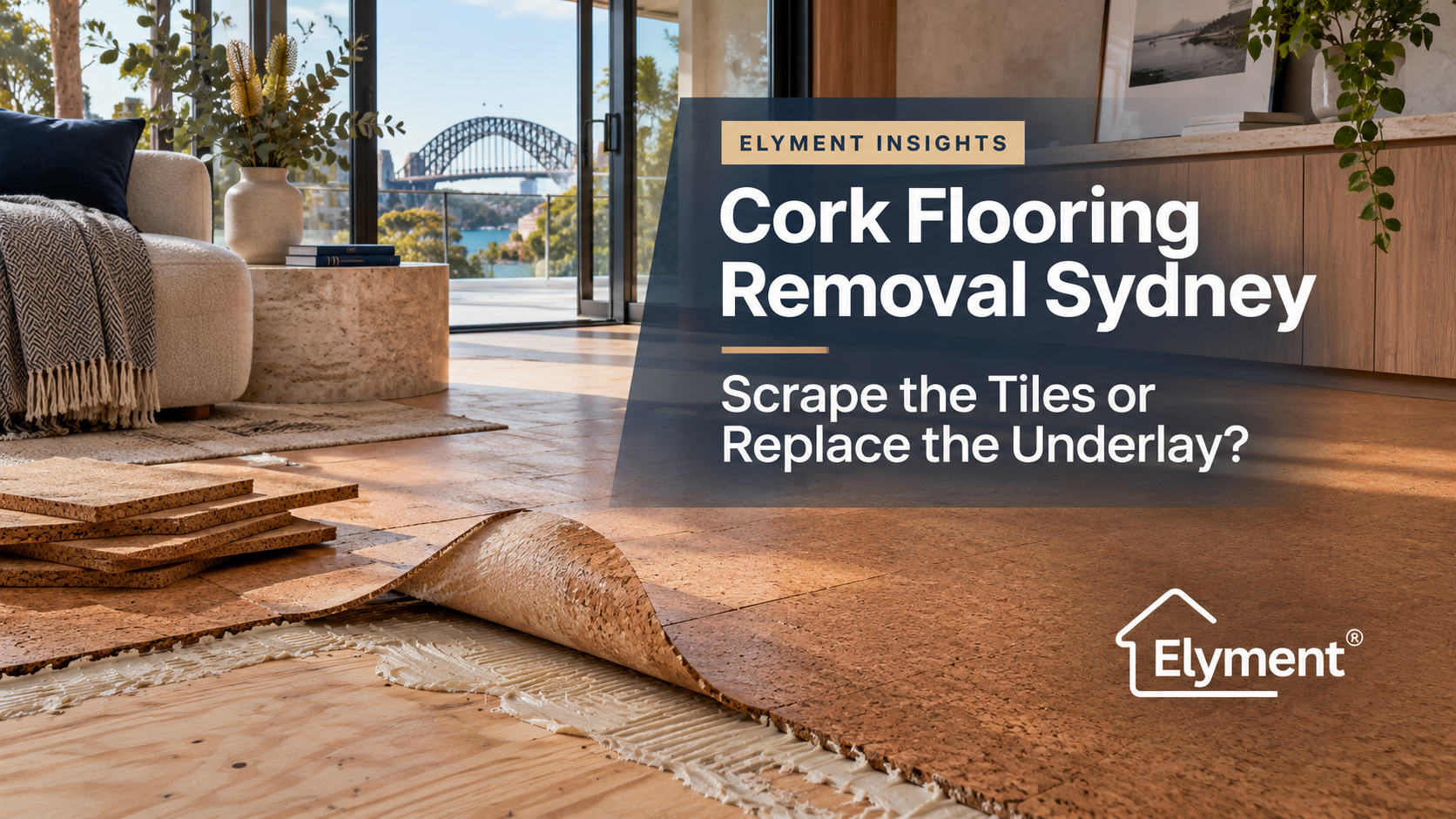
Scraping cork tiles is generally cheaper when the adhesive can be removed without damaging the plywood and the existing underlay remains suitable for the next floor. Replacing it can offer better value when scraping is labour-intensive, the sheet is damaged or its surface cannot meet installation requirements. In Sydney, the comparison should include removal labour, replacement materials, disposal and subsequent floor preparation.
The Cost Decision Begins After the Cork Comes Up
Removing cork flooring can appear to be a straightforward demolition exercise. Lift the tiles, remove the adhesive and prepare the surface for another finish. However, when cork has been installed over plywood, the more important financial decision often begins after the first section is removed.
Should the contractor spend additional time scraping the remaining adhesive and retaining the existing plywood, or remove the sheet and install a new underlay?
These are two different scopes of work, and neither is automatically the cheaper option.
Across Sydney residential renovations, particularly older properties and apartments that have undergone several flooring upgrades, cork tiles can be bonded to plywood with adhesives that vary considerably in strength and condition. Some installations allow relatively controlled removal. Others leave substantial residue, tear the upper plywood veneer or expose areas that require additional repairs.
The difference affects labour, material requirements, waste volumes and the readiness of the floor for the next installation.
For this comparison, the plywood must already have been confirmed as a non-structural flooring underlay. This is not a recommendation to remove unidentified plywood or structural sheet flooring.
Two Removal Strategies, Two Different Cost Structures
The decision is best understood by separating the physical removal cost from the cost of restoring the surface.
Option 1: Scrape the Cork Tiles and Retain the Plywood
Under this approach, the contractor removes the cork tiles while preserving the existing plywood wherever possible.
The work generally involves:
- Removing the cork tiles using controlled manual or mechanical methods.
- Separating remaining cork fragments from the adhesive layer.
- Removing incompatible adhesive residue without unnecessarily damaging the plywood veneer.
- Checking the exposed sheet for delamination, movement, damaged joints and uneven areas.
- Securing loose sections where appropriate.
- Completing localised filling, patching or surface preparation.
- Preparing the retained underlay to meet the requirements of the replacement flooring system.
Where the savings come from: The project avoids the purchase and installation of replacement plywood. It may also avoid additional labour associated with lifting sheets, removing fixings, cutting new panels and reinstating the underlay.
However, scraping is not necessarily economical when the adhesive bond is particularly strong. If workers need to spend several hours removing small sections of residue, the labour cost can approach or exceed the cost of installing a new sheet.
There is also a surface-quality consideration. Aggressive scraping can remove the upper plywood veneer, create depressions or expose damaged sections. A floor that has been stripped but requires extensive patching may not deliver the expected savings.
Option 2: Remove the Cork and Replace the Plywood Underlay
The alternative is to remove the cork tiles together with the confirmed non-structural plywood sheet beneath them.
Rather than spending additional time separating the adhesive from the existing sheet, the contractor removes the entire underlay and prepares the underlying substrate for a replacement installation.
This scope generally includes:
- Removing the cork tiles and existing plywood sheets.
- Extracting staples, screws, nails and other mechanical fixings.
- Removing remaining loose adhesive and debris from the exposed substrate.
- Inspecting the underlying floor for damage, moisture and unevenness.
- Supplying suitable replacement plywood of the specified grade and thickness.
- Cutting, fitting and mechanically fixing the new sheets.
- Preparing joints, edges and transitions for the next flooring system.
- Removing and disposing of the old cork, plywood and associated waste.
Where the savings come from: Replacement can reduce the amount of time spent attempting to recover a heavily bonded or damaged surface. It also provides an opportunity to establish a more consistent installation base.
However, the replacement approach introduces material costs, additional installation labour and potentially greater disposal requirements. The underlying substrate must also be suitable for the new underlay.
Which Option Is Actually Cheaper?
The answer depends on the relationship between adhesive removal time and the cost of replacing the sheet.
A contractor who quotes only for cork removal may overlook the work required to make the plywood suitable for another floor. Equally, a quotation recommending full underlay replacement may include unnecessary demolition if the existing sheet can be retained safely and economically.
The following comparison identifies the main cost differences.
Cost Comparison: Scrape and Retain vs Remove and Replace
Item: Cork tile removal
- Scrape and retain: Required.
- Remove and replace: Required.
Item: Adhesive removal
- Scrape and retain: Potentially more intensive.
- Remove and replace: Generally limited to the exposed underlying substrate where required.
Item: Existing plywood
- Scrape and retain: Retained if suitable.
- Remove and replace: Removed.
Item: New plywood materials
- Scrape and retain: Usually not required.
- Remove and replace: Required.
Item: New sheet installation
- Scrape and retain: Not required.
- Remove and replace: Required.
Item: Surface repairs
- Scrape and retain: Potentially required across damaged areas.
- Remove and replace: Depends on the condition of the underlying substrate.
Item: Waste disposal
- Scrape and retain: Cork, adhesive residue and damaged material.
- Remove and replace: Cork, plywood and associated demolition waste.
Item: Floor height adjustment
- Scrape and retain: Usually limited to local preparation.
- Remove and replace: May be required if replacement sheet thickness differs.
Neither method should be priced as a simple square-metre removal rate without identifying the complete scope.
The Break-Even Point Is Labour Versus Reinstatement
Consider a Sydney renovation where the cork tiles are firmly bonded to an otherwise removable plywood underlay.
The scraping option may initially appear cheaper because no replacement material is required. However, the contractor discovers that the adhesive is difficult to separate and the plywood surface becomes progressively damaged during removal.
At that point, the original labour allowance may no longer be realistic.
The alternative is to calculate the cost of removing the sheet and installing a replacement. Although this option carries a higher initial material cost, it may require less labour for adhesive separation and surface restoration.
The financial comparison should therefore consider:
- Additional labour hours required to scrape and clean the existing sheet.
- Cost of repairing damaged plywood.
- Replacement sheet supply and installation costs.
- Fastener removal and new fixing requirements.
- Waste transport and disposal charges.
- Additional preparation required by the next flooring contractor.
The more extensive the adhesive removal and surface repair requirements become, the more commercially attractive full underlay replacement may be.
The Test Patch Can Prevent an Expensive Quotation Mistake
One of the most useful steps before confirming a cork flooring removal quotation is to inspect a representative section of the floor.
A controlled test patch can reveal whether the cork separates cleanly, whether adhesive remains attached and how the plywood responds to the proposed removal method.
It also helps establish whether the existing sheet can realistically be retained.
A practical inspection should examine:
- Adhesive behaviour: Does the cork release relatively cleanly, or does the adhesive remain strongly attached to the plywood?
- Surface damage: Does scraping remove only the adhesive, or does it also tear the plywood veneer?
- Sheet condition: Is the existing underlay dry, stable and securely fixed?
- Joint integrity: Are there gaps, raised edges, movement or damaged sheet connections?
- Installation suitability: Can the retained surface meet the preparation requirements of the replacement flooring?
The inspection should be representative of the wider installation. A clean section near a doorway does not necessarily demonstrate how the adhesive will behave throughout the property.
Where removal conditions vary between rooms, the quotation should allow for different treatment rather than assuming a uniform removal rate.
The Next Flooring System Determines the Required Finish
Removing the cork is only one stage of the renovation. The surface left behind must be appropriate for the flooring that will follow.
This is particularly important when deciding whether to retain existing plywood.
A surface that appears acceptable after scraping may still contain adhesive ridges, depressions, damaged veneer or inconsistent joints. These imperfections can affect the installation of the next floor.
For New Timber Flooring
Engineered and solid timber systems have different installation requirements. The condition, stability, fixing suitability and moisture characteristics of the retained plywood must be assessed against the selected product and installation method.
Replacing the underlay may be appropriate where the existing sheet has been damaged or cannot provide a suitable fixing surface.
For Vinyl and Other Resilient Flooring
Resilient flooring can be particularly sensitive to surface imperfections. Raised adhesive lines, uneven joints, depressions and damaged plywood can become visible through the finished surface.
Additional patching or a compatible smoothing preparation system may therefore be required even when the underlay is retained.
For Hybrid and Floating Flooring
Floating systems do not eliminate the need for appropriate substrate preparation. The underlying surface must meet the product manufacturer's requirements for flatness, stability and moisture conditions.
Replacing plywood solely because a new floating floor is being installed may therefore be unnecessary if the existing underlay remains suitable.
The final installation specification should determine the preparation standard, not the preference of the demolition contractor.
For further context, Elyment's guide to grinding, patching or levelling after flooring removal explains why the condition of the exposed substrate determines the next stage of work.
Disposal Is Part of the Cost Comparison
Waste disposal is frequently treated as a secondary item in flooring removal quotations. In reality, it can change the financial difference between scraping and replacement.
Retaining the plywood generally means less material is removed from the property. The contractor still needs to account for cork tiles, adhesive residue and any damaged sheet sections.
Replacing the underlay creates an additional waste stream consisting of the removed plywood, fasteners and associated debris.
The difference becomes more significant in Sydney apartments and properties where waste movement is restricted.
Before accepting a quotation, owners and builders should establish:
- Whether removal waste is included in the quoted price.
- Whether plywood and cork waste are being handled as separate materials.
- Whether loading, transport and disposal are included.
- Whether building access, lift restrictions or limited loading areas affect removal logistics.
- Whether additional charges apply if the actual waste volume exceeds the allowance.
The NSW Environment Protection Authority's construction and demolition waste guidance provides relevant information for builders and contractors managing renovation waste.
Waste should be transported to an appropriate facility, and the contractor should be able to explain how the quoted disposal allowance has been calculated.
Older Sydney Properties Require an Additional Safety Check
Before disturbing older flooring systems, the age and history of the property should be considered.
Some older buildings contain legacy materials that cannot be identified reliably through visual inspection alone. This can include asbestos-containing materials within flooring systems or other concealed building layers.
It is important not to assume that cork tiles themselves contain asbestos. The concern is the possibility of asbestos-containing materials in the existing flooring build-up, backing, adhesive or adjoining materials.
SafeWork NSW notes that buildings constructed before the late 1980s may contain asbestos in flooring and other building components.
If asbestos is suspected, work should stop in the affected area until the material has been appropriately assessed. Suspected material should not be scraped, sanded, drilled or mechanically disturbed. A licensed asbestos professional should determine the appropriate assessment and removal requirements.
Further information is available through SafeWork NSW's asbestos guidance.
Strata Apartments Introduce Another Layer of Coordination
In Sydney strata properties, flooring removal and replacement should be coordinated with the building's approval requirements.
Owners should check the relevant by-laws and obtain any necessary approval before commencing work, particularly when the proposed replacement involves hard flooring or changes to acoustic performance.
The NSW Government identifies installing or replacing hard flooring as a type of minor renovation that generally requires owners corporation approval. Applications may require work details, contractor information and acoustic documentation.
For projects involving replacement flooring, it is worth confirming the approval requirements before removing the existing cork. Otherwise, the old floor may be removed before the replacement system has been approved.
Refer to the NSW Government's strata renovation rules for further guidance.
For builders managing several trades, the sequence should be agreed before demolition begins:
- Confirm the existing floor construction and plywood classification.
- Review strata requirements and obtain necessary approvals.
- Agree on the removal method and underlay decision.
- Complete cork removal and any authorised sheet replacement.
- Inspect and prepare the exposed surface.
- Arrange the next flooring installation once the substrate is accepted.
What a Proper Cork Flooring Removal Quote Should Include
Comparing quotations becomes easier when contractors are asked to price the same scope.
A useful quotation should separate the following items:
- Existing flooring removal: Square metres of cork tiles to be removed.
- Adhesive treatment: Whether scraping, controlled mechanical removal or another preparation method is included.
- Underlay retention: Whether the existing plywood is being retained and what condition is required for acceptance.
- Underlay replacement: The sheet specification, thickness, supply and installation allowance if replacement is proposed.
- Substrate repairs: Any localised repairs, filling, patching or additional preparation.
- Waste management: Removal, loading, transport and lawful disposal.
- Final preparation: The precise condition in which the surface will be handed over to the next flooring contractor.
- Exclusions and variations: Any work that may attract additional charges after the test patch or wider removal.
The NSW Government's guidance on obtaining contractor quotations recommends written quotations that specify the work, materials and project requirements. This is particularly relevant when two contractors propose different removal strategies.
The Commercial Decision: Retain What Works, Replace What Does Not
There is no universal cost advantage to scraping cork tiles or replacing plywood underlay.
Where the existing sheet is stable, dry, securely fixed and capable of meeting the next flooring system's requirements, controlled scraping and localised preparation may be the more economical solution.
Where the adhesive is exceptionally difficult to remove, the plywood is extensively damaged or the required surface quality cannot be achieved economically, replacement may offer better overall value.
For Sydney renovation projects, the most reliable comparison is the complete cost of reaching an installation-ready surface, rather than the initial price of removing the cork.
The objective should not be to remove the greatest amount of material. It should be to establish the most practical, safe and commercially sensible foundation for the next stage of the renovation.
Frequently Asked Questions
Is it cheaper to scrape cork flooring or replace the plywood underneath?
Scraping is generally cheaper when the cork and adhesive can be removed without damaging the plywood. Replacement may offer better value when adhesive removal requires excessive labour or the existing sheet is unsuitable for reuse.
Can cork tiles be scraped off plywood without damaging it?
It depends on the adhesive, plywood condition and removal method. A controlled test patch helps determine whether the cork can be removed without tearing the upper veneer or compromising the sheet.
Does replacing plywood eliminate the need for floor preparation?
No. The underlying substrate must still be inspected for moisture, damage, unevenness and suitability. New plywood also needs to be installed and prepared according to the next flooring system's requirements.
Does cork flooring removal include disposal?
Not automatically. Contractors should specify whether cork, adhesive residue, damaged plywood, transport and disposal are included in their quotation.
Should cork flooring be removed before choosing the replacement floor?
The replacement flooring specification should ideally be selected before demolition. This allows the removal contractor to understand the required substrate condition, finished floor height and preparation standard.
Planning a Cork Flooring Removal Project in Sydney?
Whether you are comparing scraping with underlay replacement or coordinating the next flooring installation, understanding the existing floor construction is essential to controlling cost and avoiding unnecessary work.
Elyment Property Services supports Sydney renovation projects through flooring removal, surface preparation, levelling and coordinated project delivery.
Sources and References
- Elyment – Should You Grind, Patch or Level the Floor After Old Flooring Is Removed?
- NSW Environment Protection Authority – Construction and Demolition Waste
- SafeWork NSW – Asbestos Guidance
- NSW Government – Strata Renovation Rules
- NSW Government – Getting Contractor Quotations
Planning Your Next Flooring Project?
Get practical advice on flooring removal, underlay replacement, surface preparation and renovation project coordination.
Get Flooring AdviceRelevant next actions
Explore the ELYMENT service most closely connected to this article.