Elon Musk’s $119 Billion Terafab Is Taking Shape: 5 Reasons This AI Chip Factory Is Extraordinary
Discover 5 reasons Elon Musk’s $119 billion Terafab AI chip factory stands out, from its vast scale and investment to chip output, automation and global impact.
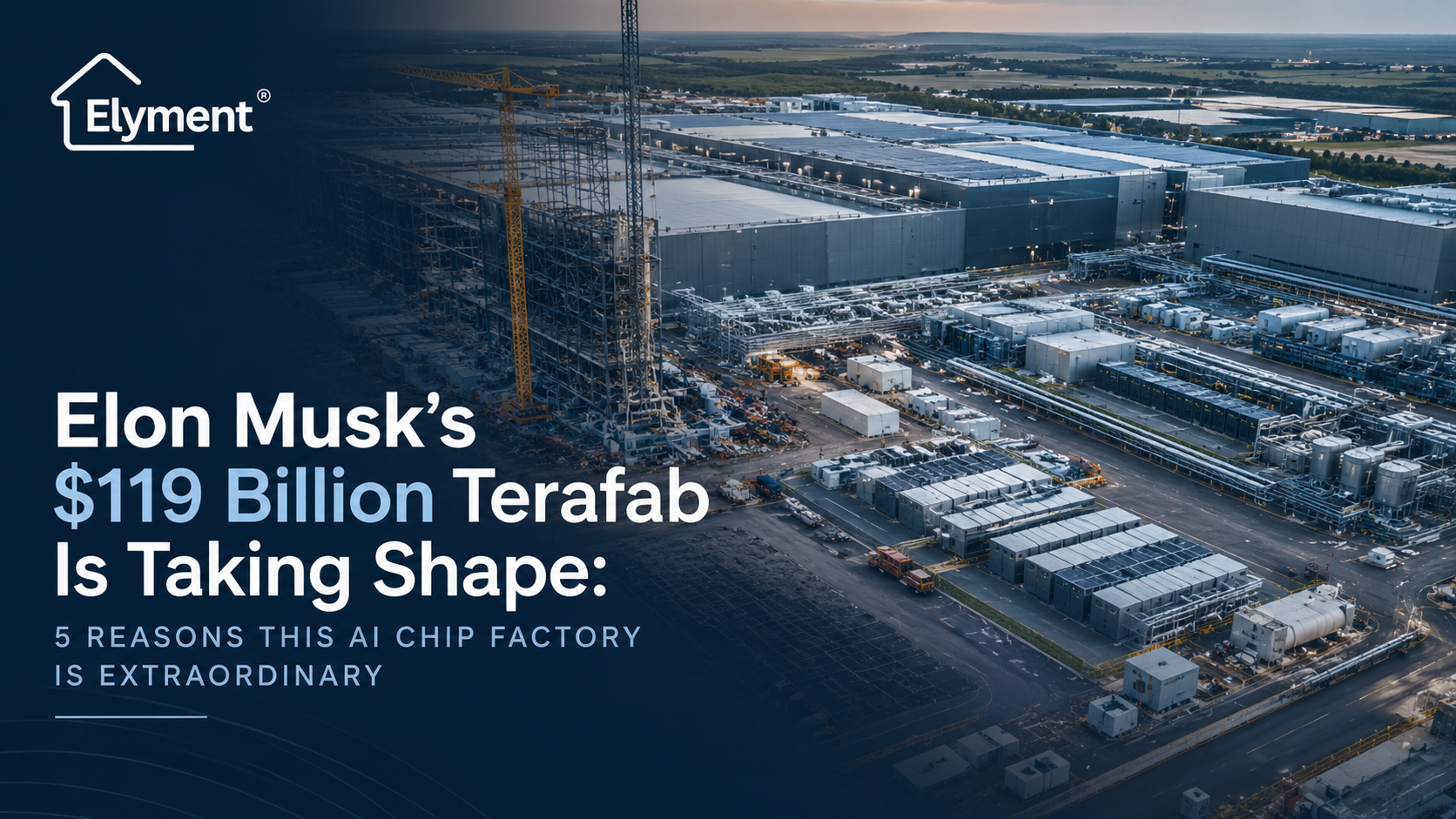
Terafab is extraordinary because its proposed scale combines advanced chip fabrication, memory, packaging and testing with an eventual investment pathway reported at up to US$119 billion. For Sydney and NSW businesses, the significance is not simply another American factory. It shows AI infrastructure becoming an industrial delivery challenge involving manufacturing capacity, utilities, supply chains, capital allocation and execution risk, rather than merely access to better software.
Elon Musk's Terafab has moved from an unusually ambitious semiconductor proposal towards a physical industrial project.
On 6 August 2026, SpaceX and Tesla confirmed that the facility would be developed in Grimes County, Texas, with more than US$16.8 billion committed to its first phase. The planned complex covers approximately 100 million square feet and is expected to employ at least 3,000 people. Reuters reported that an earlier SpaceX filing contemplated investment rising to US$119 billion if additional phases are completed.
That distinction matters. US$119 billion is not the cost of the construction currently under way. It represents the potential scale of a much larger phased development. The latest announced initial investment is US$16.8 billion.
The numbers are spectacular, but they are not the most interesting part of the project.
Terafab represents something more significant: an attempt to redesign the operating model behind AI hardware by bringing processes that are normally distributed across multiple companies, facilities and countries into an unusually concentrated manufacturing system.
Elyment's existing coverage has already examined why the AI infrastructure boom is increasing pressure on land, energy and physical delivery, and separately analysed what Nvidia's valuation says about the economics of AI infrastructure. Terafab introduces a different question.
What happens when the customer for enormous quantities of computing hardware decides that semiconductor manufacturing itself is too strategically important to leave entirely in someone else's supply chain?
1. The Scale Is Closer To Infrastructure Planning Than A Conventional Factory Expansion
The first extraordinary feature is physical scale.
SpaceX and Tesla say the vertically integrated complex will occupy about 100 million square feet. It is intended to manufacture advanced logic and memory chips and undertake packaging and testing within the same broader production environment.
At that scale, the challenge ceases to resemble simply installing more semiconductor equipment inside an existing factory.
It becomes a regional infrastructure exercise.
A programme of this size has dependencies extending well beyond the fabrication floor:
- high-capacity and highly reliable electricity supply;
- industrial water availability and treatment;
- road and freight access;
- specialised construction sequencing;
- clean-room systems and environmental controls;
- specialty gases and chemical logistics;
- equipment installation and commissioning;
- workforce accommodation and transport;
- maintenance and spare-parts systems;
- emergency, safety and environmental management; and
- long-term expansion corridors that cannot be compromised by the first construction phase.
The Texas Government says the location was selected partly because of infrastructure, workforce and logistics advantages. The facility is also planned near Gibbons Creek Reservoir, with Reuters reporting that reservoir water rather than local groundwater is intended to support industrial operations.
This is an important distinction for Australian businesses watching the AI investment cycle. The limiting factor in advanced computing is increasingly not whether someone can design another model. It is whether physical infrastructure can be assembled, approved, connected, commissioned and operated at sufficient scale.
2. Terafab Tries To Compress A Global Supply Chain Into One Operating System
Modern semiconductor production is normally highly specialised.
Chip architecture, wafer fabrication, memory, advanced packaging, testing, equipment manufacturing and materials supply may involve different businesses operating across several jurisdictions.
Terafab's proposed operating model is unusual because SpaceX describes a vertically integrated system spanning logic chips, memory, packaging and testing.
Vertical integration is attractive because each handover in a supply chain introduces time, dependency and uncertainty. Bringing more stages under coordinated control could theoretically shorten feedback loops between chip design, manufacturing, testing and product deployment.
It also makes execution much harder.
- Chip designPotential advantage of integration: Faster connection between product requirements and silicon architecture.
- New operational risk: Design decisions become tightly coupled to manufacturing capability.
- Wafer fabricationPotential advantage of integration: Greater control over strategic production capacity.
- New operational risk: Extremely high capital and yield risk.
- MemoryPotential advantage of integration: Closer optimisation between compute and memory systems.
- New operational risk: Additional specialist manufacturing complexity.
- Advanced packagingPotential advantage of integration: Potentially shorter movement between fabrication and final assembly.
- New operational risk: Packaging becomes another major internal production constraint.
- TestingPotential advantage of integration: Faster feedback into design and process changes.
- New operational risk: Quality assurance must scale alongside production throughput.
In other words, vertical integration removes certain external dependencies while creating much greater internal coordination requirements.
That is a useful lesson far outside semiconductor manufacturing.
Sydney construction, property and infrastructure projects regularly encounter the same principle at a smaller scale. Combining more services does not automatically create efficiency. The benefit only appears when scope ownership, handovers, scheduling, approvals, documentation and accountability are designed properly.
3. The Target Is Not Just More Chips. It Is More Than One Terawatt Of Compute
The third reason Terafab stands out is the demand assumption behind it.
SpaceX and Tesla say the facility is intended to address their expected requirement for more than one terawatt of computing capability in the coming years. The chips are intended for applications including Tesla's Optimus robots and Cybercabs, together with SpaceX's planned space-based computing infrastructure.
This changes how the project should be understood.
Terafab is not primarily a speculative semiconductor factory waiting for customers to arrive. Its rationale is linked to enormous anticipated internal demand across businesses controlled by Musk.
That creates a powerful strategic loop:
- AI systems create demand for additional compute.
- Additional compute increases demand for specialised chips.
- Chip dependency becomes a constraint on product growth.
- The customer invests directly in manufacturing capacity.
- Manufacturing capability becomes part of the product strategy.
This is substantially different from the more familiar enterprise AI model in which a business purchases software licences and cloud capacity from external providers.
It suggests that at the largest scale, control over AI may increasingly depend on control over the industrial inputs that make AI possible.
Elyment's analysis of Nvidia's Vera Rubin platform and the next generation of AI computing examined how increasingly capable systems are expanding the infrastructure required beneath AI applications. Terafab pushes that trend further upstream, from computing systems into the manufacturing capacity required to produce their underlying silicon.
4. US$119 Billion Makes Project Sequencing More Important Than The Headline Budget
A US$119 billion potential investment figure attracts attention, but megaprojects are rarely delivered as one continuous purchasing decision.
Reuters reported that a May SpaceX filing contemplated US$55 billion of investment with the figure potentially increasing to US$119 billion through additional phases. The latest announced first phase is more than US$16.8 billion.
The difference illustrates why phased capital planning matters.
Each expansion decision is likely to depend on what the previous phase establishes: utilities, production performance, equipment readiness, workforce capability, process yield, product demand and whether construction assumptions survive contact with operating reality.
A credible programme therefore needs more than capital.
It needs controlled gates between capital deployment and operational proof.
- Site infrastructureWhat must be proven: Power, water, access and enabling works are sufficient.
- Why it matters: Production equipment cannot compensate for missing utilities.
- Building readinessWhat must be proven: Critical environments can be commissioned to specification.
- Why it matters: Late construction defects can delay equipment installation.
- Tool installationWhat must be proven: Manufacturing equipment can operate reliably.
- Why it matters: Installed capacity is not the same as productive capacity.
- Process qualificationWhat must be proven: Manufacturing output meets technical requirements.
- Why it matters: Poor yield can undermine the economics of the entire plant.
- Volume rampWhat must be proven: Production can increase without unacceptable quality loss.
- Why it matters: Demand cannot be met by laboratory-scale success.
- ExpansionWhat must be proven: The operating model justifies another capital phase.
- Why it matters: Prevents scale from outrunning proven capability.
This is one reason the phrase "US$119 billion factory" should be used carefully. The extraordinary feature is not that US$119 billion is being spent immediately. It is that the potential programme has been structured on a scale where successive investment phases could eventually approach that amount.
5. Terafab Turns Semiconductor Supply Into A Corporate-Control Question
Perhaps the most consequential feature is strategic rather than architectural.
Musk's companies are effectively treating semiconductor availability as a constraint important enough to justify direct investment in manufacturing.
SpaceX has also partnered with Intel as part of the semiconductor initiative, while Tesla has already established research fabrication work at its Giga Texas campus as a precursor to the broader programme.
The direction is significant because semiconductor supply has traditionally been something most technology businesses manage through procurement relationships.
Terafab treats supply as an operating capability.
The model resembles what happens when a company concludes that a critical external dependency has become too important to remain purely transactional.
Businesses do not need to own every supplier to apply the principle. They do need to understand which dependencies can stop their operation.
Those dependencies might include:
- compute capacity;
- specialist equipment;
- electricity connections;
- critical materials;
- approved contractors;
- technical expertise;
- property access;
- regulatory approvals;
- data access; or
- a single supplier controlling an irreplaceable part of a workflow.
The Australian Relevance Is Industrial Capability, Not Copying Texas
Australia is unlikely to interpret Terafab by asking whether Sydney should reproduce a 100-million-square-foot semiconductor complex.
The more useful question is what capabilities Australia wants to control within the rapidly expanding AI economy.
The Australian Government identifies semiconductors, advanced integrated-circuit design and manufacturing, AI accelerators and high-performance computing among technologies of national interest. It has also been developing policy around AI infrastructure, energy, sustainable water use, local capability and workforce development.
Australia's updated AI ecosystem analysis describes the country as both an "AI-taker" and a developing "AI-maker", with much of the market currently focused on integrating globally developed technology while building selected domestic capabilities. The report identified more than 1,500 AI companies in its sample, with Sydney forming one of Australia's major geographic AI clusters.
That creates several possible positions in the value chain:
- AI adoption: using global computing infrastructure more effectively.
- Data-centre infrastructure: providing the physical compute environments required locally.
- Advanced manufacturing: developing specialised capability where Australia has commercial or strategic advantages.
- Energy and infrastructure: supplying the power, storage, water and network systems required by expanding digital infrastructure.
- Specialist services: engineering, construction, maintenance, cyber security, compliance and project delivery around the infrastructure.
- Applied AI: using global foundation models to improve Australian industries where local operational knowledge matters.
Australia, Canada and India have also recently expanded cooperation covering AI, digital infrastructure, semiconductors, cyber security and emerging technology, demonstrating that semiconductor resilience is increasingly treated as an economic and strategic issue rather than a narrow technology-sector problem.
What Sydney Project Teams Can Learn From A Semiconductor Megaproject
There is a temptation to regard Terafab as irrelevant to ordinary Australian project delivery because its budget and engineering requirements are so extreme.
The opposite is more useful.
Large projects expose operational principles that are often hidden on smaller ones.
Consider a Sydney property refurbishment involving demolition, floor removal, concrete preparation, levelling, waterproofing, finished surfaces and new joinery. Its success still depends on the same broad delivery logic:
- Establish the final requirement. Understand what the finished system must achieve before selecting the preparation pathway.
- Identify dependencies. Determine what needs power, access, approvals, materials or preceding work.
- Sequence irreversible work carefully. Avoid closing surfaces or installing finishes before concealed decisions are resolved.
- Control interfaces. Make ownership clear where one contractor's work becomes the substrate, input or prerequisite for another.
- Verify before scaling. Confirm that the first stage performs correctly before repeating the same assumption across a larger area.
A semiconductor fab expresses these principles with clean rooms, lithography equipment and industrial utilities. A Sydney renovation expresses them through demolition, substrate preparation, waterproofing, flooring, painting, services and access.
The scale is different. The management principle is not.
The Most Expensive Equipment Still Depends On Site Readiness
Terafab also illustrates a lesson familiar to construction operators: equipment cannot rescue an unprepared project.
A sophisticated manufacturing tool is useful only when the building, utilities, process environment, workforce and preceding construction packages are ready for it.
Sydney renovation projects repeatedly show the same pattern.
New timber flooring cannot correct an unprepared substrate. Microcement cannot resolve waterproofing decisions that were never coordinated. A floor levelling compound should not be treated as a substitute for identifying structural movement or unacceptable contamination. A contractor arriving with the correct machinery cannot compensate for missing building access, unavailable power or unresolved strata restrictions.
This is why operational preparation matters disproportionately as project complexity increases.
AI Is Becoming A Capital Allocation Question
For several years, businesses could discuss AI predominantly through subscriptions, cloud services and employee productivity.
Terafab belongs to a different stage of the cycle.
It places AI alongside manufacturing capacity, power infrastructure, industrial property, construction programmes and long-duration capital commitments.
Australian Industry Ministerial material in 2026 has similarly highlighted the rapidly expanding value of the AI infrastructure layer, while national policy has started placing expectations on data-centre and AI infrastructure developers around power, water, community benefit and Australian capability.
For business leaders, this means an AI strategy increasingly has two distinct dimensions:
- Digital AI strategyModels and applications
- Automation workflows
- Data governance
- Employee adoption
- Software procurement
- Operational ROI
- Physical AI strategyCompute infrastructure
- Energy and network capacity
- Data-centre and manufacturing assets
- Engineering and technical workforce
- Hardware and supply-chain resilience
- Long-duration capital allocation
Most Sydney businesses will remain firmly on the digital side of this distinction.
But the price, availability and capability of the software they use will increasingly depend on what happens on the physical side.
The Real Test Begins After Construction Starts
Groundbreaking is an important milestone, but semiconductor manufacturing projects are judged by productive output rather than architectural scale.
Terafab must still progress through enormous construction, equipment, commissioning, process and volume-manufacturing challenges before its long-term ambitions can be assessed.
That is why the next milestones matter more than the renders.
- How rapidly can the first production infrastructure be commissioned?
- Can utility requirements be delivered without constraining the programme?
- Can multiple semiconductor processes be integrated effectively?
- Can manufacturing yields reach commercially viable levels?
- Can production expand quickly enough to meet internal demand?
- Will subsequent investment phases continue towards the US$119 billion potential programme?
Those are operating questions, not publicity questions.
Why Terafab Is Extraordinary
Strip away the size of the headline and five characteristics remain.
- Physical scale: approximately 100 million square feet turns semiconductor production into a regional infrastructure programme.
- Vertical integration: logic, memory, packaging and testing are intended to operate within one broader manufacturing system.
- Demand: Tesla and SpaceX anticipate computing requirements exceeding one terawatt.
- Capital: the current first-phase commitment exceeds US$16.8 billion, while earlier planning contemplated eventual investment reaching US$119 billion if additional phases proceed.
- Strategic control: semiconductor manufacturing is being treated as a core operating dependency rather than simply a procurement category.
The last point may ultimately be the most important.
Terafab suggests that companies pursuing AI at extreme scale are beginning to look through the technology stack and ask which physical dependencies they cannot afford to leave uncontrolled.
What NSW Businesses Should Take From It
Sydney companies do not need a semiconductor plant to learn from Terafab.
They need a clear view of their own operational bottlenecks.
Which supplier can stop a project? Which approval can delay mobilisation? Which workflow fails when one employee is absent? Which physical task is being scheduled before its prerequisites are complete? Which technology dependency has no fallback? Which handover repeatedly creates rework?
These questions are less glamorous than a US$119 billion industrial complex, but they describe the same management problem.
Growth magnifies weak interfaces.
Elyment operates across physical project delivery, compliance-sensitive property workflows and technology-enabled operational systems. For Sydney and NSW projects, the objective is not to force AI into every problem. It is to make the underlying project sequence, information flow, contractor responsibilities and delivery controls sufficiently clear that physical work and technology can each perform the role they are actually suited to.
Project Delivery Review
Resolve The Operating Dependencies Before They Become Project Delays
Review project sequencing, contractor interfaces, compliance considerations, renovation planning and operational delivery before critical dependencies become expensive rework.
Final Perspective
Terafab is extraordinary not because one company has announced another large AI investment, but because it represents an attempt to turn semiconductor supply itself into a vertically coordinated operating capability.
The US$119 billion figure describes the potential outer scale of a phased programme, not the amount currently committed. What is already tangible is a US$16.8 billion first phase, a Texas site, an approximately 100-million-square-foot plan and an ambition to supply computing requirements measured in terawatts.
For Sydney and NSW operators, the lesson is broader than chips. The further AI moves into the physical economy, the more competitive advantage will depend on infrastructure, supply resilience, sequencing, engineering, project controls and the ability to turn capital into dependable operating capacity.
Sources and References
- Elyment: Why the AI infrastructure boom is increasing pressure on land, energy and physical delivery
- Elyment: What Nvidia's valuation says about the economics of AI infrastructure
- Elyment: Nvidia's Vera Rubin platform and the next generation of AI computing
- Elyment: Contact
Resolve The Operating Dependencies Before They Become Project Delays
Review project sequencing, contractor interfaces, compliance considerations, renovation planning and operational delivery before critical dependencies become expensive rework.
Request A Project Review