Engineered Timber Flooring Cost Sydney: Long vs Mixed Packs
Engineered timber flooring costs in Sydney vary by board length. See how long boards and mixed-length packs affect material cost, waste and installation quotes.
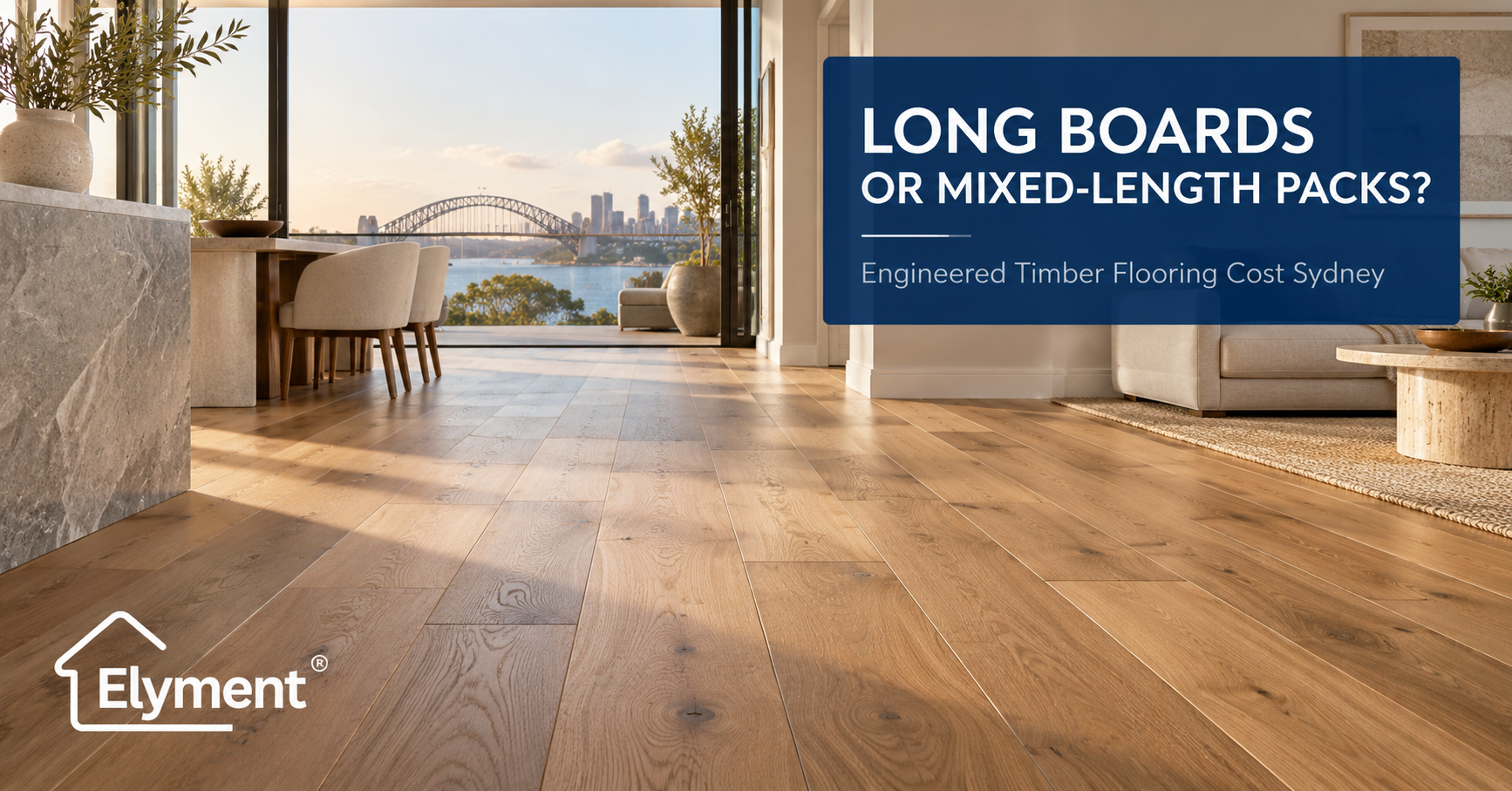
An advertised 2,200 mm engineered timber board does not mean every plank in a Sydney flooring order will measure 2,200 mm. Many ranges use mixed-length or nested packs containing factory-supplied shorter boards. This is normal when permitted by the product specification, not a manufacturing defect. Before accepting a NSW renovation quote, compare the actual length mix, pack coverage, visual expectations and installation scope rather than the maximum board length alone.
ELYMENT Insights | Flooring, Renovation Procurement & Project Delivery | Sydney, NSW | 29 October 2026
The 2.2-Metre Floorboard That Is Not Always 2.2 Metres Long
In the premium Sydney renovation market, engineered timber flooring is frequently sold through a small collection of headline specifications: European oak, a particular timber grade, a selected wear-layer thickness and an advertised plank measuring 1,900 mm, 2,200 mm or longer.
These dimensions influence purchasing decisions because long boards can create a distinctive architectural appearance.
A broad living area finished with carefully arranged long oak planks can appear visually continuous, particularly in contemporary apartments, architectural renovations and open-plan homes.
However, the advertised board length does not always describe every individual piece contained within a carton.
Some engineered timber flooring products are manufactured and packaged with shorter pieces alongside their full-length boards. These are commonly described as nested lengths, combination lengths or random-length boards.
The distinction is commercially important.
Two flooring quotations may advertise the same 2,200 mm board length while specifying different products, different proportions of shorter boards and different arrangements for the finished floor.
Neither product is automatically inferior.
The issue is whether the purchaser understands what is being supplied before the order is confirmed.
What Australian Timber Flooring Specifications Actually Say
The presence of shorter boards in engineered timber packaging is an established feature of timber flooring manufacturing.
The Australian Timber Flooring Association's published engineered flooring technical guidance recognises that advertised board lengths may include shorter nested pieces.
The guidance explains that manufacturers can supply different length configurations and recommends obtaining specific information about shorter boards when plank length is important to the purchaser.
Individual manufacturers also disclose nested lengths in their product literature.
For example, Quick-Step Australia's engineered timber product brochure identifies ranges containing nested lengths and explains that shorter pieces can make up some of the nominated full-length planks within a pack.
The manufacturer also provides guidance on incorporating those shorter pieces into the intended flooring arrangement.
Importantly, the existence of a shorter factory-supplied board does not establish that the product is defective.
The correct assessment begins with the manufacturer's declared product characteristics and the specification agreed at purchase.
Four Product Descriptions That Should Not Be Confused
1. Set-Length Boards
- What it generally indicates: Boards supplied to a specified individual length, subject to the manufacturer's stated tolerances and packaging arrangements.
- What buyers should confirm: Whether every supplied board is the nominated length or whether shorter pieces are permitted.
2. Maximum or Nominal Length
- What it generally indicates: A published dimension that may not describe every individual board in the carton.
- What buyers should confirm: The minimum length, permitted variations and actual pack composition.
3. Random-Length Boards
- What it generally indicates: A product intentionally supplied with a range of individual board lengths.
- What buyers should confirm: The declared length range and any applicable length-distribution requirements.
4. Nested-Length Packs
- What it generally indicates: Packs that include factory-supplied shorter pieces alongside longer boards.
- What buyers should confirm: The permitted quantity or proportion of shorter pieces and how they are measured.
These descriptions are not interchangeable, and manufacturers may use their own terminology.
The current product data sheet should take precedence over informal descriptions provided in advertisements or showroom conversations.
The Percentage of Short Boards Can Matter More Than the Maximum Length
Consider two engineered oak products advertised with a maximum plank length of 2,200 mm.
Both may have similar colour, width, timber species and surface finish.
However, one product might permit a relatively small proportion of shorter boards while another may be manufactured with a more substantial mixed-length composition.
That difference can influence the appearance available from the supplied material.
Some manufacturers expressly disclose nesting limits. For example, Australian engineered timber product literature may identify a proportion of random shorter boards within the supplied flooring.
The percentage must be interpreted carefully.
A statement such as "up to 25% nested lengths" should not automatically be interpreted as meaning that one-quarter of the individual boards are short.
The specification may refer to flooring area, individual board numbers, equivalent full lengths or another manufacturer-defined measure.
These calculations are not necessarily equivalent.
A supplier should clarify precisely what the percentage means for the selected product.
Questions Worth Asking Before Comparing Prices
- What is the exact manufacturer, product range and SKU?
- Is the advertised board length fixed, nominal or maximum?
- Are nested or random-length boards included?
- What is the shortest factory-supplied board permitted?
- What proportion of the supplied flooring may comprise shorter boards?
- Is that proportion measured by area, board count or another method?
- Does the supplier offer a different product with a more consistent length specification?
Written responses allow homeowners, builders and renovation coordinators to compare the proposed materials without relying on assumptions.
Why the Price Per Square Metre Does Not Tell the Whole Story
Engineered timber flooring cost in Sydney is commonly presented as a supply rate, installation rate or combined supply-and-installation figure per square metre.
These figures provide a useful starting point.
They do not establish that two quoted flooring products are commercially equivalent.
Board construction, timber grade, veneer thickness, surface coating, manufacturing specifications and length distribution can all differ between products.
A more expensive product does not necessarily guarantee a higher proportion of long boards.
Equally, a less expensive mixed-length product may be entirely appropriate for a renovation where the purchaser prefers a naturally varied flooring pattern.
An Illustrative Sydney Flooring Comparison
Consider a hypothetical renovation requiring 60 m² of completed engineered timber flooring.
For illustration, assume both suppliers quote 66 m² of material after allowing for cutting, ordering quantities and other project requirements.
Advertised Maximum Board Length
- Supplier A: 2,200 mm
- Supplier B: 2,200 mm
Illustrative Timber Supply Rate
- Supplier A: $115/m²
- Supplier B: $130/m²
Illustrative Material Quantity
- Supplier A: 66 m²
- Supplier B: 66 m²
Illustrative Supply Subtotal
- Supplier A: $7,590
- Supplier B: $8,580
Nested-Length Specification
- Supplier A: Not stated
- Supplier B: Not stated
Guaranteed Length Distribution
- Supplier A: Not established
- Supplier B: Not established
Installation and Preparation
- Supplier A: Requires separate confirmation
- Supplier B: Requires separate confirmation
These figures are hypothetical and are provided to demonstrate quotation analysis. They are not current supplier prices, market averages or recommendations for material allowance.
Supplier B costs $990 more in this example.
However, that difference cannot be attributed to board length without further documentation.
Supplier B might have a different wear layer, surface treatment, grade, warranty or manufacturing specification. Both products might contain nested lengths.
Alternatively, Supplier A might offer the same relevant performance characteristics at a lower cost.
The only reliable comparison is one that identifies the actual products and the complete scope being purchased.
This is consistent with the NSW Government's guidance on obtaining building and renovation quotes, which recommends providing contractors with the same job information and checking that quoted materials match the requested specifications.
What a Proper Engineered Timber Flooring Quote Should Identify
A quotation describing the material only as "engineered oak flooring, 2,200 mm boards" leaves several important commercial details unresolved.
A more useful procurement record identifies the specific material and distinguishes supply costs from the work necessary to complete the installation.
Essential Information to Include in a Flooring Quote
1. Manufacturer and Product Code
Allows the purchaser to verify the precise flooring specification.
2. Board Length, Width and Thickness
Identifies the stated physical dimensions of the selected product.
3. Factory-Supplied Length Distribution
Clarifies whether the flooring includes nested or random-length boards.
4. Carton Coverage
Establishes the material quantity supplied per pack.
5. Number of Cartons
Allows the total ordered quantity to be checked against the project.
6. Installation Method
Identifies whether the floor is floating, glued down or installed using another approved system.
7. Preparation and Accessories
Clarifies whether removal, grinding, levelling, adhesive, underlay, trims and skirting are included.
8. Delivery and Stock Arrangements
Identifies availability, batch continuity, delivery limitations and potential delays.
9. GST and Exclusions
Allows the full project cost to be compared consistently.
Not every flooring quotation needs to reproduce an entire technical manual.
However, the accepted quotation should identify the selected product sufficiently clearly and reference the relevant specifications.
For NSW residential building work, Building Commission NSW's home building contract guidance also establishes written-contract requirements where the applicable work exceeds $5,000.
Clear product identification reduces uncertainty about whether the material ultimately delivered matches the agreed scope.
The Hidden Procurement Risk: Ordering From the Wrong Specification
A flooring order can be correct in quantity but still fail to match the purchaser's understanding of the product.
Consider a homeowner choosing a natural oak floor for a large open-plan apartment.
The showroom sample displays an attractive long plank. The quotation identifies a 2,200 mm product. The material is ordered and delivered.
Only after delivery does the homeowner realise that the manufacturer's standard carton configuration includes a mixture of board lengths.
There may be nothing wrong with the product.
The supplier may have delivered the correct SKU in accordance with the manufacturer's specification.
The problem is that the purchaser expected a materially different distribution of board lengths.
If the homeowner now requests a different product, the change may affect:
- Material availability and replacement stock.
- Supplier return conditions and restocking charges.
- The cost of a different board specification.
- Scheduled installation dates.
- Delivery and handling arrangements.
- The availability of matching trims and accessories.
This is why product verification should occur before the purchase order becomes a delivery.
For a broader examination of material ordering, site readiness and contractor coordination, see Elyment's guide to flooring supply and installation planning in Sydney.
Long-Board Expectations Need to Be Established Before Installation
A homeowner might reasonably prefer long boards through the main living area while accepting a greater mixture of lengths elsewhere.
Another purchaser may prefer the traditional, varied appearance created by random-length timber.
Neither preference is inherently more correct.
What matters is establishing the intended appearance before materials are purchased.
A showroom sample, product photograph or architectural render should not be treated as a guarantee that every supplied board will have the same visible length.
The project's visual expectations should be considered alongside the actual product specification.
Where board length is a significant design requirement, the purchaser can request confirmation of:
- The relevant product's declared length configuration.
- Whether the manufacturer's standard mix can reasonably support the intended appearance.
- Whether an alternative product is needed to achieve a different length distribution.
- Whether the requested layout changes material selection, installation labour or the quotation.
Those decisions should be made before ordering, rather than relying on the installer to resolve a product-selection issue after delivery.
Elyment has separately examined how installation offcuts affect engineered timber flooring layouts.
That is a related but distinct consideration.
Factory-supplied nested boards are part of the purchased material, while installation offcuts are created when boards are cut during the works.
The two should not be confused when reviewing material quantities or installation outcomes.
Sydney Apartments Add Another Layer to the Purchasing Decision
For Sydney apartment renovations, the dimensions of the flooring product can influence more than the final visual appearance.
Long cartons need to be transported into the building, moved through common areas and stored safely before installation.
Older apartment buildings may have restricted lift dimensions, narrow stairwells or limited material storage areas.
In larger residential developments, delivery and unloading arrangements may be controlled by building management.
A contractor should therefore verify both the physical delivery requirements and the proposed flooring product before scheduling installation.
This is particularly relevant when a product substitution changes the maximum board or carton length.
Three Sydney Project Controls Worth Confirming
- Material access: Confirm that the cartons can be transported through the nominated building access routes without damaging common property.
- Product approval: Confirm that any proposed substitution remains compatible with the approved installation system and applicable strata requirements.
- Construction sequencing: Confirm that the material selection, delivery, subfloor preparation and installation schedule remain coordinated.
The board-length decision should not displace other technical requirements.
Engineered timber installed over concrete still depends on suitable substrate preparation, moisture assessment and an approved installation system.
Elyment's article on concrete subfloor preparation for engineered timber flooring explains why those conditions must be assessed independently of the timber's visual characteristics.
What Should Happen When the Flooring Arrives?
Material delivery provides an important opportunity to confirm that the supplied flooring matches the accepted procurement documents.
This does not require every carton to be opened or every board to be individually measured.
Instead, the receiving process should follow the supplier's packaging and inspection requirements.
A Practical Material Verification Process
- Match the product identification.
- Check the manufacturer, product range, SKU, finish and dimensions against the accepted order.
- Check carton quantities.
- Confirm the delivered pack count and declared coverage against the purchase documentation.
- Review the applicable length specification.
- Verify whether the selected product permits nested or random-length pieces.
- Inspect representative material as permitted.
- Follow the manufacturer's inspection instructions and the supplier's conditions for opening cartons.
- Resolve discrepancies before installation.
- Where the delivered material appears inconsistent with the accepted specification, seek written clarification before the affected material is installed.
The distinction between a specification discrepancy and a manufacturing defect is important.
A shorter board permitted by the agreed manufacturer specification is not automatically faulty.
However, where a supplier has expressly agreed to a particular length configuration, the delivered product should be assessed against that agreement.
The objective is not to reject legitimate factory-supplied short boards.
It is to establish whether the supplied flooring corresponds with what was ordered.
The Commercial Lesson: Compare the Material Being Delivered, Not Just the Length Advertised
For Sydney homeowners, builders and renovation managers, engineered timber flooring procurement should be based on an identifiable product specification rather than a headline board dimension.
A 2,200 mm product may be entirely suitable for a premium renovation even when its standard packaging includes shorter lengths.
Another project may justify selecting a different product because its declared length distribution more closely matches the architectural brief.
Neither decision can be made reliably from the maximum advertised length alone.
The useful purchasing question is whether the quoted price reflects a clearly identified product, an understood pack configuration and a realistic installation scope.
That is the basis for comparing engineered timber flooring quotations fairly.
It also provides a stronger foundation for controlling material substitutions, delivery expectations and renovation costs.
Planning an Engineered Timber Flooring Renovation in Sydney?
Elyment Property Services supports renovation planning, flooring removal, concrete grinding, floor levelling, flooring installation coordination and practical project delivery across Sydney.
A project review can help clarify material specifications, installation requirements, site preparation and the scope of work before renovation activities are scheduled.
Sources and References
Industry and Manufacturer References
- Australian Timber Flooring Association: Engineered Flooring Technical Guidance
- Quick-Step Australia: Engineered Timber Flooring Product Brochure
Government and Regulatory References
- NSW Government: Getting Quotes for Building and Renovation Work
- Building Commission NSW: Guide to Providing Home Building Contracts
Related Elyment Resources
- Flooring Supply and Installation Sydney: What to Confirm Before You Order Hybrid, Vinyl or Timber
- Engineered Timber Flooring Sydney: Can Offcuts Spoil Layout?
- Engineered Timber Flooring Over Concrete: The Subfloor Prep That Decides the Warranty
- Contact Elyment Property Services
Relevant next actions
Explore the ELYMENT service most closely connected to this article.