Epoxy Flooring Cost Sydney: Roll-On Coating or Self-Smoothing System?
Compare roll-on epoxy coatings and self-smoothing flooring in Sydney. Understand cost differences, surface preparation, and durability before choosing a system.
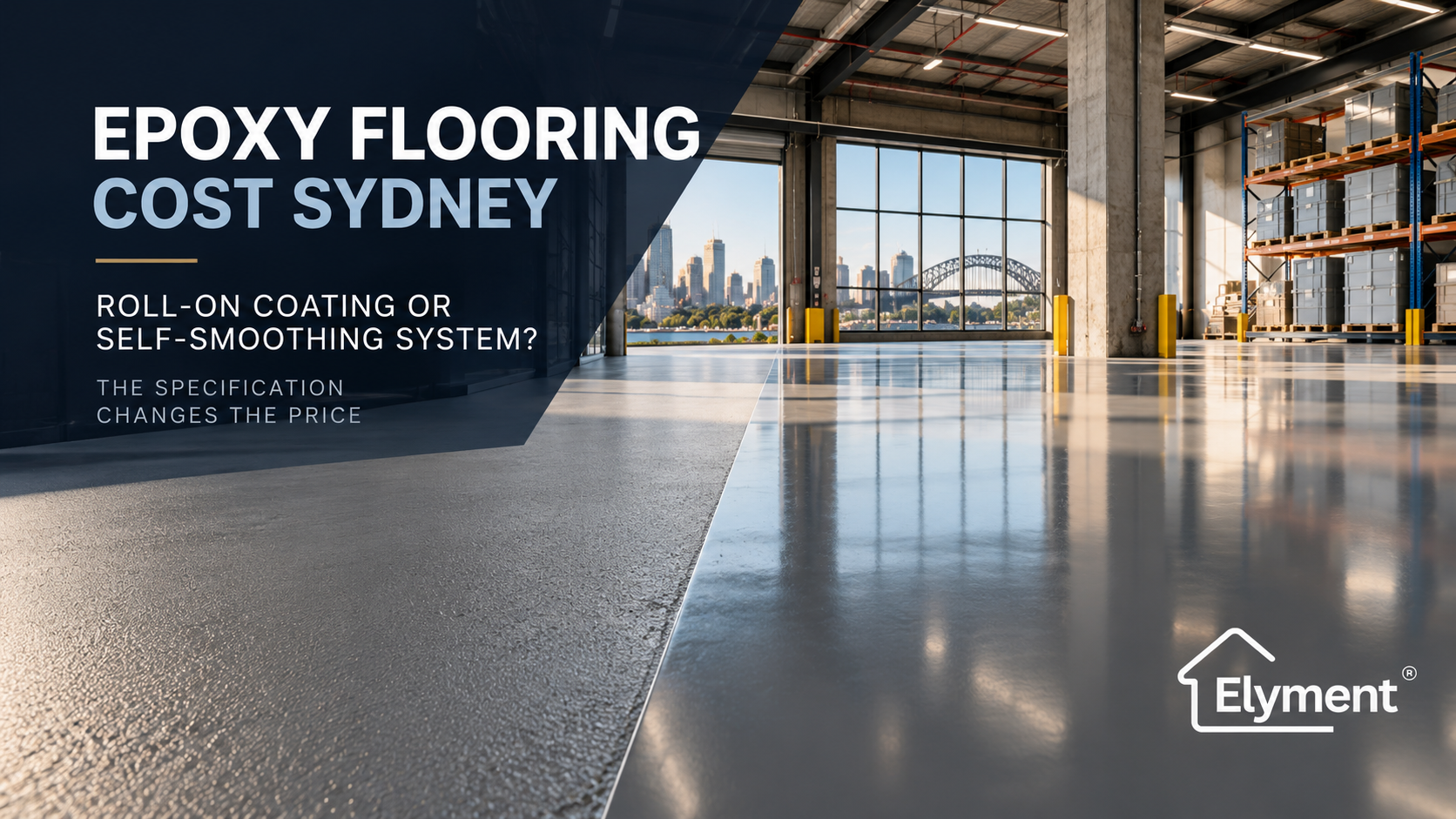
Epoxy flooring costs in Sydney depend on the specified system, not simply the floor area. Roller-applied epoxy forms a comparatively thin protective coating, while self-smoothing systems use a thicker resin layer and substantially more material. Preparation, substrate repairs, surface texture and curing requirements also affect the final price. For NSW commercial properties, comparing coating thickness, material consumption and return-to-service conditions is essential before accepting a quotation.
The Specification Gap Behind Sydney's Epoxy Flooring Quotes
Two Sydney contractors can inspect the same commercial concrete floor, recommend epoxy flooring and submit quotations that differ substantially in price.
Neither quotation is necessarily incorrect.
The discrepancy may begin with the actual flooring systems being proposed.
One contractor may specify a roller-applied epoxy coating designed to protect an existing concrete surface. Another may propose a self-smoothing resin system that forms a thicker wearing layer.
Both are legitimate epoxy flooring methods, but they are not automatically interchangeable.
The distinction is particularly relevant across Sydney's warehouses, workshops, commercial tenancies, retail premises and strata-managed buildings, where flooring performance must be balanced against renovation budgets and operational downtime.
A quotation describing only "supply and install epoxy flooring" provides insufficient information to determine whether the proposed system is appropriate.
Property owners and project managers need to understand what the specified floor actually contains, how it will be installed and when the premises can safely return to normal use.
Roller-Applied and Self-Smoothing Epoxy Are Different Flooring Systems
The distinction begins with how the coating is formulated, applied and built up over the prepared concrete.
Roller-Applied Epoxy: A Protective Coating
A roller-applied epoxy system typically involves one or more resin coats applied to mechanically prepared concrete.
Depending on the selected manufacturer and system, a suitable primer may be required before the principal coating layers.
The coating follows the existing substrate profile rather than creating an independently level surface.
These systems may be appropriate for:
- Residential garages with sound concrete.
- Commercial storage areas with moderate traffic.
- Workshops requiring a cleanable protective finish.
- Plant rooms and maintenance areas.
- Selected retail and commercial spaces where the specified performance is suitable.
Roller-applied coatings generally require less resin than thicker self-smoothing installations. However, reduced material consumption does not eliminate the need for adequate preparation.
Surface contamination, residual coatings, cracking and moisture can all affect adhesion.
Importantly, a roller-applied epoxy should not be confused with ordinary single-pack concrete paint. The actual resin chemistry, application rate and finished performance depend on the specified product.
Self-Smoothing Epoxy: A Thicker Resin Wearing Layer
A self-smoothing epoxy system uses a flowable resin formulation, often incorporating compatible fillers, to produce a thicker and more continuous surface.
Many commercial systems are specified at approximately 2–3 mm, although actual thickness varies by manufacturer and intended use.
Installation can involve mixing, distributing and regulating the resin using appropriate trowels, squeegees or other specified equipment.
Depending on the system, additional finishing procedures may be required to manage entrapped air and achieve the intended surface.
Self-smoothing epoxy is commonly considered for selected:
- Commercial and industrial facilities.
- Showrooms requiring a continuous architectural finish.
- Workshops with defined mechanical loading requirements.
- Manufacturing environments.
- Commercial premises requiring a specified resin wearing layer.
Its suitability still depends on the intended traffic, chemical exposure, cleaning regime and site conditions.
Crucially, self-smoothing epoxy flooring does not replace substrate levelling.
Although the resin can flow and produce a relatively smooth finished surface, it is not designed to correct unrestricted variations in concrete levels.
Significant hollows, high spots, unsuitable falls and other substrate defects must be assessed and corrected separately using compatible preparation and repair methods.
Elyment's Sydney floor levelling services explain how subfloor condition, required tolerances and finished floor heights influence the preparation scope.
System Comparison: What Changes Between the Two Specifications?
The following comparison outlines the principal differences between roller-applied and self-smoothing epoxy flooring systems.
Primary purpose
- Roller-Applied Epoxy: Protective surface coating.
- Self-Smoothing Epoxy: Thicker continuous resin wearing layer.
Typical build
- Roller-Applied Epoxy: Thin-film or high-build coating, depending on system.
- Self-Smoothing Epoxy: Often approximately 2–3 mm for common commercial specifications.
Application
- Roller-Applied Epoxy: Roller, with other tools where specified.
- Self-Smoothing Epoxy: Flow-applied and distributed using suitable tools.
Material consumption
- Roller-Applied Epoxy: Generally lower.
- Self-Smoothing Epoxy: Generally substantially higher.
Substrate preparation
- Roller-Applied Epoxy: Mechanical preparation and repairs as required.
- Self-Smoothing Epoxy: Mechanical preparation and potentially more demanding surface correction.
Existing floor irregularities
- Roller-Applied Epoxy: May remain visible through the finish.
- Self-Smoothing Epoxy: Minor surface texture may be reduced, but significant unevenness still requires correction.
Surface texture
- Roller-Applied Epoxy: Depends on product and roller finish; aggregates may be specified.
- Self-Smoothing Epoxy: Generally smoother unless additional texturing is incorporated.
Installation requirements
- Roller-Applied Epoxy: Coating application and specified recoat intervals.
- Self-Smoothing Epoxy: Controlled mixing, material distribution and thickness management.
Return to service
- Roller-Applied Epoxy: Product-specific curing requirements.
- Self-Smoothing Epoxy: Product-specific curing requirements.
Typical budget position
- Roller-Applied Epoxy: Usually lower material and installation cost.
- Self-Smoothing Epoxy: Usually higher material and installation cost.
The comparison illustrates general system differences. Actual performance cannot be determined from application method or coating thickness alone.
Both approaches may use related resin chemistry, and some manufacturers offer products that form part of either roller-applied or self-smoothing systems.
The complete specification, rather than the product category, determines the intended result.
Epoxy Flooring Cost Sydney: What Should Each System Cost?
Published Sydney pricing guides indicate that roller-applied epoxy generally occupies the lower-cost end of the market, while thicker commercial resin systems typically cost more.
For example, Australian pricing platform Going Rate's October 2026 Sydney estimates provide the following indicative installed price ranges.
Basic roller-applied coating
- Indicative Sydney price: $30–$80 per m².
- Pricing consideration: Lower material consumption, but preparation and coating requirements vary.
Self-levelling or industrial epoxy system
- Indicative Sydney price: $90–$140 per m².
- Pricing consideration: Greater resin consumption and a potentially more involved application process.
These are third-party indicative market estimates, not fixed Elyment rates or project quotations. Confirm GST treatment, surface preparation, repairs, primer, total thickness and other inclusions directly with the contractor.
The figures are useful for initial budgeting but should not be treated as interchangeable product prices.
A basic coating quotation may exclude extensive grinding, existing coating removal or slab repairs.
A commercial self-smoothing quotation may incorporate a different primer, additional preparation, fillers and a more substantial wearing layer.
Consequently, the difference between two quotations may be caused by several specification decisions rather than the resin alone.
The Material Calculation That Explains the Price Difference
Material consumption provides one of the clearest ways to understand why epoxy flooring quotations vary.
Manufacturer specifications demonstrate that application rates can change significantly between roller-applied and self-smoothing systems.
For example, Sika Australia's Sikafloor MultiDur ET-14 roller-applied system specifies coating applications of approximately:
- First coating: 0.25–0.35 kg/m².
- Second coating: 0.20–0.30 kg/m².
This gives an approximate combined coating consumption of 0.45–0.65 kg/m², excluding any separately specified primer, additional preparation materials and wastage.
By comparison, Sika Australia's MultiDur ES-24 self-smoothing system specifies a filled wearing-coat mixture with theoretical consumption of approximately 1.9 kg/m² per millimetre of thickness.
Illustrative Material Comparison: A 120 m² Commercial Floor
Consider a hypothetical 120 m² commercial area in Sydney.
Floor area
- Roller-Applied System: 120 m².
- 2 mm Self-Smoothing System: 120 m².
Selected application basis
- Roller-Applied System: Two specified coating layers.
- 2 mm Self-Smoothing System: 2 mm filled resin wearing layer.
Theoretical consumption
- Roller-Applied System: 0.45–0.65 kg/m² combined.
- 2 mm Self-Smoothing System: 1.9 kg/m²/mm.
Calculated material quantity
- Roller-Applied System: 54–78 kg.
- 2 mm Self-Smoothing System: 456 kg.
Additional materials
- Roller-Applied System: Primer and other specified components.
- 2 mm Self-Smoothing System: Primer, optional scratch coat and other specified components.
Calculation only. Quantities are based on the identified manufacturer system specifications and exclude additional material arising from surface profile, porosity, wastage or site-specific requirements. The self-smoothing quantity represents the filled wearing-coat mixture, not pure epoxy resin.
The comparison shows how greater thickness can substantially increase the material quantity required.
However, it does not establish a universal cost multiplier.
Different resin formulations, fillers, primers, packaging sizes, labour requirements and application methods can significantly change the installed cost.
The appropriate comparison is between complete, specified flooring systems rather than kilograms of resin in isolation.
Why Substrate Preparation Must Be Priced Separately
The existing concrete floor is often the largest uncertainty before a Sydney epoxy flooring project begins.
A clean, sound slab may require relatively straightforward mechanical preparation.
An older warehouse, workshop or commercial tenancy may contain:
- Residual paint or deteriorated resin coatings.
- Adhesive contamination from previous floor coverings.
- Oil, grease or other substances affecting adhesion.
- Cracked concrete or damaged joints.
- Localised depressions and surface irregularities.
- Moisture conditions incompatible with the selected resin system.
- Previous repairs with uncertain bond strength.
These conditions must be investigated before finalising the coating specification.
For both roller-applied and self-smoothing epoxy, mechanical preparation may be required to achieve a suitable concrete surface profile.
Where existing coatings or contaminants must be removed, Elyment's concrete grinding services in Sydney provide a relevant preparation pathway.
Surface preparation and substrate levelling should remain identifiable items within the project scope.
This is particularly important for self-smoothing systems.
A thicker resin application should not become an expensive substitute for correctly repairing an uneven concrete slab.
For example, if the substrate contains a substantial depression, the contractor must assess whether a compatible repair or levelling material is required before applying the resin wearing layer.
The product's permitted thickness, preparation requirements and compatibility with existing concrete determine the appropriate method.
Likewise, structural movement joints must be assessed and detailed appropriately rather than simply concealed beneath the coating.
Surface Texture Can Change the Entire Specification
One of the most important decisions is whether the finished floor should be smooth, lightly textured or designed to achieve a particular slip-resistance classification.
A smooth epoxy floor may be attractive in a showroom or controlled commercial interior.
However, the same finish may be inappropriate where water, oil or other contaminants create slip hazards.
Additional texture can be introduced through specified aggregates or alternative coating configurations.
These decisions influence material use, application procedures, cleaning requirements and the finished appearance.
For Sydney commercial premises, project teams should establish the relevant requirements for the actual location and intended use.
Where applicable, the National Construction Code and AS 4586:2013 provide an important framework for assessing relevant slip-resistance requirements.
The required classification depends on the building element and applicable regulatory provisions. Not every epoxy floor is subject to the same classification.
A claim that a product is "non-slip" is insufficient where a particular tested classification is required.
The test evidence should relate to the complete specified finish, including its texture and any protective topcoat.
Slip resistance is also a separate consideration from abrasion resistance, chemical resistance and the structural condition of the substrate.
The Commercial Cost Nobody Should Ignore: Returning the Floor to Service
For an operating business, the installed flooring price may represent only part of the project cost.
Closing a warehouse section, relocating inventory or restricting access to a commercial tenancy can create operational expenses that do not appear on the flooring contractor's invoice.
These costs become particularly relevant when a project requires multiple preparation and coating stages.
Importantly, self-smoothing epoxy does not automatically require a longer curing period than roller-applied epoxy.
Actual curing and reopening times depend on the specified chemistry, system build-up, temperature, humidity and intended loading.
For example, Sika Australia's Sikafloor-264 technical guidance provides indicative return-to-service information at approximately 20°C.
Foot traffic
- Indicative timing: Approximately 24 hours.
Light traffic
- Indicative timing: Approximately 4 days.
Full cure
- Indicative timing: Approximately 7 days.
These timings relate to the identified manufacturer product under stated conditions. They are not universal reopening times for every epoxy flooring system.
For commercial properties, foot traffic readiness does not necessarily mean the floor is ready for pallet jacks, vehicles, heavy storage racks or chemical exposure.
Each loading condition should be matched to the selected system's documented requirements.
How Sydney Businesses Can Reduce Disruption
A practical flooring delivery plan should identify:
- Site preparation: Confirm equipment access, waste handling, isolation requirements and concrete preparation methods.
- Substrate readiness: Complete appropriate testing, repairs and levelling before applying the resin system.
- Coating installation: Allocate sufficient time for mixing, application, recoat intervals and environmental controls.
- Restricted access: Identify when workers and other trades may safely access the finished area.
- Operational handover: Establish separate dates for foot traffic, equipment movement and full operational loading.
For a Sydney warehouse, staged installation may allow parts of the premises to remain operational.
However, staging can introduce additional mobilisation, temporary protection, isolation boundaries and coordination costs.
Those costs should be considered during the planning stage rather than treated as unexpected variations.
NSW Safety Requirements Extend Beyond the Finished Floor
Epoxy flooring installation involves both mechanical preparation and chemical handling.
Grinding concrete can generate respirable crystalline silica, requiring appropriate risk assessment and effective exposure controls.
SafeWork NSW's crystalline silica guidance outlines duties relating to risk assessment, control measures and worker protection.
Depending on the work, suitable controls may include effective on-tool extraction, isolation, appropriate respiratory protection and other measures determined by the risk assessment.
Epoxy components also require appropriate handling.
Some resin components and hardeners can cause skin irritation, sensitisation or other health effects.
Contractors must assess the hazards of their specific products and implement suitable controls.
SafeWork NSW also requires relevant workplaces to obtain current safety data sheets and maintain appropriate hazardous-chemical information.
The applicable guidance is available through SafeWork NSW's hazardous chemical requirements.
These obligations should form part of the installation plan, especially in occupied commercial and strata environments where other workers or building users may be affected.
What Sydney Property Managers Should Require Before Approval
Rather than comparing only the final price per square metre, property owners and project managers should require each proposed system to be documented against the same operational criteria.
System identification
- What the contractor should confirm: Manufacturer, product names and complete system build-up.
Finished thickness
- What the contractor should confirm: Specified nominal thickness or coating consumption, including measurement basis.
Existing substrate
- What the contractor should confirm: Concrete condition, moisture assessment and preparation assumptions.
Preparation inclusions
- What the contractor should confirm: Grinding, coating removal, crack repairs and necessary levelling.
Material application
- What the contractor should confirm: Number of coats, product consumption and required fillers or aggregates.
Performance requirements
- What the contractor should confirm: Traffic, chemical exposure, cleaning needs and applicable slip resistance.
Access and logistics
- What the contractor should confirm: Equipment movement, isolation, waste disposal and staging.
Programme
- What the contractor should confirm: Preparation dates, coating intervals and return-to-service milestones.
Commercial terms
- What the contractor should confirm: GST, exclusions, variations, inspection requirements and warranty conditions.
This approach is particularly useful for commercial projects involving several contractors or trades.
It allows a builder, facilities manager or property owner to identify whether the additional cost of a thicker system is purchasing a genuine performance requirement or merely a different finishing method.
The Right Epoxy Floor Is the One Matched to the Building's Requirements
Roller-applied epoxy and self-smoothing epoxy are not simply budget and premium versions of the same floor.
They represent different system configurations with distinct material quantities, installation requirements and potential performance outcomes.
For a sound concrete surface with modest loading requirements, a suitably specified roller-applied coating may provide an appropriate result without the additional material associated with a thicker resin floor.
Where a commercial environment requires a substantial continuous wearing layer, a correctly specified self-smoothing system may be justified.
Neither approach removes the responsibility to prepare the substrate correctly, control installation hazards or establish realistic curing requirements.
For Sydney project teams, the most useful comparison begins with the intended use of the floor, follows through to the technical specification and concludes with the programme for returning the premises to service.
That is a more reliable basis for procurement than comparing two quotations carrying the same general description of "epoxy flooring".
Planning an Epoxy Flooring Project in Sydney?
Elyment coordinates substrate preparation, flooring system selection and renovation delivery across Sydney. Discuss your floor conditions, intended use and project requirements before finalising the scope.
Sources and References
- Going Rate – Epoxy Flooring Cost Sydney (October 2026)
- Sydney epoxy flooring pricing estimates
- Sika Australia – Sikafloor MultiDur ET-14
- Roller-applied epoxy flooring system specifications
- Sika Australia – Sikafloor MultiDur ES-24
- Self-smoothing epoxy flooring system specifications
- Sika Australia – Sikafloor-264
- Product technical information and indicative curing requirements
- Australian Building Codes Board – National Construction Code
- National Construction Code
- Relevant standard: AS 4586:2013 – Slip resistance classification of new pedestrian surface materials.
- SafeWork NSW – Crystalline Silica
- Working safely with crystalline silica and engineered stone
- SafeWork NSW – Hazardous Chemicals
- General requirements for hazardous chemicals
Planning an Epoxy Flooring Project?
Review your concrete preparation, epoxy system specification and project delivery requirements with Elyment before committing to installation.
Discuss Your ProjectRelevant next actions
Explore the ELYMENT service most closely connected to this article.