Epoxy Flooring Sydney: Why Can Sunlit Garage Floors Turn Yellow?
Sunlight can yellow certain epoxy garage floors in Sydney. See why UV exposure affects the finish, what increases the risk and how to choose coatings that last.
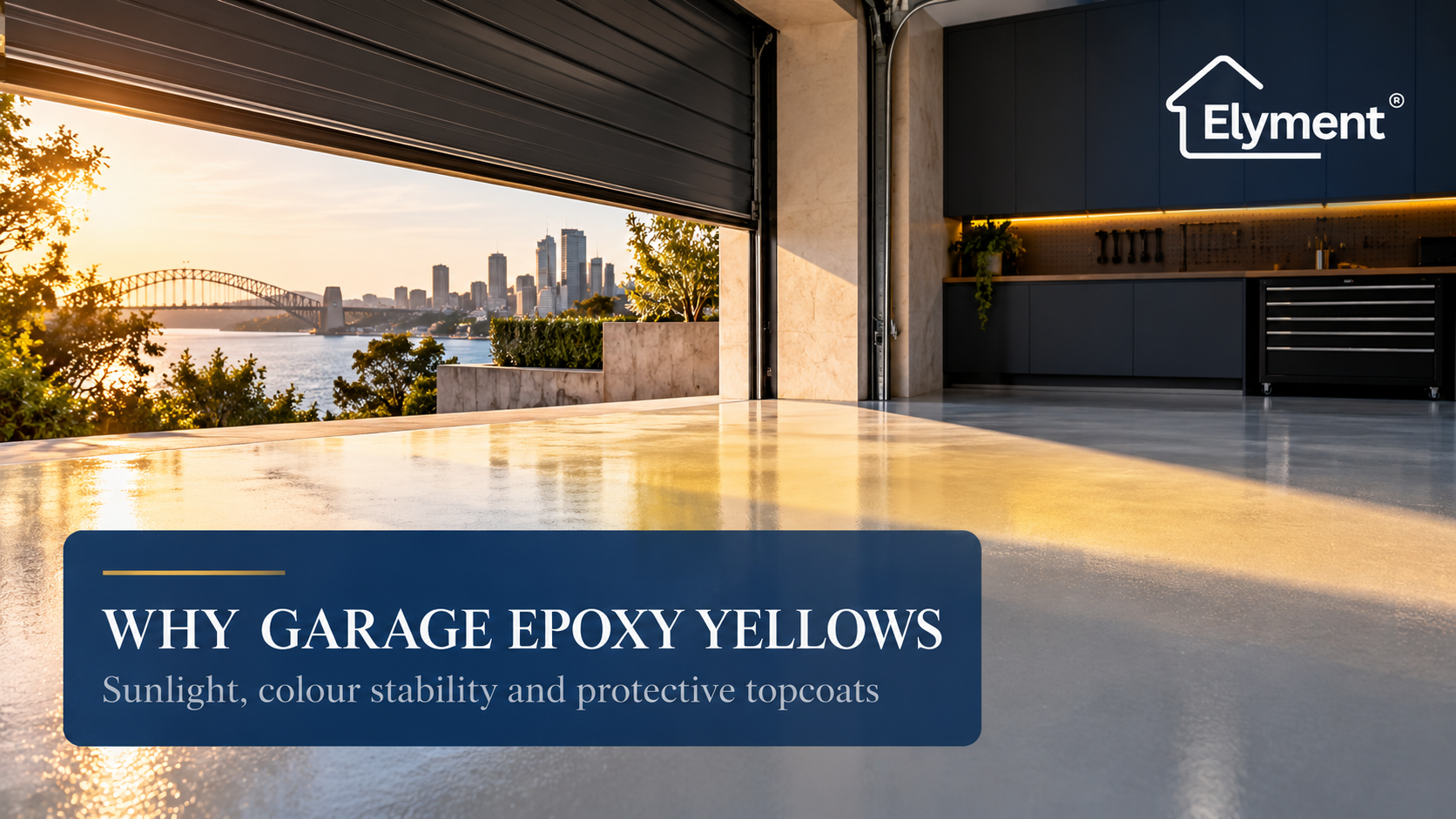
Sunlit garage floors can turn yellow because ultraviolet exposure changes the colour of certain epoxy resins, particularly near open roller doors and windows. In Sydney, this may create differences between exposed and shaded areas without necessarily weakening the coating. Sika's technical guidance recognises this distinction. Property owners should assess daylight exposure before installation, specify a compatible UV-resistant finish where appropriate and confirm whether the protective topcoat is included in the flooring quote.
The Sydney Garage That Looks Different Six Months Later
A newly coated garage can look exceptionally uniform. The floor has a consistent grey finish, the surface reflects light evenly and the space appears cleaner than it did before renovation.
Several months later, the owner notices something unexpected. The floor near the roller door has developed a yellow or amber tint, while the section beneath a parked vehicle remains close to its original colour.
The first assumption may be that the coating was incorrectly applied. The second may be that the entire garage needs resurfacing.
Neither conclusion is necessarily correct.
In Sydney, residential garages frequently occupy a position somewhere between an internal room and an external working environment. Daylight enters through roller doors, windows and open sides. Some garages receive concentrated afternoon sunlight, while others experience prolonged exposure across the entrance threshold.
These differences can matter as much to the appearance of an epoxy floor as the colour selected from a manufacturer's chart.
The overlooked procurement issue is whether the coating was specified for the actual light conditions, rather than simply sold as a durable garage finish.
Why Sunlight Changes Epoxy Colour
Epoxy flooring is generally produced by combining resin and hardener components that chemically react to form a hardened coating.
Although epoxy systems can provide excellent mechanical strength, abrasion resistance and chemical resistance, some are susceptible to colour changes when exposed to ultraviolet radiation.
UV exposure can trigger photochemical changes within susceptible resin or hardener components. These changes can alter how the cured coating absorbs and reflects visible light, producing yellowing or amber discolouration.
The degree of colour change depends on the chemistry of the particular product, pigmentation, exposure intensity, duration and the protective system applied over the epoxy.
What Sika's Technical Guidance Actually Says
Australian construction-products manufacturer Sika expressly acknowledges sunlight-related colour variation in its technical information for Sikafloor-264 epoxy flooring.
Its published guidance explains that direct sunlight can cause some discolouration and colour variation without affecting the coating's intended function and performance.
This distinction is important. A coating can remain mechanically sound while becoming less visually consistent than the owner expected.
It does not mean that every yellowed coating is acceptable, or that colour change can never accompany deterioration. Appearance expectations, contractual requirements and the actual condition of the installed system must still be assessed separately.
Why the Roller Door Is Often the Most Revealing Area
A garage does not receive sunlight evenly. The distribution changes with building orientation, neighbouring structures, seasonal sun angles and the way the space is used.
Consider a typical attached garage in Sydney's north-western residential suburbs.
The garage may remain shaded for much of the morning but receive strong afternoon sunlight when its west-facing door is open.
Over time, the exposed strip near the entrance may change colour more noticeably than sections further inside the garage.
Several exposure conditions deserve attention:
- Roller-door thresholds: Direct sunlight may repeatedly reach the same section of the coating.
- Side windows: Concentrated daylight can create localised differences in colour.
- Partially open garages: A coating may face substantially greater UV exposure than one in an enclosed basement.
- Vehicle parking: Cars, storage equipment and shelving can shade selected areas, leaving visible differences when those items are moved.
- Garage-to-driveway transitions: The coating near the entrance may experience sunlight, rainwater and greater temperature variation than the interior.
A useful site assessment should therefore document which parts of the floor receive direct sunlight and whether those conditions are compatible with the proposed resin system.
This is especially relevant for garages incorporated into contemporary Sydney homes, where the garage may serve as a vehicle space, workshop, gym or visually prominent extension of the property.
Yellowing Is Not the Same as Coating Failure
One of the most expensive mistakes in flooring maintenance is treating every visual defect as evidence of failed adhesion.
Yellowing is primarily a colour issue. Coating failure involves deterioration of the system's integrity, adhesion or intended performance.
The following conditions can help distinguish colour variation from potential coating problems.
- Uniform yellowing in sunlit areas
- Possible explanation: UV-related colour change.
- Recommended response: Check coating condition and colour specifications.
- Original colour beneath parked vehicles
- Possible explanation: Difference in sunlight exposure.
- Recommended response: Compare shaded and exposed areas.
- Peeling or lifting coating
- Possible explanation: Adhesion or system failure.
- Recommended response: Investigate substrate and coating integrity.
- Blistering or bubbling
- Possible explanation: Possible moisture, application or other defects.
- Recommended response: Undertake a technical inspection.
- Soft, tacky or powdering surface
- Possible explanation: Possible curing, chemical or weathering problem.
- Recommended response: Investigate before recoating.
- Localised tyre-shaped coating loss
- Possible explanation: Potential hot-tyre pickup or adhesion failure.
- Recommended response: Review vehicle exposure and coating specification.
These observations are diagnostic indicators, not substitutes for a professional assessment.
Elyment has separately examined hot-tyre pickup and peeling in Sydney epoxy garages, which involve different performance concerns from ordinary sunlight-related colour variation.
If a yellowed floor is still firmly bonded, hard and otherwise serviceable, complete removal may be unnecessary.
If it is peeling, soft or delaminating, the investigation must go beyond the visible colour change.
The Protective Topcoat Decision
Property owners often assume that specifying epoxy automatically produces a UV-stable floor.
That assumption is unsafe.
Epoxy describes a family of resin technologies, not a universal promise of colour stability.
Where direct sunlight is expected, project teams may need to consider a UV-resistant protective topcoat or a different flooring system specifically designed for the exposure conditions.
Why Polyurethane Is Often Considered
Certain polyurethane topcoats offer improved resistance to sunlight-related colour change compared with conventional epoxy finishes.
Sika's Australian technical information for Sikafloor-305 W polyurethane seal coat identifies good UV and yellowing resistance. The product is also described for use with selected Sika epoxy flooring systems.
The important qualification is compatibility. A polyurethane coating should not be selected solely because it carries a UV-resistance claim.
The selected topcoat must be suitable for the underlying resin, site conditions, traffic, finish, surface preparation and application requirements.
Why a Clear Topcoat Is Not Automatically Enough
Some owners expect a clear coating to preserve the appearance of the epoxy beneath it indefinitely.
However, a clear finish is not necessarily a complete barrier against UV radiation. Some formulations may allow sufficient light transmission for the underlying epoxy to discolour over time.
A pigmented, UV-stable protective layer or an alternative system may provide more appropriate colour stability in certain applications.
The correct selection should follow manufacturer guidance for the complete coating system, rather than an assumption based on the topcoat's appearance.
Different topcoats can also alter gloss level, texture, cleaning characteristics and slip resistance.
The specification therefore needs to consider appearance and operational performance together.
What Should an Epoxy Garage Flooring Quote Include?
The most useful way to prevent a future disagreement is to make the proposed flooring system clear before work begins.
A quote stating only "epoxy flooring, two coats" leaves several important questions unanswered.
It does not necessarily identify the resin, topcoat chemistry, UV performance, substrate preparation or expected colour stability.
For epoxy flooring Sydney projects, the following items deserve explicit consideration.
- Exposure assessment
- What should be confirmed: Sunlit areas, orientation and threshold conditions.
- Why it matters: Identifies potential UV-related colour variation.
- Surface preparation
- What should be confirmed: Grinding, cleaning, repairs and moisture assessment.
- Why it matters: Supports adhesion and substrate readiness.
- Primer
- What should be confirmed: Product name and substrate compatibility.
- Why it matters: Establishes the specified bonding system.
- Epoxy body coat
- What should be confirmed: Manufacturer, product, colour and application build.
- Why it matters: Defines the main flooring material.
- Decorative treatment
- What should be confirmed: Flake, solid colour or other specified finish.
- Why it matters: Clarifies visual expectations.
- UV-resistant topcoat
- What should be confirmed: Product, number of coats, compatibility and inclusion.
- Why it matters: Clarifies colour-retention protection.
- Slip resistance
- What should be confirmed: Texture and required performance for the use area.
- Why it matters: Addresses pedestrian and wet-area risks.
- Curing and access
- What should be confirmed: Recoat windows and return-to-traffic requirements.
- Why it matters: Prevents premature use.
- Warranty and exclusions
- What should be confirmed: Colour-change limitations and workmanship coverage.
- Why it matters: Reduces ambiguity after handover.
A quotation does not need to reproduce an entire manufacturer's specification.
It should, however, identify the proposed coating system sufficiently clearly that the owner can understand what is being purchased and what performance is reasonably expected.
Owners should also ask whether UV-related discolouration is expressly excluded from a product or workmanship warranty, and whether any stated colour-retention performance applies to the complete installed system.
Why Two Similar Sydney Garage Quotes May Not Be Equivalent
Consider two contractors pricing the same residential garage.
Both may include surface grinding, primer, epoxy resin and a decorative finish.
Contractor A proposes a conventional epoxy finish without additional colour-retention protection.
Contractor B specifies a compatible UV-resistant topcoat after reviewing the garage's exposure to sunlight.
The second proposal may have additional material, labour and application-stage costs. Whether that extra expenditure is justified depends on the actual exposure, intended use and appearance expectations.
A completely enclosed basement garage may have different priorities from a garage whose roller door remains open for several hours each day.
This is a procurement distinction, not an argument that every garage needs the most expensive coating.
A useful comparison examines the complete scope: substrate condition, coating system, expected exposure, finish quality, access restrictions and long-term maintenance.
Elyment's earlier analysis of flake, metallic and solid-colour epoxy flooring explains the functional differences between decorative finishes.
Sunlight resistance adds a separate specification question: will the selected finish maintain an acceptable appearance under the property's actual daylight conditions?
How Topcoat Selection Changes Project Scheduling
Adding a protective topcoat is not simply a material substitution.
It can affect the number of application stages, intercoat preparation, curing requirements and the date on which vehicles can return.
On occupied residential properties, those considerations create practical scheduling issues.
A household may need alternative parking. A strata garage may require temporary access arrangements. A commercial workshop may need to relocate equipment or limit operations.
Before work begins, the project sequence should establish:
- Inspect the substrate and identify areas receiving direct sunlight.
- Confirm the proposed resin, finish and compatible protective topcoat.
- Complete grinding, repairs and moisture assessments required by the system.
- Apply primer and epoxy within the manufacturer's specified conditions.
- Observe the required recoat windows and topcoat application procedures.
- Protect the completed surface during curing and communicate the approved return-to-use date.
Sydney's variable humidity and temperature conditions can influence application and curing times.
Contractors should follow the selected manufacturer's technical data rather than promising one universal curing period for every garage.
Where mechanical preparation is required, the work method must also address airborne dust, including respirable crystalline silica risks.
The SafeWork NSW code of practice for cutting, drilling and grinding concrete and masonry provides relevant safety guidance.
Can an Existing Yellow Epoxy Floor Be Restored?
In some circumstances, yes.
The appropriate remedy depends on whether the discolouration is superficial, whether the coating remains sound and what finish the owner expects after refurbishment.
An existing coating may be suitable for further preparation and an approved recoating system if it has adequate adhesion and the manufacturer's conditions are satisfied.
Alternatively, widespread deterioration or incompatibility may justify removing the existing coating and rebuilding the system from the prepared substrate.
A new clear coat should not be assumed to reverse yellowing already present in the underlying resin.
Nor should a new UV-resistant coating be applied over an unknown existing surface without checking compatibility and adhesion.
The Practical Inspection Sequence
- Identify the existing coating system where records are available.
- Compare shaded sections with areas that have received direct sunlight.
- Check for peeling, softening, blistering, cracking or other deterioration.
- Assess whether adhesion testing or a representative trial area is appropriate.
- Confirm compatible preparation, recoating products and colour expectations.
- Obtain a written repair scope before committing to full removal.
Where an existing coating must be removed, Elyment's guidance on concrete contamination and epoxy adhesion risks explains why preparation must consider more than the surface's visible appearance.
For projects involving uneven slabs or damaged concrete, owners can also review Sydney garage floor levelling and epoxy-ready substrate preparation before confirming the next coating system.
The Questions Worth Asking Before Approval
For homeowners, strata managers and commercial property operators, several questions can prevent uncertainty later:
- Is the garage's direct sunlight exposure suitable for the proposed epoxy system?
- Has the contractor identified possible colour changes in exposed areas?
- Does the quote include a compatible UV-resistant garage floor coating or topcoat?
- Is the proposed topcoat clear or pigmented, and what colour stability can reasonably be expected?
- Will the protective finish change the floor's gloss, texture or slip performance?
- What additional curing or access restrictions will apply?
- Are cosmetic colour variations covered or excluded under the relevant warranty?
These questions move the conversation beyond a sample colour and a price per square metre.
They help establish whether the proposed system is suitable for the property, how it will perform and what the owner is entitled to expect after installation.
The Broader Lesson for Sydney Property Owners
Sunlight-related yellowing illustrates a wider issue in renovation procurement: durability and appearance are different performance outcomes.
A coating can continue protecting concrete while no longer displaying the uniform colour that influenced the original purchase decision.
For a working garage, moderate colour variation may be acceptable.
For an architecturally finished garage, vehicle collection or premium residential property, appearance consistency may be a much greater priority.
Neither expectation should be assumed. Both should be addressed before the coating system is selected.
For Elyment Property Services, the practical project-delivery objective is to align substrate preparation, system specification, contractor coordination and handover expectations.
The most reliable approach is not to promise that an epoxy floor will never change colour. It is to identify exposure, specify an appropriate system and document the performance requirements before installation.
A Sydney garage floor should be assessed for the conditions it will actually experience, not simply for how it appears immediately after the final coat has cured.
Plan the Floor System Before the Colour Becomes a Problem.
ELYMENT PROPERTY SERVICES
Review garage substrate preparation, sunlight exposure, coating specifications, project sequencing and handover requirements before your next renovation.
Discuss Your Flooring Project →
Sources and References
Manufacturer Technical Information
- Sika Australia – Sikafloor-264 Epoxy Flooring
- Sika Australia – Sikafloor-305 W Polyurethane Seal Coat
Workplace Safety Guidance
- SafeWork NSW – Code of Practice for Cutting, Drilling and Grinding Concrete and Masonry
Related Elyment Articles and Services
- Epoxy Garage Flooring Sydney: The Hot-Tyre Problem That Makes Cheap Coatings Peel
- Flake, Metallic or Solid-Colour Epoxy: Which Finish Actually Suits a Sydney Garage, Retail Space, Warehouse or Studio?
- Concrete Grinding Sydney: Oil Stains and Paint Marks That Can Break an Epoxy Floor Bond
- Sydney Garage Floor Levelling and Epoxy-Ready Substrate Preparation
Plan the Floor System Before the Colour Becomes a Problem.
Review garage substrate preparation, sunlight exposure, coating specifications, project sequencing and handover requirements before your next renovation.
Discuss Your FlooringRelevant next actions
Explore the ELYMENT service most closely connected to this article.