Epoxy or Paint Floor Coating Removal in Sydney: Can It Be Ground Off?
Can epoxy or paint floor coatings be ground off in Sydney? Learn when grinding works, what affects removal cost and how to prepare the surface for new flooring.
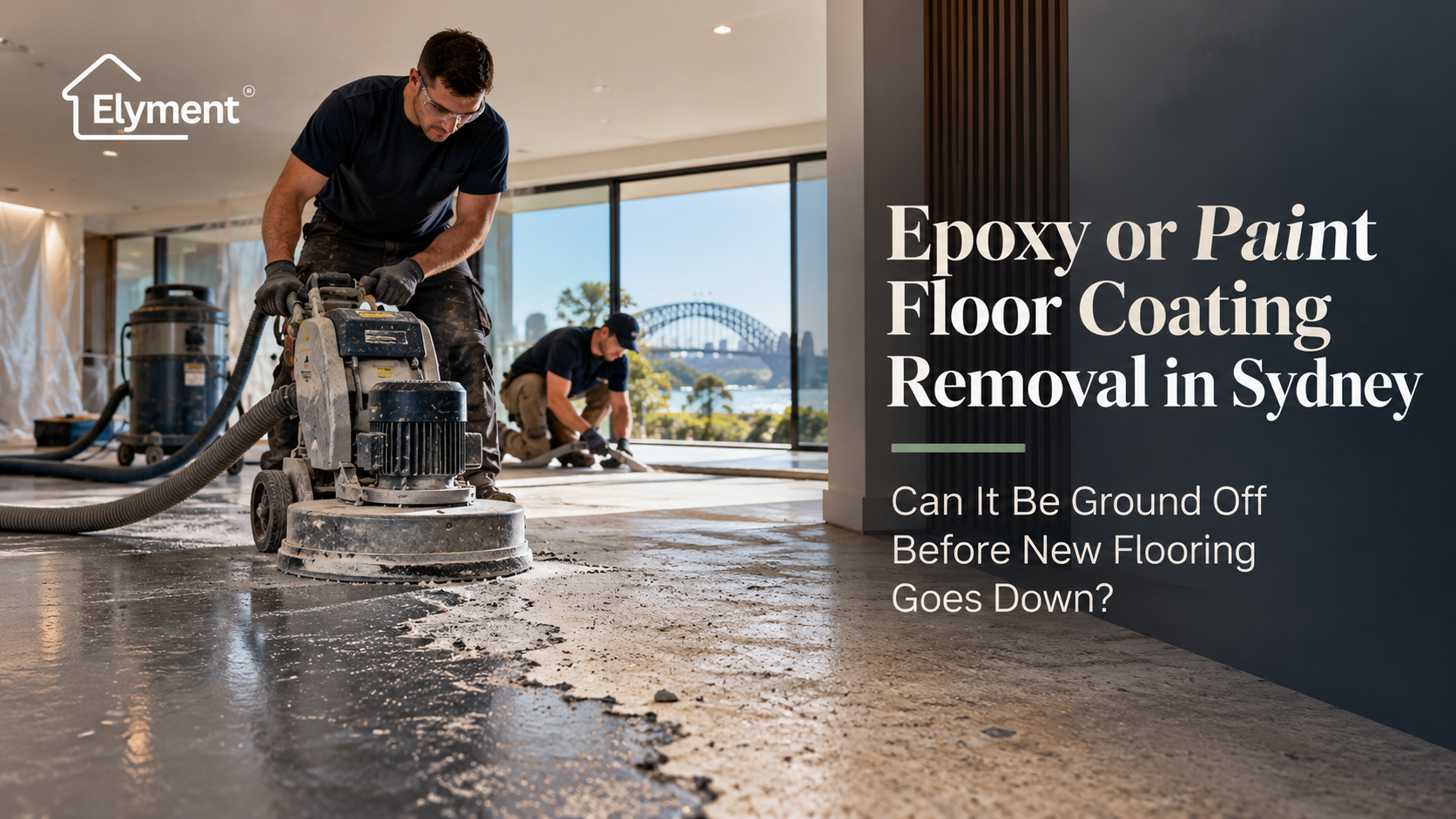
Yes. Many epoxy and floor-paint coatings on concrete can be removed by controlled mechanical grinding, but stripping the colour is not the same as preparing a slab for vinyl, timber, hybrid flooring or tiles. On Sydney projects, the method must account for coating composition, dust hazards, floor height, moisture and the next product's requirements. NSW strata permissions and safe-work controls may also affect the sequence.
ELYMENT Insights | Flooring & Property Operations | 20 October 2026
The Floor Is Changing Purpose, Not Just Colour
Consider a Sydney retail tenancy being converted from a painted-concrete interior to a premium vinyl floor. The existing coating appears relatively thin. The new flooring has been ordered, the installer has a mobilisation date, and the landlord expects the tenancy to reopen promptly.
The apparent simplicity disappears when the floor-preparation team asks what must remain after the coating is removed.
Will the vinyl be bonded directly to concrete? Will a levelling compound be installed first? Is the slab flat enough? Will the finished floor sit correctly against the adjoining corridor, shopfront threshold and fixed joinery?
These questions illustrate an important distinction in epoxy floor removal in Sydney. The objective is not necessarily to expose as much concrete as possible. It is to establish the substrate condition required by the replacement flooring system without creating avoidable damage or introducing another preparation problem.
Elyment has previously examined the scope of removing epoxy from concrete before a replacement coating.
Converting an existing coated surface to vinyl, timber, hybrid flooring or tiles introduces a different set of installation and floor-height considerations.
Epoxy, Floor Paint and Other Coatings Cannot Be Treated as One Material
The term floor coating is often used loosely in renovation enquiries. A grey surface may be an older water-based floor paint, a two-part epoxy, a polyurethane system, a decorative resin topping or several coatings applied across different refurbishment periods.
Their thickness, bond strength and response to mechanical removal can vary significantly.
Thin floor paint
- Removal consideration: May abrade relatively quickly, although age, adhesion and composition require assessment.
- Effect on new flooring: Residue may interfere with flooring adhesives or levelling primers.
Two-part epoxy coating
- Removal consideration: May require diamond grinding or other suitable mechanical removal methods.
- Effect on new flooring: Retention is possible only where the selected replacement system expressly permits it.
Thick or aggregate-filled resin
- Removal consideration: May require more aggressive preparation equipment and a subsequent refinement pass.
- Effect on new flooring: Removal can expose an irregular substrate that requires further correction.
Unknown or multiple coatings
- Removal consideration: Identification and appropriate hazard assessment may be needed before disturbance.
- Effect on new flooring: Material uncertainty can delay approval of the proposed adhesive or levelling system.
A grinding machine selected to remove a thin coating may perform poorly against a thick resin build-up. Conversely, excessively aggressive equipment can remove sound concrete, increase surface roughness and create repairs that the next flooring system would not otherwise have required.
The physical method should therefore follow material identification, rather than being assumed from the appearance of the floor.
Does Every Epoxy Coating Have to Be Removed?
Not necessarily, but retaining an existing epoxy layer should never be a general assumption.
Some manufacturers permit particular preparation and levelling systems over compatible, firmly bonded epoxy. Other products require the existing coating to be removed completely.
ARDEX Australia's technical guidance on levelling over epoxy flooring demonstrates why the selected system matters.
Its technical bulletin TB108 describes specific conditions for levelling over suitable existing epoxy coatings, including coating integrity, cleaning, mechanical preparation, compatible products and a test area.
Those instructions are product-specific. They do not establish that ordinary floor paint, polyurethane, unidentified resin or damaged epoxy can be covered using the same procedure.
There are three practical outcomes:
- Complete removal: Appropriate where the old coating is unsuitable for the proposed new system, weak, incompatible or otherwise required to be removed by the manufacturer.
- Conditional retention: Possible where the complete specified system allows it and the required preparation, testing and acceptance criteria are satisfied.
- Further investigation: Required where the coating history, contamination, adhesion or underlying material remains uncertain.
The decision should be made before ordering a primer or self-levelling compound, not while the installation crew is waiting onsite.
The Millimetres That Matter After Grinding
A coating can be removed successfully while the overall renovation becomes more complicated.
This happens because an existing coated slab and a completed flooring system occupy different vertical spaces.
Removing paint or epoxy might expose the concrete, but it does not automatically remove existing slab undulations. Where the replacement system requires correction, the project may subsequently add primer, levelling compound, adhesive, underlay and flooring.
The completed height must be considered against:
- Entry-door clearance and existing thresholds.
- Adjoining rooms with different floor finishes.
- Kitchen cabinetry, appliances and fixed joinery.
- Stair landings and the consistency of riser heights.
- Lift sills, accessible routes and doorway transitions.
- Existing movement joints and drainage falls.
In an established Sydney apartment, there may be little capacity to change these interfaces without additional work or approvals.
A competent preparation plan therefore starts with the intended finished floor level and works backwards through the proposed flooring build-up.
Elyment's Sydney flooring preparation and removal services cover the relationship between demolition, concrete preparation, levelling and readiness for the next flooring trade.
What Changes When the Replacement Floor Is Specified?
The same coated concrete slab can demand different preparation depending on what will cover it next. A visually bare surface is not a universal acceptance standard.
Glue-down vinyl
- Critical preparation question: Is the substrate suitably smooth, sound and compatible with the specified adhesive or smoothing system?
- Installation consequence: Residual coating, ridges or depressions can undermine bonding or become visible through the finish.
Engineered timber
- Critical preparation question: Does the substrate meet the timber and adhesive manufacturer's moisture, bond and flatness requirements?
- Installation consequence: Incompatible residue or moisture conditions can affect adhesive performance and installation.
Floating hybrid flooring
- Critical preparation question: Is the floor sufficiently flat and free from unstable material or protrusions?
- Installation consequence: The underlay and locking system do not eliminate the need for acceptable substrate geometry.
Ceramic or porcelain tiles
- Critical preparation question: Is the surface suitable for the specified tile adhesive, preparation system and movement-joint arrangement?
- Installation consequence: Coating incompatibility or excessive correction can change the tile assembly and finished height.
Carpet tiles
- Critical preparation question: Is the substrate acceptable for the nominated tackifier or adhesive system?
- Installation consequence: Coating residue can affect adhesion and the consistency of the completed surface.
These distinctions explain why a quotation for coating removal should be developed in consultation with the incoming flooring installer.
The installer should identify the applicable product requirements and any tests or substrate treatments needed before accepting the prepared floor.
Where levelling is part of the work, Elyment's commercial floor levelling and fit-out preparation services in Sydney provide a relevant pathway for coordinating preparation with the installation programme.
A Coating Removal Plan Should Start at the Doorway
An overlooked project-control opportunity is to establish a representative floor transition before broad-area preparation begins.
For example, a Sydney office converting an old resin floor to vinyl may need to connect the new surface with an existing tiled corridor.
Before committing to widespread grinding, the project team can document the existing levels at that interface and develop the proposed flooring build-up.
The assessment should establish:
- The existing floor height and the adjoining finished-floor level.
- The thickness and installation method of the selected replacement product.
- The likely substrate correction needed after coating removal.
- Whether a suitable transition can be installed without creating an unacceptable level difference.
- Any additional design or accessibility considerations requiring professional review.
This is a different exercise from simply testing how quickly a coating can be ground away. It tests whether the planned finished-floor assembly can be delivered within the existing building constraints.
Identifying a height conflict before full-floor removal can prevent the contractor from completing a technically successful strip-out that leaves the next trade with an impractical installation detail.
NSW Safety Requirements Can Determine Whether Grinding Proceeds
Mechanical removal involves more than the visible paint or resin. Once the equipment contacts concrete, dust generation must be assessed and controlled.
SafeWork NSW's crystalline silica guidance explains the risks associated with processing silica-containing materials such as concrete.
Suitable controls may include dust extraction, water suppression, work-zone isolation, cleaning procedures and appropriate respiratory protection.
Older or unidentified painted floors can introduce further hazards.
The NSW Government's LeadSmart renovation guidance highlights the risks of disturbing legacy lead paint.
Where historical coatings are suspected of containing lead or other hazardous substances, suitable assessment must occur before abrasive work.
Work should not proceed on the assumption that every existing grey coating is ordinary modern floor paint.
In older premises, asbestos-containing flooring materials or associated layers may also need to be considered, particularly where the work extends beyond the visible coating. A competent assessment is required where such materials may be present.
These considerations affect equipment selection, site protection, worker controls, waste handling and the programme. They should be resolved as pre-start requirements rather than managed reactively after grinding has begun.
Sydney Strata and Commercial Properties Add Another Layer of Coordination
Coating removal is often conducted in occupied buildings where access and disturbance are controlled.
For apartment projects in North Sydney, Mosman, Parramatta or the Inner West, planning may involve lift access, equipment transport, restricted work hours, common-property protection and acoustic requirements for the replacement floor.
Under the NSW Government's strata renovation rules, installing or replacing hard flooring may be classified as a minor renovation requiring approval, subject to the nature of the work and the scheme's by-laws.
Acoustic documentation may also be required.
This is especially relevant when an existing coated concrete surface is being converted to hard flooring rather than simply maintained as a coating.
Commercial projects face different operational pressures. A tenancy may need to remain closed while grinding, levelling, adhesive installation and curing take place.
Landlord approvals, services, ventilation, loading access and neighbouring occupancies can influence the delivery strategy.
The removal programme should reflect those dependencies. Completing the grinding stage early does not necessarily mean the premises can immediately be handed over for installation or reopened for business.
The Cost Decision Is About the Complete Floor Assembly
Owners comparing epoxy removal quotations should avoid treating grinding as an isolated cost when the objective is to install a different type of flooring.
There can be a meaningful difference between three project pathways.
Pathway A: Mechanical Removal and Direct Installation
The existing coating is removed, the concrete is prepared, and the substrate is confirmed suitable for direct installation of the specified flooring.
Additional correction may be limited.
Pathway B: Mechanical Removal Followed by Levelling
The coating is removed, but the exposed slab requires further repair or levelling before installation.
This introduces additional materials, labour, thickness and curing considerations.
Pathway C: Manufacturer-Approved Preparation Over Existing Epoxy
A suitable bonded epoxy layer is retained under a specifically approved preparation system, where supported by the relevant manufacturer's requirements and verified for the actual site conditions.
Pathway C is not automatically the cheapest or most appropriate option. It may require specialised products, extra preparation and testing.
Equally, complete removal may be unnecessary where a documented compatible system is available.
The appropriate comparison is the total cost and risk of delivering the specified finished floor, not simply the lowest price to remove the visible coating.
What Should Be Confirmed Before the New Flooring Arrives?
A useful completion review should provide enough information for the next trade to determine whether installation can proceed.
- Confirm the actual extent of coating removal or any expressly approved retained coating.
- Identify remaining contamination, weak areas, cracks and substrate repairs.
- Record relevant flatness and finished-floor-level observations.
- Complete required moisture, bonding or other manufacturer-specified assessments.
- Confirm that dust and loose preparation residues have been removed appropriately.
- Review thresholds, adjoining finishes, fixed joinery and other relevant interfaces.
- Obtain acceptance from the incoming installer against the selected flooring system.
Unresolved conditions should be recorded and addressed before the next layer conceals them.
This creates a clearer division between mechanical removal, substrate correction and flooring installation, without assuming one completed activity automatically authorises the next.
Plan the New Floor Before Removing the Old Coating
ELYMENT | SYDNEY RENOVATION OPERATIONS
Review coating removal, concrete preparation, finished-floor levels, compliance considerations and installation sequencing before committing to the next renovation stage.
Request a Flooring Project Review →
The Practical Conclusion
Epoxy and painted floor coatings can often be mechanically ground off concrete in Sydney, provided the material is suitable for the proposed removal method and applicable hazards have been assessed.
But removing the coating is only one decision in a flooring conversion.
The stronger project outcome is a documented route from the existing surface to the completed floor assembly, including compatible materials, acceptable substrate condition, correct floor levels, safe preparation and coordinated installation.
For Sydney property owners, builders and commercial operators, the most useful measure of success is not how quickly the old epoxy disappears.
It is whether the next floor can be installed correctly without requiring another round of demolition or preventable rectification.
Sources and References
Technical and regulatory references
- ARDEX Australia – Levelling Over Epoxy Flooring: Getting the Substrate Right
- SafeWork NSW – Crystalline Silica Technical Fact Sheet
- NSW Government – LeadSmart: Renovating and Maintenance
- NSW Government – Strata Renovations
Related Elyment resources
- Removing Epoxy from Concrete Sydney: Is Grinding Included Before the New Coating Goes Down?
- Elyment – Flooring Services
- Elyment – Commercial Floor Levelling and Fit-Out Preparation Services in Sydney
- Elyment – Contact and Flooring Project Review
ELYMENT | SYDNEY RENOVATION OPERATIONS
Plan the New Floor Before Removing the Old Coating
Review coating removal, concrete preparation, finished-floor levels, compliance considerations and installation sequencing before committing to the next renovation stage.
Request a Flooring Project Review →Relevant next actions
Explore the ELYMENT service most closely connected to this article.