Final Inspection Before Settlement NSW: Unfinished Repairs
Agreed repairs not completed before settlement in NSW? Learn what to check during your final inspection, how to raise concerns and what options buyers may have.
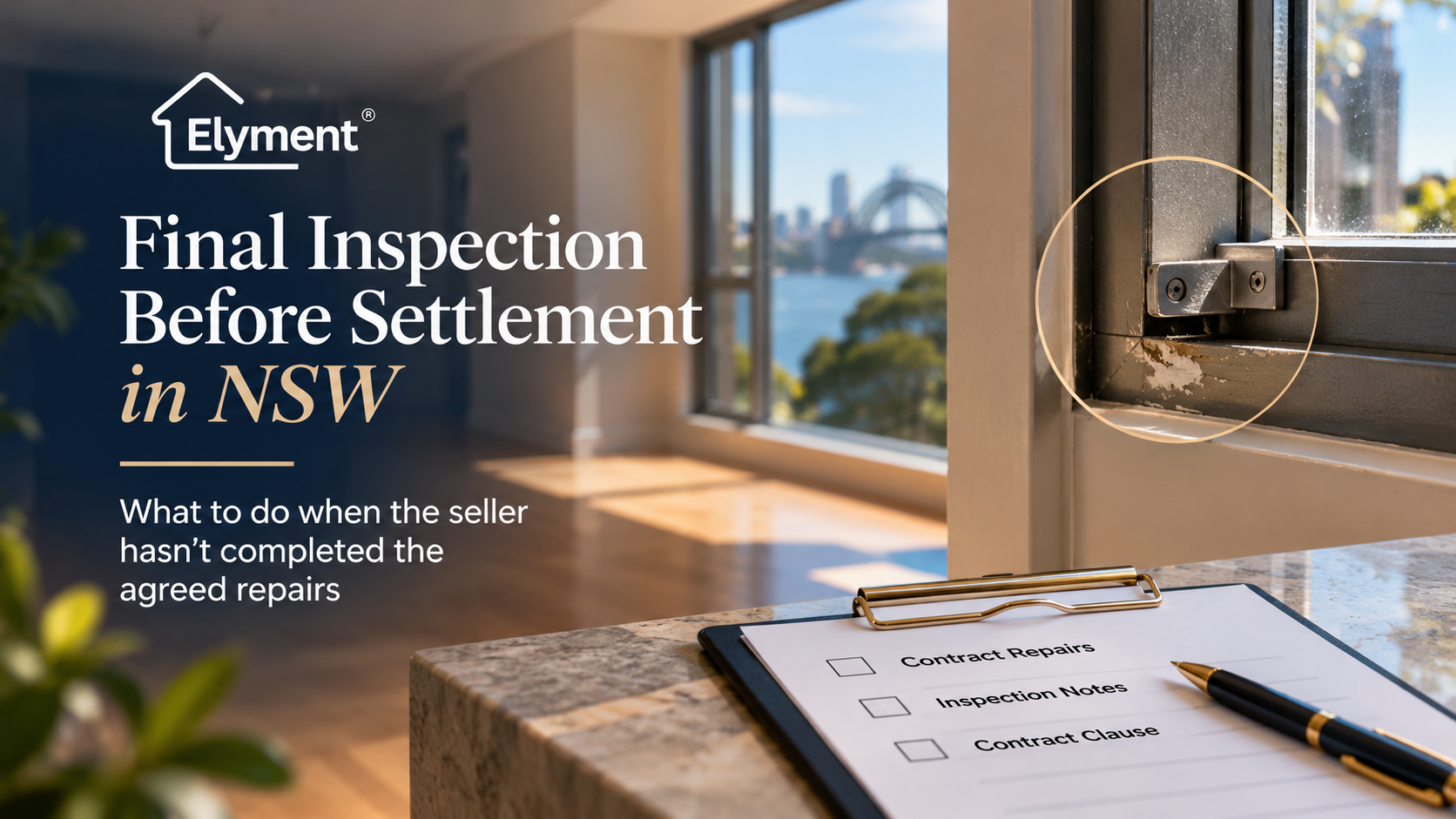
If a seller has not completed agreed repairs at the final inspection before settlement in NSW, buyers should photograph the outstanding work, locate the relevant repair clause in the exchanged contract and immediately contact their solicitor or licensed conveyancer. A written contractual obligation differs from a verbal promise. Unfinished repairs do not automatically entitle a buyer to delay settlement, withhold funds or demand compensation.
ELYMENT Insights | Property Law, Conveyancing & Property Operations | Sydney, NSW | 27 November 2026
The apartment is empty, the removalists are booked and the settlement funds are ready. Yet during the final inspection, the buyer discovers that the damaged window, leaking plumbing fitting or faulty air-conditioning system the seller agreed to repair remains untouched.
What appeared to be a routine property handover has suddenly become a contractual question with potentially significant financial and operational consequences.
For Sydney property buyers, the immediate priority is not to negotiate a repair price in the hallway or refuse to accept the keys. It is to establish precisely what the seller agreed to deliver, document the difference between that obligation and the property's current condition, and communicate the findings before settlement occurs.
The Final Inspection Is a Verification Exercise, Not a New Negotiation
The NSW Government's guidance on property contracts and settlement recommends conducting a final inspection on the morning of settlement to confirm that the property's condition remains consistent with its condition at exchange.
Where the seller has undertaken additional contractual repair obligations, the inspection also provides an opportunity to verify whether those obligations appear to have been fulfilled.
This is an important distinction. A buyer who discovers a previously known defect that the seller never agreed to repair may be in a different legal position from a buyer who identifies an outstanding obligation expressly included in the exchanged contract.
The purpose of the inspection is therefore to establish the property's condition against the relevant contractual requirements, rather than create a new list of improvements the buyer would like completed.
Find the Repair Clause Before Discussing a Remedy
When an agreed repair appears incomplete, the most important document may not be the original building inspection report or the estate agent's email. It may be a special condition contained in the exchanged contract for sale.
Buyers should ask their conveyancer to identify the exact wording governing the repair, including:
- The specific item or defect the seller agreed to rectify.
- Whether the work must be completed before settlement.
- Any specified workmanship or performance requirements.
- Whether a suitably licensed or qualified contractor must perform the work.
- Whether invoices, compliance certificates or other completion evidence are required.
- Any inspection, notification or dispute-resolution provisions.
- Any contractual consequences if the obligation remains outstanding.
The wording matters because different obligations can produce different outcomes.
A condition requiring a damaged window to be repaired before settlement is not necessarily equivalent to a condition requiring the seller to arrange for a contractor to inspect that window.
Similarly, a requirement to provide an invoice from a plumber may create a different verification question from an obligation to rectify the underlying source of a water leak.
Elyment's NSW property contract review guidance explains why negotiated conditions must be assessed alongside the wider sale contract.
A Written Contractual Obligation Is Different From a Verbal Promise
Property negotiations commonly involve conversations between buyers, sellers and real estate agents. A seller may offer to repair a defect during an inspection, or an agent may communicate that the seller intends to organise a contractor before settlement.
However, an informal assurance is not necessarily an enforceable contractual repair obligation.
NSW Government guidance directs contractual amendments through the parties' solicitors or licensed conveyancers. Real estate agents cannot themselves amend the contract of sale.
Different Forms of Seller Repair Commitments and Their Practical Significance
Repair condition in the exchanged contract
- Practical significance: Provides a documented obligation for legal assessment.
- Buyer's next step: Identify the clause and document non-completion.
Formally agreed written contract variation
- Practical significance: May modify the original contractual obligations.
- Buyer's next step: Ask the conveyancer to confirm its validity and effect.
Email or text message from the agent
- Practical significance: May provide relevant evidence but does not necessarily establish a contractual obligation.
- Buyer's next step: Preserve the correspondence and obtain legal advice.
Verbal assurance from the seller
- Practical significance: May raise evidentiary and enforceability questions.
- Buyer's next step: Record the circumstances and seek professional advice.
Defect listed in a building inspection report
- Practical significance: Identifies a condition but does not itself require the seller to repair it.
- Buyer's next step: Check whether a repair obligation was subsequently agreed.
Informal representations should not simply be discarded. Depending on the circumstances, they may have legal significance. Their effect, however, requires an assessment of the evidence, the contractual terms and applicable law.
Build a Repair Evidence Record While You Are Still at the Property
A conveyancer handling an imminent settlement needs specific information rather than a general statement that the property is not ready.
A useful inspection record should allow someone who has never visited the property to understand exactly what remains outstanding.
- Identify the location. Record the room, fixture, building element or external area affected.
- Photograph the condition. Take both wider contextual photographs and close-up images showing the outstanding defect.
- Compare the condition with earlier evidence. Retain relevant photographs, inspection reports and correspondence from before exchange.
- Record the inspection time. Note the date, time and individuals present during the inspection.
- Describe the outstanding work objectively. Explain what is visibly incomplete without making unsupported technical or legal conclusions.
- Request available completion evidence. Ask whether the seller can provide contractor invoices, reports or required certificates.
- Contact the conveyancer immediately. Send the evidence and identify the scheduled settlement time.
Buyers should avoid dismantling fixtures, opening electrical equipment, removing building materials or conducting invasive tests without appropriate permission and professional assistance.
Where the repair involves concealed plumbing, electrical systems, waterproofing or structural elements, a visual inspection alone may not establish whether the work has been completed satisfactorily.
When a Repair Looks Finished but the Obligation May Remain Outstanding
Not every incomplete repair is immediately visible.
A freshly painted ceiling may conceal earlier water staining. New sealant around a shower may improve its appearance without establishing that the underlying waterproofing problem has been resolved. A replacement air-conditioning controller may illuminate without confirming that the system operates correctly.
Three separate questions therefore arise:
- Was work actually undertaken?
- Does the work appear to satisfy the agreed scope?
- Is there sufficient evidence to establish completion under the contract?
These questions are particularly relevant in Sydney's established apartment market, where defects can involve concealed services, previous renovation works and building elements that may fall within the owners corporation's responsibility.
The NSW Government's guidance on property inspection reports provides further information about specialist assessments and the limitations of different inspection types.
An Illustrative Sydney Apartment Settlement
Consider a hypothetical apartment purchase in Chatswood where the exchanged contract includes three seller repair obligations:
- Repair a leaking kitchen plumbing fitting.
- Replace a damaged bedroom window latch.
- Restore the existing air-conditioning system to working order.
At the final inspection, the kitchen fitting appears dry and the window latch has been replaced. However, the air-conditioning system does not operate when tested under normal conditions.
Illustrative Pre-Settlement Repair Verification Record
Kitchen plumbing fitting
- Inspection finding: No visible leakage during normal operation.
- Recorded status: Appears completed; evidence to be checked.
Bedroom window latch
- Inspection finding: Replacement latch fitted and functioning.
- Recorded status: Appears completed.
Air-conditioning system
- Inspection finding: System does not operate; no contractor report supplied.
- Recorded status: Outstanding or unverified.
The buyer forwards this record to their conveyancer together with photographs, the inspection time and the relevant contract condition.
The conveyancer can then assess the actual obligation, communicate with the seller's representative and determine which responses are legally available.
The buyer has not independently established a right to compensation or delayed settlement. They have, however, provided a clear evidentiary basis for obtaining timely advice.
Can a Buyer Delay Settlement Because the Seller Has Not Completed Repairs?
Not automatically.
Whether an outstanding repair justifies delaying settlement depends on the exchanged contract, the nature and significance of the obligation, applicable law and the circumstances of the transaction.
Following professional assessment, potential responses may include:
- Requesting completion before the scheduled settlement time.
- Negotiating a mutually agreed settlement extension.
- Negotiating an adjustment to the settlement amount.
- Considering an appropriately documented retention arrangement where legally available or agreed.
- Proceeding with settlement under a documented arrangement addressing the outstanding work and preserving relevant rights where possible.
- Considering any contractual claim or other available legal remedy.
These are potential avenues for professional consideration, not automatic buyer entitlements.
Refusing to settle without a valid contractual or legal basis can expose a purchaser to default consequences. The Law Society of NSW's guidance on finalising a property purchase identifies potential interest consequences when a buyer does not complete settlement on the contractual date.
Buyers should therefore avoid instructing their lender to stop payment, withholding part of the purchase price or announcing that settlement will not proceed without first obtaining advice from the professional acting in their transaction.
The Strata Complication: When the Seller Cannot Independently Deliver the Repair
Apartment purchases can introduce an additional layer of complexity when the agreed work relates to windows, external walls, balconies, plumbing infrastructure or other building components.
Depending on the strata plan, by-laws and nature of the defect, responsibility may involve the owners corporation rather than the individual lot owner alone.
A seller's contractual promise does not necessarily confer authority to undertake work affecting common property.
Where this issue arises, the buyer's conveyancer may need to establish whether:
- The repair affects common property or an individual lot.
- Relevant strata permissions have been obtained.
- The required work depends on owners corporation approval.
- Appropriate contractor documentation is available.
- The seller's contractual obligations remain outstanding despite the involvement of another party.
Elyment's analysis of the differences between strata reports and building inspections provides further context on the distinction between physical property condition and documented building responsibilities.
Protecting the Renovation Programme Without Compromising the Settlement Decision
For many Sydney buyers, settlement is also the starting point for a renovation programme.
An unresolved plumbing leak may affect floor preparation. Incomplete electrical work may interfere with painting or joinery. A defective window may expose newly installed flooring and internal finishes to moisture.
The operational response should be proportionate to the outstanding repair.
Outstanding Seller Repairs and Potential Renovation Dependencies
Active plumbing leak
- Potential project impact: Moisture-sensitive flooring and adhesive installation.
- Operational consideration: Confirm rectification and assess substrate moisture before proceeding.
Damaged window or external opening
- Potential project impact: Exposure of internal finishes to weather.
- Operational consideration: Confirm weather protection before sensitive finishes are installed.
Incomplete electrical repair
- Potential project impact: Restricted access or disruption to finishing trades.
- Operational consideration: Coordinate assessment by an appropriately licensed electrician.
Unresolved waterproofing defect
- Potential project impact: Potential damage to adjacent flooring and wall finishes.
- Operational consideration: Determine the underlying defect and repair scope before covering affected areas.
Contractors should not commence irreversible works simply because settlement is expected to occur later that day.
Legal completion, possession, access permissions and technical readiness remain separate considerations. Elyment's guidance on renovation access before NSW settlement examines these boundaries in greater detail.
What to Send Your Conveyancer Before Settlement
A concise, organised communication can reduce unnecessary exchanges during an already time-sensitive transaction.
The buyer's message should include:
- The property address.
- The scheduled settlement date and time.
- The relevant contract clause or repair schedule, if identified.
- A factual description of the unfinished repair.
- Time-stamped photographs and relevant earlier evidence.
- Any available contractor documentation.
- A request for advice on the available options before settlement proceeds.
Where settlement is imminent, a telephone call followed by written evidence may be more appropriate than relying on an unattended email.
The real estate agent may assist with access, communication and obtaining information from the seller. The legal assessment of settlement rights should remain with the buyer's solicitor or licensed conveyancer.
The Decision Should Follow the Evidence, Not the Pressure of Settlement Day
Outstanding seller repairs can create understandable frustration, particularly when buyers have committed substantial funds and organised an immediate move or renovation.
Yet the significance of an unfinished repair cannot be determined solely by its appearance or estimated rectification cost.
The decisive considerations are the seller's actual obligations, the available evidence, the applicable contractual remedies and the consequences of any proposed settlement decision.
Through Elyment's Sydney conveyancing and settlement support services, property transactions can be considered alongside practical handover requirements, compliance considerations and subsequent renovation planning.
ELYMENT | PROPERTY & CONVEYANCING
Resolve the Outstanding Questions Before Handover
Purchasing property in Sydney or NSW? Discuss your contract conditions, outstanding repair obligations, settlement readiness and renovation requirements with Elyment.
Request a Property Transaction Review
Frequently Asked Questions
Can I refuse to settle if the seller has not completed agreed repairs in NSW?
Not automatically. Your rights depend on the contract and circumstances. Obtain advice from your solicitor or licensed conveyancer before refusing or delaying settlement.
What if the seller only verbally promised to repair something?
Preserve any relevant correspondence and details of the conversation. A verbal assurance does not necessarily create the same rights as a written contractual condition, although it may have legal significance depending on the circumstances.
Can I deduct the cost of unfinished repairs from the purchase price?
Buyers should not independently deduct repair costs. Any adjustment, compensation claim or retention arrangement requires an appropriate contractual or legal basis or agreement between the parties.
Should I ask for receipts for completed seller repairs?
Contractor invoices, reports and relevant compliance certificates can assist in verifying completion. Whether the seller is required to provide them depends on the contractual terms and applicable requirements.
When should I tell my conveyancer about unfinished repairs?
Immediately after identifying the issue, and before settlement takes place. Provide photographs, relevant contract wording and a clear description of the outstanding work.
This article provides general information about NSW residential property transactions and does not constitute legal advice. Contractual rights and remedies depend on the individual transaction. Buyers should obtain advice from an appropriately qualified NSW solicitor or licensed conveyancer before making settlement decisions.
Sources and References
Elyment Resources
- Elyment: NSW Property Contract Review Guidance
- Elyment: Conveyancing Sydney – Strata Reports vs Building Inspections
- Elyment: Can a Buyer Start Renovating Before Settlement in NSW? What an Early Access Licence Does Not Automatically Allow
- Elyment: Sydney Conveyancing and Settlement Support Services
Government and Legal Resources
- NSW Government: Buying Property in NSW – Contracts and Deposits
- NSW Government: Property Inspection Reports
- Law Society of NSW: Finalising Your Property Purchase
ELYMENT | PROPERTY & CONVEYANCING
Resolve the Outstanding Questions Before Handover
Purchasing property in Sydney or NSW? Discuss your contract conditions, outstanding repair obligations, settlement readiness and renovation requirements with Elyment.
Request a Property ReviewRelevant next actions
Explore the ELYMENT service most closely connected to this article.