Floor Levelling Sydney Over Old Terrazzo: Can Self-Levelling Cement Go Down Without Removing the Original Floor?
Can self-levelling cement go over old terrazzo in Sydney? Learn the steps, adhesion risks, moisture checks and when removing the original floor may be required.
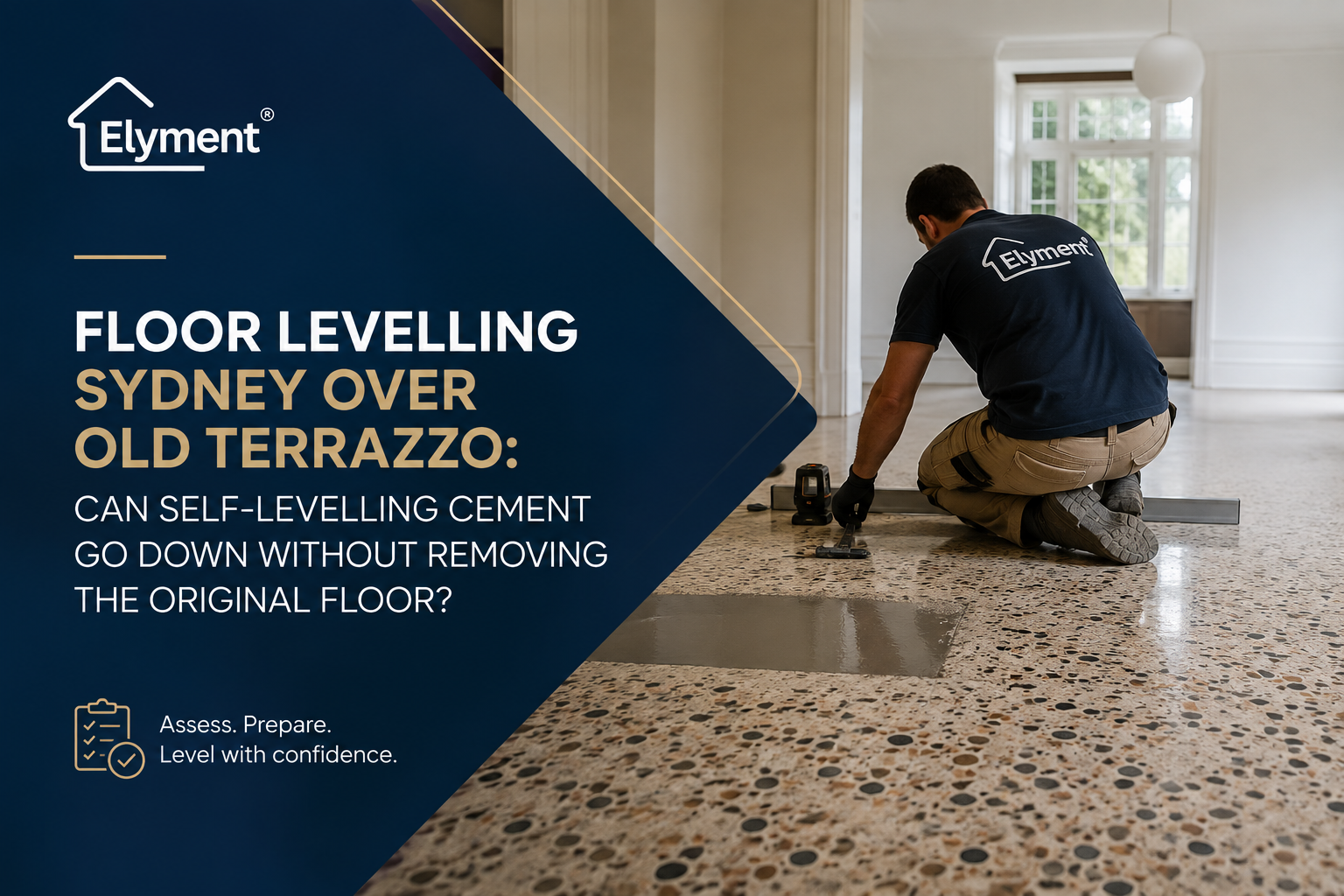
Yes, self-levelling cement can sometimes be installed over old terrazzo in Sydney without removing the original floor, but only when the terrazzo is sound, firmly bonded, clean, dry enough and compatible with the specified primer and levelling system. The decision is less about age than condition. In older NSW homes and strata apartments, retained terrazzo must also be checked for cracks, hollow areas, contamination, floor-height impacts, legacy-material risks and strata requirements.
Old terrazzo creates an unusual renovation decision. It may no longer suit the proposed interior, yet it can still be an exceptionally hard and stable substrate. Removing it simply because a new floor is planned can introduce demolition, waste, noise, dust, programme time and additional slab preparation that the project may not actually need.
Keeping it without investigation creates the opposite risk.
A polished terrazzo surface may be dense, sealed or contaminated with decades of waxes and cleaning products. Cracks may indicate movement. Isolated sections may sound hollow. Repairs completed during earlier renovations may behave differently from the original material. The floor may also already sit close to the maximum height available beneath doors, joinery and adjoining finishes.
The useful question for a Sydney renovation is therefore not simply whether self levelling cement can stick to terrazzo. It is whether the existing terrazzo has earned the right to remain inside the new floor build-up.
Retain or Remove? The Substrate Decision Comes Before the Pour
Technical guidance from major flooring-system manufacturers confirms that prepared terrazzo can, in appropriate internal applications, form a substrate for compatible primers and levelling compounds. That does not create a blanket approval to pour over every old terrazzo floor.
ARDEX Australia, for example, publishes specific guidance for levelling over existing internal terrazzo and tiled surfaces, while Sika lists terrazzo among substrates that can be treated using selected non-porous preparation systems, subject to product requirements and bond testing.
That distinction matters. The system is being installed over a retained substrate, not over the structural slab that would normally be exposed after complete demolition.
The existing terrazzo becomes part of the performance chain:
- The structural floor supports the terrazzo.
- The terrazzo must remain firmly bonded and stable.
- The preparation or primer must bond to the terrazzo.
- The self-levelling compound must bond to that prepared interface.
- The adhesive, underlay or subsequent system must bond to the leveller.
- The final flooring must perform under the intended use.
A weakness at any one of those layers can compromise the new installation above it.
Why Old Terrazzo Changes the Usual Floor-Levelling Logic
A porous concrete slab and an old terrazzo finish do not behave identically.
Terrazzo is typically dense and comparatively non-absorbent. Older floors may also have been polished, waxed, sealed or repeatedly treated with cleaning products. A surface can therefore look exceptionally clean while still being a poor bonding surface for an incorrectly specified primer.
This is why a general-purpose primer intended for absorbent concrete should not automatically be substituted for the preparation system specified for the actual substrate.
Depending on the manufacturer and complete flooring system, preparation may involve controlled mechanical abrasion, specialist cleaning, a proprietary non-porous primer, or a combination of measures. Some modern primers are specifically designed to create adhesion over smooth non-porous substrates. Other systems require a mechanically prepared surface.
The specification needs to be resolved before mobilisation, rather than improvised after the levelling compound has already been delivered.
Elyment has previously examined why priming before floor levelling needs to be treated as part of the system, rather than as a generic coating step. Old terrazzo makes that distinction particularly important.
Five Tests Before the Original Floor Is Allowed to Stay
Retaining terrazzo should be treated as a substrate acceptance decision. A practical inspection normally needs to answer five different questions.
1. Is the terrazzo actually sound?
Surface hardness is not enough.
The floor should be inspected for loose areas, hollow sections, crumbling repairs, debonded edges and other evidence that the terrazzo is no longer reliably attached to the substrate beneath it. Depending on the project, assessment can include visual inspection, percussion or tap testing and localised test areas.
Levelling compound cannot turn a detached terrazzo layer into a stable substrate. If the original layer moves, the new layers above it remain exposed to that movement.
2. Are the cracks static or still moving?
A hairline crack in an old decorative finish is not automatically a reason for full demolition, but it should not simply disappear beneath a pour without investigation.
Project teams need to determine whether cracking is confined to the terrazzo, corresponds with joints or cracking below, or shows evidence of continuing movement.
Self-levelling compound corrects surface profile. It should not be treated as structural crack repair or as a way of suppressing movement that has not been resolved.
3. What is on the surface?
Old terrazzo can carry polish, sealers, oils, wax, cleaning residues, coatings and residues from previous fit-outs. These can become bond breakers.
The preparation method must remove or accommodate anything that conflicts with the nominated system. A trial area or bond test can be far more valuable than assuming the entire floor is ready because it looks clean.
4. Is the existing floor dry enough for the new system?
Keeping terrazzo does not eliminate moisture considerations.
Moisture conditions need to be considered against the requirements of the levelling compound, adhesives, timber, vinyl, resin coating or other proposed finish. Where moisture-sensitive materials are planned, the project may require substrate testing and a compatible moisture-control strategy before the final build-up is confirmed.
5. Can the project absorb the extra floor height?
This is frequently the issue that changes the decision.
Removing terrazzo reduces the floor build-up before the new system begins. Retaining it preserves that existing height and adds the primer, floor levelling compound, adhesive, acoustic treatment and new finish above it.
That additional height can affect:
- Entry and internal door clearances.
- Sliding and cavity door operation.
- Balcony and external thresholds.
- Kitchen cabinetry and appliance clearances.
- Built-in wardrobes and joinery.
- Transition strips between rooms.
- Lift-lobby and common-area interfaces.
- Existing stair or step geometry.
- The relationship between wet and dry areas.
The cheapest demolition decision can therefore produce the most expensive finishing problem if finished floor levels are not mapped first.
The Hidden Cost Is Often Build-Up, Not the Number of Levelling Bags
Floor levelling Sydney quotes are frequently compared by square metres or by the number of bags of self levelling compound.
Over old terrazzo, that calculation is incomplete.
Imagine a 70 m² apartment where the terrazzo is structurally sound but the highest point is already close to the desired finished-floor datum. If the levelling plan is based entirely on filling lower areas, the entire installation may be driven upwards by one or two localised high points.
That creates a project-design choice. Depending on the approved preparation method and the depth of the existing terrazzo, controlled correction of high areas may reduce the amount of new build-up. In other situations, preserving the terrazzo is precisely what creates the height problem, making removal more rational.
This is the same project logic discussed in Elyment's analysis of when grinding high points can save more than adding another bag of levelling compound. Datum management often matters more than material volume alone.
Overlaying Versus Removing Old Terrazzo
- Bond to substrateRetaining terrazzo may make sense: Terrazzo is sound and firmly bonded.
- Removal may be preferable: Hollow, loose or debonded areas are widespread.
- CrackingRetaining terrazzo may make sense: Minor stable defects can be assessed and treated within the specified system.
- Removal may be preferable: Movement, widespread cracking or unstable repairs remain unresolved.
- Surface conditionRetaining terrazzo may make sense: Surface can be prepared and accepted by the selected primer and leveller system.
- Removal may be preferable: Contamination or coatings cannot be reliably removed or isolated.
- Finished floor heightRetaining terrazzo may make sense: Doors, thresholds, joinery and adjoining areas have sufficient tolerance.
- Removal may be preferable: Overlay would create unacceptable height conflicts.
- ProgrammeRetaining terrazzo may make sense: Retaining the floor avoids unnecessary demolition and waste handling.
- Removal may be preferable: Extensive isolated repairs would make retention slower than removal.
- Compliance and safetyRetaining terrazzo may make sense: Existing materials are understood and required preparation can be carried out safely.
- Removal may be preferable: Legacy-material uncertainty prevents safe mechanical preparation.
- Final finishRetaining terrazzo may make sense: The proposed flooring manufacturer accepts the complete substrate build-up.
- Removal may be preferable: The specified flooring requires a different substrate condition or system.
When Keeping the Terrazzo Becomes a False Economy
Avoiding demolition can look attractive on the initial scope. That saving disappears quickly if the retained substrate needs extensive local repairs, additional primers, moisture treatment, complicated threshold modifications and large levelling depths.
Removal becomes increasingly rational where:
- Large areas sound hollow or have detached.
- Cracking indicates unresolved movement.
- Different generations of terrazzo and patching behave inconsistently.
- The surface carries incompatible coatings or difficult contamination.
- Finished-floor height is already constrained.
- Wet-area falls or waterproofing interfaces need to be rebuilt.
- The final floor specification cannot be warranted over the retained system.
- The preparation effort approaches the cost and programme impact of controlled removal.
A good renovation scope should therefore price the decision, not merely the demolition.
Owners comparing the broader economics can also review Elyment's analysis of why floor levelling costs vary across Sydney projects.
Older Sydney Floors Also Create a Legacy-Material Question
Mechanical preparation should not start until the project understands what materials may be disturbed.
NSW asbestos guidance notes that older buildings can contain asbestos in flooring systems, adhesives and associated construction materials. The risk is not that every old terrazzo floor contains asbestos. It is that a renovation crew should not assume every historic layer beneath or adjoining the terrazzo is safe to grind, scrape or demolish without investigation.
This becomes especially relevant where earlier coverings, black adhesive residues, sheet underlays, repairs or unknown compounds are discovered during exploratory work.
If potentially asbestos-containing material is suspected, destructive preparation should stop until the material is appropriately assessed. NSW guidance specifically warns against sanding, cutting, drilling or otherwise disturbing suspected asbestos-containing materials.
Mineral-based floor preparation also needs suitable crystalline-silica controls. Grinding concrete, mortar, tile, stone and similar silica-containing materials can generate respirable dust, so mechanical preparation on a professional Sydney site should be planned with the equipment, extraction, work methods and protective controls required for the material and task.
Sydney Strata Projects Add Another Approval Gate
Old terrazzo is particularly common in apartment buildings where the flooring decision sits inside a strata environment.
NSW Government strata guidance identifies the installation or replacement of wood, tile and other hard flooring as work that can require minor-renovation approval, subject to the scheme and its by-laws. Flooring applications may also need information about the works, contractor details and acoustic performance.
The slab itself may also form common property depending on the strata plan and circumstances. A proposal to grind deeply into the existing floor, modify building elements or alter wet-area construction should therefore not be treated as interchangeable with laying a removable finish inside the lot.
Before the flooring programme is locked in, apartment owners and project teams should confirm:
- The current strata by-laws.
- The approved scope of renovation.
- Whether the proposed final hard flooring requires acoustic documentation.
- Whether common property may be affected.
- Permitted working hours and access arrangements.
- Lift and common-area protection requirements.
- How demolition waste, grinding equipment and levelling materials will move through the building.
The NSW Government's strata renovation guidance should be checked alongside the individual scheme's by-laws before works begin.
A Practical Sequence When the Terrazzo Passes the Tests
Where the assessment supports retention, the project can move into a controlled preparation sequence.
- Survey the floor. Map high and low areas with suitable measuring equipment before deciding the levelling datum.
- Inspect the terrazzo condition. Identify cracks, hollow areas, repairs, damaged edges, previous penetrations and inconsistent sections.
- Investigate legacy materials. Resolve suspicious adhesives, underlays or unidentified compounds before grinding or demolition.
- Confirm finished-floor levels. Model the full thickness of primer, levelling compound, underlay or acoustic system, adhesive and final flooring against doors, thresholds and joinery.
- Select one compatible system. Match the primer, leveller and subsequent flooring to the manufacturer's substrate requirements rather than combining unrelated products based on convenience.
- Prepare the surface. Remove contaminants and create the specified bond condition using the preparation method required for the selected system.
- Complete a test area where appropriate. Confirm that the preparation and primer are achieving the intended bond before committing the entire floor.
- Repair approved defects. Address localised damage and cracks using methods compatible with the complete floor system.
- Prime and protect the work area. Prevent dust, trade traffic and contamination from compromising the prepared surface.
- Pour to the surveyed datum. Apply the self-levelling compound within the nominated product thickness and working-time requirements.
- Verify before the next trade. Check cure condition, surface flatness, transitions and readiness for the flooring system that follows.
This approach turns the old terrazzo from an unknown historic layer into a documented component of the renovation system.
What a Floor-Preparation Quote Should Say
A quote that simply says "prime and level over existing terrazzo" leaves several commercially important questions unanswered.
A stronger scope should identify:
- Whether retention is conditional on substrate inspection.
- How hollow or failed terrazzo will be treated.
- The proposed surface-preparation method.
- Who is responsible for unexpected legacy materials.
- Which primer and levelling system is proposed.
- Whether a test area or bond verification is required.
- The levelling depth or material allowance.
- How additional material is priced if the measured requirement changes.
- What finished-floor datum is being targeted.
- What exclusions apply around structural movement, waterproofing or moisture remediation.
- What condition constitutes a handover-ready substrate.
Elyment's Sydney flooring preparation work treats demolition, concrete grinding, floor levelling and final substrate readiness as connected stages because decisions at one stage directly affect the next.
The Decision Should Protect the New Floor, Not Preserve the Old One at Any Cost
Old terrazzo does not automatically need to be removed before floor levelling in Sydney.
A sound, stable terrazzo floor can sometimes be retained and incorporated into a modern flooring system, avoiding demolition that adds little technical value. Manufacturer guidance for selected levelling systems supports that approach where the substrate is correctly prepared and compatible.
But preservation should never become the objective by default.
If the terrazzo is loose, moving, contaminated, poorly repaired, height-constrained or incompatible with the next flooring system, removal can create a more predictable substrate and a cleaner project sequence.
The better decision is made before the pour: inspect the old floor, establish the datum, understand the complete build-up, resolve safety and strata requirements, then decide whether the original terrazzo remains or comes out.
FLOOR PREPARATION & PROJECT REVIEW
Know What Can Stay Before the New Floor Goes Down
Planning over old terrazzo, tiles or an unknown existing substrate? Review floor condition, preparation requirements, finished heights, strata considerations and project sequencing before demolition or levelling begins.
Frequently Asked Questions
Can self levelling cement be poured directly onto terrazzo?
It should not simply be poured onto untreated terrazzo. Old terrazzo is commonly dense and non-porous, so the surface must be assessed and prepared using the method and primer required by the selected levelling system. Some systems require mechanical preparation, while others permit specified non-porous primers. Bond testing may also be recommended.
Does old terrazzo have to be ground before self-levelling compound is applied?
Not universally. Preparation depends on the condition of the terrazzo and the manufacturer-approved flooring system. Some systems call for mechanical roughening, while selected non-porous primers may be permitted over properly cleaned and prepared terrazzo. The product specification should determine the method.
When should terrazzo be removed instead?
Removal should be seriously considered where the terrazzo is loose, hollow, extensively cracked, contaminated, affected by movement, incompatible with the nominated flooring system or creating unacceptable finished-floor height.
Can levelling compound repair cracks in old terrazzo?
Levelling compound can correct floor profile but should not be relied upon to stabilise structural movement or unresolved moving cracks. Cracks need to be investigated and treated according to their cause and the requirements of the complete flooring system.
Do Sydney strata owners need approval before levelling over terrazzo?
Approval depends on the complete renovation scope and the scheme's by-laws. In NSW, installing or replacing hard flooring can fall within minor-renovation requirements, and flooring applications may require acoustic information. Owners should confirm the strata approval pathway before scheduling the work.
Sources and References
- Elyment: Why Is Priming Before Levelling Non-Negotiable on Sydney Construction Projects?
- Elyment: Floor Levelling Sydney — When Concrete Grinding Saves More Than Another Bag of Compound
- Elyment: What Does Floor Levelling Cost in Sydney in 2026 and Why Do Quotes Vary So Widely?
- Elyment: Sydney Flooring Services
- NSW Government: Strata Renovations
- Elyment: Contact / Project Review
Know What Can Stay Before the New Floor Goes Down
Planning over old terrazzo, tiles or an unknown existing substrate? Review floor condition, finished heights, preparation requirements, strata considerations and project sequencing before works begin.
Request a ReviewRelevant next actions
Explore the ELYMENT service most closely connected to this article.