Floor Repairs Sydney: Why Are Warehouse Joint Edges Breaking Under Forklift Traffic?
Learn why warehouse joint edges break under forklift traffic, the repair risks involved, and how Sydney facilities can reduce damage, downtime and costs onsite.
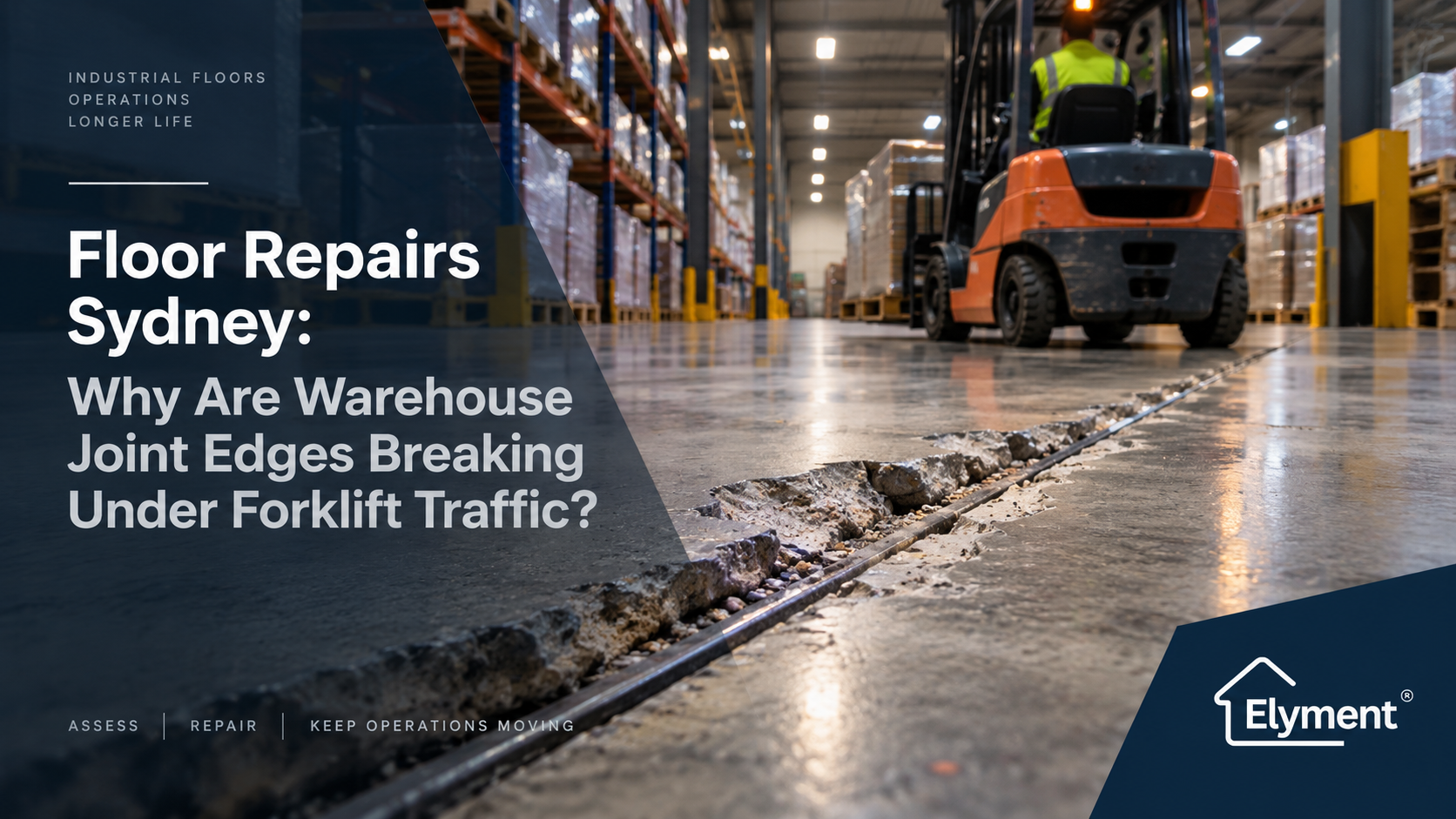
Warehouse joint edges usually break because repeated forklift wheel crossings concentrate impact at the concrete arris, especially where a joint has opened, lost support, moved vertically or has failed filler. In Sydney industrial facilities, the correct response is not to simply skim over the damage. The joint type, movement, load transfer, slab condition and forklift route should be assessed first so the repair restores edge support without incorrectly locking a joint that still needs to move.
In a busy warehouse, a strip of damaged concrete only 20 or 30 millimetres wide can become an operational problem far larger than its footprint.
The damage often appears along a construction joint or saw-cut joint running across a forklift aisle. First, a small corner breaks away. The forklift continues crossing it. The exposed edge becomes less supported, additional fragments release and the defect gradually widens. What began as a chipped arris can become a rough transition that operators feel on every crossing.
The temptation is to classify this as ordinary concrete wear and patch the missing section. That can work when the problem is genuinely superficial. It can also lead to another failure if the joint is opening, rocking, vertically displaced or transmitting wheel loads poorly.
For Sydney owners, warehouse managers, facility teams and industrial landlords, the more useful question is therefore not simply, "Which repair product is strongest?" It is, "Why is this particular edge being repeatedly damaged?"
The Damage Is Happening At A Stress Concentration Point
The upper corner of concrete beside a floor joint is commonly described as the joint arris. Unlike the centre of a continuous slab panel, that edge terminates at a gap.
When a forklift wheel crosses a sound, well-supported joint, the transition may be relatively uneventful. When the joint is open, poorly filled, uneven or locally unsupported, the wheel can effectively strike the edge rather than roll smoothly across it.
Repetition matters. A cross-aisle joint near dispatch, a loading zone or the entrance to a high-volume storage aisle may be crossed hundreds of times while a quieter joint elsewhere in the same slab remains relatively intact.
Joint-edge deterioration can be accelerated by combinations of:
- Repeated forklift crossings over the same wheel path.
- Turning or braking close to the joint.
- An open joint that leaves the arris insufficiently supported.
- Failed, missing or inappropriate joint filler.
- Small vertical differences between adjoining slab panels.
- Loss of support beneath one side of the slab.
- Poor load transfer across the joint.
- Weak or fractured concrete around the original joint.
- Previous repairs that have debonded from the surrounding concrete.
- Contamination that prevents replacement material bonding properly.
That is why an industrial warehouse concrete floor repair should begin with the failure mechanism rather than a catalogue of patching materials.
Sydney's Warehouse Growth Makes Floor Performance More Operationally Important
The issue is particularly relevant across Western Sydney, where established industrial precincts are being joined by significant new logistics and warehousing development.
The NSW Government's Western Sydney Employment Area is explicitly planned for uses including transport, logistics and warehousing. Further west, infrastructure and development around the Aerotropolis are expanding the region's freight and distribution role.
More distribution activity does not automatically mean more damaged floors. It does mean the operational performance of industrial slabs matters. Modern facilities can have tightly programmed inbound and outbound movements, defined forklift routes, automated equipment, high-density storage and limited tolerance for closing an aisle unexpectedly.
A floor repair therefore has two jobs: restore the physical joint and return the route to service without creating another weak interface.
Not Every Broken Joint Edge Has The Same Cause
Looking at the damaged concrete from standing height rarely provides enough information to specify a durable repair.
A project team should first determine what kind of joint it is. A saw-cut contraction joint, construction joint, isolation joint and deliberately designed movement joint are not interchangeable conditions.
This distinction affects what can safely be rebuilt, filled or bonded.
- Small chips along an otherwise stable joint
- What the assessment should investigate: Concrete soundness, filler condition and forklift crossing pattern.
- Why it matters: A local edge repair may be sufficient if the joint remains stable.
- Joint widening with recurring edge loss
- What the assessment should investigate: Joint movement and suitability of the existing filler.
- Why it matters: A rigid cosmetic patch may fail again if movement continues.
- One slab panel sits higher than the other
- What the assessment should investigate: Differential movement, support and load transfer.
- Why it matters: Repairing only the broken corner may leave the wheel-impact mechanism unchanged.
- Repair material has separated from old concrete
- What the assessment should investigate: Preparation, contamination, repair geometry and product compatibility.
- Why it matters: A stronger repair compound cannot compensate for a poor bond interface.
- Deep cracking or extensive breakout beside the joint
- What the assessment should investigate: Depth of failure, reinforcement, dowels and surrounding slab condition.
- Why it matters: The scope may extend beyond a surface repair.
- Joint damage repeatedly follows one forklift lane
- What the assessment should investigate: Traffic frequency, speed, approach angle, turning and braking.
- Why it matters: Operational loading may explain why one location deteriorates faster than the rest of the floor.
The Assessment Should Extend Beyond The Visible Spall
A credible floor-repair scope normally maps the damage before demolition begins.
That sounds administrative, but it can materially change the repair quantity. A warehouse may initially report five damaged joints. Closer inspection may show that one joint has ten metres of intermittent deterioration, another has a local vertical step and a third contains an old repair that is already hollow or loose.
A practical condition survey can record:
- Joint location and type. Identify whether it is a saw-cut, construction or movement joint.
- Length of visible edge failure. Map both sides rather than pricing only the most obvious breakout.
- Joint width. Record whether the gap is consistent or changing.
- Differential elevation. Check whether adjoining panels remain flush.
- Concrete integrity. Identify loose, hollow, cracked or weak material beyond the visible edge.
- Existing filler. Determine whether it is missing, debonded, excessively soft, excessively rigid or otherwise unsuitable for the joint condition.
- Traffic pattern. Record whether forklifts cross straight, turn, brake or accelerate over the defect.
- Previous repair history. A recurring failure often provides useful evidence about the original repair geometry or preparation.
- Operational constraints. Establish when the aisle can be isolated and when forklift access must resume.
Where the investigation reveals significant vertical movement, rocking panels, suspected support loss, deep structural cracking or defective load-transfer components, the appropriate next step may include engineering assessment rather than repeated cosmetic patching.
Why Simply Filling The Missing Concrete Can Fail
A repair can be extremely hard and still fail.
Strength is only one part of the system. Geometry, preparation, bond, curing, traffic return and joint behaviour are equally important.
Consider an active joint where both edges have spalled. Filling the entire damaged zone with a rigid material may create a visually impressive continuous strip. If that material bridges a joint that must continue moving, the repair can crack through the centre, debond at one side or push the next failure into the adjoining concrete.
Conversely, using a soft sealant alone where the arris itself has broken away may protect the gap without rebuilding the load-bearing concrete edge.
Successful floor repairs in Sydney warehouses therefore often separate two functions:
- Reconstruct the damaged concrete edge.
- Treat the joint itself with a system appropriate to its intended movement and traffic.
The Repair Method Depends On What The Inspection Finds
There is no single repair detail suitable for every industrial joint.
Localised arris reconstruction
Where the surrounding concrete is stable and the damage is confined to the joint edge, loose material can be removed back to sound concrete and the arris reconstructed using a repair system specified for the depth, substrate and return-to-service requirements.
The repair geometry matters. Thin, unsupported feather edges are vulnerable in a forklift route. Preparation should create a sound interface consistent with the selected manufacturer's installation requirements.
Joint filler replacement
Some industrial saw-cut or construction joints use semi-rigid fillers designed to support joint shoulders while accommodating limited slab behaviour.
If that material has deteriorated, recessed or separated from the edges, replacing the concrete alone may leave the original problem unresolved.
Movement-joint treatment
A joint specifically intended to accommodate significant movement should not automatically be filled with the same rigid system used for a damaged saw-cut.
Its movement function must be preserved. The repair product and joint treatment should follow the applicable design, engineering and manufacturer requirements.
Deeper slab remediation
Widespread cracking, pumping, rocking, voiding, failed load transfer or deep deterioration can move a project beyond ordinary surface patching. Local full-depth repair, load-transfer remediation or slab replacement may need to be considered after appropriate investigation.
Elyment's Sydney warehouse floor preparation and levelling service approaches industrial slabs in the context of traffic, joints, future use and handover requirements rather than treating surface appearance as the only criterion.
The Difficult Part In An Operating Warehouse Is Often The Programme
A repair system cannot be considered independently of warehouse operations.
If the affected joint crosses the principal forklift path between receiving and racking, taking the entire route out of service may interrupt dispatch, replenishment and stock movement.
SafeWork NSW's forklift safety guidance emphasises traffic-management planning and separation between moving forklifts and people. Repair works introduce another reason to formally control the traffic zone rather than expecting forklifts to simply steer around workers and uncured patches.
A staged repair programme can look like this:
- Map the affected joints. Group repairs according to operational zones rather than treating each defect as an isolated call-out.
- Agree temporary routes. Determine which forklift paths can be closed without compromising emergency access or safe traffic separation.
- Isolate the repair zone. Remove forklift and pedestrian exposure before cutting, chasing, grinding or demolition begins.
- Prepare back to sound material. Remove fractured edges, defective filler and previous repairs where required.
- Reassess the exposed condition. The true depth and extent of the defect often becomes clearer after loose concrete has been removed.
- Install the approved repair system. Reconstruct the arris and treat the joint according to its intended behaviour.
- Protect the cure window. Do not allow production pressure to determine traffic reopening before the specified return-to-service condition is achieved.
- Inspect the finished transition. Confirm the wheel path is clean, stable and suitable for handover.
- Reopen the lane and move to the next zone. Staging can maintain partial operations while preventing forklifts from crossing unfinished work.
For projects where multiple preparation trades need to operate around an active business, Elyment's commercial floor preparation and programme coordination pathway provides a useful framework for sequencing access, preparation and final handover.
Grinding And Concrete Removal Bring Their Own NSW Controls
Edge repairs can involve saw cutting, grinding, chasing or mechanically removing concrete.
SafeWork NSW notes that concrete can contain crystalline silica and that processing activities can generate respirable crystalline silica dust. Its crystalline silica guidance identifies appropriate planning and dust-control measures, including effective dust capture.
On an operating warehouse site, that has practical consequences for:
- Work-zone isolation.
- Dust extraction.
- Adjacent staff and stock.
- Equipment selection.
- Cleaning.
- PPE and respiratory protection where required.
- Forklift-route diversions.
- The timing of reopening the area.
Elyment's broader Sydney flooring preparation and substrate assessment services cover demolition, concrete preparation, grinding, levelling and readiness handovers where several of these stages need to be coordinated under one scope.
What Usually Makes The Repair More Expensive
The length of the broken edge is only one pricing factor.
- Damage on both sides of the joint
- Why it changes the scope: More concrete needs removal, reconstruction and finishing.
- Deep deterioration
- Why it changes the scope: The job moves beyond a shallow edge rebuild.
- Failed previous repairs
- Why it changes the scope: Existing material may have to be completely removed before a reliable bond can be established.
- Active slab movement
- Why it changes the scope: Additional investigation and a different joint treatment may be required.
- Night or weekend access
- Why it changes the scope: Labour, mobilisation and operational coordination become part of the cost.
- Short reopening window
- Why it changes the scope: The repair system must satisfy both technical and programme requirements.
- Multiple isolated defects
- Why it changes the scope: Mobilisation and traffic staging can matter more than the total repair area.
- Continuous forklift operations
- Why it changes the scope: Temporary routes and staged closures may be required to keep the facility functioning safely.
This is why comparing warehouse repair quotes only by dollars per linear metre can be misleading. Two contractors may be pricing fundamentally different assumptions about demolition depth, joint treatment, access, curing and handover.
The Repair Scope Should Define The Handover, Not Just The Material
Property managers and operators can reduce ambiguity by requiring the scope to state what condition will exist when the contractor leaves.
A stronger scope can identify:
- Which joints and sections are included.
- How defective concrete will be identified and removed.
- Whether existing filler is being replaced.
- How active joints will be preserved.
- What happens if deeper defects are exposed.
- Who determines whether engineering input is required.
- The planned curing and protection period.
- The conditions for forklift reopening.
- Dust and work-zone controls.
- The required finished transition at the wheel path.
For larger industrial portfolios, this can also create useful maintenance intelligence. If the same joint fails again, the owner has a record of what was removed, what was installed and what conditions existed at the time.
The Key Question Is Whether The Edge Failed Or The Joint System Failed
A chipped concrete corner and a moving industrial joint can look similar during a quick warehouse walk-through. They are not the same repair problem.
If the concrete immediately beside the joint is sound, the panels remain stable and the deterioration is localised, a properly prepared edge reconstruction may provide a straightforward solution.
If the joint is widening, vertically displaced, poorly supported or repeatedly failing beneath the same forklift route, another patch without investigation can simply reset the failure cycle.
The more defensible approach to floor repairs Sydney projects is therefore to establish the joint condition first, select the repair around that diagnosis and then programme the work around the warehouse's actual traffic requirements.
Review The Failure Before Repairing The Surface
Assess damaged warehouse joints, forklift routes, repair sequencing, concrete preparation, safety requirements and reopening constraints before committing to a remediation scope.
Request a Warehouse Floor Repair Review
What Sydney Property Teams Should Take Away
Warehouse joint-edge deterioration is rarely solved by asking for the hardest available patching compound. The repair needs to respond to the joint, the surrounding slab and the way forklifts actually use the floor.
For owners and project teams, the most useful sequence is simple: inspect, classify, expose, reassess, repair, protect and verify. That process can prevent a small damaged arris from becoming a repeated maintenance item across one of the busiest routes in the building.
Sources and References
- NSW Government: Western Sydney Employment Area
- SafeWork NSW: Forklift safety guidance
- SafeWork NSW: Crystalline silica guidance
- Elyment: Sydney warehouse floor preparation and levelling service
- Elyment: Commercial floor preparation and programme coordination pathway
- Elyment: Sydney flooring preparation and substrate assessment services
- Elyment: Contact
Review The Failure Before Repairing The Surface
Assess damaged warehouse joints, forklift routes, repair sequencing, concrete preparation, safety requirements and reopening constraints before committing to a remediation scope.
Request a Floor ReviewRelevant next actions
Explore the ELYMENT service most closely connected to this article.