Google DeepMind Genie 4: Features, How It Works and Access
Explore Google DeepMind Genie 4 features, how its AI world simulations work and who can use it. Understand early access limits before planning to try the model.
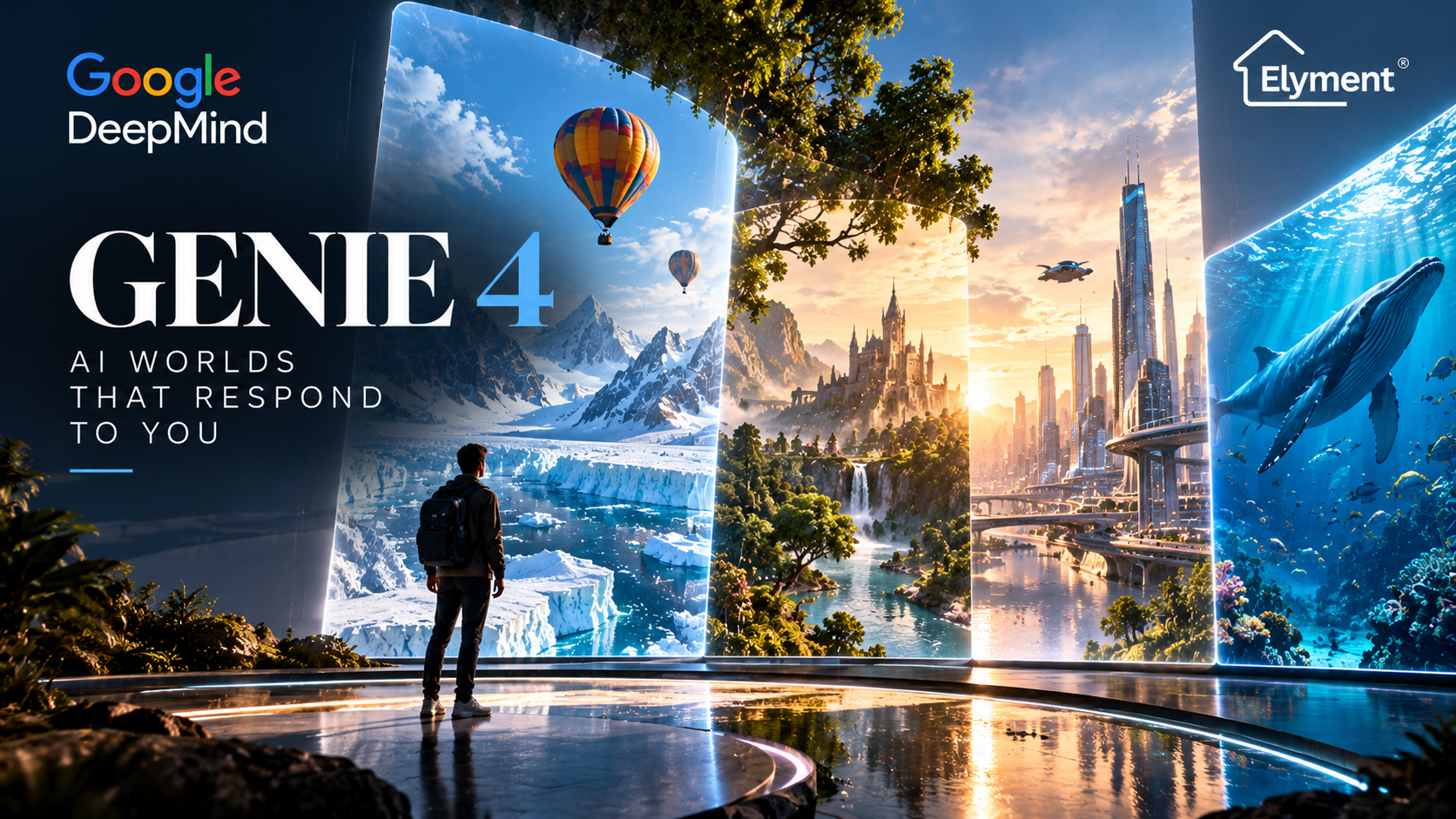
Google DeepMind's Genie 4 is an experimental AI world model that generates interactive environments with realistic movement, native audio and real-time controls. Announced on 27 October 2026, it is initially available to selected research testers, with broader access planned. For Sydney businesses, its potential includes creative pre-visualisation, training and scenario exploration, although generated environments cannot replace verified site information, engineering assessments or operational approvals.
ELYMENT Insights | Artificial Intelligence & Business Operations | Sydney, NSW | 28 October 2026
Google Is Moving Beyond AI That Simply Produces Content
Artificial intelligence has become increasingly capable of generating text, photographs, video and software. Google DeepMind's latest announcement points towards something more interactive.
On 27 October 2026, Google DeepMind introduced Genie 4, a new generation of its experimental world-simulation technology.
Instead of producing only a fixed image or prerecorded video, Genie 4 is designed to generate an environment that responds to the actions and instructions of the person exploring it.
A user can move through a scene, introduce an event, alter the weather, change the camera's position or introduce new objects and characters.
The model then attempts to simulate what happens next, including how objects move, how people respond and how the environment sounds.
The distinction is significant.
Conventional generative video presents a sequence of images selected during production. An interactive world model allows the viewer's actions to influence how the sequence develops.
For industries involved in property, infrastructure, design and operational planning, this introduces a potentially useful category of visual technology.
It also raises a practical question: how much of a convincing simulated world can be trusted to represent a real physical environment?
What Is Google DeepMind Genie 4?
Genie 4 is a generative world model developed by Google DeepMind.
A world model attempts to simulate an environment and predict how it changes in response to actions, movement and external events.
Unlike a conventional chatbot, which primarily generates responses through language, Genie 4 produces an evolving visual environment that users can explore and influence.
Google's announcement identifies four important areas of development:
- Real-time world control: Users can steer environments through natural-language instructions and navigation controls.
- More realistic physical behaviour: The model can simulate movement, collisions, environmental changes and human actions.
- Native audio generation: Sound is generated alongside the evolving world, including environmental audio, music and dialogue.
- Multi-step event simulation: Gemini models can help interpret goals and guide changing sequences of events.
These are announced research capabilities rather than evidence that Genie 4 can reproduce every physical situation accurately.
Google acknowledges that the technology remains experimental, particularly when simulations become more complex or continue for longer periods.
How Genie 4 Works: The Relationship Between Genie and Gemini
One of the more technically important details in Google's announcement is the relationship between Genie 4 and the wider Gemini model family.
Google describes Genie 4 as incorporating capabilities from Gemini models to improve the appearance, behaviour and coherence of generated environments.
Gemini Omni helps anchor simulations in real-world appearance and behaviour.
Other Gemini models provide additional reasoning that helps the simulation maintain continuity as events develop.
In Google's demonstration of complex event simulation, Gemini 3.8 Flash operates as a guiding agent.
It observes the developing environment, interprets objectives, breaks tasks into steps and evaluates whether those steps have been completed.
Genie 4 handles the generation of the evolving simulated environment.
A Simplified Interaction Process
- Establish the environment. The user describes or provides visual context for the scene.
- Generate the world. Genie 4 creates an interactive environment based on the supplied context.
- Explore and interact. Navigation controls allow the user to move through the generated environment.
- Introduce changes. Text instructions can alter events, characters, weather or camera movement.
- Continue the simulation. Genie and supporting Gemini components attempt to maintain a coherent sequence as the environment responds.
This description simplifies a complex research architecture.
It should not be interpreted as confirmation that every future consumer or developer product will expose identical controls or capabilities.
Elyment has previously examined Google's Gemini 4 Argon and long-running coding agents.
Genie 4 addresses a different problem: generating an interactive environment rather than primarily producing code or completing digital tasks.
The Five Capabilities That Matter Most
1. Environments That Respond to Instructions
Genie 4 allows users to modify a scene while exploring it.
Google's demonstrations include changes to weather conditions, camera positions and characters.
This could eventually give creative teams more freedom to explore alternatives without producing a completely new sequence for every proposed change.
2. More Convincing Human Movement
Google identifies realistic human movement and environmental interaction as an important advance.
The model can generate people who appear to respond to events and surrounding objects.
This may become valuable for storyboarding, interactive training concepts and early-stage experience design.
However, visually convincing movement does not demonstrate that the underlying physics or human behaviour is always correct.
3. Sound Generated Within the World
Genie 4 introduces native audio generation into Google's real-time world-model research.
Environmental sounds can develop with the scene.
Google's examples include wind, water, music and interactive conversations.
This is different from manually attaching a separate audio track to a completed video.
4. Complex Sequences of Events
Gemini's involvement allows Google to investigate more structured simulations involving multiple actions.
For example, Google has demonstrated research involving Gemini models and simulated robotic activities.
The objective is to improve the relationship between an instruction, the resulting action and subsequent changes in the environment.
5. Interactive Creative Prototyping
Trusted testers are examining Genie 4 for activities such as filmmaking, game development, journalism and engineering-related simulations.
The potential advantage is faster exploration of an idea before substantial production resources are committed.
That remains an emerging use case, not a guarantee of commercial-grade performance or unrestricted access.
Genie 4 Availability: Who Can Actually Use It?
Access is one of the most important qualifications surrounding Google's announcement.
As at 28 October 2026, Genie 4 is not a generally available consumer or developer product.
Google says the model is being introduced through a research preview involving trusted testers.
The company intends to expand access through Project Genie and selected developer channels.
Genie 4 Availability by User Group
1. Trusted Research Testers
- Announced access position: Initial Genie 4 research-preview access is being rolled out.
2. Google AI Ultra Subscribers
- Announced access position: Genie 4 access through Project Genie is planned for a future rollout.
3. Gemini API Partners
- Announced access position: Early access is planned for selected partners.
4. Google AI Studio Users
- Announced access position: Early partner access is planned. General availability is not confirmed.
5. Australian Businesses
- Announced access position: No confirmed general Australian availability date has been announced.
Google has published a Genie 4 information page with a link to its Project Genie waitlist.
Joining a waitlist does not guarantee immediate access.
The distinction between Project Genie and Genie 4 is also important.
Google previously introduced Project Genie as an experimental experience for exploring AI-generated worlds.
Access to an earlier Project Genie experience should not be confused with confirmed access to the newly announced Genie 4 model.
Commercial API pricing, broad access conditions and a definitive Australian rollout date have not been established in the announcement.
Where Sydney Businesses Could Find Practical Value
The immediate commercial significance of Genie 4 is not that it can replace a project-management system or a specialist design application.
Its more interesting potential lies in helping people explore situations that are difficult to communicate through static images.
Property Development and Design Communication
Consider a Sydney property team preparing an early-stage concept for a residential refurbishment.
A future interactive world-model workflow could allow stakeholders to explore different visual concepts and experience how a proposed environment might feel from changing viewpoints.
Changes in lighting, visual materials or surrounding activity could potentially become easier to demonstrate.
However, a generated walkthrough is not automatically an accurate representation of the actual property.
Dimensions, building services, structural conditions and the approved scope would still require verification against authoritative project information.
Construction Logistics and Project Sequencing
Interactive simulation may eventually support early discussions about how activities could occur within a site.
For example, a team could explore conceptual scenarios involving deliveries, temporary access routes and the interaction of different work activities.
In a Sydney apartment refurbishment, the underlying operational questions could include:
- How materials will reach the work area.
- Whether building access is restricted to particular hours.
- Which activities must finish before following trades can begin.
- How shared corridors and lifts will be protected.
- What contingency arrangements are needed if access or deliveries change.
These questions are suitable for structured planning discussions.
But Genie 4 has not been demonstrated as a validated construction scheduling, safety-engineering or logistics optimisation product.
The potential application described here is conceptual rather than a confirmed commercial feature.
Training and Operational Scenarios
A world model capable of responding to changing instructions could eventually help organisations develop interactive training scenarios.
This is relevant to industries where workers must understand changing physical environments.
However, businesses would need to validate the simulation against established procedures and actual operating conditions.
Elyment previously examined NVIDIA and Skild AI's research into robot learning.
The two developments address related but distinct technical challenges.
Robot learning concerns the ability to execute or generalise tasks. World simulation concerns the ability to generate environments and model how events unfold.
Combining these capabilities could support future research, but simulated success does not establish that a robot will perform safely or reliably in the physical world.
The Critical Limitation: Realistic Does Not Mean Accurate
One of the most important facts in Google's documentation concerns the accuracy of the worlds being generated.
Google explicitly acknowledges that Genie 4 cannot reproduce real-world locations with perfect accuracy.
It also identifies continuing limitations involving:
- Visual consistency over time.
- Object permanence when scenes change or users move around.
- Complex physical interactions.
- Multiple independently acting characters or agents.
- Accurate spatial representation.
- Reliable text rendering.
- Real-time audio accuracy.
- Continuous interaction over extended periods.
Google's product documentation describes interaction lasting a few minutes rather than extended sessions.
These limitations are particularly important in property and infrastructure environments.
A visually convincing corridor does not establish its width.
A simulated stairway does not demonstrate compliance with applicable construction requirements.
A generated flooring installation sequence does not confirm substrate suitability, material compatibility or installation tolerances.
In NSW, development approvals and their conditions remain separate from visual concepts.
The NSW Planning Portal explains the development consent process and the need to address changes to approved plans.
Similarly, SafeWork NSW's guidance on safe work method statements requires appropriate, site-specific planning for high-risk construction work.
An AI-generated environment does not replace these obligations.
The practical distinction is between using a simulation to communicate an idea and relying on it as evidence that an activity is feasible, safe or approved.
Privacy, Synthetic Media and Commercial Governance
Greater realism also introduces questions about the information used to produce simulations.
Google says Genie 4-generated video and audio will include SynthID, its technology for embedding imperceptible digital watermarks.
Such watermarking can support identification of synthetic content, but it does not independently establish whether the content is factually accurate.
For Sydney businesses considering future world-model tools, the governance questions may involve confidential building plans, customer information, private property photographs and commercially sensitive workflows.
The Office of the Australian Information Commissioner's guidance on commercial AI products recommends due diligence, data minimisation and appropriate human oversight.
Whether particular Privacy Act obligations apply depends on the organisation and the information being handled.
Before using any future commercial Genie 4 service, businesses should examine its actual contractual terms, data-handling arrangements and access controls.
Those details should not be assumed from the existence of a research demonstration.
What Organisations Should Evaluate Before Adopting World Models
Businesses evaluating interactive AI environments should distinguish between the quality of a demonstration and the reliability of an operational workflow.
A useful assessment would examine five areas.
- Purpose: Is the simulation intended for creative exploration, training, communication or a consequential operational decision?
- Accuracy: Which details must correspond to verified real-world conditions, and how will they be checked?
- Access and cost: Is the model available to the organisation, and what are the applicable commercial terms?
- Data protection: What information will be supplied to the system, and who can access it?
- Accountability: Which qualified person will approve outputs before operational reliance?
A world model may eventually become an effective way to explore alternative scenarios.
However, the commercial test should be whether it improves an actual decision or workflow, rather than simply producing an impressive visual result.
Elyment has also examined the operational accountability challenges of Google's Gemini workplace agents.
Those systems concern the execution of digital work.
Genie 4 introduces a different issue: whether a generated representation of the physical world can support meaningful exploration without being mistaken for verified reality.
What Happens Next for Genie 4?
Google's immediate priority is to learn from selected research testers before expanding access.
The planned next channels include Google AI Ultra subscribers through Project Genie and selected developer partners.
The company has not established a firm public timetable for general Australian availability.
Nor should the announcement be interpreted as evidence that interactive world models are ready to replace established engineering, architectural or operational software.
Genie 4 is significant because it demonstrates where generative AI research is heading.
AI systems are beginning to move beyond producing isolated pieces of content towards creating environments that respond to human interaction.
For Sydney's property, renovation and infrastructure sectors, the opportunity is worth watching.
The immediate lesson, however, is straightforward.
The ability to simulate an environment convincingly is not the same as the ability to verify it.
That distinction will determine whether world-model technology becomes a valuable operational tool or remains primarily an impressive creative demonstration.
Planning a Sydney Property or Renovation Project?
Explore practical project planning, operational coordination and delivery considerations with Elyment.
Sources and References
- Google DeepMind: Genie 4, A New Generation of World Simulation, 27 October 2026
- Google DeepMind: Genie 4 Model Information, Capabilities and Limitations
- Google: Introducing Genie 4
- NSW Planning Portal: Development Approvals
- SafeWork NSW: Safe Work Method Statements
- OAIC: Guidance on Privacy and Commercial AI Products
Related Elyment Resources
- Elyment: Google Gemini 4 Argon, Coding Agents and 1M Token Output
- Elyment: NVIDIA and Skild AI's Robot Breakthrough — Can One Video Teach a New Job?
- Elyment: Gemini Agent for Work — Should Sydney Businesses Use It?
Technology Moves Forward. Successful Projects Still Need Practical Planning.
From renovation planning and project sequencing to operational coordination, Elyment helps Sydney property owners and businesses approach complex projects with greater clarity.
Discuss Your ProjectRelevant next actions
Explore the ELYMENT service most closely connected to this article.