Google Project Suncatcher: AI Data Centres in Space
Google Project Suncatcher puts AI chips in orbit, raising questions about power, cooling, latency, launch cost and whether space could host future data centres.
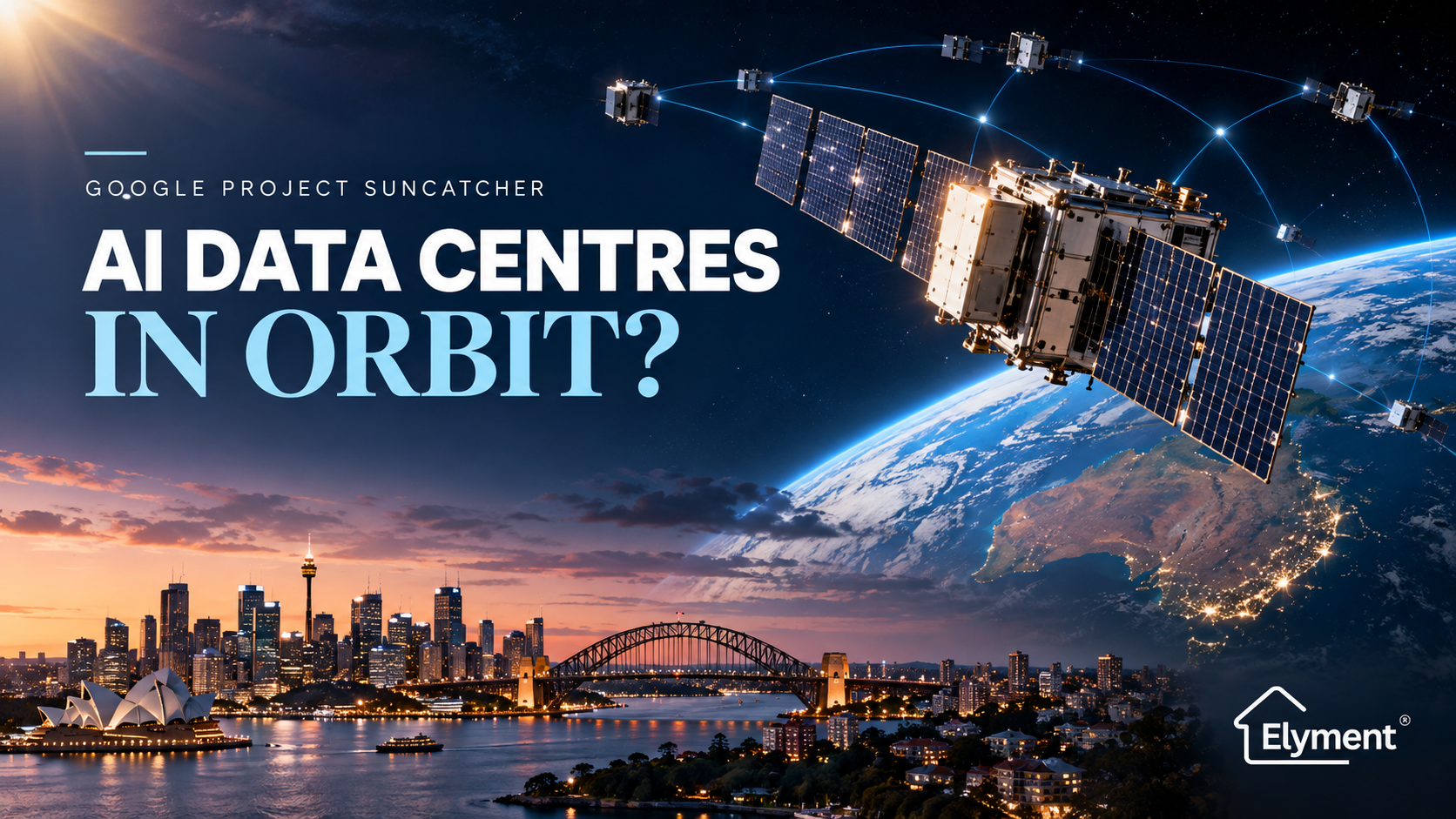
Google’s Project Suncatcher is testing whether AI computing can eventually move beyond terrestrial data centres into solar-powered satellite clusters. For Sydney and NSW, the immediate significance is not that local data centres are about to disappear. It is that AI infrastructure may eventually gain another location option as NSW confronts rapidly increasing electricity demand, grid connections, water requirements and the physical cost of scaling computing capacity.
The most important thing about Google putting Tensor Processing Units into orbit is also the easiest thing to misunderstand.
The satellite being prepared under Google: Project Suncatcher is not a functioning replacement for a hyperscale data centre.
It is an engineering experiment.
Google is sending AI hardware into low Earth orbit to discover whether its chips can survive launch vibration, radiation, thermal extremes and the unusual problem of removing heat when there is no surrounding air.
If those problems can eventually be solved at commercial scale, however, the experiment raises a much bigger infrastructure question.
What happens when the physical location of computing power is no longer assumed to be a warehouse-sized building connected to land, water, electricity and fibre?
The First Mission Is a Hardware Test, Not an Orbital Data Centre
As at 29 September 2026, Google had scheduled its first in-orbit Project Suncatcher experiment for SpaceX's Transporter-18 rideshare mission, working with satellite company Planet.
The initial objective is deliberately narrow. Google wants real-world data on how its TPU hardware responds to launch and the low Earth orbit environment.
The company says a journey into orbit exposes the spacecraft to sustained acceleration of up to approximately 10 times Earth's gravity, while individual components can experience considerably greater loads. Radiation presents another problem because energetic particles can disrupt electronic systems and introduce errors into memory and computation.
Google's ground testing has been encouraging. Its earlier Project Suncatcher research reported that Trillium TPUs endured radiation testing beyond the anticipated shielded dose for a five-year low Earth orbit mission without total-ionising-dose failures during the test.
Orbit now provides the more difficult validation.
Launch vibration and acceleration
Why it matters: AI hardware must arrive operational after an unusually violent deployment process.
Terrestrial equivalent: Transport, installation and commissioning risk.
Radiation tolerance
Why it matters: Memory errors or hardware degradation could undermine reliable long-duration computing.
Terrestrial equivalent: Equipment reliability and environmental protection.
Thermal management
Why it matters: Heat cannot be removed using conventional airflow in a vacuum.
Terrestrial equivalent: Data-centre cooling infrastructure.
Satellite communications
Why it matters: Large AI workloads require extremely high-speed connections between accelerators.
Terrestrial equivalent: High-bandwidth internal data-centre networking.
Formation control
Why it matters: Future satellites may need to remain unusually close together for high-capacity optical links.
Terrestrial equivalent: Physical rack, network and campus topology.
The Attraction Is Not Space Itself. It Is Energy.
Today's AI infrastructure problem is increasingly physical.
Advanced processors require enormous supporting systems: electricity generation, grid connections, substations, cooling, water strategies, telecommunications, backup power, specialised construction and long-term maintenance.
Elyment has already examined how AI data-centre expansion is becoming a project-delivery and skilled-trades challenge and why computing growth now competes directly for capabilities normally associated with major infrastructure.
Project Suncatcher approaches the constraint from another direction.
Instead of asking how much more generation, cooling and land can be assembled around a terrestrial data centre, Google is investigating whether some of the computing itself could eventually move closer to the energy source.
Google says that in the right orbit, solar panels can generate up to eight times as much energy as equivalent panels on Earth because they can access near-continuous sunlight without cloud cover, night-time interruption or the same atmospheric losses.
A dawn-dusk sun-synchronous orbit could therefore create an unusually productive solar environment while reducing the battery capacity required to bridge periods without sunlight.
That is the strategic proposition behind Suncatcher.
It is not simply moving servers higher.
It is testing whether the energy architecture around computing can be redesigned.
Moving the Compute Does Not Remove the Infrastructure
The phrase “data centre in space” can make the concept sound almost infrastructure-free.
It is the opposite.
A viable orbital computing network would replace familiar terrestrial dependencies with a new and potentially more complicated dependency chain.
- AI hardware still has to be manufactured. TPUs, memory, networking components, solar systems, radiators and satellite structures remain industrial products built on Earth.
- Launch becomes part of data-centre deployment. A terrestrial server can arrive by road. Orbital equipment requires launch capacity, launch integration, weather windows and mission planning.
- Cooling becomes a spacecraft engineering problem. Airflow is unavailable in a vacuum, so heat must be transferred through the spacecraft and radiated into space.
- Networking becomes formation flying. Google says future AI workloads could require optical connections delivering tens of terabits per second between satellites.
- Maintenance becomes replacement-or-redundancy planning. Repairing a failed rack inside a Sydney facility is difficult but routine. Replacing failed orbital hardware changes the cost and recovery model.
- Ground infrastructure remains essential. Information ultimately has to enter and leave the orbital computing environment, creating requirements for terrestrial communications, routing, control and resilience.
That distinction is critical for infrastructure investors.
Elyment's analysis of the financing risk behind hundreds of billions of dollars of proposed AI infrastructure examined how the full economic asset extends beyond the processor itself.
Project Suncatcher extends that principle into orbit.
Cheap solar energy alone cannot determine viability. Launch cost, satellite production, utilisation, networking, reliability, replacement cycles and the useful economic life of rapidly changing AI hardware also become part of the calculation.
Google's Network Ambition Shows How Different the Architecture Could Become
The long-term concept is considerably more ambitious than putting an isolated accelerator on a satellite.
Google's research has modelled compact clusters of satellites connected by free-space optical links.
In one illustrative model, researchers examined an 81-satellite formation at approximately 650 kilometres altitude within a cluster roughly one kilometre in radius.
That configuration is not a deployment commitment. It is a modelling case used to understand orbital dynamics.
The communications problem may be even more significant.
Large machine-learning systems do not behave like independent computers occasionally exchanging files. Thousands of accelerators can need extremely high-bandwidth, low-latency communication during the same workload.
Google's research says performance approaching terrestrial data-centre architectures could require inter-satellite connections measured in tens of terabits per second.
Its laboratory demonstrator has already achieved 800 Gbps in each direction using a single transceiver pair, or 1.6 Tbps combined.
The next major step is expected in 2027, when Google plans to use two satellites to test the precision optical links required for distributed computing.
The Most Difficult Problem May Be Heat, Not Power
Abundant solar energy solves only one side of the equation.
Every watt consumed by a processor ultimately contributes heat that has to go somewhere.
Terrestrial data centres have enormous mechanical systems dedicated to this task. They can use air cooling, chilled-water systems, liquid cooling, heat exchangers, cooling towers and other architectures depending on the facility.
Space provides no surrounding atmosphere through which ordinary convection can remove heat.
Google's experimental system therefore combines technologies including heat pipes and radiators. The company has been testing the approach inside thermal vacuum chambers before observing how it performs in actual orbit.
This is a useful reminder for the broader AI infrastructure sector.
Energy supply attracts the headlines, but successful computing infrastructure depends on the entire thermal, electrical, communications and control system remaining balanced.
Why This Matters in NSW Right Now
Orbital data centres remain experimental, but the terrestrial capacity problem they are attempting to address is already visible in NSW.
The NSW Government's 2026 data-centre connection reform consultation reported that, as of July 2026, data centres were seeking NSW network connections totalling up to 28 gigawatts.
Approximately 13 GW was described as being in advanced connection discussions. The NSW Government noted that 13 GW exceeds the state's average daily electricity demand.
That does not mean all proposed capacity will be constructed simultaneously, or at all.
It does demonstrate the scale of the infrastructure queue confronting network planners.
The Australian Government has separately published national expectations for data-centre and AI infrastructure developers covering energy, water, national interest, local skills and research capability.
For Sydney, this makes Project Suncatcher more than an unusual Silicon Valley engineering experiment.
It represents one possible long-term response to a constraint Australia is already trying to manage: AI computing demand is scaling faster than some of the conventional infrastructure supporting it can easily be delivered.
Orbital Compute Would Probably Complement Sydney Data Centres, Not Replace Them
The strongest interpretation of Suncatcher is not that Sydney's data-centre campuses eventually become redundant.
Different workloads have different infrastructure needs.
Access to abundant solar energy
Terrestrial infrastructure advantage: Established generation and grid systems.
Potential orbital advantage: Near-continuous solar exposure in suitable orbit.
Hardware maintenance
Terrestrial infrastructure advantage: Technicians can access and replace equipment.
Potential orbital advantage: Limited.
Large-scale physical expansion
Terrestrial infrastructure advantage: Dependent on land, grid, water and approvals.
Potential orbital advantage: Potentially modular if launch economics improve.
Cooling
Terrestrial infrastructure advantage: Mature mechanical and liquid-cooling systems.
Potential orbital advantage: Requires specialised radiation-based heat rejection.
Data sovereignty and residency
Terrestrial infrastructure advantage: Location and legal jurisdiction can be structured conventionally.
Potential orbital advantage: Would require new legal and architectural consideration.
Hardware replacement cycles
Terrestrial infrastructure advantage: Equipment can be upgraded inside existing facilities.
Potential orbital advantage: Potentially dependent on future launches.
A future computing market could therefore become more distributed rather than simply migrating from Earth to orbit.
Some workloads may remain in metropolitan data centres close to users, telecommunications infrastructure and regulated data environments.
Others might eventually be processed in remote terrestrial facilities, sovereign facilities, edge devices or orbital infrastructure depending on economics, latency, security and energy requirements.
Elyment's earlier analysis of Amazon's expanding AI infrastructure investment highlighted how cloud computing increasingly depends on physical assets, energy systems and long-duration project delivery.
Suncatcher does not reverse that trend.
It potentially expands the definition of the physical asset.
The Project-Delivery Lesson Is More Immediate Than the Technology
Businesses in Sydney do not need an orbital computing strategy today.
There is, however, a practical lesson in the way Google is approaching the project.
The company is not beginning with a full-scale orbital AI network and hoping every engineering assumption works.
It is progressively validating dependencies.
Hardware survival comes first. Thermal behaviour follows. Optical networking and multi-satellite operation follow after that. Larger clusters only become credible if those earlier stages produce reliable evidence.
The same sequencing principle applies to far more ordinary infrastructure, technology and property projects.
- Identify the assumption most capable of stopping the project.
- Test that assumption before committing the entire programme.
- Separate laboratory performance from operational performance.
- Define handovers between equipment, infrastructure and operating teams.
- Build redundancy around components that cannot be repaired quickly.
- Do not confuse technical possibility with commercial viability.
That final distinction is particularly important.
Google's earlier research suggested that falling launch prices could eventually make orbital computing more economically competitive. Its modelling indicated that launch costs below US$200 per kilogram by the mid-2030s could materially change the economics.
That is a research assumption, not a current market price or a guarantee that orbital data centres will become economical.
Commercial viability also depends on satellite manufacturing, reliability, utilisation, networking, hardware depreciation and how frequently computing equipment must be replaced.
That is why the current experiment should be read as engineering evidence gathering rather than a declaration that terrestrial data centres have reached the end of their useful life.
Could Space Really Become the Next AI Data Centre?
Space could eventually become another location in the global computing architecture.
Project Suncatcher provides credible engineering reasons to investigate the possibility: unusually productive solar generation, modular satellites, specialised AI accelerators and high-speed optical networking.
It also exposes why the transition would be difficult.
Orbital infrastructure has to solve launch, heat rejection, radiation, communications, reliability, replacement, ground connectivity and economics at the same time.
For Sydney and NSW, the development matters because it arrives while policymakers are dealing with a very terrestrial problem: how to add enormous amounts of AI computing capacity without transferring unreasonable electricity, water and infrastructure costs to the rest of the economy.
The future may therefore not be a choice between data centres on Earth and data centres in space.
It may be a layered computing system in which infrastructure is placed wherever energy, connectivity, regulation, cost and operational resilience make the most sense.
Project Suncatcher's first satellite will not answer that question.
What it can do is reveal whether one of the industry's most unconventional infrastructure options deserves to progress to the next stage.
Review the Infrastructure Behind the Technology
Assess project dependencies, operational risks, approvals, infrastructure requirements and delivery sequencing before major technology decisions become physical project commitments.
Sources and References
- Google: Project Suncatcher
- Google Research: Exploring a space-based scalable AI infrastructure system design
- NSW Government: Data-centre connection reform consultation
- Australian Government: Expectations for data centres and AI infrastructure developers
Review the Infrastructure Behind the Technology
Assess project dependencies, operational risks, approvals, infrastructure requirements and delivery sequencing before major technology decisions become physical project commitments.
Request a Project Review