Grok Voice 3.0 in Tesla: Hands-Free AI, Connectors & Grok Bot
Grok Voice 3.0 brings hands-free AI to Tesla, but what can it actually do? Explore voice features, driving limitations, and what owners should check before use.
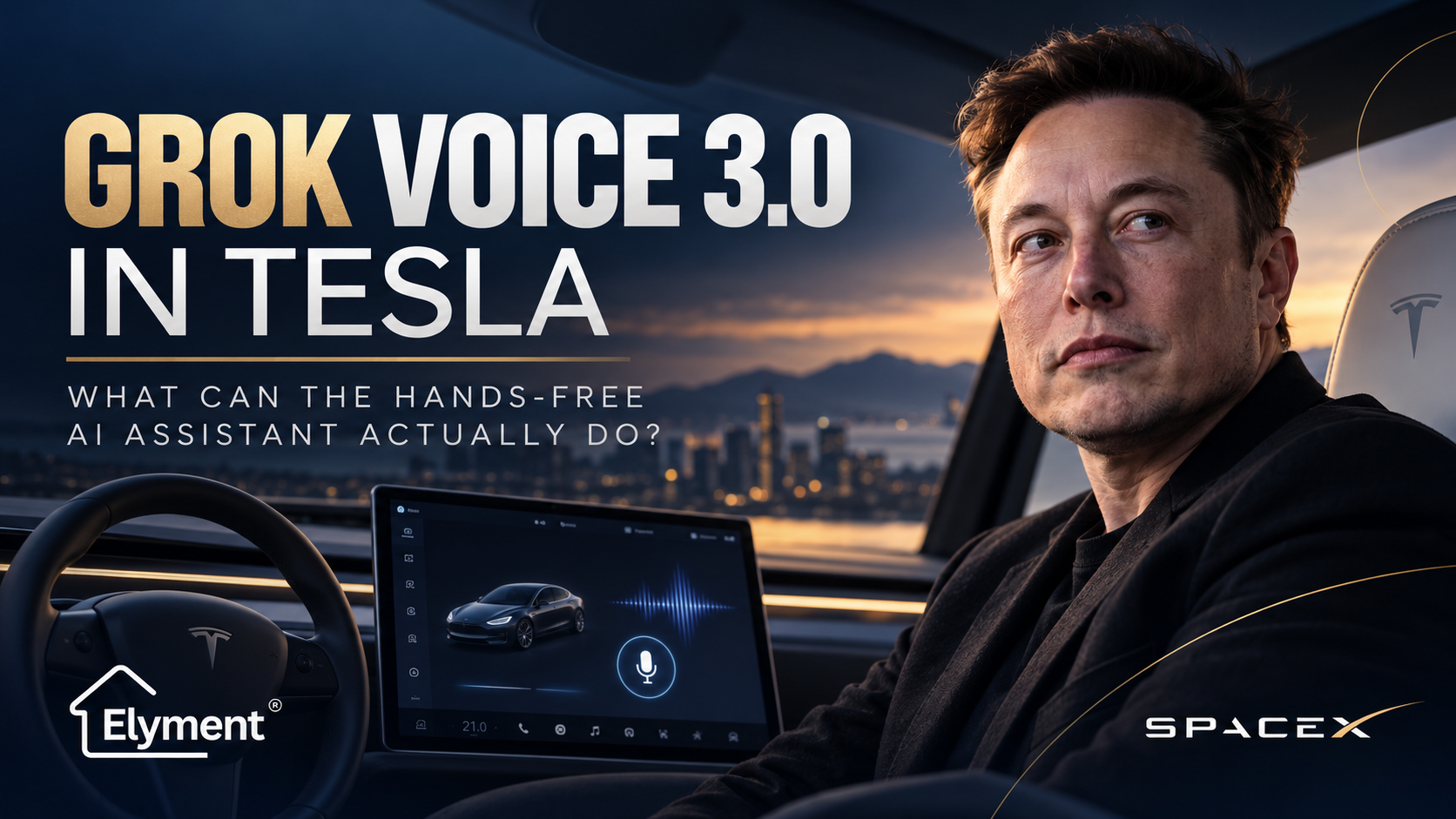
Announced on 14 October 2026, Grok Voice 3.0 promises more natural conversations in compatible Tesla vehicles. It can answer questions and support vehicle commands, while Grok Connectors can access linked email, calendars and files, and Grok Bot can undertake selected multi-step tasks. For Sydney and NSW drivers, capabilities depend on software, accounts, subscriptions and availability. Hands-free interaction does not remove road-safety or privacy responsibilities.
ELYMENT Insights | Technology & Operations | 19 October 2026
When the Car Starts Answering Back, What Happens Next?
A driver travelling across Sydney asks an in-car assistant whether an afternoon appointment has moved.
A conventional voice assistant might provide a general response or ask the driver to check a calendar manually. A connected AI assistant could potentially retrieve the relevant appointment, explain the change and help organise a response.
Those are different levels of capability.
The first requires speech recognition and a useful answer. The second requires authorised access to a personal account. The third may require the system to take an action in another application.
That distinction sits at the centre of SpaceXAI's 14 October announcement of Grok Voice 3.0.
The company presents its latest speech-to-speech model as a faster, more natural conversational system already supporting large volumes of interactions across Tesla and SpaceX services.
But the practical question for Australian motorists is not whether the assistant can maintain a conversation.
It is what the assistant is authorised and technically equipped to do after understanding the request.
What Changed With Grok Voice 3.0 on 14 October?
Grok Voice 3.0 is a speech-to-speech AI model. Unlike a conventional pipeline that separately transcribes speech, processes text and produces spoken output, a speech-to-speech system is designed to support more direct spoken interaction.
SpaceXAI identifies three particularly important improvements:
- Faster responses: The company claims conversational latency below one second.
- More natural turn-taking: The model is designed to manage pauses, interruptions and exchanges between speakers.
- Stronger speech reasoning: It is intended to interpret spoken requests and respond appropriately across more complex conversational situations.
According to benchmark results published alongside the announcement, Grok Voice 3.0 achieved 86.9 on Artificial Analysis's Speech-to-Speech Index and 97 per cent on Full Duplex Bench, a benchmark addressing conversational behaviours such as interruptions and turn-taking.
These are reported benchmark results, not independent evidence that every request made inside a moving vehicle will be understood correctly.
Road noise, competing voices, mobile connectivity and the complexity of individual instructions can still affect the real-world experience.
Importantly, the 14 October release also made Grok Voice 3.0 available through the company's developer API. That API release is distinct from confirming when a particular Australian Tesla receives an updated in-car feature.
For motorists, the most useful improvement may be an assistant that requires fewer repeated instructions. Whether that improvement translates into reliable task completion depends on the systems connected behind the conversation.
Three Different Capabilities Are Being Sold as One Experience
Tesla's product information describes a combination of conversational assistance, Grok Connectors and Grok Bot. The distinctions are important because the three capabilities carry different technical requirements and levels of authority.
- Grok conversational assistant
- What it can do: Answer questions, explain information and support specified vehicle functions.
- Important limitation: A spoken answer does not establish that an external action has been completed.
- Grok Connectors
- What it can do: Access supported linked services, including email, calendars and cloud files.
- Important limitation: Requires account connections, appropriate permissions and supported vehicle software.
- Grok Bot
- What it can do: Attempt supported multi-step tasks, including orders, reservations and appointments.
- Important limitation: Requires additional setup and subscription eligibility. Individual tasks can depend on external services.
This separation helps avoid a misleading assumption: that because a vehicle can discuss a task, it can also carry out that task.
A conversational model can explain restaurant options. A connected system may retrieve calendar availability. An authorised agent may attempt a reservation.
Only the final step represents an attempted transaction with an external service, and successful completion should be verified through a booking confirmation.
What Can the Tesla Grok Voice Assistant Control?
According to Tesla's Australian Grok support documentation, supported vehicle interactions include navigation, phone calls, media playback, climate adjustments and questions about the vehicle.
Tesla also identifies certain controls such as opening the glove box. Its vehicle documentation explains that supported commands may depend on selecting the appropriate Assistant personality.
Examples of practical requests include:
- Navigate to a selected destination.
- Call a contact using the vehicle's phone integration.
- Search for and play supported media.
- Adjust cabin temperature.
- Ask how a vehicle feature operates.
- Locate a supported setting within the controls menu.
These are not unlimited vehicle-control privileges.
Grok's ability to answer a question about a Tesla does not establish authority to operate every mechanical, electrical or driving function.
Tesla's existing voice-command system also remains relevant. A driver should not assume that every traditional voice command has become a Grok command or that Grok replaces all previous methods of vehicle interaction.
The distinction matters most where an incorrect response could affect safety, navigation or the driver's understanding of the vehicle's operating state.
Grok Connectors: From General Knowledge to Personal Context
The largest practical difference between a general voice assistant and a connected assistant is access to information that belongs to the user.
Tesla says Grok Connectors support services including Gmail, Google Calendar, Outlook and Google Drive.
Once the appropriate accounts are linked, a supported assistant can retrieve information that would not ordinarily be available to a general conversational model.
Consider a Sydney professional with several appointments across the Northern Beaches, North Sydney and the CBD.
Before departure, a connected assistant might help identify the next appointment, retrieve information from an authorised calendar or prepare a response to a scheduling message.
But there are several separate questions:
- Does Grok have permission to access that account?
- Can it retrieve the correct and current record?
- Is the requested action supported by that Connector?
- Does the action change information or merely read it?
- How can the user verify the result?
These questions distinguish a useful connected assistant from a voice interface that simply sounds confident.
Tesla says Connectors are configured through Grok on a phone or computer, rather than directly through the vehicle's touchscreen.
The same Grok account must then be used in the vehicle for those connections to become available.
This also creates an important privacy consideration: an assistant with access to a work inbox, customer correspondence or calendar may encounter confidential business information.
Permission should therefore reflect the information genuinely required for the task rather than the maximum access a service offers.
Grok Bot Can Attempt Tasks. That Does Not Guarantee Completion.
SpaceXAI and Tesla describe Grok Bot as a system capable of handling more complex work than ordinary question-and-answer assistance.
Their examples include ordering coffee, arranging restaurant reservations and scheduling appointments.
Those examples illustrate the direction of the technology, but they should not be interpreted as guaranteed availability across every Australian business, booking service or transaction.
A reservation request may involve several independent stages:
- Understanding the requested venue, date and time.
- Identifying the appropriate booking service.
- Checking whether a suitable booking is available.
- Applying any required account or payment permissions.
- Submitting the reservation through a supported service.
- Receiving evidence that the booking was accepted.
Success at one stage does not guarantee success at the next.
This is why a spoken acknowledgement should not be treated as proof that a purchase, appointment or booking exists.
Users should verify consequential results through the relevant provider's confirmation system.
Tesla's support documentation also specifies that Grok Bot requires a SuperGrok subscription and associated account setup. It is not automatically included simply because basic Grok is available in a vehicle.
This consumer task-assistant model is distinct from the enterprise deployment discussed in Elyment's earlier analysis of Grok Bot and AI customer-service operations.
The vehicle experience is best understood as a personal voice interface to supported services, not proof of unlimited autonomous capability.
Is Grok Voice 3.0 Available in Australian Teslas?
Tesla provides an Australian-language support page covering Grok, Connectors and Grok Bot. However, publication of Australian product documentation does not guarantee that every locally delivered vehicle has access to every capability.
As listed on Tesla Australia's support page at the time of review, the eligibility conditions are:
- Vehicle processor
- Australian support guidance: AMD infotainment processor.
- Basic Grok software
- Australian support guidance: Vehicle software 2026.2.6 or later.
- Internet connection
- Australian support guidance: Premium Connectivity or stable Wi-Fi.
- Connectors and Grok Bot
- Australian support guidance: Vehicle software 2026.26 or later.
- Connectors account
- Australian support guidance: Signed-in Grok account.
- Grok Bot subscription
- Australian support guidance: SuperGrok subscription.
Source: Tesla Support Australia, reviewed 19 October 2026. Software requirements, regional availability and account conditions may change.
Tesla's US documentation has published different minimum software requirements for basic Grok. Australian owners should therefore refer to the current local documentation and their vehicle's installed software rather than relying on overseas demonstrations.
Owners can check their processor under Controls > Software > Additional Vehicle Information.
They should also check the installed software, confirm that Grok appears in the vehicle interface and establish which connected features are actually enabled for their account.
The 14 October model announcement establishes that Grok Voice 3.0 was released and described as being used across Tesla. It does not, on its own, establish the precise deployment status of every Tesla registered in NSW.
Hands-Free Does Not Mean Risk-Free on NSW Roads
A system that removes the need to touch a screen can reduce some forms of physical interaction. It does not eliminate cognitive distraction.
A driver can be looking at the road while mentally concentrating on a complicated conversation, correcting misunderstood instructions or making a financial decision.
The NSW Government's guidance on mobile phones, digital screens and GPS imposes restrictions that vary by licence class and type of device interaction.
For example, mobile-phone use by learner and provisional drivers is subject to strict prohibitions, including hands-free operation. Full licence holders also face restrictions on mobile-phone functions while driving.
Those mobile-phone rules should not be automatically treated as a complete legal classification of every function built into a vehicle's infotainment system. The precise interaction and applicable road rules matter.
Nevertheless, operating a connected AI assistant does not create a general exemption from driving-safety obligations.
A prudent distinction is to reserve brief, supported vehicle and navigation interactions for situations where the driver can maintain full attention, while leaving correspondence, document review, reservations, purchases and complex decisions until parked.
The capability to conduct a longer conversation should not be mistaken for a recommendation to conduct one while navigating Sydney traffic.
Connected Accounts Introduce a Second Risk: Who Can Hear and Access the Information?
Privacy changes considerably when an assistant moves beyond public information.
A general question about driving range does not necessarily require access to a customer's correspondence.
A question about an upcoming appointment, however, may require access to a calendar containing personal details, client information or commercially sensitive notes.
Tesla says Grok interactions are processed by SpaceXAI and that conversations are not linked to the vehicle by Tesla.
It also explains that connected-account information is accessed and processed through SpaceXAI when Connectors or Grok Bot are used.
These statements describe the company's privacy arrangements. They should not be interpreted as meaning that connected information never leaves its original service or that no data is processed by the AI provider.
For NSW businesses, the Office of the Australian Information Commissioner's guidance on commercial AI provides a useful framework for assessing personal-information handling.
Practical safeguards include limiting account permissions, reviewing provider privacy terms, avoiding unnecessary disclosure of client details and removing connections that are no longer required.
Spoken output also introduces a physical privacy concern: passengers may hear information that would otherwise remain inside a private inbox or document.
A vehicle's convenience features do not remove an organisation's obligations to protect confidential information.
What Should a Sydney Business Actually Test?
The broader implication of Grok Voice 3.0 is that a conversational interface can become an access point to everyday work.
For a Sydney property manager, consultant or operations coordinator, that may be useful for checking appointment information before travelling between locations.
But it is important not to confuse convenience with an established business workflow.
An effective real-world assessment should examine a small number of observable outcomes:
- Accuracy: Does the system identify the correct calendar event, person or document?
- Currency: Is the information based on the latest authorised record?
- Authority: Can the system read information only, or can it also change and transmit it?
- Confirmation: Is there independent evidence that a requested action was completed?
- Recovery: What happens when connectivity drops, a service is unavailable or a request fails?
- Safety: Can the interaction take place without interfering with the driver's responsibilities?
These are tests of the actual experience, not merely of speech-model performance.
Organisations seeking broader integration between email, project records and business systems can examine Elyment's Sydney workflow automation services.
A purpose-designed operational system may require different permissions, approvals and audit records from those provided by a consumer assistant.
Elyment's explanation of AI business operating systems addresses the broader distinction between conversation and governed business execution.
The Real Test Is the Outcome, Not the Conversation
A successful voice interaction can sound remarkably natural without producing any external result.
That is not necessarily a failure. Answering questions is a useful capability in its own right.
But connected tasks create a higher standard of success.
A calendar question should identify the correct appointment. A navigation request should produce the intended destination. A booking request should end with a verifiable reservation.
Businesses and consumers should measure these outcomes separately.
SpaceXAI's previous Grok Voice Transcribe 2.0 addressed the conversion of speech into usable text.
Grok Voice 3.0 raises a different question: how effectively can spoken instructions support a conversation and move towards a completed, authorised task?
ELYMENT | TECHNOLOGY & OPERATIONS
Connect the Technology to the Work That Matters
Review connected workflows, project coordination, account permissions, approval requirements and operational delivery before introducing AI into business-critical processes.
Request an Operational Project Review →
What Grok Voice 3.0 Really Changes
Grok Voice 3.0 represents a meaningful development in the ambition of conversational vehicle technology.
SpaceXAI is seeking to make spoken interaction faster, more natural and more capable of connecting with the systems people already use.
Tesla's integration brings that capability into an environment where convenience must be balanced against driving safety, connectivity limitations and the sensitivity of personal information.
For Australian motorists, the immediate priorities are straightforward: check local eligibility, understand the difference between basic Grok, Connectors and Grok Bot, review account permissions and confirm completed tasks independently.
The most significant advance may not be the car's ability to speak.
It may be the emergence of a voice interface capable of reaching beyond the dashboard into everyday services.
Whether that becomes genuinely dependable will be determined by supported actions, visible confirmations and responsible use, not simply by how human the assistant sounds.
Sources and References
Technology and Manufacturer Sources
- SpaceXAI: Grok Voice 3.0 Announcement — 14 October 2026
- Tesla Australia: Grok Support, Vehicle Requirements and Connected Features
Regulatory and Government Sources
- NSW Government: Mobile Phones, Digital Screens and GPS — Road Safety Rules
- Office of the Australian Information Commissioner: Guidance on Privacy and the Use of Commercially Available AI Products
Elyment Services and Related Articles
- Elyment: SpaceXAI Grok Bot Customer Support — A New AI Service Model
- Elyment: Workflow Automation Sydney
- Elyment: What Is Elyment AI Business Operating System?
- Elyment: Elon Musk's xAI Unveils Grok Voice Transcribe 2.0 — Are Customer Calls the Next AI Battleground?
- Elyment: Contact and Operational Project Enquiries
ELYMENT | TECHNOLOGY & OPERATIONS
Connect the Technology to the Work That Matters
Review connected workflows, project coordination, account permissions, approval requirements and operational delivery before introducing AI into business-critical processes.
Review My Operations