Heritage Tile Removal Sydney: Approvals, Salvage & Costs
Removing heritage tiles in Sydney can harm original features and breach conservation rules. Learn what may be removed, what to preserve and when to seek advice.
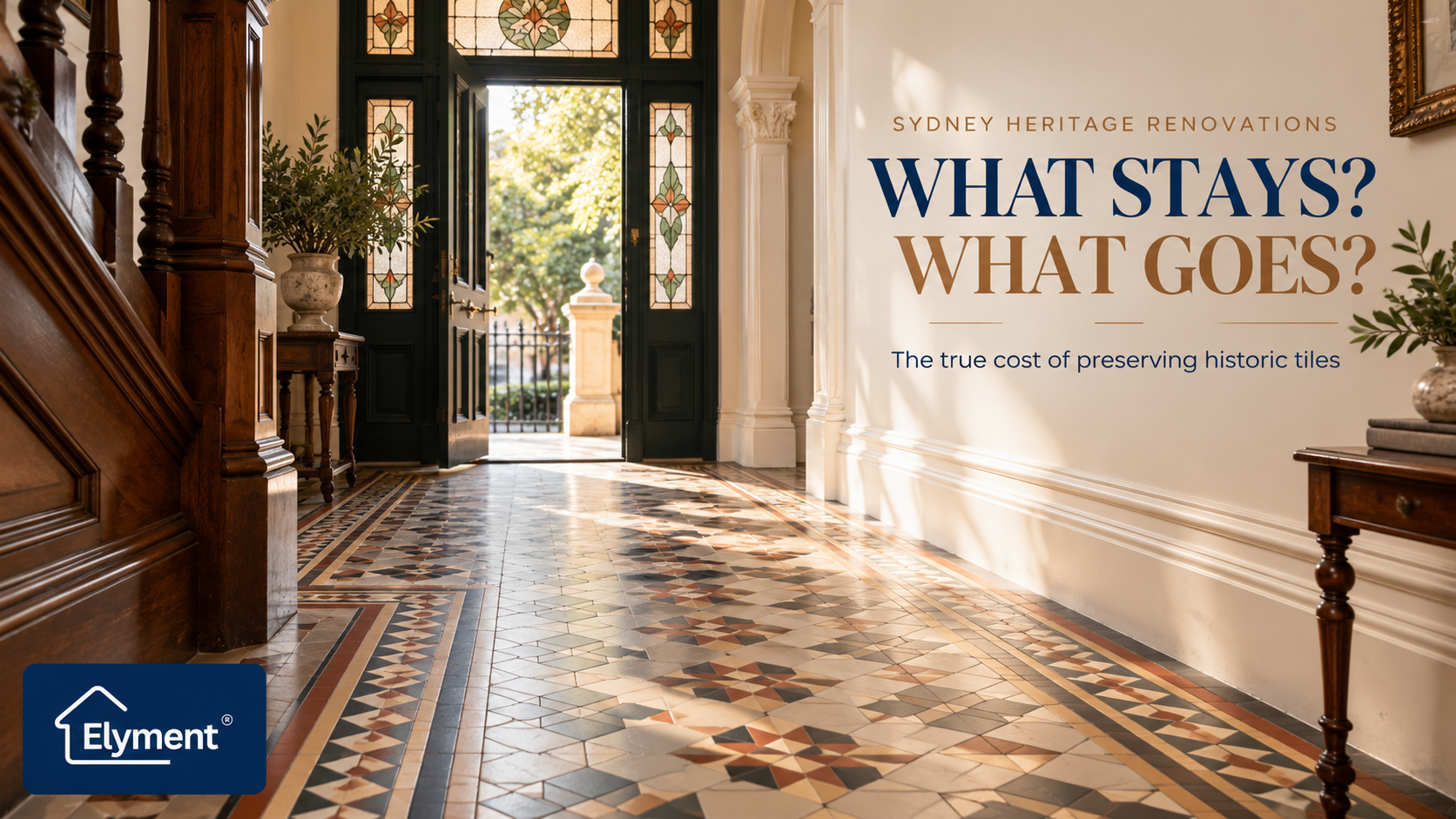
Heritage tile removal in Sydney requires a decision about significance and permissions before demolition begins. Original tiles may warrant conservation, while later replacements may be candidates for removal, depending on the property's heritage controls. Carefully authorised trial lifting can help assess recoverability, but bonded tiles may fracture despite specialist handling. NSW owners should confirm approval requirements, document the existing floor and budget separately for conservation, salvage labour and conventional removal.
A Floor Can Contain Several Generations of Renovation History
A patterned tiled entrance in an older Sydney building can appear to be one continuous historical installation. Look more closely, and the surface may reveal several generations of building work.
Original decorative tiles might survive around a doorway. A central section may have been replaced following plumbing work decades later. A more recent repair could contain modern tiles selected to resemble the original pattern.
To a conventional demolition contractor, these surfaces may represent one removal area. To a heritage consultant, architect or conservation specialist, they may represent different levels of historical significance.
That difference determines the appropriate scope. It can also change the approvals, tools, labour, programme and final cost of the project.
Sydney's established suburbs, including Parramatta, Glebe, Newtown, Paddington and parts of the Inner West, contain buildings in which decorative entrance floors, verandah tiles and historical internal finishes contribute to their architectural character.
Yet age alone does not establish heritage significance. Neither does a familiar geometric pattern.
The central question is whether the flooring contributes to the recognised significance of the particular property and how proposed work may affect that value.
This is a different problem from ordinary Sydney flooring removal and preparation, where success is commonly measured by the condition of the substrate left for the next finish.
In heritage-sensitive work, successful delivery may instead mean removing less material than originally anticipated.
Heritage Status Changes the Starting Point, Not Just the Paperwork
The first task is to determine which planning and heritage controls apply to the property.
Heritage protection in NSW operates at different levels. An individual building may be locally listed, included on the State Heritage Register, subject to an interim heritage order, or located within a heritage conservation area.
Those categories are not interchangeable, and they do not create one universal approval requirement for every internal floor.
The NSW State Heritage Inventory provides a starting point for identifying heritage-listed places and recorded significance. Relevant council planning instruments, heritage inventory sheets and conservation management plans should also be checked.
Parramatta's Approach Illustrates Why Early Advice Matters
The City of Parramatta's heritage development approvals guidance explains that heritage listing does not prohibit modernisation, but changes must recognise heritage significance.
Council identifies development applications and heritage minor works applications as possible pathways, depending on the proposal.
Importantly, it also notes that minor maintenance and many internal works that do not affect the structure will generally not require consent, while recommending that owners contact its Heritage Advisor before making changes.
This distinction matters for tiled interiors. A modest repair involving later replacement tiles may present a different heritage impact from the complete removal of an original decorative hallway.
Neither outcome should be assumed without reviewing the applicable controls and the significance of the affected fabric.
State-Listed Properties Require an Additional Check
Work affecting a State Heritage Register item or a property subject to an interim heritage order must be assessed against the relevant provisions of the Heritage Act 1977.
Heritage NSW publishes standard exemptions for State Heritage Register items alongside information about section 60 approval pathways.
An exemption cannot simply be assumed because work is indoors or involves a relatively small area. Its applicable conditions must be satisfied.
Where the proposed disturbance is not exempt, the relevant approval must be obtained before the affected work proceeds.
State heritage item
- Initial verification: Heritage NSW listing, significance, exemptions and applicable approvals.
- Potential consequence: Specialist assessment and possible Heritage Act approval before disturbance.
Local heritage item
- Initial verification: Council planning controls and significance documentation.
- Potential consequence: Council advice, consent or another applicable approval pathway.
Heritage conservation area
- Initial verification: Relevant council controls and the impact of proposed internal works.
- Potential consequence: Approval requirements determined by the actual scope and circumstances.
Strata heritage building
- Initial verification: Heritage controls, lot boundaries, common property and by-laws.
- Potential consequence: Separate strata permissions may also be necessary.
These checks are complementary rather than substitutes. A strata resolution, for example, does not replace a required heritage approval.
Original Tiles and Later Replacements Should Not Automatically Receive the Same Treatment
The most commercially important distinction in a heritage tiled floor may be invisible in the initial quotation.
A floor comprising original ceramic or encaustic tiles, later reproduction tiles and modern patch repairs should not automatically be specified for wholesale removal.
Different sections may require different conservation decisions.
How the Existing Floor Can Be Investigated
- Historical photographs and plans: Compare the current arrangement with available records of the building.
- Tile dimensions and manufacturing characteristics: Examine thickness, edge formation, surface character and variation between tiles.
- Pattern continuity: Look for interrupted borders, mismatched colours and altered geometric arrangements.
- Bedding and grout: Different fixing materials may indicate separate installation campaigns.
- Previous conservation records: Review any documented repairs, replacements or alterations.
- Specialist interpretation: Seek advice where visual differences cannot reliably establish age or significance.
These indicators help build evidence. They do not independently prove that a particular tile is original.
A later replacement may also have acquired significance through the building's history. Conversely, a visually old tile is not necessarily a significant element that must remain untouched.
The decision should be informed by the property's significance documentation and appropriate professional assessment.
The Australia ICOMOS Burra Charter provides an established conservation framework based on understanding cultural significance and making only necessary changes.
Applied to a tiled floor, that approach encourages the project team to ask whether an original surface can remain in place before treating removal and reinstallation as the preferred option.
Saving Tiles Is Not Always the Same as Conserving the Floor
Salvage and conservation are related, but they are not identical.
Salvage generally involves recovering physical material for possible reuse, storage, reinstatement or another agreed purpose.
Conservation may require retaining the existing flooring in its original position, together with its pattern, relationships and historical evidence.
A contractor could theoretically recover many individual tiles yet still destroy the arrangement that made the floor significant.
This becomes particularly important with tessellated entrances, decorative borders, motifs and small-format patterned floors.
The geometry of a surviving border may tell more about the original architecture than a collection of loose tiles stored off-site.
When a conservation assessment supports retaining the floor in place, extensive removal may be an unnecessary intervention.
If removal is genuinely required, the approved scope should establish how the location, orientation and condition of recovered components will be recorded.
Such a project is materially different from the conventional small-format tile demolition explored in Elyment's article on mosaic tile removal and rough subfloors.
In ordinary demolition, fragmented tiles can be removed as waste. In an authorised salvage project, preventing fragmentation becomes one of the principal labour objectives.
The Trial Lift Is an Investigation, Not a Promise of Recovery
Where heritage approvals and the conservation method permit disturbance, a carefully controlled trial lift can provide evidence about how the tiles are bonded.
It may help establish whether the material can realistically be separated from the underlying bedding without unacceptable damage.
However, the test itself may irreversibly damage an original component. It must not be carried out before the necessary authority to disturb the floor has been established.
What a Controlled Trial Should Establish
1. Location and permission. Select a test area consistent with heritage advice, approvals and the agreed conservation methodology.
2. Existing condition. Photograph and map tile positions, grout joints, cracks, loose edges and previous repairs.
3. Material and hazard assessment. Confirm that suspected asbestos-containing products or other hazardous materials have been appropriately investigated.
4. Controlled separation. Use the approved, appropriately restrained lifting method, with suitable tools and protection for neighbouring fabric.
5. Damage recording. Record which tiles remain intact, which crack, and whether adjacent materials are being damaged.
6. Method review. Determine whether recovery can continue, the technique requires modification, or further removal should stop.
The result should inform the programme and budget before an extensive removal area is committed.
Why Even Experienced Contractors Cannot Guarantee Salvage
Historic tiles may be fixed to mortar or adhesive systems that have developed strong bonds over many years.
Some tiles are inherently brittle. Others contain existing hairline cracks or weakened edges that become apparent only during attempted separation.
A tile can also remain bonded more strongly to the bedding beneath it than its own internal structure can withstand.
A successful test in one location does not guarantee the same result elsewhere. Installation methods, earlier repairs and moisture exposure may vary across the floor.
Consequently, a professional quote should distinguish between making a controlled recovery attempt and guaranteeing a particular number of usable tiles.
No responsible salvage allowance should promise that every bonded heritage tile can be recovered intact.
The Cost of Preservation Is Mostly Hidden in the Labour
Conventional tile removal and heritage tile recovery are fundamentally different production tasks.
Standard demolition commonly prioritises efficient removal, safe waste handling and preparation of the underlying surface.
Heritage recovery may require slower, individually controlled operations that cannot be priced using the same output assumptions.
The difference is not necessarily the purchase price of specialised tools. It is the additional time and responsibility assigned to each square metre.
Pre-start work
- Conventional removal: Scope and substrate checks.
- Heritage recovery: Significance review, approvals, recording and specialist input.
Removal method
- Conventional removal: Controlled demolition using appropriate mechanical or hand tools.
- Heritage recovery: Slower, selective separation of individual components.
Output measure
- Conventional removal: Area removed and cleared.
- Heritage recovery: Area assessed and number of recoverable components.
Material handling
- Conventional removal: Waste collection and disposal.
- Heritage recovery: Identification, cushioning, packing, inventory and storage.
Risk allowance
- Conventional removal: Concealed substrate conditions.
- Heritage recovery: Breakage, uncertain recovery yield, conservation hold points and substrate conditions.
Completion
- Conventional removal: Substrate ready for the next preparation stage.
- Heritage recovery: Documented recovery, conservation inspection and approved next steps.
There is no reliable universal per-square-metre heritage tile salvage rate for Sydney projects.
A quotation depends on the tile dimensions, pattern complexity, fixing method, extent of original fabric, site access and the required recovery standard.
A small decorative entrance could therefore involve more labour per square metre than a considerably larger area of ordinary tiling.
For meaningful comparisons, owners should request separate allowances for assessment, trial work, approved recovery, conventional removal, specialist advice and reinstatement.
A Better Quotation Separates the Work Into Decision Packages
The phrase "remove and salvage heritage tiles" is too broad to establish a dependable price or scope of responsibility.
A better commercial structure makes the uncertainties visible before contractors are committed to the site.
Recommended Scope Breakdown
- Package A: Investigation. Existing-condition survey, tile mapping, records review and heritage consultation.
- Package B: Approvals. Identification and coordination of the applicable council, heritage and strata requirements.
- Package C: Authorised trial. Controlled test removal, inspection, recording and method assessment.
- Package D: Selective recovery. Approved hand lifting, component protection and recording of recovered materials.
- Package E: Storage and handling. Numbering, packing, movement, temporary storage and inventory.
- Package F: Conventional removal. Removal of approved non-significant material, waste loading and disposal.
- Package G: Substrate and reinstatement. Further assessment, approved preparation, specialist repairs and final installation.
Pricing these packages individually makes it easier to distinguish committed works from provisional works.
It also helps identify which stages require decisions by the owner, heritage adviser, architect or principal contractor before the next stage is released.
The number of tiles recovered intact should be a reported outcome of the agreed process, not an unsupported promise in the quote.
What Happens to the Tiles After They Leave the Floor?
The operational difficulties do not necessarily end when a tile is lifted without damage.
Historic components may need to be documented, protected, transported, stored and later considered for reinstatement.
Once removed, their original locations may become difficult to reconstruct without adequate records.
A practical salvage inventory can include:
- Floor plan reference and original position.
- Tile dimensions, pattern and visible colour.
- Photographic condition before and after lifting.
- Damage, chips and residual bedding.
- Packaging or crate identification.
- Temporary storage location.
- Approved destination and intended reuse.
The project documents should also establish ownership and custody of removed materials.
A contractor should not assume that recovered components can be taken away, sold, substituted or discarded merely because they are no longer attached to the building.
For heritage-sensitive work, the material may remain subject to the owner's instructions, heritage conditions or an agreed conservation plan.
Storage requirements can affect the budget. Crated components occupy space, require handling and may need protection while other renovation work continues.
Their cleaning should also follow an appropriately assessed method. Aggressive chemical treatment or mechanical grinding of original surfaces can introduce further irreversible damage.
Strata Buildings Add a Second Layer of Authority
Heritage tiles are sometimes located in older Sydney apartment buildings, particularly entrances, common hallways, shared stairs and decorative thresholds.
An individual owner may not have authority to alter every part of those areas.
The applicable strata plan and by-laws should be reviewed to determine whether the flooring forms part of a private lot or common property.
The NSW Government's strata renovation rules explain how approval requirements differ between cosmetic, minor and major renovations.
Installation or replacement of hard flooring may require owners corporation approval. Works affecting common property, structure or waterproofing can require further consideration.
An approved scope may also need to address:
- Resident and visitor access during works.
- Protection of adjacent original surfaces.
- Noise and dust-control arrangements.
- Delivery, lift and waste-management access.
- Responsibility for damage and reinstatement.
- Coordination with any separately required heritage consent.
Elyment's earlier analysis of protecting original terrazzo thresholds in Art Deco apartments addresses the neighbouring-fabric issue.
The present heritage tile decision is wider: it asks whether the existing tiled floor, or particular parts of it, should be disturbed at all.
Hazardous Materials Must Be Addressed Before Any Physical Trial
Older tiled floors can conceal historical adhesives, bedding materials, membranes, sheet products and earlier floor finishes.
Their age and construction history may warrant a hazardous-material assessment before lifting, cutting or grinding.
The NSW Government's asbestos guidance for adhesives and dry powder mixes identifies historical grouts, adhesives and related construction materials that may contain asbestos.
The presence of old tiles does not prove asbestos is present. Equally, an apparently ordinary adhesive should not be assumed asbestos-free solely from its appearance.
Where suspect material cannot be ruled out, disturbance should stop until appropriate assessment and controls are established.
Dust from disturbing silica-containing materials also requires suitable occupational health and safety controls.
A heritage conservation objective does not justify unsafe handling or bypassing hazardous-material requirements.
Specialist safety controls and conservation methodology must be coordinated before physical investigation proceeds.
An Illustrative Parramatta Project: Preserve the Border, Reassess the Centre
Consider a hypothetical renovation of an older Parramatta commercial premises containing a decorative entrance floor.
The owner proposes removing all the tiles to create a more level surface for a new interior fit-out.
During the preliminary review, the project team notices differences between the geometric perimeter border and the plain tiles covering the centre.
Further documentary research and specialist assessment establish that the perimeter may retain important early fabric, while the central area appears to have undergone later alteration.
Rather than pricing immediate wholesale demolition, the owner first seeks advice on the site's significance and necessary permissions.
The revised project scope may then distinguish three areas:
1. Original significant fabric proposed for retention and protection in place.
2. Later material that may be eligible for removal under the applicable approvals.
3. Uncertain areas requiring further investigation before disturbance.
Where authorised, a limited trial may help establish the method and likely recovery performance for selected areas.
The floor levelling or replacement flooring specification can then be reviewed against what must remain.
This approach may not produce the cheapest initial labour estimate. It can, however, prevent the project from committing prematurely to removing material that should have been retained.
This example is illustrative and does not describe a verified Elyment project or an approval issued by Parramatta Council.
Five Questions That Should Be Answered Before the Work Order Is Signed
1. What is actually significant? Is the whole floor important, or are particular sections, borders or original components identified?
2. Which permissions are required? Have council, Heritage NSW and strata obligations been considered where applicable?
3. Can the material remain in place? Has conservation without removal been considered before salvage or demolition?
4. What happens if tiles break? Does the contract explain the limits of recovery and the process for changed conditions?
5. Who controls the recovered material? Are ownership, recording, packing, storage and reinstatement responsibilities documented?
These questions make the quotation more commercially useful because they establish how decisions will be made when actual conditions differ from initial assumptions.
Heritage Tile Removal Sydney: Practical Questions
Can heritage tiles be removed from a Sydney property?
Potentially, but the answer depends on the property's heritage status, the significance of the affected tiles, the proposed scope and the applicable approvals or exemptions.
Do internal heritage tiles always need council approval?
Not necessarily. Some internal works may not require consent, but this cannot be assumed for significant heritage fabric. Relevant council controls and any State heritage requirements should be checked before work begins.
Can old floor tiles be lifted without breaking?
Some tiles may be recovered intact using an appropriate, authorised method. Results depend on the tile condition, bedding, adhesive, existing cracks and surrounding construction. No universal recovery guarantee is possible.
Why does heritage tile salvage cost more in Sydney?
The additional cost can reflect preliminary investigations, specialist advice, approval coordination, controlled lifting, slower labour, documentation, packing and storage. The final price depends on site conditions and the approved conservation scope.
Should damaged original tiles be replaced with modern replicas?
Not automatically. The decision may involve retaining damaged original fabric, specialist repair, compatible replacement or another conservation approach. It should be guided by heritage significance and the approved scope of work.
The Most Important Removal Decision May Be Not to Remove
Heritage-sensitive flooring work demands a different definition of project success.
Removing every tile quickly may deliver an empty floor, but it can also eliminate evidence that cannot be recreated.
The value of an appropriate conservation decision lies in identifying what genuinely needs to change and what should remain.
For Sydney property owners, builders and project managers, that means resolving significance, permissions and practical recovery limitations before committing to demolition.
Where removal is approved and necessary, controlled trials and clearly separated cost allowances can help manage uncertainty without suggesting that every historic tile can be saved.
Heritage tile work is ultimately about more than recovering a construction product. It is about coordinating necessary building change while preserving the evidence of what came before.
SYDNEY HERITAGE-SENSITIVE RENOVATION PLANNING
Before the First Tile Lifts, Know What Must Remain.
Discuss flooring removal scope, heritage-sensitive project sequencing, substrate preparation, access requirements and coordination with the relevant specialists and authorities.
Discuss Your Renovation Project →
PROJECT REVIEW • REMOVAL PLANNING • COORDINATED DELIVERY
Sources and References
NSW Heritage and Planning Guidance
- NSW Government — State Heritage Inventory
- City of Parramatta — Heritage Development Approvals
- Heritage NSW — Standard Exemptions for State Heritage Register Items
- NSW Government — Strata Renovations
Conservation Standards and Safety Guidance
- Australia ICOMOS — Burra Charter and Practice Notes
- NSW Government — Adhesives, Dry Powder Mixes and Asbestos
Related Elyment Services and Articles
- Elyment — Sydney Flooring Services
- Elyment — Why Does Removing Small Mosaic Tile Leave the Roughest Subfloors in Sydney Renovations?
- Elyment — Magnesite Removal Sydney in Art Deco Apartments: Protecting Original Terrazzo Thresholds During Demolition
- Elyment — Contact
Before the First Tile Lifts, Know What Must Remain.
Discuss flooring removal scope, heritage-sensitive project sequencing, substrate preparation, access requirements and coordination with the relevant specialists and authorities.
Discuss Your Renovation PROJECT REVIEW • REMOVAL PLANNING • COORDINATED DELIVERYRelevant next actions
Explore the ELYMENT service most closely connected to this article.