Hybrid Flooring Sydney: SPC vs WPC, Which Suits Your Home and Budget?
Choosing SPC or WPC hybrid flooring in Sydney? Compare comfort, durability, water resistance and installation costs to avoid a costly mismatch in your own home.
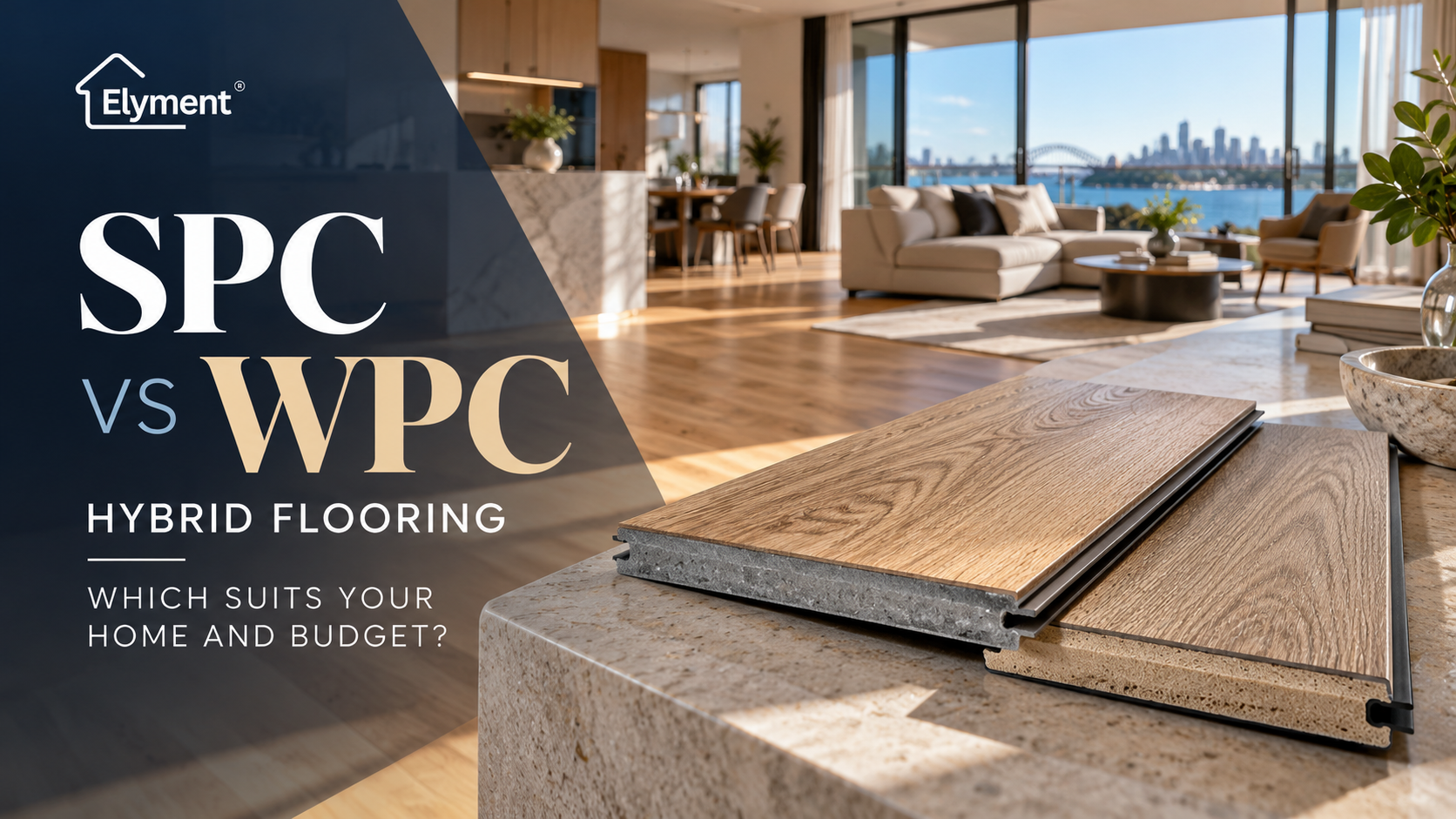
SPC hybrid flooring generally offers a denser, harder core with strong indentation resistance and dimensional stability, while WPC uses an expanded polymer core that typically feels softer and warmer underfoot. For Sydney homeowners, the better choice depends on the specific product's tested performance, room conditions and total installed cost. Neither construction eliminates the need for suitable subfloor preparation, and NSW strata apartments may require acoustic evidence and renovation approval.
ELYMENT Insights | Flooring & Renovation Operations | Sydney, NSW | 28 October 2026
Two Flooring Technologies, One Increasingly Complicated Buying Decision
Hybrid flooring occupies an increasingly important position in residential renovation decisions. It offers timber-look finishes, relatively straightforward maintenance and the possibility of floating installation without the expense of traditional hardwood flooring systems.
Yet the term hybrid flooring describes a category rather than one universal construction.
Across Sydney showrooms, buyers encounter products described as SPC, WPC, rigid-core vinyl and multilayer hybrid flooring. The finishes can appear almost identical, even when the materials beneath their decorative surfaces behave differently.
That distinction matters for more than appearance.
A homeowner renovating a North Shore apartment may prioritise acoustic performance. A family in Western Sydney may place greater importance on indentation resistance and stability in rooms exposed to strong sunlight. An owner renovating an older Inner West terrace may need to consider an irregular substrate and limited floor-height clearance.
The central question is therefore not which material has the more persuasive marketing description.
It is which complete flooring system offers the most appropriate performance for the property, and what that performance costs once installation requirements are included.
What SPC and WPC Actually Mean
The Resilient Floor Covering Institute's rigid-core flooring guidance identifies two principal rigid-core constructions: Solid Polymer Core (SPC) and Expanded Polymer Core (WPC).
This distinction is important because the abbreviations are sometimes explained inconsistently in flooring marketing. Product-specific construction information should take precedence over broad category descriptions.
SPC: A Denser and More Rigid Core
SPC flooring uses a solid polymer core. Products commonly incorporate mineral fillers within the core formulation, although composition varies between manufacturers.
The resulting construction is generally dense and rigid. According to the RFCI, SPC's hardness offers advantages in indentation resistance, dimensional stability and temperature stability.
These characteristics can be useful in high-traffic residential environments, particularly where furniture, everyday foot traffic and changing indoor temperatures influence material selection.
However, a rigid core should not be confused with indestructibility.
Surface scratching, damaged locking joints and movement caused by inappropriate installation can still occur. Performance depends on the complete product construction, not the core designation alone.
WPC: An Expanded Core Designed for Comfort
WPC flooring uses an expanded polymer core. The construction generally produces a lighter product with a degree of resilience that can improve comfort underfoot.
The RFCI identifies underfoot comfort and favourable acoustic characteristics among the advantages of WPC construction.
WPC products are often thicker than SPC alternatives, although thickness varies substantially between ranges.
A thicker, more resilient construction may appeal to homeowners who prefer a less rigid walking sensation, particularly in bedrooms, living areas and other predominantly residential spaces.
These qualities do not automatically establish that WPC will perform better acoustically in every building. Acoustic outcomes depend on the complete installed assembly and its supporting test evidence.
SPC vs WPC Flooring: The Practical Comparison
The distinction becomes clearer when construction, comfort and performance are considered together.
General Characteristics of SPC and WPC Rigid-Core Flooring
1. Core Construction
- SPC flooring: Solid polymer core.
- WPC flooring: Expanded polymer core.
2. Core Density
- SPC flooring: Generally denser and harder.
- WPC flooring: Generally lighter and more resilient.
3. Underfoot Feel
- SPC flooring: Typically firmer.
- WPC flooring: Typically softer.
4. Indentation Resistance
- SPC flooring: Generally favourable, subject to product testing.
- WPC flooring: Product-dependent; compare test results.
5. Dimensional Stability
- SPC flooring: Generally a strength of the construction.
- WPC flooring: Must be assessed using product specifications.
6. Acoustic Performance
- SPC flooring: Depends on backing and tested floor assembly.
- WPC flooring: May offer comfort and acoustic advantages, but assembly testing remains essential.
7. Water Resistance
- SPC flooring: Rigid-core products offer water-resistant capabilities; warranty conditions vary.
- WPC flooring: Rigid-core products offer water-resistant capabilities; warranty conditions vary.
8. Installation
- SPC flooring: Many products permit floating click-lock installation.
- WPC flooring: Many products permit floating click-lock installation.
9. Cost Comparison
- SPC flooring: Compare complete product and installation pricing.
- WPC flooring: Compare complete product and installation pricing.
10. Subfloor Preparation
- SPC flooring: Required where substrate conditions fall outside manufacturer limits.
- WPC flooring: Required where substrate conditions fall outside manufacturer limits.
The comparison describes general construction tendencies. It should not be interpreted as a performance guarantee for every SPC or WPC product sold in Australia.
Two products within the same category can differ materially in wear layers, locking systems, backing, dimensional stability and warranty conditions.
The Durability Question Cannot Be Answered by Core Type Alone
Durability is frequently presented as a single characteristic. In practice, flooring products can perform differently against scratching, indentation, concentrated loads, temperature variation and moisture exposure.
Each performance category addresses a different failure risk.
For example, a product may demonstrate strong indentation resistance but still develop visible surface scratches if its protective finish is poorly suited to the intended use.
Similarly, a rigid plank may perform well in dimensional stability testing while its locking system remains vulnerable to movement caused by an uneven substrate.
Five Specifications Worth Examining
- Wear layer and protective coating: Examine the wear layer, surface finish and manufacturer's intended-use classification. Thickness is useful information but does not independently establish scratch resistance or overall service life.
- Residual indentation: Request evidence showing how the product performs under the relevant test conditions. This is particularly useful where furniture, concentrated loads or heavy domestic use are expected.
- Dimensional stability: Review the manufacturer's results and restrictions concerning temperature variation, direct sunlight and installation conditions.
- Joint and locking-system performance: Confirm that the selected system is suitable for the proposed room dimensions, layout, expansion allowances and installation method.
- Warranty and usage limitations: Identify the actual product covered by the warranty, including exclusions for moisture, temperature, furniture loading and installation outside specifications.
International product standards provide a useful framework for understanding these distinctions.
ASTM F3261-26 addresses physical and performance requirements for resilient flooring with a rigid polymeric core. Its scope includes characteristics such as dimensional stability, residual indentation, surface integrity, chemical resistance and static load resistance.
Referencing a standard is not the same as demonstrating that a particular product has passed all relevant tests. Buyers should request the actual specification and supporting evidence for the exact product being supplied.
The RFCI's ASSURE Certified programme provides another reference point for qualifying rigid-core flooring products. It incorporates independent certification requirements covering specified performance characteristics, indoor air quality and restricted substances.
Such certification can help assess product evidence, although it does not replace Australian project requirements, manufacturer installation instructions or site-specific acoustic assessments.
Comfort Has Value, but Acoustic Performance Must Be Proven
Comfort is one area where WPC's expanded core may provide a meaningful advantage.
Homeowners accustomed to carpet, cork or timber may notice the firmer sensation of some SPC products. WPC's more resilient construction can produce a different walking experience.
Nevertheless, showroom impressions are not enough to establish acoustic suitability.
In a detached Sydney house, the owner may primarily be concerned with how footsteps sound inside the room. In an apartment, impact noise transmitted to the dwelling below can become a building-management issue.
These are different acoustic considerations.
A floor that sounds relatively quiet when walked on in a showroom may not provide the required impact-noise performance in a particular apartment.
The flooring plank, attached backing, subfloor and any permitted acoustic treatment must be assessed as an installed system.
The NSW Government's strata renovation guidance identifies hard-floor replacement as minor renovation work requiring approval in relevant circumstances and explains that flooring applications require acoustic documentation.
Sydney apartment owners should therefore verify the strata scheme's by-laws and required acoustic evidence before choosing between SPC and WPC.
A factory-attached acoustic backing does not automatically establish that the complete system meets a particular building's requirements.
Additional underlay should also not be introduced without confirming manufacturer approval. An unsuitable underlay may change joint support, installation performance or warranty conditions.
What Hybrid Flooring Installation Costs in Sydney
The price difference between SPC and WPC is not determined by core construction alone.
Brand positioning, decorative finish, wear layer, board dimensions, backing, warranty terms and supplier availability all influence the purchase price.
An October 2026 Sydney flooring cost guide published by What's The Damage? places hybrid/SPC flooring at approximately $63 to $140 per square metre for supply and installation, including GST.
This is an indicative market range, not an Elyment quotation or an SPC-versus-WPC price comparison. It does not establish a standard WPC premium, and site preparation, removal and finishing may be charged separately.
A Worked Budget Comparison for a 50 m² Sydney Renovation
Consider a hypothetical 50 m² residential renovation. The homeowner is comparing an SPC product with a higher-priced WPC product.
Both products are assumed to be suitable for the proposed rooms and installation method. The existing flooring, preparation requirements and labour scope are identical.
The following figures are illustrative budgeting assumptions, not actual supplier quotations or verified product prices. All amounts are in Australian dollars and include GST.
Illustrative 50 m² Installation Budget
Including an 8% material waste allowance.
1. Flooring Supply — 54 m² Including Cutting Allowance
- SPC option: $2,430
- WPC option: $3,510
2. Floating Installation Labour — 50 m²
- SPC option: $1,750
- WPC option: $1,750
3. Existing Flooring Removal and Disposal
- SPC option: $1,000
- WPC option: $1,000
4. Assumed Subfloor Preparation Allowance
- SPC option: $1,500
- WPC option: $1,500
5. Assumed Trims and Finishing Allowance
- SPC option: $450
- WPC option: $450
6. Illustrative Installed Total
- SPC option: $7,130
- WPC option: $8,210
In this example, the WPC option costs $1,080 more. The difference comes entirely from the assumed material supply prices.
Importantly, the combined removal and preparation allowance is $2,500 for either product.
This demonstrates why comparing boards alone gives an incomplete picture of renovation expenditure.
If the existing substrate requires more extensive grinding, repairs or levelling, the budget may change materially regardless of which core is selected.
Conversely, where the subfloor is already suitable, an owner may be able to allocate more of the budget towards a product with stronger documented performance or preferred comfort characteristics.
The appropriate comparison is therefore based on the complete installed specification, not simply a showroom's advertised square-metre price.
Why a Rigid Core Does Not Remove the Need for Floor Preparation
Both SPC and WPC can tolerate certain minor substrate variations better than some flexible flooring products. However, this does not mean either product can compensate for an unsuitable floor.
The RFCI expressly notes that manufacturer requirements for substrate flatness, moisture, expansion allowance and underlayment remain relevant to rigid-core installation.
Sydney renovation projects regularly involve existing surfaces that must be assessed before a floating flooring system can be installed.
Examples include:
- Concrete slabs with localised high spots or depressions.
- Existing tiles with uneven joints or unstable sections.
- Old adhesive left behind after carpet, vinyl or timber removal.
- Timber subfloors with movement, damaged sheets or inconsistent support.
- Previous levelling layers that are cracked, weak or poorly bonded.
- Substrates with moisture conditions outside the manufacturer's installation limits.
An expanded WPC core should not be treated as a substitute for correcting these conditions. Likewise, the density of SPC does not eliminate the need for adequate support beneath the locking system.
Depending on the substrate, preparation may involve cleaning, repairs, controlled grinding, patching or application of a suitable levelling system.
Elyment's concrete grinding services in Sydney address surface preparation requirements where existing concrete needs adhesive removal, high-spot correction or appropriate profiling.
Where floor geometry requires correction, floor levelling and substrate preparation may form a separate component of the installation scope.
The required preparation must be established from the actual floor condition and the selected manufacturer's specifications. There is no universal tolerance that applies to every SPC and WPC product.
If concrete grinding is necessary, suitable dust controls must also be incorporated. SafeWork NSW's crystalline silica guidance explains the risks associated with processing silica-containing materials such as concrete and identifies relevant exposure controls.
Where SPC and WPC Make Sense Across Different Sydney Homes
The most appropriate flooring construction depends on how the property is used.
Busy Family Homes
For homes with frequent foot traffic, movable furniture and active family living, SPC's generally strong indentation resistance can make it an attractive option.
A suitable product should still be selected using its actual wear-surface performance, installation requirements and warranty conditions.
Bedrooms and Comfort-Focused Living Areas
WPC may appeal where underfoot comfort is more important than obtaining the firmest possible surface.
The difference is best assessed through physical samples and the manufacturer's supporting product information.
Sun-Exposed Living Spaces
North-facing rooms with extensive glazing can experience substantial surface temperature changes.
SPC's dimensional and temperature stability characteristics may be advantageous, but owners should check the exact product's limitations concerning direct sunlight, floor temperature, expansion and installation conditions.
Neither core should be regarded as immune to inappropriate heat exposure.
Strata Apartments
For apartments in areas such as Chatswood, Parramatta, Zetland and the Sydney CBD, acoustic compliance may become the deciding factor.
Neither SPC nor WPC should be approved solely because the product includes acoustic backing.
The selected assembly must satisfy the applicable building requirements and strata approval conditions.
A product change may also alter the floor build-up, affecting thresholds, doors and the approved installation specification.
The Product Decision Should Come Before the Final Installation Quote
Once a preferred SPC or WPC product has been identified, the renovation scope can be evaluated against its actual installation requirements.
This is particularly important when an older Sydney home is being renovated in stages.
Removal of existing flooring may reveal conditions that were not visible during the initial measure. Elyment's flooring demolition and removal services cover strip-out, disposal and preparation sequencing before subsequent flooring work begins.
A complete hybrid flooring installation quote should distinguish between the following costs:
- Selected product, brand, exact model and core type.
- Supply quantity, cutting allowance and material pricing.
- Existing floor removal and waste disposal.
- Substrate assessment, grinding and levelling.
- Installation labour and approved underlay requirements.
- Scotia, skirting, thresholds, trims and other finishing.
- Access restrictions, strata requirements and project-specific allowances.
Where work qualifies as residential building work under NSW home building legislation, applicable contract requirements must also be observed.
The NSW Government's residential building contract guidance explains written-contract requirements for work exceeding $5,000 including GST, together with the applicable rules for deposits and payments.
Importantly, the construction method, product, preparation work and finishing details should be documented in the agreed scope.
A More Useful Way to Compare Two Flooring Quotations
Before selecting the lower quotation, homeowners should request a like-for-like comparison.
The following six questions can help establish whether two proposed products and installation scopes are genuinely comparable.
- Are the products equivalent? Compare core construction, wear layer, intended usage, warranty and supporting performance information.
- Is the installation system approved? Confirm the manufacturer's instructions, permitted underlay, expansion requirements and relevant site restrictions.
- Is the material allowance realistic? Check the measured area, cutting waste, carton quantity and availability of matching trims.
- Has the existing substrate been assessed? Confirm the extent of any included removal, grinding, repairs or levelling.
- Are acoustic obligations documented? For strata properties, determine whether the proposed assembly satisfies the required approval and evidence process.
- What is the final installed cost? Compare complete totals, GST treatment, provisional allowances, exclusions and potential variations.
This process is particularly useful where one quotation offers a lower-cost SPC product and another proposes a more expensive WPC system.
The higher price may reflect a meaningful comfort preference or stronger product specifications. It may also reflect a different brand, thicker construction or different installation inclusions.
Those differences should be identifiable rather than assumed.
Common Questions About SPC and WPC Hybrid Flooring
Is SPC or WPC flooring more durable?
SPC generally offers advantages in core hardness, indentation resistance and dimensional stability.
However, overall durability depends on the exact product's wear surface, locking system, performance testing and installation quality.
Is WPC flooring always more expensive than SPC?
No. Product pricing depends on brand, construction, finish, specifications and supplier availability.
A premium SPC product may cost more than a lower-priced WPC alternative. Compare actual supplier quotations rather than assuming a fixed premium.
Does SPC hybrid flooring need floor levelling?
SPC flooring may require floor levelling or other preparation where the existing substrate does not meet the manufacturer's flatness, stability or moisture requirements.
The same principle applies to WPC flooring.
Which hybrid flooring is better for Sydney apartments?
The better option is the product and installation assembly that meets the apartment's acoustic, strata and manufacturer requirements while providing the desired comfort and durability.
Core type alone cannot establish compliance.
The Final Decision Is About Performance per Dollar
SPC and WPC serve overlapping markets, but their construction characteristics create different advantages.
SPC's denser core can be attractive where hardness, indentation resistance and dimensional stability are priorities.
WPC's expanded core may justify consideration where walking comfort and a more resilient underfoot sensation are important.
Neither category should be selected without examining the actual product specification.
For Sydney homeowners, the financially sound decision is not necessarily the cheapest board or the most expensive construction.
It is the flooring system that satisfies the property's usage, installation and approval requirements at a justified total project cost.
When the decision is supported by product testing, a properly assessed substrate and a complete installation scope, homeowners can compare SPC and WPC with considerably greater confidence.
Planning a Hybrid Flooring Renovation?
SYDNEY FLOORING & RENOVATION PLANNING
Review flooring specifications, existing substrate conditions, removal requirements and installation costs before committing to your renovation.
Request a Flooring Project Review
Sources and Technical References
- Resilient Floor Covering Institute (RFCI): Rigid-Core Flooring Guidance
- ASTM International: ASTM F3261-26 — Standard Specification for Resilient Flooring in Modular Format with Rigid Polymeric Core
- Resilient Floor Covering Institute: ASSURE Certified Programme
- NSW Government: Strata Renovation Rules
- What's The Damage?: Flooring Cost Sydney
- SafeWork NSW: Crystalline Silica Technical Fact Sheet
- NSW Government: Residential Building Contract Guidance
Editorial Note
This article provides general construction, product-selection and renovation planning information for Sydney and NSW.
Product performance and installation requirements vary by manufacturer. Indicative pricing and hypothetical examples are not quotations.
Site-specific professional advice and applicable approvals should be obtained before work begins.
SYDNEY FLOORING & RENOVATION PLANNING
Planning a Hybrid Flooring Renovation?
Review your flooring specifications, existing substrate conditions, removal requirements and installation costs before committing to your renovation.
Request a Flooring Project ReviewRelevant next actions
Explore the ELYMENT service most closely connected to this article.