Jensen Huang Resigns: NVIDIA's Rubin Roadmap and CEO Search
Jensen Huang has resigned as NVIDIA's CEO. Explore how the leadership change could affect AI chip competition, investor confidence, product strategy and growth.
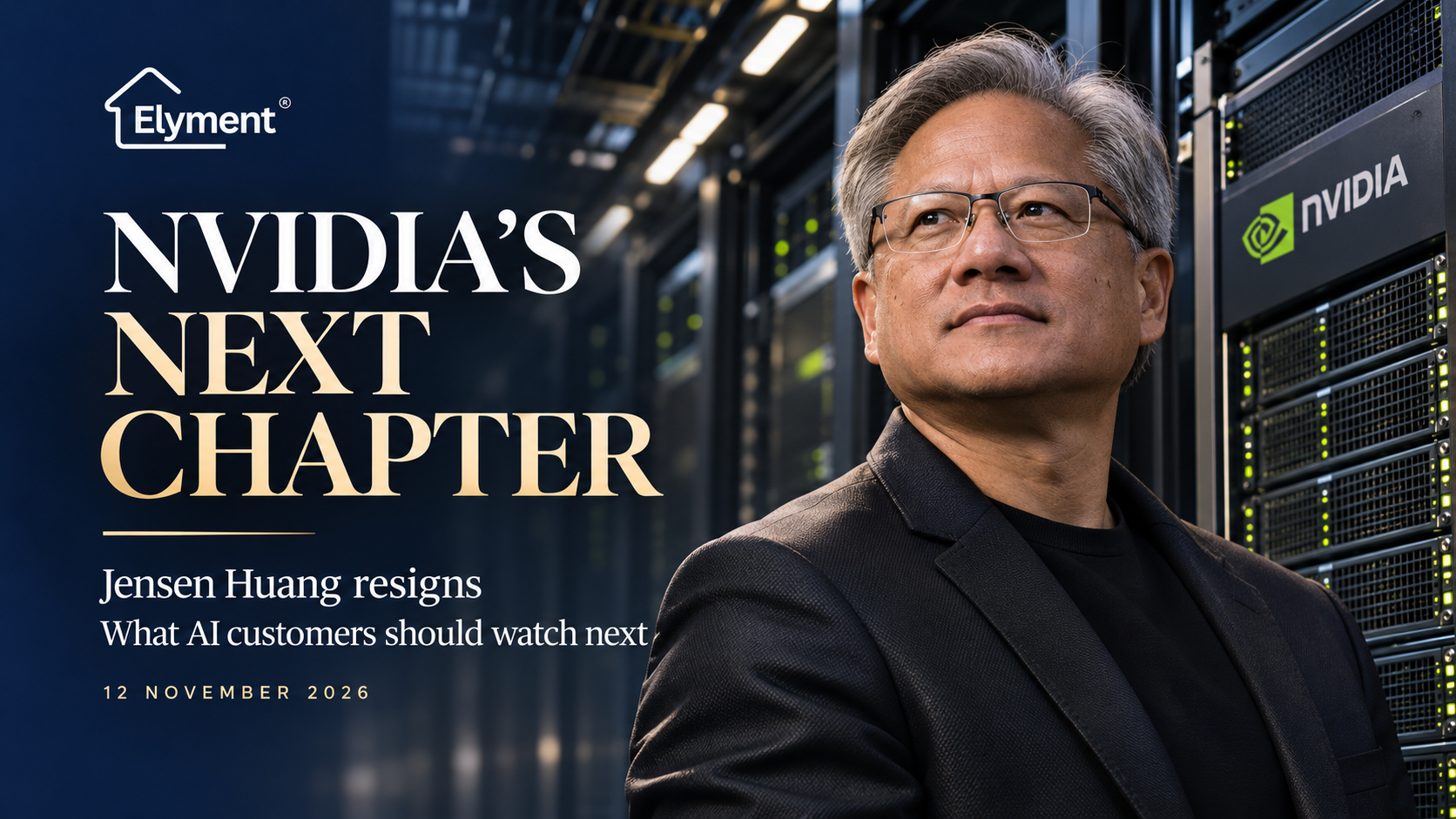
On 12 November 2026, NVIDIA confirmed Jensen Huang's immediate departure and appointed chief financial officer Colette Kress as interim CEO. NVIDIA expects its product roadmap and customer commitments to continue, but that assurance does not guarantee uninterrupted delivery. For Sydney and NSW organisations investing in AI infrastructure, the immediate priorities are verifying Rubin deployment schedules, confirming chip supply arrangements and monitoring the appointment of a permanent chief executive.
ELYMENT Insights | Artificial Intelligence & Business Operations | Sydney, NSW | 13 November 2026
The End of an Era Creates a Test That NVIDIA Cannot Answer With Another Chip Launch
For more than three decades, Jensen Huang has been inseparable from NVIDIA's identity. His leadership helped transform a graphics-chip company into a central supplier of the computing infrastructure underpinning modern artificial intelligence.
Now, that identity must operate without him at the top.
In a statement published on 12 November 2026, NVIDIA confirmed Huang had resigned as president, chief executive officer and director, effective immediately.
The company's regulatory filing provides an important distinction: its board accepted the resignation on 11 November, one day before the public announcement.
Colette Kress, NVIDIA's chief financial officer since 2013, has assumed the interim chief executive role while retaining her financial responsibilities. The board has begun searching for a permanent successor, considering both internal and external candidates.
Harvey C. Jones has also been appointed the company's first chair of the board.
These are confirmed governance changes. They do not, by themselves, establish that NVIDIA has cancelled orders, delayed products or changed its technology strategy.
That distinction matters. Leadership uncertainty can influence investor expectations almost immediately, but the operational consequences must be measured against manufacturing schedules, supplier performance, customer contracts and actual delivery.
What NVIDIA Has Confirmed, and What Remains Unanswered
NVIDIA's announcement offers an explicit message of continuity. Jones expressed confidence in the existing leadership team and said the company expected its operations, customer commitments and product roadmap to continue without interruption.
That is a statement of management expectations, not an independent verification of every customer delivery date.
Chief Executive
- Confirmed position: Jensen Huang has resigned.
- Still to be established: The identity and appointment date of his permanent successor.
Interim Leadership
- Confirmed position: Colette Kress is interim CEO and remains CFO.
- Still to be established: How responsibilities will be allocated over an extended transition.
Board Leadership
- Confirmed position: Harvey C. Jones has been appointed chair.
- Still to be established: Any future governance or strategic changes.
AI Chip Roadmap
- Confirmed position: NVIDIA expects continuity.
- Still to be established: Whether subsequent product milestones and customer deployments remain on schedule.
Supply Commitments
- Confirmed position: No cancellations were announced in the transition statement.
- Still to be established: Customer-specific allocations, delivery dates and future supply terms.
The official transition statement does not establish the reasons for Huang's departure. Public speculation about motives, future leadership candidates or strategic disruption should not be presented as confirmed corporate decisions.
For customers, this is not a reason to disregard the transition. It is a reason to distinguish evidence from assumptions before changing investment plans.
Rubin Is the First Major Operational Test
The most consequential near-term question concerns NVIDIA's next-generation Vera Rubin computing platform.
Rubin represents more than an individual graphics processor. NVIDIA has designed the architecture around tightly integrated computing, networking, memory, interconnects and rack-scale systems intended for large AI training and inference workloads.
In May 2026, NVIDIA announced that Vera Rubin was ramping into full production, supported by major server manufacturers and a geographically distributed supply chain.
Its financial disclosures subsequently reported the beginning of Rubin production shipments during the third quarter of fiscal 2027, alongside continuing Blackwell shipments and certain supply constraints.
The resignation announcement does not withdraw those earlier disclosures.
However, a successful production ramp does not automatically mean every customer receives deployable capacity at the same time.
There are several distinct stages:
- Component manufacturing: Chips, memory, networking equipment and supporting components must be produced.
- System integration: Manufacturers assemble and validate complete rack-scale platforms.
- Customer allocation: Capacity must be assigned against commercial commitments.
- Site readiness: Data centres require sufficient electricity, cooling, networking and physical infrastructure.
- Operational deployment: Hardware must be commissioned, tested and made available to workloads.
A customer could therefore encounter a deployment delay even when chip manufacturing itself remains on schedule.
That is why Rubin delivery provides a more meaningful operational measure of NVIDIA's transition than commentary about the company's share price alone.
The Supply Chain Is Larger Than Any Single Executive
NVIDIA's position in AI computing depends on a complex industrial network involving semiconductor manufacturing, advanced packaging, high-bandwidth memory, system assembly, networking and specialised data centre infrastructure.
Its second-quarter fiscal 2027 regulatory filing disclosed approximately US$279 billion in supply and capacity commitments as at 26 July 2026, reflecting efforts to secure manufacturing resources over multiple years.
That figure should not be confused with completed customer orders, delivered chips or guaranteed revenue.
The disclosure also identified risks from production complexity, supply constraints, changing customer demand and the availability of infrastructure required to deploy advanced computing systems.
Leadership continuity becomes relevant when those risks require coordinated decisions across several companies.
For example, customers should monitor whether NVIDIA's leadership transition changes:
- Previously communicated production and delivery schedules.
- Supplier capacity arrangements and system integration milestones.
- Product availability through cloud providers and enterprise hardware partners.
- Technical support, software maintenance and compatibility commitments.
- Commercial allocation arrangements for customers with large infrastructure requirements.
There is no verified basis, as at 13 November 2026, to conclude that Huang's resignation has disrupted these areas.
Nevertheless, they are the operational indicators that matter more than an executive change considered in isolation.
The distinction between financial investment and physical deployment is explored in Elyment's earlier analysis of NVIDIA, AMD and Meta's AI infrastructure commitments. The same principle applies here: an announcement is not equivalent to installed, functioning capacity.
Why Sydney Has a Particular Interest in NVIDIA's Next Chapter
NVIDIA's leadership transition is an American corporate event, but the consequences of any future change to AI infrastructure availability would be international.
Sydney is an important part of that picture.
In a 9 November 2026 analysis, the Reserve Bank of Australia reported that data centre investment had increased approximately tenfold over three years.
The RBA also identified Sydney and Melbourne as the primary locations for existing and planned Australian data centres, reflecting access to electricity, water, telecommunications, skilled labour and major customers.
This creates two separate questions for NSW businesses.
The first concerns access to computing capacity. Cloud customers need to establish whether their provider can deliver the required performance, location, availability and commercial terms.
The second concerns the physical infrastructure behind that computing capacity.
Data centre operators must coordinate electrical connections, cooling systems, equipment installation, construction sequencing and commissioning before new hardware can be brought into service.
NSW is already examining these pressures. The NSW Government's consultation on data centre electricity network connections outlines proposed reforms addressing infrastructure investment, network access and the allocation of related costs.
These constraints are not caused by NVIDIA's CEO transition. They are existing conditions that could affect how quickly any advanced AI hardware becomes operational in NSW.
A successful Rubin manufacturing programme cannot compensate for a Sydney facility that has not secured its required power connection or completed commissioning.
What AI Customers Should Watch Before Changing Their Plans
For Australian enterprises, the response should be structured supplier monitoring rather than an immediate assumption that NVIDIA's technology or commercial position has weakened.
Rubin Availability
- Evidence worth requesting: Written delivery or deployment milestones from the contracted provider.
- Potential business consequence: Delayed migration or expansion.
GPU Allocation
- Evidence worth requesting: Confirmed capacity reservations and contractual allocation terms.
- Potential business consequence: Unexpected availability or pricing exposure.
System Readiness
- Evidence worth requesting: Integration, commissioning and acceptance criteria.
- Potential business consequence: Hardware delivered before the facility can use it.
Platform Support
- Evidence worth requesting: Maintenance commitments, compatibility information and support arrangements.
- Potential business consequence: Integration and continuity risks.
Executive Succession
- Evidence worth requesting: Board announcements and subsequent investor disclosures.
- Potential business consequence: Potential changes to strategic priorities or commercial execution.
A practical example is a Sydney business planning to expand AI workloads through a cloud provider promising access to Rubin-based infrastructure.
The business should not assume that a publicly announced production milestone constitutes a firm allocation to its account.
Instead, its purchasing team should establish when capacity becomes available, which region will host the workloads, what performance commitments apply and what contractual remedies exist if the deployment changes.
For smaller businesses, the question may be whether specialised NVIDIA hardware is necessary at all.
Elyment has examined this procurement decision through the example of NVIDIA DGX Spark and local AI deployment for Sydney businesses, where ownership, security, maintenance and operational suitability can matter more than headline hardware performance.
The Permanent CEO Search Will Reveal More Than a Name
Colette Kress enters the interim position with substantial institutional knowledge. Her long tenure as CFO means she understands NVIDIA's financial position, supplier relationships, capital commitments and growth model.
That experience may support continuity through the transition.
However, interim leadership also concentrates executive and financial responsibilities in one person. Investors and enterprise customers should watch how NVIDIA delegates operational authority and whether its technical leadership retains sufficient decision-making capacity.
The board's decision to consider both internal and external candidates leaves several possible approaches open.
An internal appointment could prioritise strategic continuity. An external candidate could bring different operating or commercial priorities.
Neither result can be treated as more likely until NVIDIA provides further information.
The permanent appointment will matter particularly because NVIDIA competes across an increasingly broad technology stack, including hardware, networking, software and complete computing infrastructure.
The next CEO must oversee the integration of these businesses while maintaining customer confidence and the pace of technological development.
Leadership succession is therefore more than a corporate governance exercise. It is an operational test of whether the organisation can maintain its execution capabilities independently of its founder.
17 November: The Next Scheduled Public Test
NVIDIA's next scheduled financial disclosure offers a near-term opportunity to assess the transition.
According to its announcement, the company plans to report third-quarter fiscal 2027 results on Tuesday, 17 November 2026, followed by an earnings conference call.
As at the publication date of this article, those results have not yet been released.
Four areas deserve particular attention:
- Data centre performance: Whether the financial results and commentary indicate continuing demand and execution.
- Rubin deployment: Whether management provides updated production, delivery or adoption information.
- Supply conditions: Whether capacity constraints, production costs or customer delivery schedules have changed.
- Leadership responsibilities: Whether the company provides further information on the permanent CEO search and operating structure.
Any reported movement in these indicators would need to be assessed against existing demand, market conditions and previously disclosed supply constraints. It should not automatically be attributed to Huang's departure.
A Practical Response for NSW Organisations
Businesses planning substantial AI investments should consider three actions before making major changes to procurement or deployment schedules.
1. Separate Supplier Announcements from Contractual Commitments
Document the exact capacity, service levels, availability dates and support arrangements promised by each supplier. Distinguish general roadmap statements from binding commercial obligations.
2. Review Dependencies Beyond the GPU
Assess network connections, facilities, software compatibility, operational readiness and cloud service availability. A project may encounter delays unrelated to chip manufacturing or NVIDIA's management structure.
3. Maintain Realistic Contingency Arrangements
Identify which workloads require specialised accelerated computing and which can continue on existing infrastructure or alternative services. Establish change approvals and decision points before additional expenditure is committed.
For businesses implementing AI across customer service, procurement and project management, this discipline is particularly important. As Elyment's analysis of the operational costs of poorly designed AI automation explains, cheaper or more powerful technology does not automatically produce a reliable business process.
Can NVIDIA Stay Ahead Without Jensen Huang?
The evidence available on 13 November 2026 supports a measured conclusion.
NVIDIA has confirmed a major leadership change, appointed an experienced interim executive and stated its intention to maintain customer commitments and the existing technology roadmap.
Its manufacturing partnerships, installed software ecosystem and established commercial relationships do not disappear with a chief executive's resignation.
Equally, a company's historic success is not proof that future product launches, supply commitments or strategic decisions will proceed without difficulty.
The critical question is whether NVIDIA can convert its existing industrial advantages into consistent delivery under new leadership.
For Sydney and NSW customers, that means watching verifiable milestones rather than predicting a corporate collapse or assuming uninterrupted dominance.
NVIDIA's next chapter will be judged less by whether it can replace Jensen Huang's public profile than by whether its technology, management systems and supplier network can continue to perform without him.
Planning AI Infrastructure or Operational Changes in Sydney?
ELYMENT | AI & BUSINESS OPERATIONS
Review technology dependencies, procurement decisions, implementation risks and operational readiness before committing to your next phase of investment.
Sources and References
NVIDIA Corporate Announcements and Technical Information
- NVIDIA — CEO Transition Announcement, 12 November 2026
- NVIDIA — Vera Rubin Full Production and Agentic AI Factory Announcement
Australian Economic and Government References
- Reserve Bank of Australia — Data Centre Investment in Australia, 9 November 2026
- NSW Government — Data Centre Electricity Network Connections Consultation
Related Elyment Guides
- NVIDIA and AMD Invest US$4B in Meta: AI Chip Infrastructure Impact
- NVIDIA DGX Spark: 64GB Local AI for Sydney Businesses
- AI Tools May Get Cheaper, but Bad Automations Still Cost Businesses: What to Fix Before You Scale
ELYMENT | AI & BUSINESS OPERATIONS
Planning AI Infrastructure or Operational Changes in Sydney?
Review technology dependencies, procurement decisions, implementation risks and operational readiness before committing to your next phase of investment.
Discuss Your Project