Jensen Huang Returns as NVIDIA CEO. The Stock Jumps 31.5%
Buying a NSW apartment? Check strata insurance excess, past water leaks and potential repair costs before exchange to avoid unexpected expenses upon settlement.
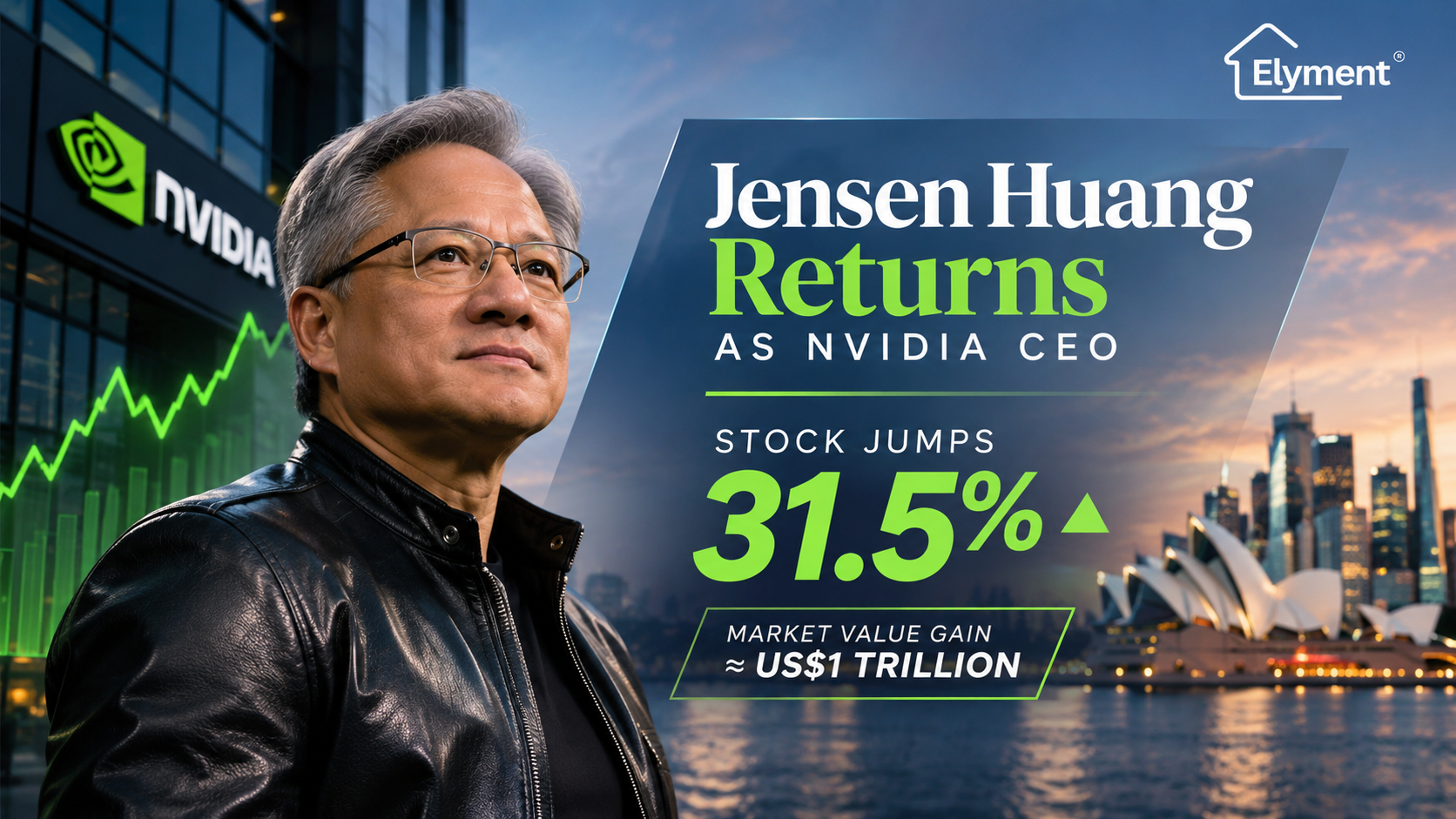
Jensen Huang returned as NVIDIA's president and chief executive officer on 23 November 2026, sending its shares 31.5% higher by the US market close. Early trading estimates placed the company's market value gain at approximately US$1 trillion. The increase represents investor valuation, not corporate earnings or personal income. For Sydney and NSW businesses investing in artificial intelligence, the event highlights the importance of separating financial market confidence from measurable commercial returns.
ELYMENT Insights | Artificial Intelligence, Business & Technology | Sydney, NSW | 24 November 2026
Eleven days after NVIDIA publicly announced his resignation, Jensen Huang is back in charge of one of the world's most influential technology companies.
On Monday, 23 November 2026, NVIDIA's board announced that it had unanimously reinstated its co-founder as president, chief executive officer and board director, effective immediately.
Wall Street responded with an extraordinary revaluation.
According to the Associated Press's closing market report, NVIDIA shares finished the session 31.5% higher.
Earlier in the session, financial reporting carried by Yahoo Finance estimated that the rally had increased NVIDIA's market capitalisation by approximately US$1 trillion.
The scale of the recovery illustrates how heavily financial markets can value leadership continuity, particularly when a company occupies such a significant position within the global artificial intelligence economy.
But the headline figure requires careful interpretation. NVIDIA did not earn US$1 trillion on Monday, and Huang did not personally receive that amount.
Jensen Huang's Return: What NVIDIA Has Confirmed
In its official announcement on 23 November, NVIDIA confirmed several important governance developments.
- Jensen Huang has resumed his positions as president, CEO and board director.
- All board members supported the reinstatement.
- Interim CEO Colette Kress remains chief financial officer.
- Harvey C. Jones continues as board chair.
- The independent investigation remains ongoing.
- NVIDIA intends to appoint a new chief compliance officer.
The board said it had received information from senior US government officials that informed its assessment of national security concerns surrounding Huang's return.
Importantly, the reinstatement does not represent the conclusion of every investigation or governance matter.
Elyment previously examined the circumstances of the leadership transition in its analysis of Jensen Huang's resignation and NVIDIA's leadership search. The latest announcement reverses that leadership change, but it also raises a separate financial question: how can the return of one executive influence nearly US$1 trillion of corporate valuation?
NVIDIA's 31.5% Stock Surge in Numbers
NVIDIA's Market Reaction on 23 November 2026
Public reinstatement announcement
- Reported date: 23 November 2026.
Previous closing share price
- US$125.53.
23 November closing share price
- US$165.05.
Closing share price increase
- Approximately 31.5%.
Early market value gain estimate
- Approximately US$1 trillion.
Estimated closing market value
- Approximately US$4 trillion.
The closing market figures reported by Reuters also showed that NVIDIA recovered nearly US$1 trillion in market value, although the rally did not erase all the losses recorded since Huang's departure.
Market capitalisation estimates can vary throughout a trading session as share prices change. They should therefore be understood in relation to the time at which they were calculated.
Did NVIDIA Really Make US$1 Trillion in One Day?
No. The reported increase relates to market capitalisation, which represents the combined market value of a company's outstanding shares.
The calculation is straightforward:
Market capitalisation = Share price × Outstanding shares
When investors become willing to pay more for a company's shares, the implied value of the entire company increases.
That increase does not automatically deposit additional money into the company's bank accounts.
Market capitalisation
- What it represents: Market value of outstanding shares.
- Effect of the share price rally: Increased substantially.
Corporate revenue
- What it represents: Income generated from business activities.
- Effect of the share price rally: Not directly increased by share trading.
Net profit
- What it represents: Earnings after applicable expenses and taxes.
- Effect of the share price rally: Not automatically increased.
Corporate cash reserves
- What it represents: Cash held by the company.
- Effect of the share price rally: Do not automatically increase.
Shareholder wealth
- What it represents: Market value of an investor's holdings.
- Effect of the share price rally: May increase without generating realised cash.
Consider a hypothetical company with 100 million outstanding shares trading at $30 each.
Its market capitalisation would be $3 billion. If the share price increased to $40, its valuation would rise to $4 billion, even if the business had not sold a single additional product during that period.
The same financial principle applies to NVIDIA, although the magnitude is considerably larger.
Did Jensen Huang Personally Receive US$1 Trillion?
No. NVIDIA's market capitalisation belongs to the valuation of the company as a whole, not exclusively to its chief executive.
As a shareholder, Huang may experience an increase in the estimated value of his NVIDIA holdings when the share price rises. However, the value of those holdings is distinct from salary, bonuses, dividends or cash received through share sales.
Any calculation of his personal wealth increase would require verified information about his share ownership and the relevant valuation date.
Why Wall Street Reacted So Strongly
The market reaction suggests that investors had attached substantial importance to Huang's leadership when assessing NVIDIA's future prospects.
His return potentially reduces uncertainty surrounding strategic direction, management continuity and relationships within the wider AI industry.
However, several forces may have contributed to the rally:
- Reversal of selling pressure following the earlier leadership crisis.
- Renewed confidence in NVIDIA's strategic direction.
- Reassessment of perceived management and governance risks.
- A broader recovery across AI-related technology shares.
These factors provide plausible explanations for the scale of the movement. They should not be interpreted as proof that every investor returned for the same reason.
Nor does a single trading session establish whether NVIDIA's future commercial performance will justify the recovered valuation.
The Governance Question Behind the Comeback
There is an important tension between the market's enthusiastic response and NVIDIA's continuing governance responsibilities.
The company has confirmed that an independent board committee will continue its investigation. It has also established a committee overseeing national security and export control matters and plans to recruit a chief compliance officer.
These developments demonstrate that leadership continuity and governance oversight are separate responsibilities.
For technology-dependent organisations, executive confidence cannot substitute for documented controls, delegated authority and effective institutional oversight.
The broader lesson is not that founder-led businesses are inherently unreliable. It is that operational resilience should extend beyond the reputation or availability of any individual.
What NVIDIA's Recovery Means for Sydney Businesses
By Tuesday morning in Sydney, Australian businesses were assessing the implications of the overnight US technology rally.
For organisations considering expenditure on AI systems, the distinction between supplier valuation and customer value is particularly important.
A stronger NVIDIA share price does not automatically mean that:
- Australian AI subscriptions will become cheaper.
- Existing software contracts will improve.
- GPU-based computing services will become more affordable.
- AI implementation projects will generate higher returns.
- Technology procurement risks have disappeared.
The National AI Centre's AI Adoption Tracker provides Australian businesses with a more locally relevant view of how small and medium enterprises are adopting artificial intelligence.
Local adoption, operational suitability and implementation costs provide a different measure of progress from the valuation of an overseas semiconductor company.
A Sydney Renovation Business Does Not Need a Wall Street Valuation
Consider a hypothetical Sydney renovation and property services business assessing whether to introduce an AI-assisted system for estimating, scheduling and project administration.
Its management team may be encouraged by renewed confidence across the AI sector. But approving an implementation budget requires evidence specific to its own operations.
Suppose the proposed system involves the following illustrative costs:
Initial implementation
- Illustrative amount: AUD $8,000.
Staff training
- Illustrative amount: AUD $2,000.
Monthly software and computing costs
- Illustrative amount: AUD $600.
First-year total
- Illustrative amount: AUD $17,200.
If the system produces measurable net operational benefits of $2,000 per month before the listed technology costs, the business could generate $24,000 in annual benefits against those first-year costs.
That represents a potential first-year surplus of $6,800 under the stated assumptions, before tax and any unlisted expenditure.
If those operational benefits fail to materialise, the same technology investment may produce a loss regardless of NVIDIA's market performance.
All figures are hypothetical and are not supplier quotations or guaranteed savings.
This is the distinction between financial market enthusiasm and commercially justified technology expenditure.
Where Governance Meets Everyday Project Delivery
For property, construction and renovation businesses, AI reliability is not simply a software consideration.
Incorrect information can affect material orders, contractor attendance, flooring estimates, customer communications and project completion dates.
Consider an AI-assisted workflow that prepares documentation for a Sydney apartment renovation. The business should establish who verifies quantities, confirms subcontractor availability and approves changes before information is communicated to the customer.
Those responsibilities must remain clear even if the technology supplier experiences a leadership change, service interruption or commercial restructuring.
The Australian Signals Directorate's AI guidance for small businesses identifies risks associated with inaccurate outputs, data handling and technology supply chains.
These risks become particularly relevant when automated systems interact with customer records, project documentation and commercially sensitive information.
What NSW Businesses Should Measure Instead of Share Prices
Organisations evaluating AI systems can establish practical measures before approving expenditure.
1. Establish the existing operating cost.
Measure the time and expenditure associated with the current manual process.
2. Define the expected improvement.
Identify whether the technology should reduce administration, improve accuracy or accelerate project delivery.
3. Document approval responsibilities.
Establish which decisions require human verification.
4. Measure actual implementation expenditure.
Include software, integration, training, maintenance and computing costs.
5. Review realised business benefits.
Compare actual results against the original business case before expanding the investment.
Elyment's analysis of the NVIDIA DGX Spark Developer Kit and paid private AI pilots explores how a specific business requirement can be tested before committing to wider deployment.
Businesses can also examine the portability of AI workloads between GPUs and alternative computing platforms when assessing longer-term technology dependencies.
The Market Has Delivered Its Verdict. The Business Results Are Still to Come.
Jensen Huang's reinstatement has produced a remarkable financial reaction, demonstrating the extent to which his leadership influences investor expectations of NVIDIA.
The 31.5% share price recovery and approximately US$1 trillion increase in valuation are significant financial developments. They are not equivalent to new revenue, cash generation or completed technology deployments.
NVIDIA must continue to demonstrate commercial performance while addressing its ongoing governance responsibilities.
For Sydney and NSW organisations, the most useful response is to evaluate artificial intelligence against the economics and responsibilities of their own operations.
Wall Street can revalue a technology company in a matter of hours. Building a reliable, productive and commercially sustainable business system takes considerably longer.
ELYMENT | TECHNOLOGY & BUSINESS OPERATIONS
Turn AI Confidence Into Measurable Business Value
Review technology expenditure, operational workflows, implementation responsibilities and project delivery requirements before committing to your next business transformation.
Sources and References
- Associated Press: Closing Market Report
- Yahoo Finance: NVIDIA Shares and Technology Stock Market Reporting
- NVIDIA Investor Relations: Board Reinstates Jensen Huang as President, CEO and Board Director
- Reuters: NVIDIA Reinstates Jensen Huang as CEO
- National AI Centre: AI Adoption Tracker
- Australian Signals Directorate: Artificial Intelligence for Small Business
Related Elyment Resources
- Jensen Huang Resigns as NVIDIA CEO: Leadership Search and Rubin Roadmap
- NVIDIA DGX Spark Developer Kit and Paid Private AI Pilots
- TorchTPU: Can PyTorch Models Move From GPUs to Google TPUs?
Conversion note (not part of the article): The original editorial content and supplied links have been preserved. The reported resignation, reinstatement, governance developments, market figures and source URLs have not been independently verified and should be fact-checked before publication.
ELYMENT | TECHNOLOGY & BUSINESS OPERATIONS
Turn AI Confidence Into Measurable Business Value
Review technology expenditure, operational workflows, implementation responsibilities and project delivery requirements before committing to your next business transformation.
Optimise Your Operations