Loose-Lay Vinyl Flooring Sydney: Does a Busy Shop Still Need Adhesive?
Does a busy Sydney shop need adhesive for loose-lay vinyl flooring? Explore movement risks, heavy traffic, subfloor preparation and when fixing may be required.
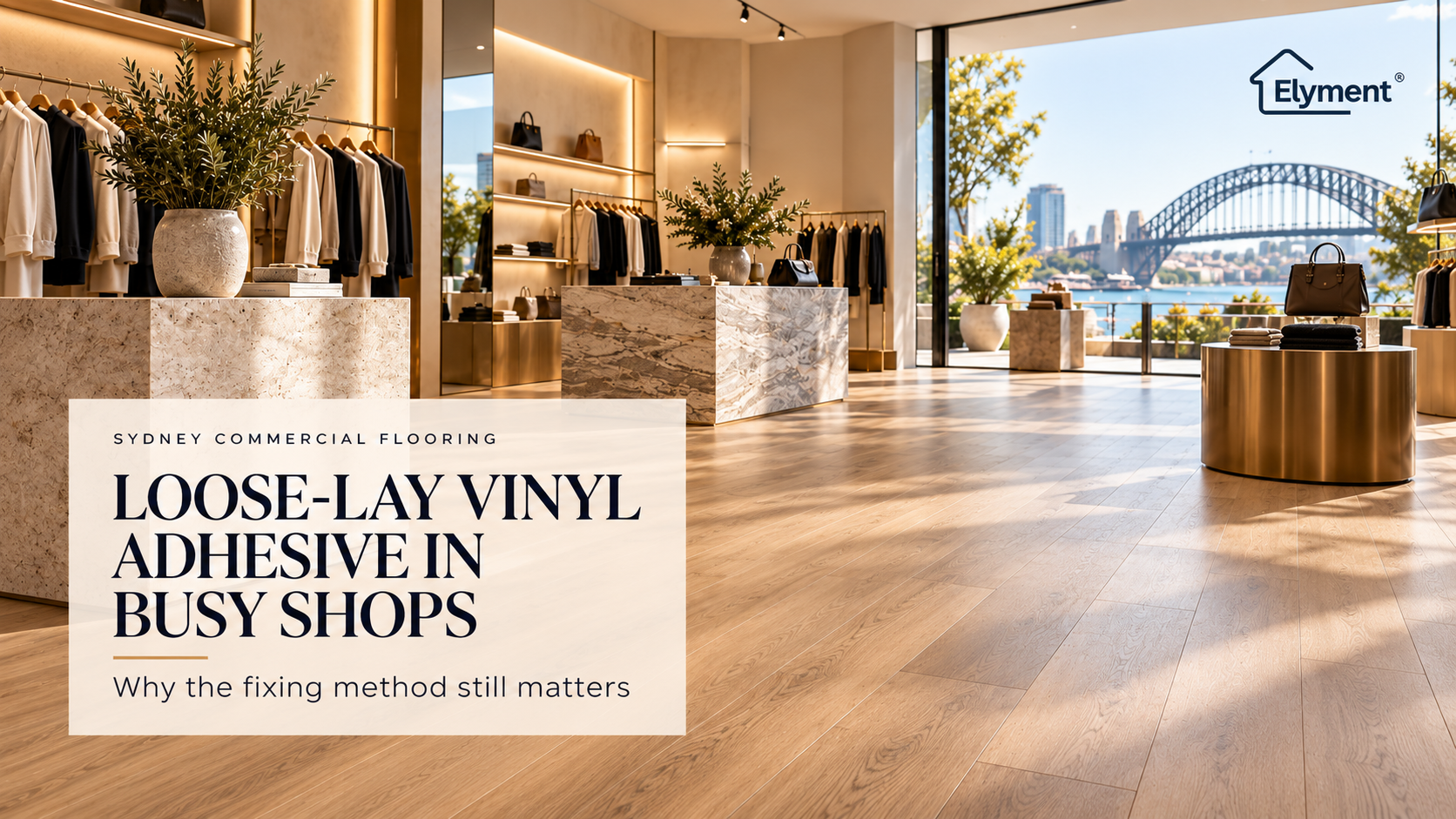
Loose-lay vinyl flooring in Sydney does not automatically mean adhesive-free installation. Some products permit limited adhesive or removable fixing systems, while busy commercial environments may require full-spread adhesive to manage foot traffic, rolling loads and temperature fluctuations. The manufacturer's installation requirements, rather than the term "loose-lay", determine the correct method. Concrete grinding, floor levelling and moisture assessment can also materially affect installation costs and project timing.
ELYMENT Insights | Flooring & Commercial Renovation | Sydney, NSW | 27 October 2026
The Promise of Loose-Lay Flooring Meets the Reality of Retail
A Sydney retailer preparing to refurbish a busy shop encounters an attractive proposition: vinyl planks that can be installed quickly, replaced individually and potentially removed without destroying the floor underneath.
The product is described as loose-lay vinyl flooring. The assumption follows almost immediately.
If the planks are designed to sit securely on the substrate, why would the shop need adhesive?
The answer becomes less straightforward when the floor must withstand hundreds of customer movements, delivery trolleys, cleaning equipment, repositioned merchandise displays and direct sunlight through a glazed shopfront.
Those conditions introduce forces that may not exist in a residential room or lightly occupied office.
For commercial tenants, landlords and shopfitters, the distinction matters because the fixing method affects installation cost, flooring performance, maintenance access and the practical consequences of replacing damaged planks.
The commercial decision is therefore not simply whether to use adhesive.
It is whether the selected flooring system can deliver the required stability while retaining enough flexibility for future maintenance.
Loose-Lay Is a Product Description, Not an Installation Guarantee
Loose-lay luxury vinyl flooring generally uses dimensional stability, backing characteristics and close-fitting installation to help maintain plank position.
However, loose-lay products are not interchangeable. Their permitted fixing methods depend on the manufacturer's installation instructions, the substrate and the intended operating environment.
This distinction is particularly clear in Karndean's Australian and New Zealand loose-lay installation guidance.
The manufacturer's guidance identifies different installation approaches according to traffic, environmental stability and exposure conditions.
Examples of Fixing Approaches Identified in Karndean's Australian and New Zealand Guidance
- Light Foot Traffic, Non-Commercial, Stable Indoor Conditions
- Specified Fixing Approach: Perimeter and grid fixing using an appropriate pressure-sensitive adhesive.
- Commercial Implication: Limited adhesive coverage may suit the nominated low-traffic application.
- General Traffic, Light Commercial Use, Stable Indoor Conditions
- Specified Fixing Approach: Full-area pressure-sensitive adhesive application.
- Commercial Implication: Adhesive may be required throughout the commercial floor.
- High Foot Traffic or Unstable Indoor Temperature Conditions
- Specified Fixing Approach: Full-area hard-set adhesive.
- Commercial Implication: Greater fixing security may come with more demanding future removal.
- High-Spillage Environments or Significant Heat Exposure
- Specified Fixing Approach: Suitable full-area chemical-cure or water- and heat-resistant adhesive.
- Commercial Implication: The environmental conditions influence adhesive selection.
These are examples from one manufacturer's specified system, not universal installation rules for every loose-lay vinyl product.
Other manufacturers may provide different installation options.
For example, Gerflor's Creation 55 Looselay product information describes adhesive-free installation under defined conditions and removable installations using tackifier.
The relevant product's current Australian installation instructions must still be checked before applying those methods to a Sydney commercial tenancy.
This exposes a weakness in quotations that simply promise "loose-lay vinyl supplied and installed".
Without identifying the product, application conditions and fixing system, that description does not establish what the contractor intends to install.
Why a Busy Shop Changes the Fixing Decision
Commercial flooring is not exposed to traffic in a uniform way.
A retail store may have comparatively light movement around its perimeter but concentrated activity at the entrance, checkout and stockroom.
The loads imposed on the floor can also differ considerably.
Repeated Foot Traffic
Customers entering a shop frequently accelerate, stop, turn and change direction.
Those movements generate lateral forces that can affect individual planks, particularly around entrances and frequently used circulation routes.
Rolling Stock and Equipment
Retail operations may involve delivery trolleys, mobile shelving, cleaning equipment and wheeled merchandise displays.
Rolling loads can concentrate force along plank joints and repeatedly stress the installed surface.
A product suitable for ordinary pedestrian traffic is not automatically approved for every type of rolling equipment.
Direct Sunlight
Sydney shopfronts with extensive glazing may expose sections of flooring to significantly different temperatures.
Solar exposure can influence dimensional movement and the performance requirements of the fixing system.
A floor that performs adequately under stable air-conditioning conditions may require a different installation approach near heat-exposed glazing.
Concentrated Fixture Loads
Heavy counters, display cabinets and shelving systems can introduce concentrated loads and restrict natural material movement.
Their position should be considered during product selection rather than treated as an installation detail after the flooring arrives.
The important distinction is that commercial suitability and fixing suitability are related but separate technical questions.
A commercial wear rating does not, by itself, authorise adhesive-free installation under every traffic and environmental condition.
The Replacement Advantage Comes With Conditions
One of the strongest commercial arguments for loose-lay vinyl is the potential to replace individual damaged planks.
A retailer may prefer to repair a small damaged section rather than replace an entire continuous floor.
This can be particularly valuable where merchandise displays, furniture movement or localised wear create uneven replacement needs.
However, replacement convenience depends on how the flooring was originally fixed.
Removable Fixing Systems
Where a product is approved for installation using a releasable tackifier or another removable system, individual plank replacement may be relatively straightforward.
Even then, removal depends on adhesive condition, substrate integrity and the manufacturer's repair procedure.
Permanent Adhesive Systems
Hard-set adhesive can provide fixing characteristics appropriate to more demanding commercial conditions.
The trade-off is that removing a damaged plank may require additional labour, controlled lifting and localised substrate preparation.
The replacement plank must then be installed using a compatible repair method.
A floor should not be marketed to a commercial tenant as automatically removable simply because its product family carries the loose-lay label.
Before purchasing, the retailer should obtain the manufacturer's replacement instructions for the exact product and specified adhesive system.
Replacement stock also matters. Colour variation, discontinued designs and production batch differences can complicate otherwise simple repairs.
Holding an appropriate quantity of matching replacement planks may therefore be more useful operationally than relying solely on claims of easy removability.
The Existing Concrete May Be the Most Expensive Part
Loose-lay flooring can reduce certain installation operations under approved conditions.
It does not eliminate the need for a suitable substrate.
A common commercial refurbishment involves removing existing carpet tiles, vinyl flooring or another bonded finish before installing new vinyl planks.
Once the previous flooring is removed, the contractor may discover old adhesive, uneven concrete, damaged levelling compound or moisture-related defects.
The replacement flooring cannot automatically conceal those conditions.
Old Adhesive Removal
Existing flooring adhesive may create ridges, soft patches, contamination or inconsistent surface conditions.
Depending on its composition, condition and the new product's requirements, mechanical adhesive removal may be necessary.
Elyment's concrete grinding and adhesive removal services address preparation requirements where existing coatings, residues or unsuitable concrete surfaces must be treated before new flooring is installed.
However, grinding is not a universal response to every existing floor. Unidentified materials must be assessed before they are mechanically disturbed.
Concrete Flatness and Surface Preparation
Loose-lay planks still require a substrate that satisfies the nominated product's flatness, smoothness and stability requirements.
Localised concrete high points may require appropriate mechanical preparation.
Depressions, damaged patches and inconsistent surfaces may require compatible repair or levelling materials.
This work should be assessed before finalising the flooring installation price.
Elyment's Sydney floor levelling and subfloor preparation service provides a relevant starting point for assessing the preparation required beneath a new floor finish.
Moisture Is Not Removed From the Equation
The absence of permanent adhesive does not mean concrete moisture can be ignored.
Manufacturers may specify moisture limits for the flooring itself, while adhesive, primer and levelling systems can have separate requirements.
Substrate testing and the applicable moisture management method should therefore be established for the complete flooring assembly.
Australian resilient flooring installations should also be assessed against the relevant requirements of AS/NZS 1884 and current manufacturer instructions.
The Quotation Should Separate Product Cost From Installation Risk
Vinyl flooring installation cost is often presented as a price per square metre.
That figure can be useful for preliminary budgeting.
However, two commercial flooring quotations covering identical floor areas may include substantially different preparation and fixing work.
The differences are easier to identify when the quotation separates the principal work packages.
Commercial Loose-Lay Vinyl Flooring: Quotation Items Worth Checking
- Vinyl Product
- What Should Be Clarified: Brand, range, product code, wear specification and quantity.
- Potential Cost Consequence: Material cost, suitability and replacement availability.
- Existing Floor Removal
- What Should Be Clarified: Flooring type, underlay, disposal and access.
- Potential Cost Consequence: Additional demolition labour and waste handling.
- Concrete Grinding
- What Should Be Clarified: Adhesive removal, high spots and required surface preparation.
- Potential Cost Consequence: Specialist equipment, labour and dust controls.
- Floor Levelling
- What Should Be Clarified: Required repair areas, depth and material specification.
- Potential Cost Consequence: Additional materials, preparation and curing time.
- Adhesive System
- What Should Be Clarified: Approved product, coverage and fixing method.
- Potential Cost Consequence: Material, application and replacement implications.
- Installation Labour
- What Should Be Clarified: Layout, cutting, edge details and commercial access.
- Potential Cost Consequence: Labour requirements and installation sequencing.
- Operational Constraints
- What Should Be Clarified: Trading hours, fixture movement, loading access and protection.
- Potential Cost Consequence: Potential additional shifts, handling and business disruption.
- Testing and Handover
- What Should Be Clarified: Moisture assessment, substrate acceptance and completion checks.
- Potential Cost Consequence: Testing allowances and defect-risk management.
A quotation that excludes adhesive may initially appear less expensive than one including full-area fixing.
But the comparison is only meaningful if both installation methods are permitted for the nominated product and commercial environment.
The cheapest installation is not necessarily the lowest-cost floor across the tenancy's operating life.
Two Retail Tenancies Can Reach Different Decisions
Consider two illustrative Sydney commercial flooring projects.
Both owners select a loose-lay vinyl plank appearance.
Both want to minimise disruption and preserve the option of replacing damaged sections.
Their operating requirements, however, are different.
Scenario One: A Small Appointment-Based Showroom
The first tenancy has controlled indoor temperatures, limited daily foot traffic and relatively infrequent furniture movement.
The substrate is sound, the floor area is modest and there are no significant rolling loads.
Depending on the selected product, the manufacturer may permit an installation method that preserves easier plank replacement.
In this situation, a removable fixing system may offer both installation and maintenance advantages.
Scenario Two: A Busy Street-Front Retail Store
The second tenancy has continuous customer movement, wheeled deliveries, heavy display units and a glazed entrance exposed to sunlight.
Its existing flooring also conceals patches of adhesive and uneven concrete.
The nominated product's installation requirements may call for full-area adhesive or another specifically approved commercial fixing system.
The project may also require adhesive removal, concrete grinding, localised levelling and moisture assessment before installation.
The second store is not necessarily receiving a more sophisticated flooring product.
It is purchasing an installation system designed around a more demanding operating environment.
Neither scenario authorises a particular fixing method without product-specific confirmation.
NSW Safety and Building Requirements Still Apply
Flooring installation methods influence more than maintenance and material performance.
Retail property owners and project teams must also consider workplace safety, access and building-specific requirements.
Slip and Trip Risk
SafeWork NSW's guidance on slips, trips and falls identifies uneven flooring, changes in floor surfaces, loose materials and contaminants as workplace hazards.
These risks are relevant to a commercial vinyl floor, particularly at entrances, transitions and heavily used circulation areas.
The final floor must be assessed for its intended use and relevant slip-resistance requirements.
Concrete Grinding and Dust Exposure
Concrete surface preparation may generate respirable crystalline silica.
SafeWork NSW's crystalline silica guidance explains the need to identify exposure risks and implement suitable controls.
Dust management is particularly important in occupied buildings and retail environments containing stock, fixtures and neighbouring commercial operations.
Legacy Flooring Materials
Older Sydney retail properties may contain historical flooring layers or adhesives requiring further investigation.
Suspected asbestos-containing materials must be assessed before disturbance, with appropriate controls and removal arrangements where required.
SafeWork NSW provides asbestos identification and removal guidance relevant to these situations.
Tenancy and Building Requirements
Where flooring works occur in a shopping centre or managed commercial building, the project team should also check applicable lease conditions, landlord requirements, fit-out approvals and access rules.
Entrances, accessible routes, floor transitions and adjoining finishes may create additional design and compliance considerations.
These matters should be resolved before committing to a flooring build-up or installation programme.
The Decision Should Be Documented Before Materials Are Ordered
A practical specification review should establish more than the selected colour and plank size.
Before approving a commercial vinyl plank installation, the project team should confirm:
- Product Identification: The exact manufacturer, range, product code and current Australian installation instructions.
- Commercial Suitability: Expected pedestrian traffic, rolling equipment, fixture loads and environmental conditions.
- Fixing Requirements: Whether the manufacturer approves adhesive-free, partial, releasable or full-area fixing for the application.
- Substrate Condition: Existing flooring, adhesive residues, concrete soundness, moisture and surface irregularities.
- Preparation Scope: The grinding, repair, priming and levelling required before the new product can be installed.
- Replacement Method: How damaged planks can be removed, what repairs will require and whether spare stock should be retained.
- Installation Programme: Material conditioning, preparation time, adhesive requirements, permitted access and return-to-service conditions.
- Commercial Responsibility: Who approves the prepared substrate, authorises variations and accepts the completed flooring.
These decisions are particularly important where flooring supply, removal, preparation and installation are being performed by different contractors.
Elyment's Sydney flooring and renovation services bring these related requirements into the wider planning of removal, substrate preparation and installation work.
The Real Cost Is Determined by the Complete Flooring System
Loose-lay vinyl can be a practical option for Sydney commercial properties.
Its potential advantages include flexible maintenance, individual plank replacement and simplified installation under appropriate conditions.
Those advantages should not be confused with a universal promise of adhesive-free flooring.
A busy shop may require a more substantial fixing system than a lightly used showroom.
An apparently simple installation may still depend on removing previous flooring, grinding adhesive, repairing concrete and achieving an acceptable finished surface.
For commercial owners, the most useful comparison is therefore not loose-lay versus glued vinyl in isolation.
It is the installed cost, maintenance flexibility, operational suitability and long-term serviceability of the complete flooring system.
The question worth resolving before signing the quotation is whether the proposed fixing method actually matches the shop's operating conditions.
Review the Installation System Before the Fit-Out Begins
SYDNEY COMMERCIAL FLOORING
Planning a retail flooring upgrade in Sydney? Review vinyl installation requirements, adhesive systems, concrete preparation, floor levelling and project sequencing before committing to the final scope.
Request a Commercial Flooring Project Review
Sources and References
Manufacturer Installation Guidance
- Karndean: Australian and New Zealand Loose-Lay Installation Guidance
- Manufacturer installation guidance covering traffic conditions, adhesive requirements and fixing methods for loose-lay vinyl flooring.
- Gerflor: Creation 55 Looselay Product Information
- Manufacturer information describing loose-lay installation options, including adhesive-free applications under defined conditions and removable fixing systems.
- Australian/New Zealand Standard AS/NZS 1884 — Floor Coverings: Resilient Sheet and Tiles — Installation Practices
- Standard addressing relevant substrate assessment, preparation and installation practices for resilient flooring.
NSW Workplace Safety References
- SafeWork NSW: Slips, Trips and Falls on the Same Level
- Workplace safety guidance covering flooring hazards, uneven surfaces, contaminants and slip and trip risks.
- SafeWork NSW: Working Safely With Crystalline Silica
- Guidance on exposure risks and workplace controls associated with respirable crystalline silica.
- SafeWork NSW: Asbestos Safety and Removal Guidance
- Information about identifying, managing and safely removing asbestos-containing materials.
Related Elyment Flooring Resources
- Concrete Grinding and Adhesive Removal Services Sydney
- Sydney Floor Levelling and Subfloor Preparation Services
- Sydney Flooring and Renovation Services
- Contact Elyment Property Services
COMMERCIAL FLOORING | SYDNEY NSW
Is Your Flooring Specification Ready for Installation?
Review the selected vinyl system, adhesive requirements, existing concrete condition and project delivery considerations before your commercial fit-out begins.
Request a Commercial Flooring Project ReviewRelevant next actions
Explore the ELYMENT service most closely connected to this article.