Magnesite Removal Cost Sydney: Waste Testing & Disposal
Magnesite removal costs in Sydney can depend on waste testing. Find out why disposal quotes may change after results, and what to check before setting a budget.
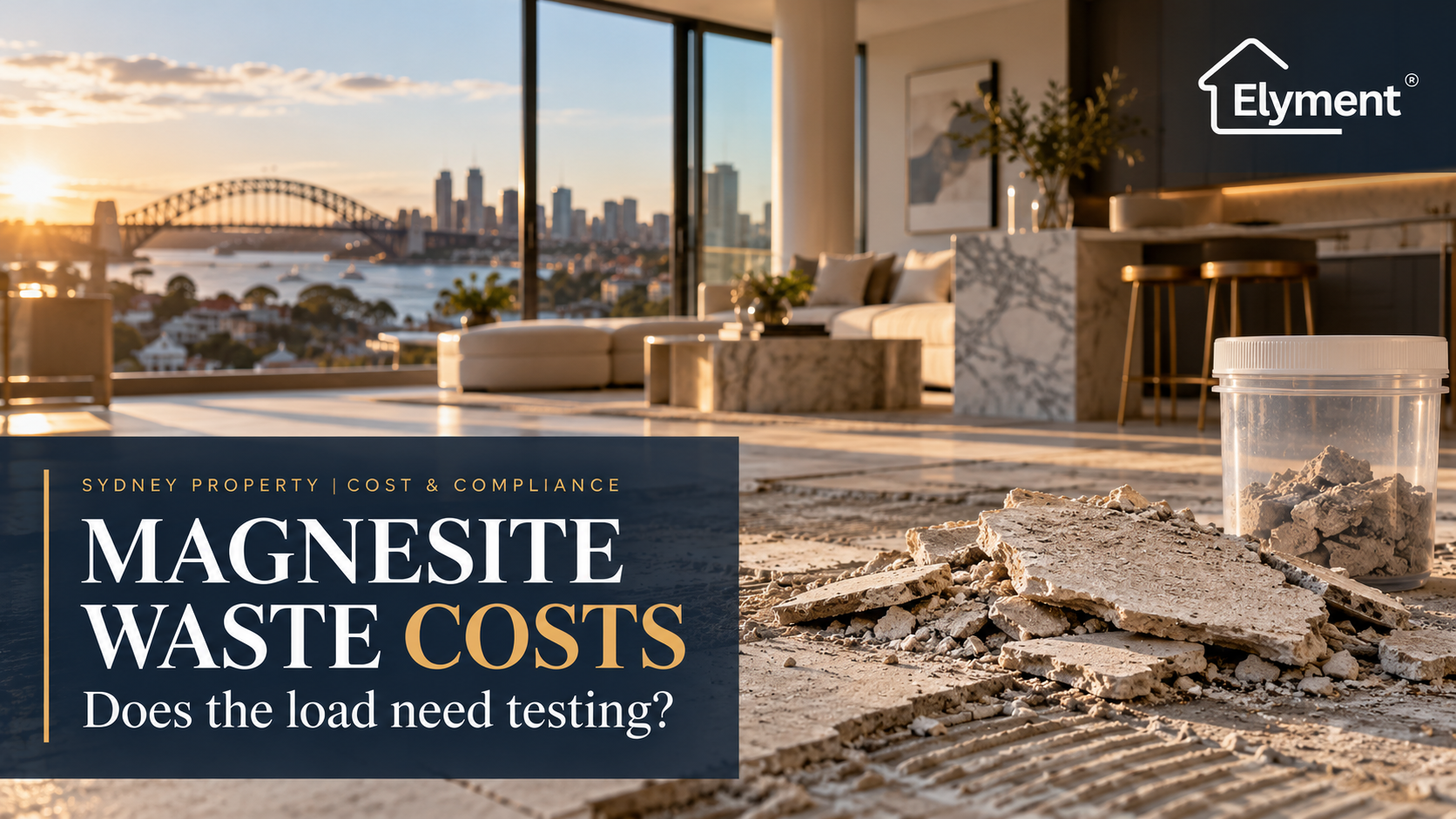
Magnesite waste does not automatically require laboratory testing or hazardous-waste disposal in Sydney. Under NSW EPA rules, classification depends on the material, its origin, possible contamination and whether an applicable pre-classification can be established. Testing may be necessary when the waste cannot otherwise be classified. Before disposal costs are finalised, contractors should confirm the classification, any required evidence and acceptance by an appropriately authorised receiving facility.
The Disposal Price Can Be Uncertain Even When the Removal Scope Is Clear
A Sydney apartment owner may know precisely how much magnesite needs removing. The floor area has been measured, access has been inspected and the contractor has estimated the demolition labour.
Yet one important part of the quotation may remain unresolved: what happens to the material after it leaves the property?
That uncertainty is not necessarily about the number of truckloads or the distance to a waste facility. It may concern whether the removed flooring has been correctly classified and whether the proposed destination will accept it.
In an older strata building, demolition can produce several distinct materials, including magnesite topping, old adhesive, floor coverings and residual concrete fragments. Their composition, condition and contamination history may not be identical.
For project managers, the commercial problem is determining whether sufficient information exists to price disposal before work starts, or whether assessment is needed to prevent an incorrectly priced waste stream.
This is a separate issue from deciding who supplies a container or transports the material. The classification decision determines the lawful disposal pathway and can influence which receiving facilities are available.
NSW Waste Classification Starts With Evidence, Not Assumptions
The NSW Environment Protection Authority establishes a step-by-step system through its Waste Classification Guidelines.
The framework identifies six principal waste classes:
- Special waste
- Liquid waste
- Hazardous waste
- Restricted solid waste
- General solid waste (putrescible)
- General solid waste (non-putrescible)
The guidelines require classification steps to be considered in order. The process first examines special waste and liquid waste, then whether the material is pre-classified, followed by hazardous characteristics and chemical assessment where necessary.
Why pre-classification matters
Certain materials are already pre-classified under NSW waste rules. This includes building and demolition waste meeting the relevant statutory definition, which is generally classified as general solid waste (non-putrescible).
Importantly, the definition of building and demolition waste refers to unsegregated material from qualifying construction and demolition activities, excluding material containing asbestos waste or liquid waste.
That distinction matters when a contractor removes magnesite as a separate material stream. A standalone load of magnesite should not automatically be treated as qualifying under the same pre-classification simply because it originated from a renovation.
Its actual characteristics and the applicable classification pathway must be established.
Likewise, a historical description of a floor as magnesite does not, by itself, establish that the demolished material is hazardous.
The relevant question is not whether magnesite is universally hazardous. It is whether the particular waste stream can be correctly classified using the applicable NSW framework.
When Existing Building Information May Be Enough
Laboratory analysis is not automatically required for every demolition load. Some waste can be classified through an applicable pre-classification, supported by reliable information about its source and composition.
However, existing documentation must actually support the applicable classification. An old inspection report or supplier specification cannot replace a chemical assessment when the NSW EPA process requires one.
Useful information available before demolition may include:
- Previous material identification: Building reports or investigations identifying the existing topping and associated layers.
- Hazardous-material surveys: Relevant asbestos or other hazardous-material findings covering the materials that will be disturbed.
- Renovation records: Evidence of later adhesives, coatings, repairs or alterations that may affect the waste stream.
- Earlier analytical reports: Results that remain representative of the actual material and areas proposed for removal.
- Site observations: Information about unexpected staining, residues, leaks or distinct materials beneath the floor covering.
- Receiving-facility requirements: Confirmation of what the intended destination needs before accepting the material.
The quality and relevance of that evidence matter more than the number of documents collected.
A report from a neighbouring apartment may provide useful background, but it does not automatically classify material from another lot. Differences in renovation history, adhesive systems and moisture exposure may affect whether the findings are representative.
In Sydney strata buildings, obtaining earlier reports through the owners corporation or building manager may reduce uncertainty. Their existence, however, does not eliminate the need for site-specific assessment where the evidence is incomplete.
When Specialist Testing Becomes a Pricing Issue
Under the NSW EPA classification process, chemical assessment becomes relevant when a waste has not been classified through the preceding steps.
The guidelines provide an important consequence: where waste remains unclassified after the first four steps and chemical assessment is not undertaken, it must be classified as hazardous waste.
That does not mean all magnesite is hazardous. It means that an unresolved classification cannot simply be treated as ordinary disposal for convenience.
The following circumstances can justify further specialist review.
Clearly identified renovation waste meeting an applicable pre-classification
- Classification consideration: Document the classification basis and confirm facility acceptance.
- Potential cost effect: Laboratory testing may not be required for classification.
Separate magnesite waste stream with insufficient evidence
- Classification consideration: Confirm whether pre-classification applies or chemical assessment is necessary.
- Potential cost effect: Specialist assessment and sampling may be required before a firm disposal rate.
Suspected asbestos-containing adhesive or associated material
- Classification consideration: Arrange competent hazardous-material assessment before disturbance; asbestos waste is special waste.
- Potential cost effect: Potential changes to handling, transport, disposal and contractor requirements.
Unexpected chemical residues, contamination or distinct repair materials
- Classification consideration: Review the affected material separately and determine appropriate analytical requirements.
- Potential cost effect: Additional sampling, segregation and a different receiving facility may be needed.
Receiving facility requests further evidence
- Classification consideration: Clarify whether the issue concerns legal classification, material composition or site acceptance criteria.
- Potential cost effect: Additional documentation, testing or an alternative disposal route may change the quote.
Where chemical testing is required, a suitably qualified environmental consultant or waste-classification specialist should determine the appropriate sampling strategy and analytical parameters.
Depending on the circumstances, this may involve assessing specific contaminant concentrations or leachability against the applicable EPA criteria.
Testing should answer a defined classification question rather than provide a generic laboratory report with no clear disposal decision attached.
Not Every Test on a Magnesite Floor Answers the Same Question
A particular source of confusion in renovation quotations is the assumption that one test establishes everything contractors need to know.
It does not.
Material and asbestos identification
Testing may be needed to identify suspected asbestos-containing materials within an older flooring assembly. The result influences safe removal requirements and waste management if asbestos is confirmed.
Magnesite itself should not be assumed to contain asbestos simply because it was installed in an older building. Associated adhesives, floor coverings or other materials require separate consideration where their history raises concern.
See Elyment's existing magnesite removal and asbestos testing guidance for the distinction between flooring identification and hazardous-material precautions.
Concrete chloride testing
Chloride testing of the concrete substrate is generally concerned with corrosion risks, slab condition and subsequent flooring preparation.
It is not automatically a waste-classification test for the material being transported off site.
Elyment has separately examined chloride contamination testing before new flooring is ordered, which addresses the substrate and reinstatement decision.
Waste classification testing
Waste-classification analysis assesses the discarded material against the applicable NSW requirements to establish its waste class.
A suitable report should identify the material assessed, sampling methodology, relevant analytical findings and the resulting classification.
For owners and contractors, the practical lesson is to establish the purpose of each investigation. A report addressing concrete corrosion should not be presented as proof that an unrelated demolition load meets a particular disposal classification.
Waste Separation Can Protect the Disposal Budget
Magnesite removal rarely occurs in isolation from other building materials.
Contractors may first lift carpet, vinyl, timber or another covering. Adhesives and repair compounds may remain attached to the underlying topping. Concrete fragments can also become mixed with removed material during demolition.
NSW EPA guidance supports separating waste of different classifications where it is practicable, safe and appropriate.
Separation can help preserve a lawful disposal pathway for material that does not require the same controls as another stream.
However, separation is not a mechanism for disguising contamination. The EPA expressly prohibits mixing different waste classes to dilute chemical contaminants.
A practical removal plan may therefore distinguish:
- Floor coverings and associated components removed before the topping.
- Magnesite material proposed for separate collection and classification.
- Suspected hazardous materials requiring controlled handling and an appropriate disposal pathway.
- Concrete rubble or other materials generated during subsequent floor preparation.
These distinctions should be made where justified by the actual material and approved work method, rather than assuming every layer can be economically or safely separated.
For a Sydney commercial refurbishment, separation decisions made before demolition may prevent large quantities of otherwise manageable material from being included in a higher-cost waste stream unnecessarily.
For residential strata projects, they can also reduce the likelihood of disputed disposal variations when unexpected materials are discovered.
A Waste Classification Does Not Guarantee Facility Acceptance
One of the most significant distinctions in disposal procurement is the difference between classifying waste and obtaining acceptance from a particular facility.
A classification identifies the applicable regulatory category. The intended facility must also be legally authorised to receive that class and type of waste.
The NSW EPA's construction and demolition waste guidance explains the obligation under section 143 of the Protection of the Environment Operations Act 1997 to transport waste to a lawful destination.
The EPA also recommends checking the receiving facility's environmental protection licence or relevant consent rather than relying solely on its general description as a recycling centre or waste facility.
Before finalising a disposal allowance, a contractor should seek clarity on:
- Proposed classification: What class has been established and on what evidence?
- Material description: Will the load consist of magnesite alone or another documented combination of materials?
- Facility authorisation: Can the destination lawfully accept that classification and waste type?
- Acceptance conditions: Does the operator require a classification report, analytical results, photographs or other information?
- Price basis: Does the quoted rate apply to the actual material and its anticipated condition?
- Rejection procedure: What happens if the delivered load differs from the accepted description?
A facility may have more specific operational acceptance criteria than the minimum information used to establish a waste classification.
This is why a quoted disposal rate should not be treated as final merely because someone has nominated a waste category.
How Classification Uncertainty Should Appear in the Quote
The fairest approach is not to price every magnesite project as a worst-case hazardous-waste removal. Nor is it reasonable to promise ordinary disposal where classification is unresolved.
A transparent quotation should distinguish confirmed costs from conditional requirements.
Floor removal labour
- Recommended treatment: Price against the measured scope and agreed demolition method.
Waste identification and classification review
- Recommended treatment: State whether existing documents have been reviewed and who confirms the waste class.
Specialist assessment or laboratory testing
- Recommended treatment: Identify as included, excluded or conditional, with an approval process where necessary.
Waste separation and handling
- Recommended treatment: Specify distinct streams and any additional handling required.
Receiving-facility charges
- Recommended treatment: Base the allowance on an appropriate facility and the documented waste type.
Changed classification or rejected load
- Recommended treatment: Set out the notification, evidence and variation procedure before work begins.
This allows owners to distinguish a legitimate classification-related variation from a charge arising because the waste destination was never properly checked.
Broader issues such as removal productivity, slab grinding and levelling allowances are addressed in Elyment's magnesite removal cost breakdown for Sydney.
The classification decision should remain a separate commercial item rather than disappearing into a general demolition allowance.
A Sydney Apartment Example: Two Disposal Decisions, Two Different Quotes
Consider a hypothetical 60-square-metre apartment in an established Sydney strata building.
The owner wants the existing magnesite removed before engineered timber flooring is installed. The contractor has inspected the site and priced the demolition labour.
During the documentation review, two possible waste scenarios emerge.
Scenario A: Classification can be established
Relevant material information is available, the proposed waste stream has been assessed under the EPA guidelines, the applicable classification can be documented and an authorised facility confirms acceptance.
The contractor can obtain a disposal rate based on that established pathway without automatically commissioning further laboratory analysis.
Scenario B: The separated material remains uncertain
The flooring history is incomplete, the removed topping cannot confidently be assigned an applicable pre-classification and earlier repair materials are unidentified.
A specialist review determines that chemical assessment is required to establish the waste class.
The contractor therefore quotes the removal labour separately and identifies waste assessment and disposal as conditional until the relevant evidence and facility acceptance are obtained.
Neither scenario establishes a universal price for magnesite disposal.
Instead, they illustrate why two superficially similar apartments may carry different levels of disposal-price certainty before demolition begins.
The lower-risk commercial outcome is the one in which the material's classification and destination are supported by evidence, not simply the one with the cheapest initial disposal allowance.
The Pre-Start Decision That Can Protect the Renovation Programme
Waste classification becomes most disruptive when it is addressed only after demolition material has accumulated.
In a Sydney apartment building, an unresolved load may interfere with booked contractors, shared-area access, waste collection and the next flooring trade.
A practical procurement sequence is:
- Review available records: Identify the flooring system, associated materials and relevant previous assessments.
- Establish the classification pathway: Determine whether an EPA pre-classification applies or whether additional assessment is required.
- Resolve evidence gaps: Arrange targeted specialist inspection or testing where justified.
- Confirm the receiving facility: Verify lawful acceptance, documentation requirements and the actual disposal rate.
- Release the disposal allowance: Finalise the quotation and record the agreed process for unexpected findings.
Where concealed materials cannot reasonably be assessed before demolition, the contract should identify an inspection hold point and a process for approving the revised waste pathway before the affected material is removed or mixed.
This is particularly useful where strata approvals, multiple contractors and limited refurbishment windows make an unexpected interruption costly.
The Evidence Worth Keeping After the Waste Has Left
Classification and disposal do not end when material is loaded onto a vehicle.
The NSW EPA recommends maintaining accurate waste records, including transporter details and receiving-facility dockets or receipts.
Depending on the project, the handover file should include:
- The documented classification basis and any relevant assessment reports.
- Copies of laboratory results where testing formed part of classification.
- Receiving-facility details and any material acceptance confirmation.
- Waste transport and delivery records.
- Facility receipts or weighbridge documentation.
- Relevant records for any waste requiring special handling or tracking.
These records can help owners corporations, project managers and property owners demonstrate that disposal was managed through an appropriate documented pathway.
They also provide a clearer commercial record if the final disposal charge differs from the original allowance.
Clarify the Waste Pathway Before Committing to the Removal
Magnesite Removal & Project Planning
Review material information, classification responsibilities, disposal assumptions and project sequencing before approving your Sydney renovation scope.
The Most Reliable Disposal Quote Is the One With a Defensible Classification
Magnesite removal cost in Sydney cannot be evaluated solely by calculating floor area and demolition labour.
The price of lawful disposal depends on knowing what material is being discarded, whether its classification can be established under the NSW framework and which facility can receive it.
Existing information may be sufficient in some circumstances. Specialist testing may be necessary in others. Neither hazardous classification nor laboratory testing should be presumed for every magnesite floor.
For owners, strata committees and contractors, the essential procurement question is whether the disposal allowance rests on a documented classification and an appropriate receiving facility.
Answering that question before demolition provides a stronger basis for budgeting, scheduling and accountable project delivery.
Sources and References
Government and Regulatory Sources
- NSW Environment Protection Authority: Waste Classification Guidelines
- NSW Environment Protection Authority: Construction and Demolition Waste Guidance
Related Elyment Articles
- Magnesite Removal and Asbestos Testing: Essential Safety Protocols for Sydney Homes
- Magnesite Removal Sydney: Chloride Contamination Testing Before New Flooring Is Ordered
- Magnesite Removal Cost Sydney: Grinding, Waste and Floor Levelling
MAGNESITE REMOVAL & PROJECT PLANNING
Clarify the Waste Pathway Before Committing to the Removal.
Review material information, classification responsibilities, disposal assumptions and project sequencing before approving your Sydney renovation scope.
Request a Project ReviewRelevant next actions
Explore the ELYMENT service most closely connected to this article.