Magnesite Removal Sydney: Is an Inspection Opening Worth Paying For?
Is an inspection opening worth the cost before magnesite removal in Sydney? Learn how it can reveal hidden concrete damage, corrosion and estimated repair costs
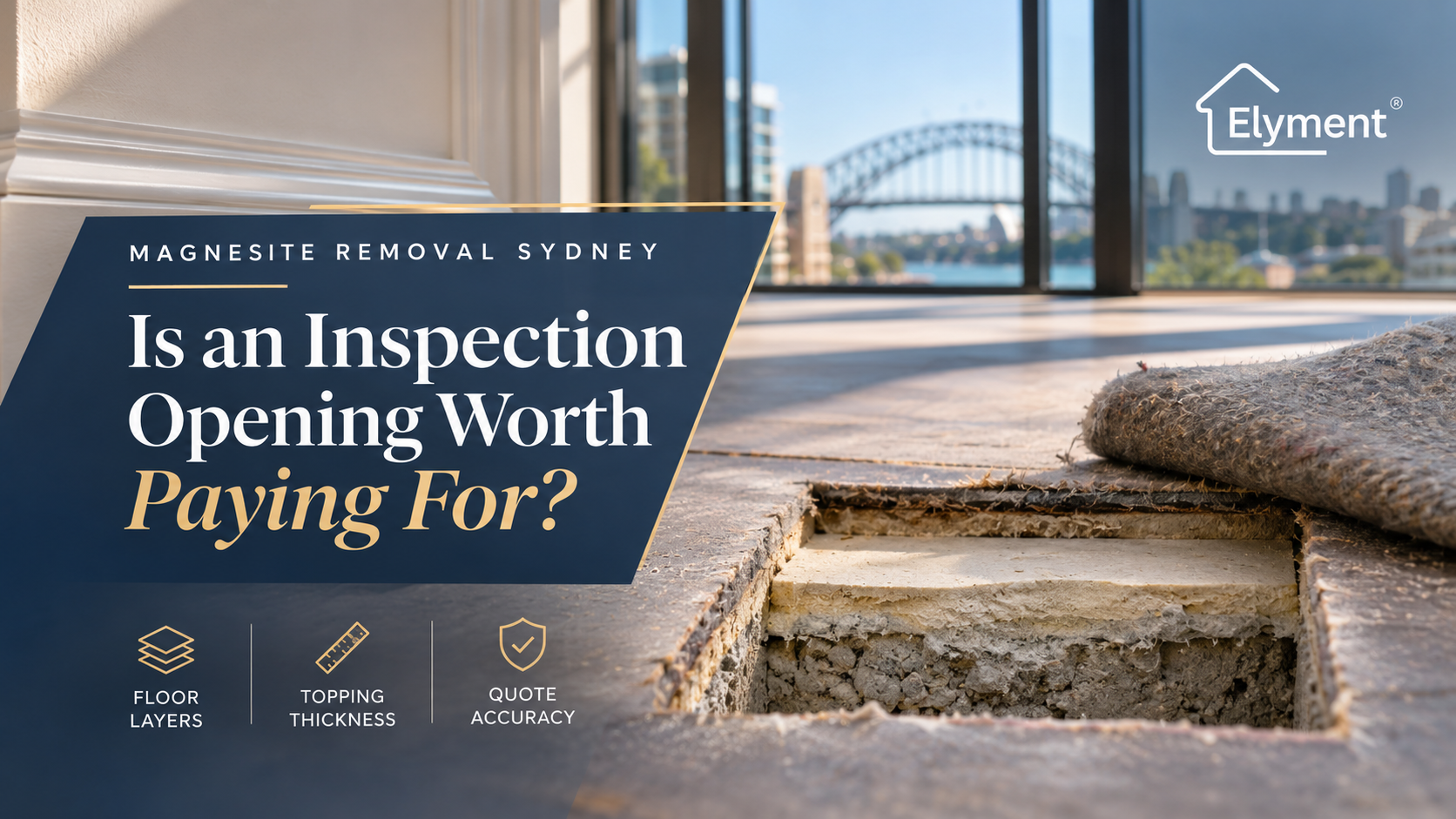
Paying for a small, professionally authorised magnesite floor inspection opening before obtaining removal quotes can be worthwhile when concealed flooring layers, topping thickness or underlying materials create significant pricing uncertainty. In Sydney and NSW strata properties, the investigation must follow applicable approval and hazardous material requirements. Although a limited opening can improve tender accuracy, it cannot establish the condition of the entire concrete slab or eliminate every potential variation.
Three contractors inspect an apartment in Sydney's Lower North Shore. Each receives the same floor plan, photographs and renovation requirements. Yet their magnesite removal quotations differ considerably.
One assumes a relatively thin topping beneath the existing carpet. Another allows for a deeper material layer and more demanding removal conditions. The third includes a provisional allowance for concealed flooring materials.
None has sufficient information to confirm the complete floor construction.
For the property owner, the immediate temptation is to negotiate the quotations. A potentially more productive decision is to establish whether the contractors are pricing the same physical conditions in the first place.
This is where a limited, authorised inspection opening can become a commercial investigation rather than simply another renovation expense.
The Economics of Paying for Information Before Tendering
Most property owners expect a contractor to provide a quotation without an upfront charge. For straightforward flooring projects, that expectation is understandable.
However, an ordinary site visit and an intrusive investigation are different services.
A visual inspection can establish access conditions, approximate dimensions, existing finishes and obvious surface defects. It may not reveal the construction beneath an intact floor covering.
An appropriately planned inspection opening can provide physical evidence about a specific concealed section of the floor, subject to safety assessment and authorisation.
The commercial purpose is to reduce an uncertainty that could materially influence the removal quotation.
Depending on the property's construction, this might include:
- The number of concealed flooring layers.
- The thickness of the existing mineral topping at the inspected location.
- The presence of previous adhesives, screeds or levelling materials.
- Whether different materials are present between the visible finish and the structural substrate.
- Whether the findings indicate a need for further specialist investigation.
The value lies in obtaining information that changes a purchasing or project delivery decision, rather than simply confirming that an older floor exists.
Why Topping Thickness Can Change the Commercial Assessment
Two Sydney apartments with identical flooring areas can present substantially different removal requirements.
Consider an illustrative project involving a confirmed 50 m² removal area. The remaining uncertainty concerns the thickness of the existing topping.
Illustrative Material Volumes for the Same Removal Area
Scenario A
- Topping thickness: 15 mm.
- Theoretical material volume: 0.75 m³.
Scenario B
- Topping thickness: 30 mm.
- Theoretical material volume: 1.50 m³.
Scenario C
- Topping thickness: 45 mm.
- Theoretical material volume: 2.25 m³.
These figures are theoretical examples assuming uniform thickness. They are not measured site quantities, loose waste volumes or removal quotations.
The difference between the first and third scenarios is substantial, despite the removal area remaining unchanged.
Greater material volume may influence demolition productivity, handling requirements, waste transport and disposal arrangements. Actual costs will also depend on material density, bonding characteristics, access and the required preparation standard.
A limited inspection may help establish which assumption is more plausible at a particular location. It does not establish that the same thickness exists throughout the apartment.
This distinction complements Elyment's separate analysis of why apartment size and actual magnesite removal area should not be treated as interchangeable.
What an Inspection Opening Can and Cannot Establish
The investigation should begin with a clearly defined question. Without one, the owner risks purchasing an inspection that produces photographs but little useful commercial information.
Capabilities and Limitations of a Limited Flooring Investigation
How thick is the topping?
- What may be established: Measured thickness at the inspection location.
- Remaining limitation: Thickness may vary elsewhere.
What layers are present?
- What may be established: Visible local flooring construction.
- Remaining limitation: Other rooms may have different materials.
Is the material magnesite?
- What may be established: Physical observations and specialist testing where required.
- Remaining limitation: Appearance alone is not definitive identification.
Is the underlying slab damaged?
- What may be established: Visible conditions within the exposed section.
- Remaining limitation: Concealed deterioration elsewhere remains unknown.
Does the flooring contain asbestos?
- What may be established: Appropriate professional assessment and laboratory analysis.
- Remaining limitation: Results apply within the limits of the sampling assessment.
How much floor levelling will be required?
- What may be established: Some information about local floor construction and depth.
- Remaining limitation: Full requirements depend on wider substrate measurements and the specified finish.
An inspection opening is therefore a local investigation, not a structural clearance certificate, an apartment-wide hazardous material assessment or a comprehensive floor levelling survey.
Free Quotes and Paid Investigations Are Not the Same Product
Sydney's flooring removal market includes contractors offering complimentary site inspections and quotations. These can be entirely appropriate where the existing conditions are sufficiently understood.
Public pricing also demonstrates why a single advertised removal rate does not necessarily describe the entire project.
For example, one Sydney contractor's published magnesite removal cost guide lists a removal rate of $42 per square metre while separately identifying concrete grinding at $10 to $60 per square metre.
These are advertised prices from an individual provider, not independently established market averages or Elyment quotations. Their relevance is that removal and subsequent surface preparation may represent different commercial work packages.
Where concealed flooring construction affects those packages, an investigation may allow contractors to prepare quotations using better-supported assumptions.
Further information about these cost components is available in Elyment's analysis of magnesite removal, grinding, waste disposal and floor levelling costs in Sydney.
When Paying for an Investigation Makes Financial Sense
The case for an inspection becomes stronger when the unresolved question has a meaningful influence on the anticipated contract value or renovation programme.
Examples include:
- Contractors have submitted substantially different allowances for topping thickness.
- Previous renovations have introduced undocumented flooring layers.
- Several bidders are relying on incompatible assumptions.
- The proposed renovation has a restricted budget or a significant exposure to variations.
- A strata committee requires additional evidence before considering the proposed work.
- The flooring replacement forms part of a wider programme involving other contractors.
In these circumstances, the investigation fee should be considered against the potential value of reducing uncertainty.
An illustrative tender decision
Suppose a property owner receives an indicative removal quotation containing a $1,800 allowance associated with uncertain floor construction.
An appropriately authorised investigation is offered for $450, including an agreed written record of the findings.
If the investigation establishes sufficient information for the contractor to reduce that allowance to $900, the owner has potentially reduced the tender allowance by $900 at an investigation cost of $450.
The net reduction in the initial budget provision would be $450.
However, the investigation could equally reveal more complicated conditions and result in a higher quotation. That outcome may still be commercially valuable because the additional expenditure becomes visible before the owner commits to the removal contract.
All figures in this example are hypothetical and are not recommended inspection fees, actual project prices or guaranteed savings. A reduced tender allowance does not necessarily translate into a lower final project cost.
Hazardous Materials Must Be Considered Before Any Disturbance
The potential financial benefit of an inspection does not justify disturbing unidentified flooring materials.
Older Sydney apartments may contain asbestos in certain historical flooring products, adhesives, underlays or other concealed building materials. Some older magnesite formulations may also contain asbestos.
Neither the colour nor the appearance of a material can reliably establish whether asbestos is present.
The NSW Government's asbestos testing guidance recommends professional sampling and testing before renovation work involving suspected asbestos-containing materials.
Where potentially hazardous materials are suspected, the appropriate specialist assessment must precede ordinary intrusive flooring investigation. Any necessary sampling should be undertaken through a competent professional using appropriate controls.
Property owners should not undertake their own inspection openings by cutting, scraping, drilling or breaking unidentified flooring materials.
Relevant considerations include:
- Existing asbestos reports and available building records.
- Assessment by a competent asbestos professional where required.
- Appropriate laboratory analysis and interpretation of sampling results.
- Suitable work methods and dust exposure controls.
- Applicable licensing, notification and disposal requirements.
- Protection of occupants, workers and adjoining properties.
Additional regulatory guidance is available through SafeWork NSW's asbestos safety resources.
Hazardous material assessment is a safety and compliance consideration, not an optional investigation that should be omitted simply because its immediate financial return is uncertain.
Who Authorises and Pays for the Investigation in a Strata Building?
In Sydney strata properties, commissioning an inspection is not necessarily a decision that an individual apartment owner can make independently.
The proposed investigation may involve materials associated with common property, affect existing waterproofing or require access to building elements subject to strata controls.
Before commissioning intrusive work, owners should establish the applicable approval pathway with the strata manager or owners corporation and review the relevant strata plan and by-laws.
The NSW Government's strata renovation rules distinguish between cosmetic works, minor renovations and more substantial building alterations requiring different approvals.
For a proposed investigation, the parties should clarify:
- Who has authority to approve the proposed opening.
- Which materials or building elements may be affected.
- Who will commission and initially fund the investigation.
- Whether the findings will be shared with the owners corporation.
- Who is responsible for securing or reinstating the inspection location.
- Whether subsequent removal requires a separate approval.
Authorising an investigation does not automatically establish responsibility for the eventual removal or structural repair costs.
Where responsibility is disputed, scheme-specific professional or legal advice may be necessary.
What Property Owners Should Receive for Their Money
A paid magnesite floor inspection should provide a defined deliverable that contractors can use when preparing their quotations.
Depending on the agreed investigation scope, the owner should request:
- A defined investigation objective: The specific pricing or construction uncertainty being examined.
- A recorded inspection location: Identification of the room and position examined.
- Photographic documentation: Clear images of the safely exposed materials, where appropriate.
- Recorded measurements: Local layer thicknesses and other relevant observations.
- Material identification status: A distinction between confirmed findings and suspected materials.
- Investigation limitations: A record of what remains concealed or unverified.
- Commercial implications: Identification of the quotation assumptions that the findings may help refine.
- Reinstatement arrangements: Confirmation of how the inspected area will be left after the investigation.
Specialist testing, engineering advice and hazardous material reports may require separate commissioning.
Where multiple contractors are tendering, the same investigation record should be made available to each bidder, subject to any agreed restrictions.
This creates a more consistent information base without requiring every contractor to commission a separate intrusive inspection.
Using the Findings Without Creating False Certainty
A contractor receiving an investigation report should distinguish between measured facts and assumptions extrapolated from those facts.
For example, a local thickness measurement of 30 mm may support an initial pricing assumption. It should not be represented as a verified uniform thickness across all rooms.
A revised tender may therefore include:
- Confirmed work items based on available evidence.
- Explicit assumptions relating to concealed conditions.
- Provisional allowances for unresolved quantities.
- Agreed variation assessment procedures.
- Specialist inspection hold points where necessary.
The objective is not to eliminate every variation. It is to improve the distinction between foreseeable work and genuinely concealed conditions.
Even after a preliminary investigation, further assessment may be required once the topping has been removed. Elyment explains this separately in its analysis of why magnesite removal quotations can change after concrete slab exposure.
Evidence of possible structural deterioration should also be addressed through the appropriate specialist pathway, as discussed in Elyment's guide to when an engineer should inspect the exposed concrete slab.
When an Inspection Opening May Not Be Worth the Expense
Not every Sydney magnesite removal project requires a separate intrusive investigation before tendering.
A paid opening may provide limited additional value where:
- Reliable existing investigation records already establish the relevant conditions.
- Previous authorised works have exposed sufficiently relevant sections of the floor.
- The remaining uncertainty has little influence on the proposed removal price.
- Contractors can provide a suitable quotation with transparent and manageable provisional allowances.
- The disruption and reinstatement costs would outweigh the likely commercial benefit.
In some cases, the appropriate decision is to defer physical investigation until the property is vacant or until the required specialist assessments and strata approvals are available.
The timing of an investigation should support the overall renovation programme rather than introduce an unnecessary obstacle.
ELYMENT | SYDNEY & NSW
Establish the Flooring Conditions Before Committing to Removal
Review concealed flooring risks, investigation requirements, removal assumptions and renovation sequencing before committing to your magnesite removal project.
Request a Renovation Project Review
The Better Purchasing Decision Is Not Always the Cheapest Quote
For Sydney property owners, builders and strata managers, commissioning a limited investigation is fundamentally a decision about the value of information.
Where a concealed construction detail could materially change the tender, paying to investigate that detail may be more productive than repeatedly negotiating quotations based on uncertain assumptions.
Where the uncertainty is minor or reliable evidence already exists, a separate investigation may offer little additional benefit.
Elyment Property Services approaches magnesite removal within the wider operational requirements of flooring removal, concrete preparation, waste handling, floor levelling and installation-ready project delivery across Sydney and NSW.
The most useful investigation is not necessarily the most extensive one. It is the safely authorised investigation that answers a commercially important question, documents its limitations and allows the next project decision to be made with better information.
Sources and References
- Carpet Removal Sydney: The Cost of Removing Magnesite
- NSW Government: Getting an Asbestos Sample Tested
- SafeWork NSW: Asbestos Safety Resources
- NSW Government: Strata Renovation Rules
Related Elyment Resources
- Magnesite Removal Sydney: 80 m² Apartment Scope Check
- Magnesite Removal Cost Sydney: Grinding, Waste Disposal and Floor Levelling
- Why Can a Magnesite Floor Removal Quote Change After the Concrete Slab Is Exposed?
- Magnesite Removal Sydney: When Should an Engineer Inspect the Slab?
ELYMENT | SYDNEY & NSW
Establish the Flooring Conditions Before Committing to Removal
Review concealed flooring risks, investigation requirements, removal assumptions and renovation sequencing before committing to your magnesite removal project.
Request a Project ReviewRelevant next actions
Explore the ELYMENT service most closely connected to this article.