Meta Brings Muse to the UK: What Can Its AI Agent Do on Your Behalf?
Meta brings Muse to the UK. Learn what its AI agent can do on your behalf, how it may handle everyday tasks and what to consider before granting access to data.
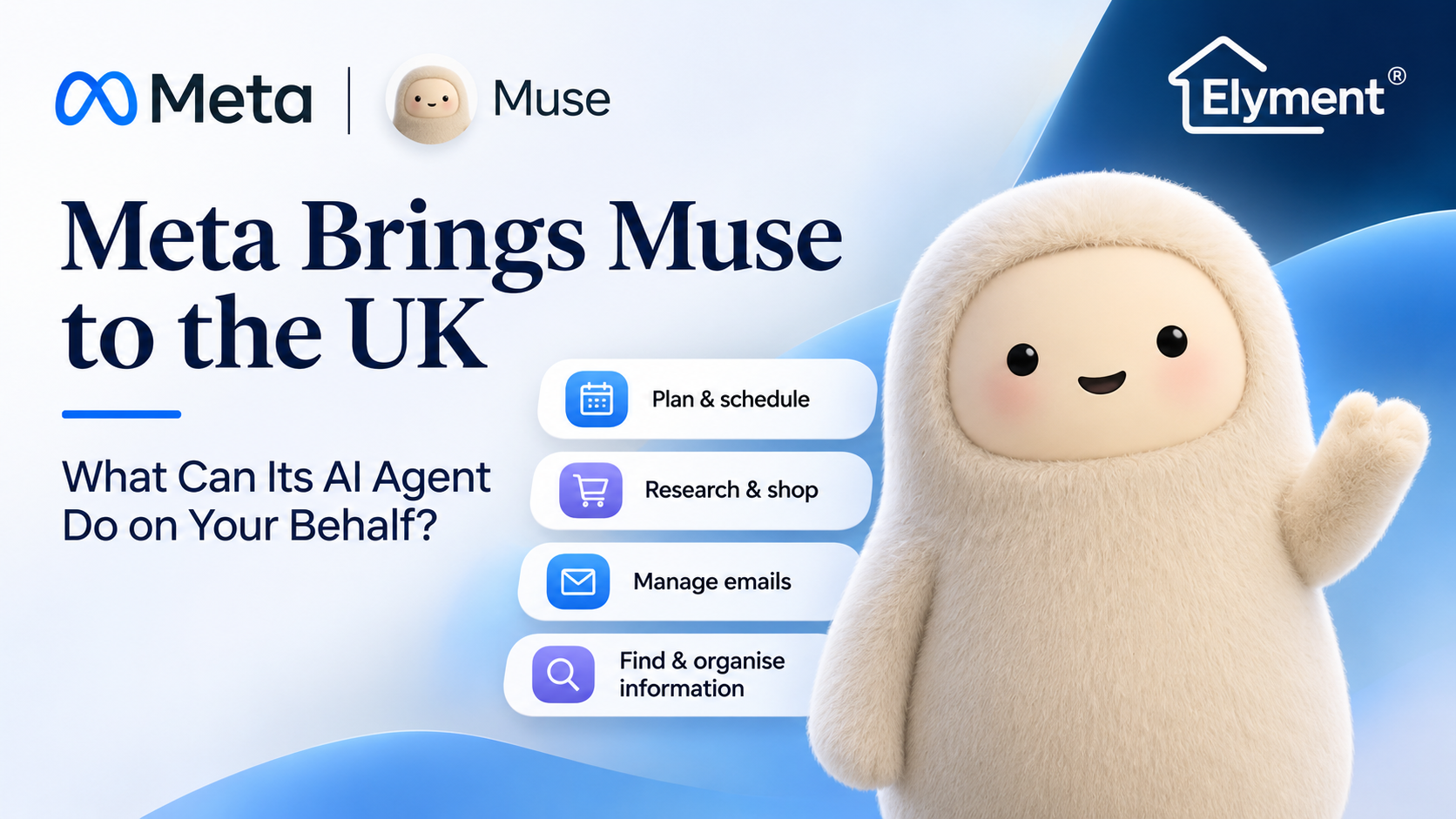
Meta launched its personal AI agent, Muse, in the UK on 23 November 2026, allowing users to delegate research, shopping, scheduling and other digital tasks while retaining control over permissions and sensitive actions. Already available in Australia since 17 November, Muse presents new opportunities for Sydney and NSW businesses to reduce administrative workloads. However, application access, purchasing approvals, permission duration and the progressive rollout of Australian integrations require careful consideration.
ELYMENT Insights | Artificial Intelligence, Business & Technology | Sydney, NSW | 25 November 2026
The next significant development in artificial intelligence is not necessarily its ability to provide better answers. It is its ability to act on those answers.
On 23 November 2026, Meta announced the UK launch of Muse, its personal AI agent designed to undertake multi-stage digital tasks across websites, applications and connected services.
Unlike a conventional chatbot, Muse can advance an assignment without requiring continuous instructions. It can research options, organise information, prepare communications and continue working after the user closes the application.
But the most commercially important part of the announcement concerns the authority users give the agent, rather than its underlying intelligence.
For Sydney businesses, property owners and operational teams, the distinction between asking software to recommend an action and authorising it to perform that action could fundamentally change how administrative responsibilities are distributed.
Meta Muse UK: From Instructions to Delegated Responsibilities
According to Meta's UK launch announcement, Muse can undertake activities ranging from organising personal schedules to researching purchases, arranging travel and pursuing refunds.
The underlying change is that users can assign an objective rather than individually directing every intermediate step.
A user researching a holiday, for example, may delegate the collection and organisation of travel options instead of visiting several websites independently.
For a property owner, the equivalent assignment might involve researching renovation materials, identifying available products and organising potential delivery dates.
These activities become more consequential when the agent moves beyond information gathering and begins interacting with external businesses.
What Tasks Can Users Delegate to Meta Muse?
Meta's published capabilities cover several categories of digital activity. Actual execution depends on the connected service, available functionality and permissions granted by the user.
Product research
- Potential Muse activity: Compare products, availability and prices.
- Recommended human control: Confirm specifications and suitability.
Email administration
- Potential Muse activity: Organise correspondence and prepare replies.
- Recommended human control: Review outgoing communications.
Purchasing
- Potential Muse activity: Identify products and prepare transactions.
- Recommended human control: Approve each purchase.
Scheduling
- Potential Muse activity: Coordinate calendars and identify available times.
- Recommended human control: Retain control over important commitments.
Refund enquiries
- Potential Muse activity: Investigate refund options and communicate with suppliers.
- Recommended human control: Review proposed resolutions and terms.
Property research
- Potential Muse activity: Explore listings through available integrations.
- Recommended human control: Independently verify property information.
Project organisation
- Potential Muse activity: Maintain trackers, plans and administrative records.
- Recommended human control: Validate deadlines and project decisions.
These capabilities indicate how personal AI agents may reduce the manual effort involved in everyday administration. They do not establish that Muse can independently assess technical requirements, contractual obligations or regulatory compliance.
The Three Decisions Behind Every Delegated Task
Giving an AI agent an assignment involves three separate decisions that users should not confuse.
1. What Information Can the Agent Access?
Connecting an email account, calendar or external application establishes a potential source of information for the agent.
However, access to an application should not automatically imply unrestricted authority to perform every available action.
A property manager might want an agent to identify maintenance requests without authorising it to communicate with tenants or engage contractors.
2. What Actions Is the Agent Authorised to Perform?
Reading a supplier quotation is different from accepting it. Preparing an email is different from sending it. Identifying a suitable product is different from purchasing it.
These distinctions become particularly important in commercial environments, where external communications may create expectations, financial exposure or contractual complications.
3. How Long Does That Permission Remain Valid?
One of the more significant details in Meta's UK release is that permissions for certain activities can extend beyond a single action.
According to Meta's explanation of Muse permissions and controls, users can determine the duration of some authorisations, while purchases require approval on each occasion.
A temporary authorisation for a specific administrative exercise presents a different operational risk from continuing access to a company's communications.
Businesses should therefore consider permission expiry as carefully as they consider the initial access request.
What Control Does the User Retain?
Meta describes a permission-based operating model intended to preserve user oversight.
The company's published controls include:
- Managing connected applications and authorised activities.
- Reviewing proposed sensitive actions before execution.
- Changing or withdrawing existing permissions.
- Inspecting completed and planned activities.
- Managing retained information and memory.
- Intervening during browser-based tasks.
- Adjusting data settings relating to AI development.
Meta also describes an independent security component that evaluates proposed actions against existing authorisations.
The company's Muse approval and permission guidance provides further information about restricting access and reviewing default permissions.
These are important product safeguards. Nevertheless, manufacturer-described controls should not be interpreted as independent proof that an agent will always execute instructions correctly or that every business use is appropriate.
When a Routine Renovation Enquiry Becomes a Commercial Commitment
Consider a hypothetical Sydney apartment renovation involving new flooring, subfloor preparation and multiple material suppliers.
The property owner asks an AI agent to investigate suitable flooring products, identify suppliers and organise potential delivery arrangements.
The agent may be able to research products, prepare a shortlist and draft questions about stock availability.
The consequences change when the assignment expands into ordering products or confirming delivery.
Before materials are purchased, several project-specific issues may need to be resolved:
- Compatibility with the existing substrate.
- Strata acoustic requirements.
- Correct quantities and installation allowances.
- Building access and delivery restrictions.
- Installation sequencing and preparation requirements.
- Supplier return and cancellation conditions.
An agent may locate relevant information, but the suitability of the materials remains a technical and commercial decision.
The most useful delegation boundary in this example is to allow research and preparation while reserving product selection, technical acceptance and purchasing decisions for the responsible people.
This distinction is central to effective workflow automation for Sydney operations teams, where administrative efficiency must remain compatible with project dependencies and approval responsibilities.
Meta Muse Australia: What Has Actually Been Confirmed?
Australian users do not need to wait for an Australian launch following the UK announcement.
Meta's Australian launch announcement, published on 17 November 2026, confirmed that Muse was already available locally.
The company identified integrations covering communications, scheduling and consumer services, alongside Australian connector partners including:
- Canva
- Domain
- realestate.com.au
- Officeworks
- Kogan
- MECCA
- SWEAT
- ShopBack
- Ticketek
Importantly, Meta indicated that local connector experiences would become available progressively.
What Has Not Been Established for Australia?
General Muse availability
- Australian position: Confirmed from 17 November 2026.
Australian connector partnerships
- Australian position: Announced, with functionality rolling out progressively.
Complete availability of every local connector function
- Australian position: Not established by the launch announcement.
Identical UK and Australian retail integrations
- Australian position: Not confirmed.
Identical payment and purchase protection arrangements
- Australian position: Australian applicability should be verified separately.
Enterprise suitability for confidential property and legal workflows
- Australian position: Requires organisation-specific assessment.
Australian-specific implementation of UK regulatory arrangements
- Australian position: Not established by the reviewed announcements.
The UK announcement provides useful detail about Meta's intended operating model, but Australian users should not assume that every overseas commercial arrangement or integration is available locally.
Why UK Regulators Are Examining Delegated AI Authority
The regulatory response to Muse is particularly relevant because personal AI agents can interact with businesses and undertake activities carrying real-world consequences.
On 24 November 2026, the UK's Competition and Markets Authority issued a statement addressing Muse and the application of existing consumer protection requirements to personal AI agents.
Following discussions with the regulator, Meta made changes to its consumer terms. The authority indicated that scrutiny of the product would continue during its rollout.
The UK's Information Commissioner's Office also confirmed a voluntary monitoring and reporting arrangement with Meta.
These developments demonstrate that the regulatory question is no longer confined to the accuracy of AI-generated information. It also concerns whether consumers understand what an agent can do, the information it can access and the implications of granting it greater autonomy.
Connecting a Personal AI Agent to a NSW Business Is a Separate Decision
A personal AI agent used for shopping or household planning presents a different information environment from one connected to a business mailbox.
For Sydney property, renovation and professional services businesses, workplace applications may contain:
- Client names and residential addresses.
- Commercially sensitive supplier quotations.
- Building access arrangements.
- Contracts and confidential correspondence.
- Financial records and payment instructions.
- Property transaction information.
Giving an agent access to these records should be treated as a business information-management decision rather than an individual productivity preference.
The Office of the Australian Information Commissioner's guidance on commercially available AI products identifies privacy assessment, information security and appropriate human supervision as important considerations for organisations adopting AI.
Where the Privacy Act and Australian Privacy Principles apply, organisations must consider their obligations when allowing AI systems to process personal information.
A consumer-facing permission screen does not, by itself, establish that a particular organisational use complies with those obligations.
Businesses exploring this transition should distinguish personal tools from deliberately scoped AI systems and software development designed around organisational responsibilities and approved information flows.
Five Questions to Answer Before Delegating a Task
Rather than immediately connecting every available application, Sydney businesses can establish a defined delegation process.
1. What is the precise assignment?
Define the required outcome and identify activities outside the approved scope.
2. Which information sources are necessary?
Restrict access to the records and applications genuinely required for the assignment.
3. Where must the agent stop?
Identify approval boundaries involving expenditure, communications, disclosure and contractual commitments.
4. When should permission expire?
A completed assignment should trigger a review of continuing access.
5. Who reviews the result?
Assign responsibility for verifying completed actions and correcting mistakes.
This process is particularly valuable when AI activities cross operational departments, such as procurement, scheduling, customer service and accounts.
For related context, Elyment's analysis of Claude Duet, Meta Muse and OpenAI Dots examines the differences between emerging personal AI platforms.
The Commercial Value of Knowing Where an Agent Must Stop
The productivity of personal AI agents will increasingly depend on the quality of the responsibilities assigned to them.
Unlimited access is not necessarily more productive than carefully restricted access. An agent that saves an hour of administration but creates an incorrect supplier commitment may introduce substantially more work than it removes.
For NSW property and renovation businesses, administrative delegation should support existing operational responsibilities rather than obscure them.
Research can be delegated. Information can be organised. Routine preparations can be automated.
But decisions affecting technical compliance, contractual obligations, significant expenditure and project delivery should remain subject to appropriate human review.
ELYMENT | TECHNOLOGY & OPERATIONAL DELIVERY
Delegate the Work. Retain Control.
Review your business workflows, application permissions, approval responsibilities and automation opportunities before introducing AI into consequential operational processes.
Delegation Is Becoming the Next Test of Artificial Intelligence
Meta's UK launch of Muse offers another indication that personal artificial intelligence is developing beyond conversational assistance.
For Australian users, the opportunity is already present, although the availability of particular local integrations continues to develop.
The larger challenge for Sydney businesses is determining which responsibilities can be transferred to software without transferring decisions that require professional judgement.
The question is no longer simply whether artificial intelligence can complete a task. It is whether the task has been delegated with sufficient clarity, appropriate permissions and a clearly defined point at which human authority resumes.
Sources and References
External Sources
- Meta – Introducing Muse in the UK: A Personal AI Agent You Control
- Meta – Muse Now Available in the UK: Muse Does the Work, You Stay in Control
- Meta Help Centre – Muse Approval and Permission Guidance
- Meta – Muse Is Now Available in Australia
- Competition and Markets Authority – CMA Statement on UK Launch of Meta Muse
- Information Commissioner's Office – Statement on UK Launch of Meta Muse
- Office of the Australian Information Commissioner – Guidance on Privacy and the Use of Commercially Available AI Products
Related Elyment Articles and Services
- Workflow Automation Sydney
- AI Services and Software Development
- Claude Duet vs Meta Muse vs OpenAI Dots
ELYMENT | TECHNOLOGY & OPERATIONAL DELIVERY
Delegate the Work. Retain Control.
Review your business workflows, application permissions, approval responsibilities and automation opportunities before introducing AI into consequential operational processes.
Review Your OperationsRelevant next actions
Explore the ELYMENT service most closely connected to this article.