Meta’s Muse Glimmer Runs Agentic AI on One Computer: Could Local AI Cut Cloud Costs for Businesses?
Meta's Muse Glimmer runs agentic AI on one computer. See how local AI could reduce cloud costs, data transfer and infrastructure needs for businesses securely.
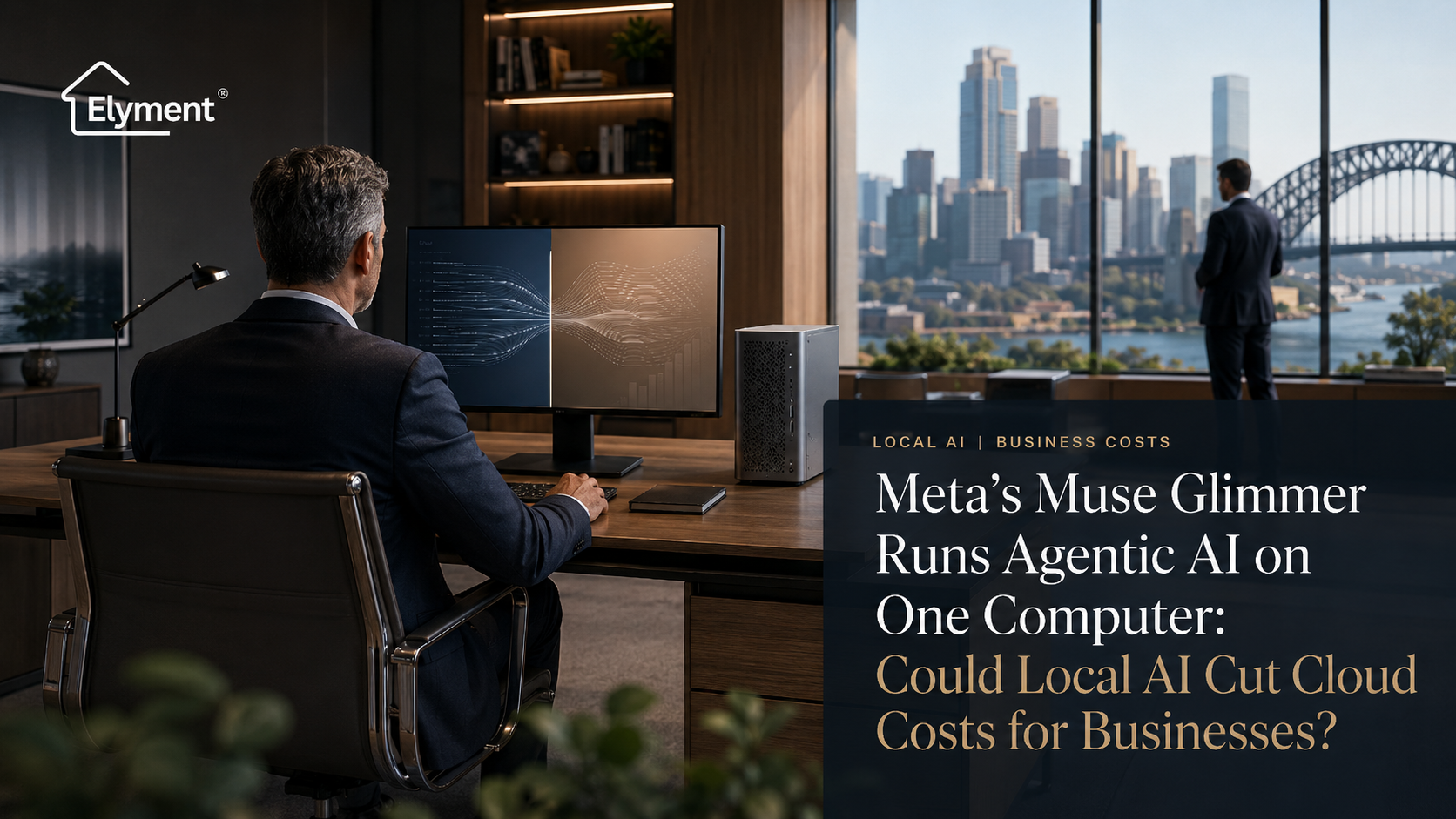
Meta’s Muse Glimmer strengthens the case for running some agentic AI workloads locally rather than paying for every task through remote cloud infrastructure. For Sydney and NSW businesses, the potential savings are real, particularly for repetitive, high-volume work. But local AI does not make computing free. Hardware, electricity, support, security, model updates and peak capacity must be included before a local deployment can genuinely outperform cloud pricing.
The most important part of Meta’s latest AI release may not be another improvement in model intelligence. It may be where the intelligence can run.
Meta has released Muse Glimmer as a compact, open-weight model designed to perform reasoning and agentic tasks on consumer-grade computing hardware. Reporting on the launch describes Glimmer as a roughly 30-billion-parameter model capable of operating locally on a laptop or PC rather than requiring every inference to pass through a remote hyperscale data centre.
That changes the commercial discussion.
Businesses have spent much of the generative AI era comparing models by capability, token price and subscription tier. Local models introduce another question: should the business continue renting AI compute every time an employee or automated workflow needs intelligence, or should some of that capacity become infrastructure the organisation owns and controls?
For Sydney professional firms, property operators, construction businesses, service organisations and companies running large administrative workflows, this is increasingly a cost-management decision rather than a technology experiment.
The New Question Is Where The AI Workload Should Run
Cloud AI solved an enormous practical problem. A business could access highly capable models without purchasing GPUs, maintaining machine-learning infrastructure or employing a specialised team to operate it.
That remains a compelling model for irregular or highly complex workloads.
The economics become less straightforward when an organisation begins making thousands or millions of routine AI calls each month.
Consider the kinds of work emerging across Sydney businesses:
- classifying incoming enquiries;
- extracting structured information from documents;
- summarising internal project notes;
- matching information against known operating rules;
- drafting routine internal communications;
- reviewing job records for missing information;
- routing requests between teams;
- analysing images or screenshots;
- preparing proposed calendar or task updates; and
- supporting internal software and coding workflows.
Individually, these tasks may cost very little through an API. At sufficient volume, however, the business is effectively renting processing capacity continuously.
Glimmer makes the alternative more credible: retain cloud models for difficult work, while moving predictable workloads onto hardware located in the office, data room or controlled computing environment.
Local AI Is A Capacity-Purchasing Decision
The simplest comparison between cloud and local AI is often misleading.
Cloud pricing appears as operating expenditure. The business pays according to usage, subscription arrangements or reserved capacity.
Local AI moves more of that cost forward.
Instead of purchasing tokens, the organisation purchases computing capacity and then attempts to keep that capacity productively utilised.
- Initial hardware
- Cloud AI: Low.
- Local AI: Potentially significant.
- Usage cost
- Cloud AI: Continues with activity.
- Local AI: Marginal inference cost can become low once capacity exists.
- Peak capacity
- Cloud AI: Provider absorbs much of the scaling requirement.
- Local AI: Business must provision sufficient hardware.
- Model maintenance
- Cloud AI: Primarily provider-managed.
- Local AI: Business must manage deployment and updates.
- Internet dependency
- Cloud AI: Usually required.
- Local AI: Some workloads can continue locally.
- Data movement
- Cloud AI: Information may leave the local environment subject to provider architecture and terms.
- Local AI: Selected information can remain within controlled infrastructure.
- Advanced capability
- Cloud AI: Access to frontier-scale models.
- Local AI: Limited by the models and hardware that can practically be operated locally.
This means local AI becomes economically attractive under particular conditions rather than automatically.
A machine sitting idle for most of the week may be more expensive than an API. A machine processing predictable workloads throughout the working day can produce a very different cost curve.
The Break-Even Point Matters More Than The Token Price
Businesses evaluating local AI should calculate a break-even point.
Assume, for example, that a company purchases a dedicated AI workstation. The relevant cost is not simply the purchase price. A useful model should include:
- Hardware acquisition. GPU, memory, storage, processor, networking and backup requirements.
- Useful economic life. How many years the business expects the machine to remain suitable for the workload.
- Electricity. Both computing consumption and any additional cooling requirement.
- Technical management. Installation, monitoring, upgrades, troubleshooting and security.
- Software and orchestration. The application layer required to expose the model to staff and workflows.
- Downtime. What happens when the device fails, updates or reaches maximum capacity.
- Model replacement. Whether the hardware will support the next generation of models the business expects to use.
Those costs can then be compared with the business’s actual annual cloud inference spend for the workloads that could realistically move locally.
This is a more disciplined calculation than assuming an open-weight model automatically removes an AI bill.
Elyment’s build-versus-buy AI planning for Sydney businesses addresses the same underlying principle: technology should be assessed through total cost of ownership, operational fit and implementation risk rather than purchase price alone.
Why Agentic AI Makes Local Economics More Interesting
The economics become particularly important when AI becomes agentic.
A conventional chatbot may receive one question and return one answer. An agent can perform a sequence involving reasoning, tool calls, retries, checking and further reasoning before completing a task.
One employee request can therefore generate substantially more model activity than one visible prompt.
Meta describes the broader Muse family as supporting end-to-end agentic workflows, coding and computer use. Muse Glimmer’s significance is that smaller open-weight models are increasingly entering the same operational territory that businesses have associated with large remotely hosted models.
That does not mean a local model will equal a leading frontier cloud model on every task. It means many businesses may no longer need frontier-scale intelligence for every step of every workflow.
A Sydney Property Workflow Shows The Difference
Consider a Sydney property or renovation operator receiving hundreds of project communications, photographs and job updates.
An AI-enabled operating workflow might need to:
- classify whether a message relates to quoting, scheduling, access, payment or a variation;
- extract the suburb, project number and requested date;
- identify missing site information;
- summarise new job notes;
- compare the information against internal project records;
- prepare the next action; and
- escalate unusual cases to a person.
Most of those steps do not necessarily require the strongest model available on the global market.
The organisation could theoretically run classification, extraction and routine summarisation locally, then send only complex reasoning or unusual exceptions to a more capable cloud model.
This creates a tiered compute architecture.
The objective is not to eliminate cloud AI. It is to stop paying frontier-model economics for work that does not need frontier-model capability.
The Hybrid Model May Be More Important Than Fully Local AI
For many businesses, the practical destination is likely to be hybrid.
- Basic classification
- Likely compute path: Local.
- Reason: High volume, relatively constrained task.
- Internal document summarisation
- Likely compute path: Local or private environment.
- Reason: Potential privacy and volume advantages.
- Routine extraction
- Likely compute path: Local.
- Reason: Predictable output structure.
- Complex commercial analysis
- Likely compute path: Cloud frontier model.
- Reason: Higher reasoning capability may justify additional cost.
- Current web research
- Likely compute path: Cloud or connected service.
- Reason: Requires external information and retrieval infrastructure.
- High-consequence decision
- Likely compute path: AI-assisted with human review.
- Reason: Accountability should not be delegated simply because deployment is local.
The architecture resembles workforce allocation.
Businesses do not normally assign their most expensive specialist to every administrative task. AI infrastructure can be managed in the same way. Use sufficient capability for the job, escalate where necessary and measure the economics of the complete workflow.
Organisations considering this structure can begin with an AI readiness assessment for Sydney operations to identify which workloads are repetitive enough, predictable enough and low-risk enough to justify local or hybrid processing.
Local Processing Can Reduce One Form Of Vendor Dependency
Cost is only one reason businesses may investigate local inference.
Cloud AI introduces an external infrastructure dependency. Service availability, pricing, rate limits, model retirement, provider policy and internet connectivity can affect the business even where its own internal systems remain healthy.
Local processing can reduce some of those dependencies for selected workloads.
A locally operated model may continue performing internal extraction, classification or summarisation even when an external AI API is temporarily unavailable.
That can be particularly useful where AI has moved from optional experimentation into a workflow employees expect to use every day.
It does not eliminate dependency completely. The organisation still relies on hardware vendors, model developers, software libraries, operating systems and potentially external tools connected to the agent.
The dependency simply changes shape.
Local Does Not Automatically Mean Private
One of the most dangerous assumptions in local AI discussions is that running a model inside the office makes the complete system private.
Privacy depends on the entire workflow.
An agent running locally may still:
- send information to an external search provider;
- call a cloud-based CRM;
- access externally hosted email;
- write information into third-party applications;
- use telemetry services;
- store prompts or logs insecurely; or
- operate with excessive permissions.
The Office of the Australian Information Commissioner’s guidance on commercial AI products makes clear that Privacy Act obligations continue to apply where AI systems handle personal information. The OAIC recommends due diligence, appropriate human oversight, privacy-by-design controls and continuing review rather than treating AI deployment as a set-and-forget exercise.
Local infrastructure can provide businesses with more architectural choices about where information is processed. It does not remove their responsibility for how that information is collected, accessed, used, retained or disclosed.
An Agent On Your Own Computer Can Still Be A Security Risk
Local agentic AI also creates a security paradox.
Keeping information close to the business can reduce some forms of external data exposure. At the same time, an agent that can interact with local files, internal systems and applications can become highly privileged infrastructure.
In 2026, the Australian Signals Directorate and international cyber security partners issued guidance urging organisations to adopt agentic AI incrementally, maintain strict privilege controls, preserve human oversight and avoid giving agents broad or unrestricted access to sensitive data or critical systems.
That guidance matters even more for locally operated agents.
A business should not conclude:
“The model is running on our computer, therefore we can safely give it access to everything on our computer.”
The safer architecture is the opposite.
The model should receive only the information and permissions required for its defined function.
Businesses comparing agentic systems with fixed automation can also review Elyment’s AI agent versus workflow automation decision framework, particularly where predictable rules can perform a task with less operational uncertainty than autonomous reasoning.
Hardware Utilisation Will Decide Whether The Economics Work
Local AI economics depend heavily on utilisation.
Imagine two Sydney businesses purchasing identical AI workstations.
Business A runs several internal agents throughout the day across project intake, document processing, CRM preparation and internal search.
Business B uses the machine for occasional staff questions.
The hardware cost is identical. The effective cost per useful task is not.
This creates a capacity-management problem familiar to other infrastructure industries. Owned infrastructure works economically when enough productive demand exists to justify the fixed cost.
Before purchasing hardware, businesses should measure:
- current model calls per day;
- average and peak concurrency;
- input and output volume;
- which workloads genuinely require high-end reasoning;
- hours when demand is concentrated;
- acceptable response time;
- availability requirements; and
- expected growth in AI usage.
Without this workload profile, the company is buying infrastructure before understanding demand.
The Hidden Cost May Move From Tokens To People
Cloud AI outsources a great deal of engineering.
The provider maintains the underlying inference infrastructure, deploys updated models, distributes traffic and absorbs substantial technical complexity.
Local AI brings part of that operational responsibility back into the organisation.
Someone must own:
- model deployment;
- version control;
- security patches;
- monitoring;
- hardware failure;
- capacity;
- backups where required;
- performance testing;
- access management;
- workflow integration; and
- retirement of outdated models.
A business that saves $20,000 in annual API fees but requires $35,000 of additional technical support has not reduced its operating cost.
This is why AI architecture and implementation planning in Sydney needs to examine the operating model around the technology, not simply whether a model can technically execute on local hardware.
One Computer Is Not The Same As Enterprise Availability
Glimmer’s ability to operate on one capable computer is strategically significant, but businesses should separate technical feasibility from production resilience.
A demonstration has one objective: make the system work.
An operational deployment has several additional objectives:
- make it work consistently;
- support simultaneous users;
- recover from failure;
- preserve security;
- control access;
- record relevant activity;
- maintain acceptable response times; and
- continue operating when hardware needs maintenance.
A company whose critical workflow runs through one workstation has created a single point of failure unless a fallback exists.
Production local AI may therefore require redundant machines, cloud failover or a queue that holds non-urgent work while infrastructure is unavailable.
Five Workloads That May Move Local First
Not every AI workload is an equally strong candidate for local processing.
Early candidates are likely to share three characteristics: high volume, relatively bounded complexity and predictable inputs.
- Document classification.
- Sorting correspondence, invoices, job records, project photographs and operational documents into known categories can create significant recurring inference volume.
- Information extraction.
- Pulling dates, names, project identifiers, addresses, amounts or other structured fields from documents is often more constrained than open-ended reasoning.
- Internal summarisation.
- Project histories, meeting notes and operational records may be processed locally before only difficult cases are escalated.
- Routine drafting.
- Internal descriptions, proposed task notes and standardised communications can be prepared locally with appropriate human review.
- Software assistance.
- Development teams may use local models for repeated coding, explanation or repository-related tasks where the workload and confidentiality profile make local processing useful.
The important discipline is not forcing every task onto the local model simply because the business owns the hardware.
Build A Routing Layer Rather Than Choosing One Model
The strongest architecture may treat AI models as a portfolio of computing resources.
A routing layer can decide:
- Can a deterministic rule complete the task?
- If reasoning is required, can the approved local model handle it?
- If not, should the request move to a stronger cloud model?
- Does the information need to be redacted or transformed before leaving the local environment?
- Does the result require human approval before another system is changed?
This approach can reduce unnecessary model consumption while preserving access to frontier capability when the problem genuinely requires it.
Elyment’s workflow automation services for Sydney operations teams focus on this wider architecture of systems, routing, approvals and operational handoffs rather than treating the AI model as the complete workflow.
The Business Case Should Be Tested With Real Work
Local AI should not be approved from benchmark scores alone.
A meaningful pilot should use representative business work.
A practical evaluation could follow seven stages:
- Select one high-volume workflow. Avoid beginning with the entire business.
- Establish the existing cloud cost. Measure actual usage rather than estimating from subscription pricing.
- Run representative tasks locally. Include normal cases, difficult cases and incomplete information.
- Measure quality. Compare accuracy, consistency and the rate of human correction.
- Measure throughput. Test realistic concurrent demand, not one request at a time.
- Calculate full infrastructure cost. Include equipment, support, power, maintenance and fallback capacity.
- Define an escalation path. Decide when the workflow should move to another model or a person.
Only after this exercise can management determine whether local AI is genuinely cheaper for that workflow.
What Sydney And NSW Businesses Should Decide Before Buying Hardware
Muse Glimmer may encourage businesses to investigate local AI, but the technology purchase should come after an operating decision.
Management should be able to answer:
- Which workloads are generating enough cloud expenditure to justify investigation?
- Which tasks can a smaller local model perform at an acceptable quality level?
- Which information should remain within a controlled environment?
- Who will maintain the infrastructure?
- What happens when local capacity is exhausted?
- Which workflows need cloud failover?
- How will model versions be tested before replacement?
- Which actions remain subject to human approval?
- How are identity, permissions and logs controlled?
- What is the three-year total cost rather than the first-year hardware price?
These questions turn local AI from an interesting technology purchase into an infrastructure decision.
The Bigger Shift Is From Buying AI Software To Designing AI Infrastructure
Meta’s Muse Glimmer does not mean cloud AI is about to disappear.
The leading cloud platforms retain enormous advantages in model capability, elastic capacity, managed infrastructure and rapid access to new systems.
Glimmer instead expands the range of architectures available to businesses.
A company may use deterministic automation for fixed rules, a local model for high-volume routine reasoning, a frontier cloud model for difficult analysis and a person for decisions carrying material commercial, legal, safety or client consequences.
That is a fundamentally different model from subscribing to one AI platform and sending everything through it.
For Sydney and NSW businesses, the cost opportunity lies in workload placement.
The company that knows precisely which intelligence it needs, where it needs it and how frequently it will be used may be able to reduce recurring cloud expenditure without sacrificing access to more powerful models.
The company that simply buys an expensive GPU because local AI appears cheaper may discover that it has exchanged a visible API bill for a less visible infrastructure bill.
The Bottom Line
Muse Glimmer matters because it demonstrates how capable agentic AI is moving closer to the machines businesses already control.
That could make local inference commercially attractive for repetitive, predictable and high-volume workloads across Sydney organisations.
But the correct comparison is not “free local AI versus expensive cloud AI”. It is owned capacity versus rented capacity, including hardware, utilisation, electricity, support, security, resilience and model lifecycle costs.
For many businesses, the strongest answer will not be completely local or completely cloud-based.
It will be a governed hybrid architecture that sends each task to the least expensive computing layer capable of performing it reliably.
Sources And References
- Meta AI: Muse models and agentic workflow capabilities
- Financial Times: Meta’s return to open AI models and Muse Glimmer
- Office of the Australian Information Commissioner: Guidance on privacy and commercial AI products
- Australian Signals Directorate: Careful adoption of agentic AI
- Elyment: AI Readiness Assessment Sydney
- Elyment: Workflow Automation Sydney
- Elyment: Build vs Buy AI Sydney
Decide What Should Run Locally Before Moving AI Spend Into Hardware
Review workload volume, cloud costs, local compute requirements, privacy, security, approval controls and hybrid architecture before changing how AI operates across the business.
Review Your AI Setup