Microsoft’s Guardian Agents: Can AI Supervise Other AI Before It Acts?
Can Microsoft's Guardian Agents oversee AI before it acts? Explore how AI supervision may reduce automation errors, compliance breaches and real business risks.
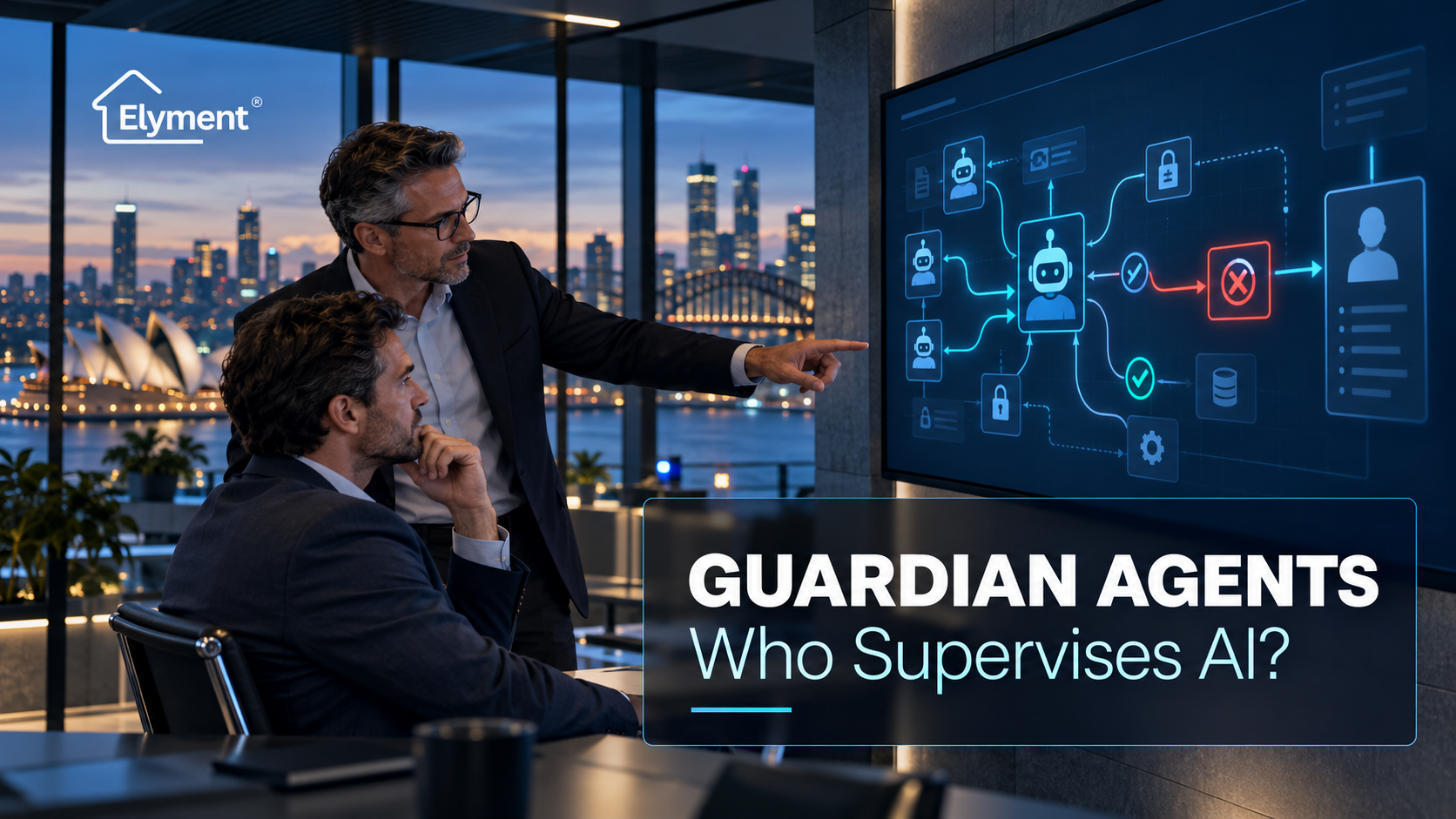
Microsoft announced Guardian Agents on 19 October 2026 as part of Project Perception, describing AI-assisted supervision that investigates changing agent risk and helps enforce security policy. It does not, by itself, prove that harmful actions will be stopped reliably. For Sydney and NSW organisations, the practical issue is whether permission changes, human approvals and security interventions can be independently traced and tested before autonomous workflows receive wider authority.
ELYMENT Insights | Artificial Intelligence & Business Technology | 21 October 2026
The Next AI Security Problem Is Who Supervises the Supervisor
Imagine a Sydney financial services company using an AI agent to reconcile supplier invoices. The agent reads incoming documents, checks account information and prepares payment records.
A manipulated invoice arrives containing instructions designed to redirect the agent towards an unauthorised banking change.
The agent has valid credentials. It is operating inside an approved workflow. Nothing about the employee who delegated the task has necessarily changed.
Yet the requested action has moved outside the organisation's legitimate instructions.
Conventional access controls may establish whether a particular account can reach a system. They do not always establish whether an individual action is appropriate to the business task currently being performed.
Microsoft's latest AI security announcement addresses that distinction. But it creates a further governance question: if another AI agent supervises the first, how can a business demonstrate that the intervention was justified, correctly enforced and properly recorded?
That question matters because a security decision can have consequences in both directions. Failing to stop an inappropriate action can expose information or alter records. Incorrectly stopping legitimate work can interrupt an otherwise compliant business process.
What Microsoft Actually Announced on 19 October
In its 19 October 2026 security announcement, Agents are your newest insiders. Security must move at their speed, Microsoft outlined an extension of Project Perception aimed at securing AI agents operating inside enterprise environments.
The announcement introduced Guardian Agents and security Playbooks designed to support continuous investigation, risk assessment and protective actions.
Microsoft's described architecture includes several connected capabilities:
- Agent discovery and identity: Identifying agents, assigning ownership and distinguishing an agent's activities from those of its human sponsor.
- Dynamic Permissions: Limiting an agent's authority to the approved task and reducing or withdrawing that authority as circumstances change.
- Dynamic Agent Risk: Combining security signals from identity, data, endpoints, networks, cloud services and agent activity.
- Dynamic Conditional Access: Connecting changes in assessed risk to proportional restrictions or containment.
- Guardian Agents: Investigating relevant evidence, explaining changes in risk and recommending or carrying out protective actions within defined policy.
Microsoft also described shared security signals, context and a unified registry between Project Perception and Microsoft Agent 365.
These are announced capabilities and architectural intentions. The announcement does not establish an independently verified rate of successful attack prevention, an enterprise-wide false-positive rate or measured operational reliability across different customer environments.
Businesses should therefore distinguish the functionality Microsoft describes from the outcomes they can validate in their own systems.
Continuous Supervision Is Different From Permanent Permission
A central feature of Microsoft's proposal is that an AI agent should not automatically inherit every permission held by the employee using it.
Instead, an agent can receive its own identity and narrowly defined authority for a specific task and period.
Consider an AI agent preparing quarterly expense reports. It may need to read transactions, match supporting documents and generate a draft report.
It does not necessarily require authority to modify supplier banking details, delete historical records or approve every reimbursement.
If the agent subsequently encounters suspicious instructions, Microsoft's described approach allows policy to respond proportionately.
Some read operations might continue while write operations are blocked. Access to sensitive resources could be narrowed. A consequential action could require verified human approval. At higher risk levels, execution could be stopped.
This is materially different from assigning broad credentials at the start of a workflow and revoking them only after an incident.
Elyment previously examined the broader agent inventory and ownership problem in its analysis of Microsoft Agent 365 as an enterprise control room.
Guardian Agents introduce a more specific issue: how protective decisions are made and justified while an authorised agent is already operating.
An AI Security Intervention Needs an Evidence Trail
For a business, knowing that a Guardian Agent blocked an action is not the same as understanding whether the security system behaved correctly.
An auditable supervisory process should help reconstruct the attempted activity, the evidence considered, the applicable policy and the resulting enforcement decision.
The following is a proposed business assurance model, not a claim that every evidence field is already delivered by Project Perception.
- Agent starts a task
- Control question: Who authorised this activity?
- Evidence to retain: Agent identity, sponsor, task and policy version.
- Agent requests access
- Control question: Is this action within its authority?
- Evidence to retain: Requested resource, permission scope and expiry.
- Security risk changes
- Control question: What evidence triggered reassessment?
- Evidence to retain: Relevant signals, timestamps and risk rationale.
- Guardian recommends containment
- Control question: Which policy supports the intervention?
- Evidence to retain: Policy rule, recommendation and decision owner.
- Access is restricted
- Control question: Was the restriction actually enforced?
- Evidence to retain: Enforcement response and resulting access state.
- Human approves an exception
- Control question: Who approved what and for how long?
- Evidence to retain: Approval identity, permitted scope and duration.
- Normal operations resume
- Control question: Was the underlying risk resolved?
- Evidence to retain: Review outcome, restored permissions and closure record.
This distinction between detection and demonstrable enforcement is essential.
An AI-generated explanation may be useful, but it should not be the sole evidence that a control operated correctly. Independent system records should establish what was requested, what actually happened and which permissions were in force.
Microsoft emphasises keeping security decisions and enforcement outside the agent being protected. For customers, independently verifiable records should be part of testing that boundary.
The Difficult Case Is an Agent That Looks Legitimate
A compromised employee account is a familiar security problem. An AI agent acting under an approved identity presents a more complicated one.
The agent may use expected applications, operate during normal business hours and possess valid access to the affected information.
The warning may emerge only from the relationship between the delegated objective, the information encountered and the sequence of actions attempted.
This is where continuous supervision could add value beyond a static access policy.
However, the same complexity also makes independent testing necessary. A legitimate change in business circumstances must not automatically be treated as malicious behaviour.
A Sydney accounting team, for example, may legitimately update payment details after a documented supplier verification process.
A security system should be capable of distinguishing an unverified request from one supported by the organisation's approved checks and authorisations.
That is not simply a question of model intelligence. It depends on the quality of the surrounding application controls, business records and human decision process.
Related concerns about action-level controls appear in Elyment's analysis of why AI agent tool calls require independent security inspection.
The new Microsoft announcement shifts attention from inspecting an individual action towards continuously reassessing the agent's authority as evidence accumulates.
What Needs Independent Testing Before Businesses Rely on It?
The main commercial question is not whether Guardian Agents can produce a persuasive security explanation. It is whether the full protection process performs reliably against representative business risks.
An enterprise pilot should test at least six distinct outcomes:
1. Pre-action enforcement:
Verify that an unauthorised write, transfer or tool invocation is prevented before it affects a live system.
2. False-positive impact:
Measure how often legitimate work is delayed, blocked or escalated unnecessarily.
3. Detection and response time:
Establish how long the system takes to identify risk and enforce an appropriate restriction.
4. Evidence completeness:
Confirm that independent records allow investigators to reconstruct the decision and its consequences.
5. Coverage across integrations:
Identify connected applications, local agents, tools and data pathways that fall outside the effective control boundary.
6. Human recovery:
Test how authorised staff review a disputed intervention, restore appropriate access and resume interrupted work.
These tests should include benign unusual behaviour as well as simulated malicious inputs. A system that stops every unfamiliar action may appear protective while causing unacceptable business disruption.
The results should be measured using actual permissions, tool calls and application responses, not only the Guardian Agent's own explanation.
This is especially relevant where agents can modify records or communicate externally at speeds that make retrospective manual intervention ineffective.
Australian Cyber Guidance Supports Independent Control Boundaries
Microsoft's announcement is consistent with an important distinction in Australian cyber guidance.
On 11 September 2026, the Australian Signals Directorate published guidance on agentic AI harnesses, describing the software layer connecting an AI model to organisational data, tools and systems.
The guidance identifies least-privilege access, monitoring, logging, human oversight and controlled integration as important safeguards.
The implication is significant. An AI model's ability to identify a suspicious request does not eliminate the need for a separately enforced technical boundary.
The Office of the Australian Information Commissioner also advises organisations to consider data access, privacy risks, testing and human oversight when deploying commercially available AI products.
Where an organisation is subject to relevant Privacy Act obligations, collecting additional agent activity records may itself create data-handling responsibilities.
Security traceability should therefore be designed with appropriate retention limits, access restrictions and investigation procedures.
Why This Matters to Sydney and NSW Organisations
Sydney businesses evaluating autonomous workflows face a practical tension between efficiency and accountability.
A system that processes large volumes of correspondence or financial records may reduce repetitive administrative work. It may also generate substantial operational exposure if one incorrectly authorised action propagates across connected applications.
This makes supervisory architecture a business continuity issue as well as a cybersecurity issue.
NSW Government agencies face additional institutional requirements. Under the NSW AI Assessment Framework, agencies must register AI use cases and complete required assessments, with reassessment when significant changes occur.
The framework is mandatory for the covered government agencies, not automatically for ordinary private businesses. Its emphasis on ownership, recorded decisions and continuing assurance nevertheless offers a useful comparison.
A private business introducing Guardian Agents should similarly determine who owns the supervisory policy, who reviews security exceptions and who has authority to override an automated restriction.
It also needs a workable fallback process when the supervising system itself becomes unavailable.
Elyment has previously examined that separate resilience requirement in its discussion of emergency stopping and recovery arrangements for AI agents.
The Commercial Test Is Control Without Unnecessary Friction
Introducing AI supervision does not remove the cost of enterprise governance.
Guardian Agents may themselves consume compute capacity, process security events and produce investigations requiring review.
Additional monitoring can also increase engineering complexity, logging volumes and operational costs.
Organisations therefore need to assess both the protective benefit and the administrative burden introduced by an additional security layer.
A useful evaluation should compare successful containment, legitimate workflows interrupted, investigation time, approval delays and the cost of maintaining reliable evidence.
Neither an increased number of blocked actions nor a larger volume of security alerts independently demonstrates better protection.
The relevant outcome is whether the system reduces meaningful operational risk without creating disproportionate friction for legitimate business activity.
Review the Controls Behind Your AI Workflows
ELYMENT | TECHNOLOGY & OPERATIONS
Assess workflow permissions, human approvals, traceability and operational dependencies before expanding business automation.
Request an Operational Review →
Sydney & NSW | AI Systems | Business Operations
AI Can Assist Security, but Authority Must Remain Verifiable
Microsoft's Guardian Agents announcement reflects a significant change in how enterprise AI security is being conceived.
Instead of treating permission as a fixed condition established before deployment, the proposed architecture continuously reassesses what an agent should be allowed to do while it works.
That approach addresses a genuine problem: an AI agent can remain technically authorised while its behaviour diverges from the task it was assigned.
The unresolved question is how consistently this supervisory model can identify those situations, intervene correctly and leave independently verifiable evidence.
For Sydney and NSW organisations, the distinction between a security capability being announced and its effectiveness being demonstrated should remain central to adoption decisions.
Another AI agent may be capable of supervising the work. Responsibility for defining its authority, validating its performance and accepting the business consequences still belongs to people.
Sources and References
Microsoft Announcements and Technical References
Australian Government and Regulatory References
- Australian Signals Directorate: Agentic AI Harnesses (11 September 2026)
- Office of the Australian Information Commissioner: Guidance on Privacy and the Use of Commercially Available AI Products
- NSW Government: NSW AI Assessment Framework
Related Elyment Resources
- Elyment: Microsoft Agent 365 Is Becoming a Control Room for AI Workers – What Businesses Should Map First
- Elyment: AWS Says Model Guardrails Miss AI Agent Tool Calls – Should Large Companies Inspect Every Action?
- Elyment: AI Agents Are Getting Powerful Enough to Need a Kill Switch – What Businesses Should Set Before Automation Goes Live
- Elyment: Contact and Operational Review Enquiries
ELYMENT | TECHNOLOGY & OPERATIONS
Review the Controls Behind Your AI Workflows
Assess workflow permissions, human approvals, traceability and operational dependencies before expanding business automation.
Review Your AI WorkflowsSydney & NSW | AI Systems | Business Operations