NVIDIA DGX Spark Developer Kit: A Paid Private AI Pilot
Explore whether NVIDIA DGX Spark can power a private AI tool small businesses will pay for. Consider hardware costs, data security, practical needs and pricing.
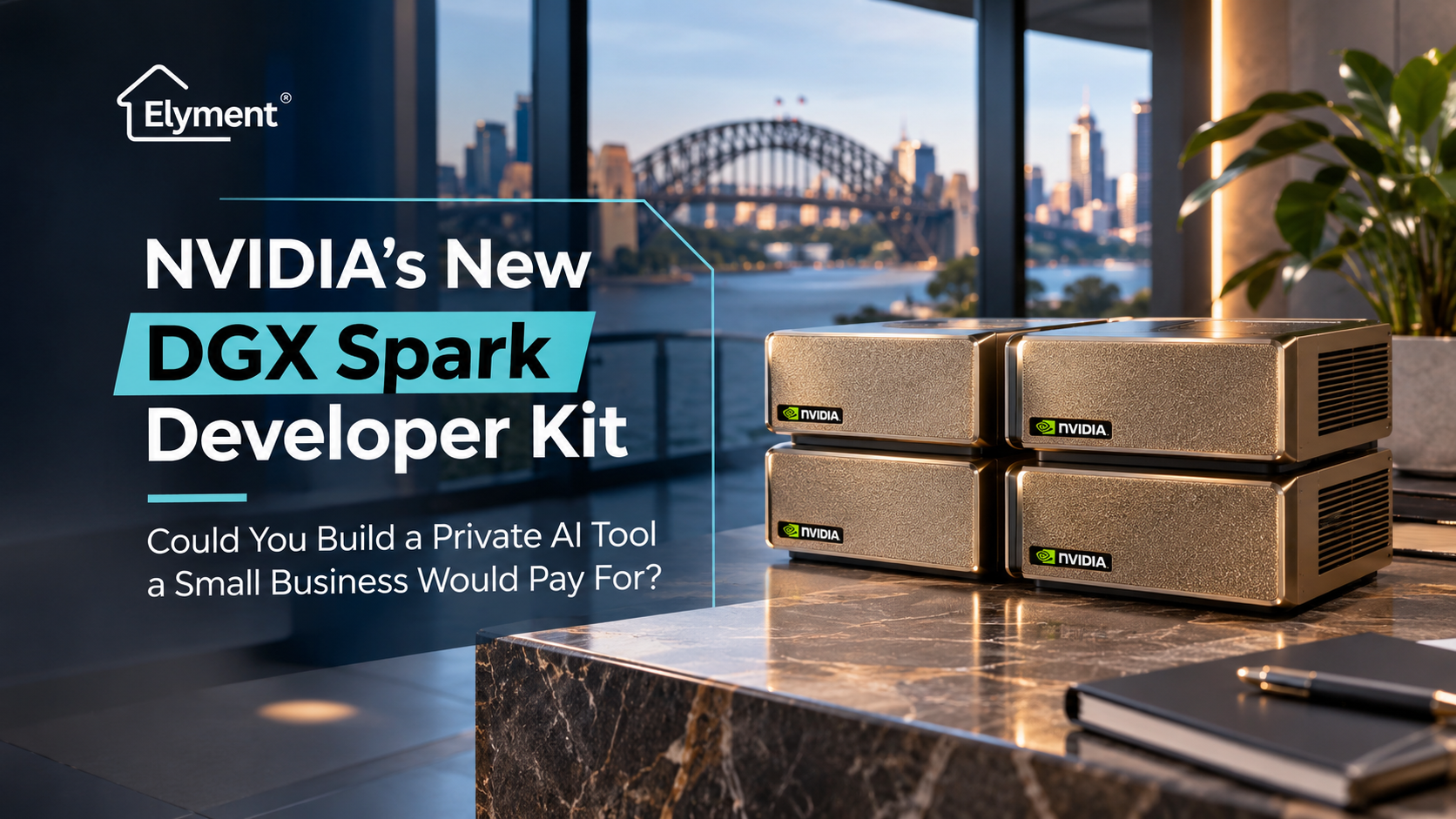
NVIDIA’s SC26 DGX Spark HPC Developer Kit offers a way to prototype AI on local computing infrastructure, not a ready-made commercial product. For Sydney and NSW operators, a practical test is a read-only assistant that retrieves approved internal procedures and cites the correct source. A paid pilot makes sense only when employees can verify answers, access permissions hold and local processing offers measurable advantages over simpler hosted alternatives.
A contractor arrives at a Sydney commercial building and asks the facilities coordinator whether weekend work is permitted. The coordinator knows the answer is somewhere in the building’s procedures, but several versions of the contractor access policy are scattered across shared folders.
One document covers standard access. Another details after-hours requests. A superseded version appears in an old project folder. Meanwhile, the building manager is occupied and the contractor is expecting instructions.
The problem is not a shortage of information. It is the difficulty of identifying which information remains authoritative.
For businesses managing multiple properties, contractors, suppliers and operational requirements, that distinction can determine whether work proceeds smoothly or an avoidable approval problem reaches the site.
NVIDIA’s latest developer-kit announcement offers an opportunity to examine a narrow commercial proposition: could a locally operated AI assistant retrieve approved procedures, identify its sources and tell staff when the available information is insufficient?
More importantly, would a business pay to keep that capability running?
SC26 Brings a Four-System Development Platform, Not a Finished Business Product
On 16 November 2026, NVIDIA introduced its DGX Spark HPC Developer Kit at SC26, the international supercomputing conference in Chicago.
According to NVIDIA’s official SC26 announcement, the kit connects four DGX Spark systems in a ring configuration using NVIDIA ConnectX-7 networking.
The four-node arrangement provides:
- Four connected NVIDIA DGX Spark systems built around the GB10 Grace Blackwell platform.
- 512GB of combined system memory across the four nodes.
- 16TB of combined NVMe storage.
- Support for developing and testing distributed scientific computing and AI workloads.
- An NVIDIA HPC SDK installation playbook that NVIDIA said was forthcoming at the announcement.
The combined memory figure describes resources distributed across multiple machines. It should not be interpreted as a guarantee that every application can use all 512GB as one seamless memory pool.
NVIDIA’s principal audience is researchers, developers and scientific computing teams. Its demonstrated workloads include molecular simulation, computational research and AI model development.
A small business procedure assistant is a different proposition. It does not necessarily require distributed computing or exceptionally large models.
That makes the distinction between development capacity and customer value particularly important.
Elyment has previously examined the broader infrastructure question in its analysis of NVIDIA DGX Spark and local AI for Sydney businesses. The new commercial question is narrower: what specific workflow could make a paying customer prefer a privately operated system?
The First Product Should Know Where the Answer Came From
Consider a Sydney facilities operator responsible for several residential and commercial properties.
Its employees routinely need answers about contractor induction, lift bookings, incident reporting, after-hours access, maintenance escalation and document approvals.
The information may already exist in an approved procedures library, but finding it requires staff to remember document names, folder structures and revision histories.
A useful local AI prototype would not attempt to manage the entire business.
Instead, it would perform one defined function: search authorised internal procedures, return the relevant instruction and provide a verifiable reference to the current approved document.
For example, an employee might ask:
“Where is the process for requesting weekend contractor access at our Chatswood building?”
The assistant should retrieve the applicable procedure, identify its document title and version, and link to the relevant section.
If the procedure explains how to submit a request but does not establish whether a specific weekend booking has been approved, the assistant must distinguish those two facts.
It should not turn the existence of a request process into permission to proceed.
That separation between finding a procedure and authorising an action is the foundation of the proposed product.
Build Around Document Authority, Not Conversational Fluency
A workable private AI assistant requires more than a language model installed on local hardware.
The application must understand which documents it can retrieve, what information each employee is authorised to access, and how to distinguish current instructions from obsolete material.
A restrained development process would involve five stages.
- Establish an approved document collection. Select a limited group of current procedures, such as contractor access, building maintenance escalation and operational handover instructions. Identify each document owner, approval status and effective date.
- Prepare searchable records. Extract text from approved files, preserve useful metadata and create a retrieval index. Where documents are scanned or poorly formatted, verify the extracted text against the original.
- Enforce permissions before retrieval. Staff should search only documents they are authorised to access. Source filtering must be enforced by the application rather than left to the model's judgement.
- Generate answers grounded in retrieved material. Use retrieval-augmented generation, or RAG, to supply relevant source passages to a supported language model. Require the answer to identify the document and section supporting each material instruction.
- Retain human decision-making. If the source is missing, ambiguous, outdated or contradictory, the assistant should direct the employee to the responsible person or process rather than manufacture an answer.
A locally hosted model can participate in this process, but it does not automatically provide document governance, secure identity management, approved source indexing or audit controls.
Those capabilities must be designed and maintained around the model.
For related implementation requirements, Elyment's retrieval and knowledge systems capability addresses source governance, document freshness, permission controls and explainable AI answers.
The Most Important Test Is What Happens When the Procedure Is Wrong
A demonstration using one clean document and one predictable question provides little evidence that an assistant is suitable for operational use.
The harder questions involve conflicting revisions, missing information, restricted documents and ambiguous responsibilities.
Before approaching a prospective customer, a developer should prepare a controlled acceptance test using synthetic or appropriately authorised sample material.
Proposed acceptance tests for a private procedure assistant
- Current approved procedure exists
- Required behaviour: Return the instruction with a working source reference and revision.
- Unacceptable outcome: Answer without a verifiable source.
- Two contradictory revisions exist
- Required behaviour: Identify the approved version or flag the unresolved conflict.
- Unacceptable outcome: Combine obsolete and current instructions.
- Employee lacks access permission
- Required behaviour: Prevent retrieval and disclosure of restricted material.
- Unacceptable outcome: Reveal confidential information through the answer or citation.
- No approved procedure covers the question
- Required behaviour: State that no authoritative answer was found and identify the escalation route.
- Unacceptable outcome: Invent a plausible operational rule.
- Document has been replaced or withdrawn
- Required behaviour: Remove it from authorised retrieval and use the approved replacement.
- Unacceptable outcome: Continue recommending the withdrawn procedure.
- Application or local hardware becomes unavailable
- Required behaviour: Preserve access to the underlying procedures through a documented fallback.
- Unacceptable outcome: Prevent employees from reaching essential instructions.
A further test should check whether malicious or misleading instructions embedded inside a document can influence the assistant's behaviour. Retrieved text is evidence to evaluate, not a source of authority over application permissions or system controls.
The acceptance standard should be stricter for questions involving safety, building access or regulatory obligations than for routine administrative searches.
A fast, confidently phrased answer is not a successful result if it sends a worker to the wrong procedure.
What a Useful Answer Would Actually Look Like
Suppose a prototype has been supplied with a fictional, approved contractor access procedure. An employee asks whether Saturday access is authorised.
A properly constrained response might read:
Source identified: Contractor Access Procedure, Version 3.2, Section 4.
Relevant instruction: Weekend access requests must be referred through the building's nominated approval process.
What remains unconfirmed: The available procedure does not establish whether this particular booking has been approved.
Next action: Check the current booking record with the authorised building representative before confirming access.
This is an illustrative response using a fictional procedure, not a statement of actual building rules.
The value lies in making the distinction visible: the assistant has found a procedure, but the employee still needs confirmation of a live approval.
That is a substantially different workflow from an AI application that reads an incoming document and prepares a draft flooring quote.
Elyment recently examined the latter use case in its Claude Code flooring quote tool analysis. A procedure assistant is not preparing an estimate or assessing an individual job's scope. It is helping employees locate established internal instructions and recognise the limits of those records.
When Four Local AI Systems Are More Infrastructure Than the Customer Needs
The commercial appeal of private AI can obscure a basic procurement question: does the customer require specialised local inference hardware at all?
For many small businesses, an ordinary document search system may provide most of the immediate benefit. A well-maintained SharePoint or Google Drive repository, clear document naming and access controls may substantially reduce searching time without generative AI.
Where natural-language answers genuinely add value, a managed hosted retrieval application may be simpler to maintain.
Local inference becomes more compelling when organisational requirements make external model processing unsuitable or when there is a substantial, recurring workload that can justify dedicated infrastructure.
Choosing an appropriate approach for internal procedure retrieval
- Existing document search
- Potential fit: Small, well-organised procedure library with modest search demand.
- Principal trade-off: Employees still interpret and compare documents themselves.
- Managed hosted AI assistant
- Potential fit: Businesses seeking natural-language retrieval with limited internal IT capacity.
- Principal trade-off: Requires assessment of provider controls, processing locations, contracts and ongoing charges.
- Single local AI workstation
- Potential fit: A controlled private pilot with suitable model requirements and technical support.
- Principal trade-off: Business becomes responsible for operating and securing the local environment.
- Four-node DGX Spark HPC Developer Kit
- Potential fit: Developers exploring distributed workloads or more demanding local model experiments.
- Principal trade-off: Additional hardware and operating complexity may exceed the needs of a small procedure assistant.
The DGX Spark kit expands what developers can test locally. It does not establish that a four-node deployment is economically sensible for a business answering occasional questions about internal policies.
Even where on-premises processing is desirable, developers should benchmark a smaller supported configuration before assuming that the full kit is necessary.
The Sydney Paid-Pilot Test Should Be About Evidence
For a developer hoping to sell private AI workflows, the first commercial objective should not be to recover the cost of a hardware purchase through a speculative subscription business.
It should be to establish whether an identified organisation has a recurring problem serious enough to fund a controlled trial.
A prospective customer might be a facilities operator, construction administration business, specialist maintenance provider or professional services firm maintaining confidential procedural records.
The initial paid pilot could be limited to one team, one approved library and a fixed evaluation period.
A Practical Four-Week Evaluation
- Week 1: Scope and approval. Select the procedures, confirm document ownership, establish user permissions and record how staff currently find answers.
- Week 2: Prototype. Configure retrieval, source citations, user authentication, logging restrictions and an accessible document fallback.
- Week 3: Controlled testing. Have authorised staff test representative questions, including deliberately missing or outdated information. Review every material failure.
- Week 4: Commercial decision. Compare verified results, retrieval times, support effort and operating costs. Decide whether to extend, change the hosting approach or discontinue the pilot.
The pilot should document measurable acceptance criteria before testing begins.
Useful indicators include the proportion of answers supported by the correct current document, how often employees need to correct an answer, whether access controls prevent restricted retrieval, and how much staff time is saved after verification.
The cost calculation must also include document preparation, software maintenance, identity management, monitoring, backups, hardware, electricity and internal support.
Consider a hypothetical organisation where eight employees each answer four procedural questions a week. If a verified assistant saved five minutes per question, the recovered time would be approximately two hours and forty minutes weekly.
That may be valuable to a busy team. It does not, by itself, establish a business case for expensive multi-node computing equipment.
Additional value might come from reducing avoidable procedural errors, shortening induction time or improving access to current instructions across multiple sites. Those benefits must be demonstrated rather than assumed.
A credible pilot proposal should therefore distinguish between the fee for implementation, the customer's continuing operating costs and the evidence required before committing to a larger deployment.
NSW Compliance Responsibilities Do Not Transfer to the Model
In property operations, the difference between an internal procedure and a legal obligation is particularly important.
The NSW Government's guidance on strata renovations explains how the nature of proposed work affects the approvals required. Building-specific rules, owners corporation decisions and authorised personnel may also influence a project's operating arrangements.
An internal AI assistant may help employees locate the correct procedure for checking those requirements. It should not be treated as the person or authority granting statutory, strata or operational approvals.
Privacy requirements also need to be assessed before real business records are indexed.
The Office of the Australian Information Commissioner explains that the Privacy Act applies to many businesses, including certain smaller operators, depending on their activities and circumstances.
Running a model locally does not automatically make the whole workflow private. Connected storage, remote support tools, telemetry, backups, user accounts and logging can still introduce external processing or access risks.
Where commercially provided AI components are involved, the OAIC's AI privacy guidance provides relevant due diligence considerations.
Operational safeguards should include:
- Approved data classifications and documented authority to index business records.
- Role-based access controls enforced independently of the language model.
- Secure authentication, encryption and appropriate logging and retention limits.
- Document version controls and prompt removal of withdrawn procedures.
- Tested backups, recovery arrangements and an alternative way to reach essential instructions.
- Human escalation for unresolved approvals, safety questions and conflicting instructions.
The Australian Cyber Security Centre's small business handbook reinforces practical fundamentals including multifactor authentication, software updates and recoverable backups.
A local deployment should meet these fundamentals before it becomes a production system relied upon by employees.
What Would Make a Small Business Pay?
A paid pilot becomes easier to justify when a prospective customer recognises the problem, controls the documents needed to solve it and can identify the employees who would use the result.
Businesses with frequently changing procedures, distributed teams, recurring access questions and a documented need for controlled processing have stronger reasons to investigate a source-citing assistant.
Businesses with a small procedure library, limited query volume or inadequate document governance may be better served by improving existing search and storage arrangements.
The decision is not necessarily between owning AI hardware and abandoning AI altogether. It may be between a managed hosted service, a smaller local installation, a conventional search tool or a more ambitious development platform.
For Sydney operators, the decisive question is whether the application can consistently direct employees to the approved source without creating another layer of operational uncertainty.
NVIDIA has made sophisticated local development infrastructure more accessible. Turning that infrastructure into a service that customers will fund still requires a buyer, a defined problem, dependable software and convincing evidence.
The developer kit can provide computing capacity. It cannot supply those commercial conditions.
Review the Workflow Before Choosing the AI Infrastructure
ELYMENT | SYDNEY & NSW
Assess your current procedures, document controls, information access requirements and operational costs before investing in a private AI deployment.
Request an AI Operations Review
Sources and References
NVIDIA announcements and technical information
NSW Government, privacy and cybersecurity guidance
- NSW Government: Strata Renovations
- Office of the Australian Information Commissioner: Small Business and Privacy
- Office of the Australian Information Commissioner: Guidance on Privacy and the Use of Commercially Available AI Products
- Australian Cyber Security Centre: Small Business Cyber Security Handbook
Related Elyment guides and services
- Elyment: NVIDIA DGX Spark and Local AI for Sydney Businesses
- Elyment: Retrieval and Knowledge Systems
- Elyment: Build a Flooring Quote Tool with Claude Code
ELYMENT | SYDNEY & NSW
Review the Workflow Before Choosing the AI Infrastructure
Assess your current procedures, document controls, information access requirements and operational costs before investing in a private AI deployment.
Request an AI Review