Nvidia's DSX POD Puts an AI Factory in a Shipping Container
Nvidia's DSX POD puts an AI factory in a shipping container. Explore what this means for AI deployment costs, site requirements, power, cooling and scalability.
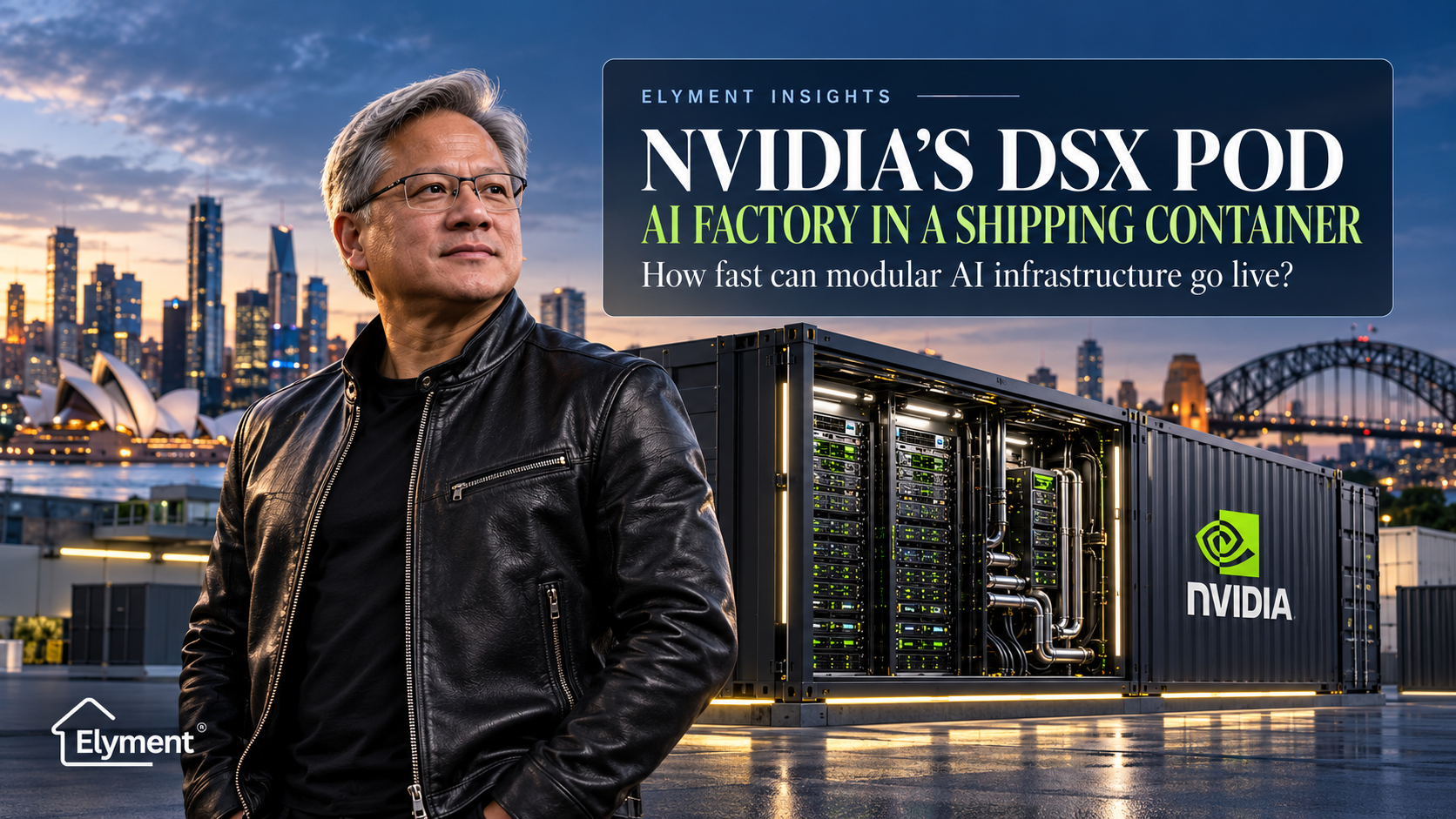
NVIDIA's DSX POD is a modular AI factory reference design that allows partners to integrate and test computing infrastructure before delivery. NVIDIA says deployment at a prepared site could fall from six months to as little as 14 days. For Sydney and NSW operators, the opportunity is faster access to AI computing capacity, provided electricity, cooling, connectivity, commissioning and commercial readiness are already addressed.
ELYMENT Insights | Artificial Intelligence & Business Technology | 22 October 2026
The Shipping Container Is Not the Breakthrough
A shipping container is an unlikely symbol of the next phase of artificial intelligence. Yet NVIDIA's latest infrastructure announcement suggests that the most consequential improvement in AI computing may be how quickly processing capacity can become operational.
On 21 October 2026, at GTC Berlin, NVIDIA introduced DSX POD, a reference design for modular AI factories built around its Vera Rubin computing platform.
Rather than requiring operators to integrate every computing system at its final destination, NVIDIA proposes that partners complete much of the integration, cabling, power distribution and liquid-cooling validation before shipment.
The containers arrive as coordinated systems intended to connect to prepared supporting infrastructure.
According to NVIDIA's official announcement, that approach could reduce deployment time at a prepared location from approximately six months to as little as 14 days.
It is a significant proposition, but the figure needs careful interpretation.
NVIDIA is describing a reference architecture and an intended deployment capability, not reporting an independently established average across completed commercial installations.
The more interesting question is whether standardised AI infrastructure can reduce the time between investing in computing hardware and delivering a reliable, revenue-generating AI service.
Fourteen Days Is Not the Entire Deployment Calendar
There is an important qualification behind the 14-day headline: the destination must already be ready to receive the infrastructure.
NVIDIA's proposed timetable begins after critical external dependencies have been prepared. It should not be interpreted as a guarantee that a new AI computing operation can progress from initial investment approval to commercial service within two weeks.
The distinction matters because an AI factory is an interconnected operating system, not simply a collection of processors.
Compute
- What DSX POD changes: Factory-integrated Vera Rubin systems.
- What still needs verification: Workload configuration, performance and production acceptance.
Networking
- What DSX POD changes: Preconfigured internal cabling and connectivity.
- What still needs verification: External connectivity, routing, security and service performance.
Cooling
- What DSX POD changes: Factory-integrated liquid-cooling interfaces.
- What still needs verification: External cooling capacity and operating performance.
Power
- What DSX POD changes: Standardised internal electrical interfaces.
- What still needs verification: Available electrical capacity, power quality and resilience.
Commercial service
- What DSX POD changes: Potentially earlier system availability.
- What still needs verification: Customer onboarding, service assurance and sustained productive workloads.
NVIDIA's published DSX POD technical explanation confirms that the reference design covers computing, storage, networking, power, controls and liquid cooling, with defined interfaces between systems.
Its power architecture includes a standard 800 VDC input design, while partners remain responsible for engineering compatible upstream power arrangements.
This is why the phrase "plug-in AI factory" is useful as a description of simplified integration, but potentially misleading as an operational promise.
The Real Commercial Metric Is Time to First Productive Token
Traditional technology procurement commonly measures success through delivery dates, installation completion and system availability.
AI infrastructure adds a more commercially meaningful milestone: when the equipment begins producing useful model output for live workloads.
NVIDIA calls this the time to first token.
However, a successful initial inference request is not necessarily evidence that an entire computing service is ready for customers.
An operator still needs to establish acceptable availability, throughput, latency, security and operational recovery procedures.
Consider a hypothetical Australian cloud provider planning to introduce additional AI inference capacity.
If integrated hardware arrives substantially earlier, the provider may be able to begin testing customer workloads sooner. That could shorten the period during which expensive equipment has been purchased but is not generating commercial value.
The commercial benefit nevertheless depends on whether paying customers are available, whether software and models perform as required, and whether demand justifies the capacity.
Earlier availability improves the opportunity to earn revenue. It does not guarantee revenue.
Five Metrics That Matter More Than Delivery Speed Alone
- Time to first successful inference: When does the integrated platform first execute an approved workload?
- Time to production acceptance: When does the service satisfy agreed performance, security and resilience requirements?
- Productive utilisation: What proportion of available computing capacity is performing useful work?
- Cost per useful output: What is the fully allocated operating cost of delivering the required model output?
- Time to first billable service: When can the operator reliably fulfil a paying customer's computing requirements?
These measures help distinguish a faster deployment process from an economically successful AI operation.
Standardisation Could Move the Industry's Bottleneck
NVIDIA's proposal changes where operational risk is concentrated.
In a conventional deployment, operators may receive infrastructure from multiple suppliers and then coordinate integration, configuration and testing.
Under the DSX POD model, a greater proportion of that work would be completed and validated before delivery.
That creates the possibility of more consistent configurations and more repeatable deployments. It also creates new responsibilities.
- Configuration assurance: Operators must confirm that delivered systems match approved hardware, firmware and network baselines.
- Transport integrity: Factory testing must be followed by checks confirming that shipment has not affected performance or reliability.
- Supplier coordination: Hardware, networking, infrastructure and service partners need clearly assigned operational responsibilities.
- Support arrangements: Operators need agreed maintenance access, replacement procedures and escalation pathways.
- Version consistency: Repeated deployments need change management so that supposedly identical units do not develop incompatible configurations.
Standardisation can reduce integration uncertainty, but it cannot eliminate failures, operational dependencies or vendor-specific risks.
The potential benefit is a more predictable commissioning process, not the disappearance of commissioning itself.
Sydney's Constraint May Be Available Power, Not Containers
The DSX POD announcement arrives during a significant expansion of Australia's data-centre economy.
Sydney is particularly relevant because it is one of the country's principal locations for cloud computing, enterprise data services and advanced digital infrastructure.
According to the NSW Government's March 2026 announcement, 15 data-centre investment proposals collectively valued at $51.9 billion were endorsed for progression through the Investment Delivery Authority.
Endorsement does not establish that those projects are complete, operational or using NVIDIA DSX POD.
The scale of proposed investment does demonstrate why accelerating access to usable computing capacity could become commercially important.
There is, however, a major constraint that modular delivery does not resolve: electricity availability.
A container can arrive with computing systems integrated and tested. It cannot independently create the energy supply required to operate them.
The NSW Data Centre Policy Framework announced on 17 August 2026 establishes expectations concerning energy, water, environmental performance and the costs imposed on supporting infrastructure.
The NSW Government is seeking to ensure that operators contribute appropriately to the additional resources and network capacity required for their activities.
Similarly, the Australian Government's expectations for data centres and AI infrastructure developers address energy security, water efficiency, national capability and responsible operations.
Those national expectations operate alongside existing legal requirements; they are not a blanket approval for a particular deployment technology.
For NSW operators, modularity may accelerate technical deployment once resources are available. It does not override the need to secure those resources responsibly.
Would Containerised AI Create More Local Computing Choice?
Modular infrastructure could eventually broaden how computing providers expand capacity across Australia.
Rather than treating every capacity increase as an entirely bespoke integration exercise, operators could assess repeatable computing units with defined technical interfaces.
This may be attractive to Australian cloud providers, specialised AI infrastructure companies and organisations with substantial model-training or inference requirements.
For a Sydney business consuming AI services, the relevant benefit would be indirect.
More locally available computing capacity could potentially improve provider choice, reduce some network delays or support additional service options.
These outcomes remain dependent on actual Australian deployments, operating costs, service availability and commercial competition.
Local physical infrastructure also does not, by itself, guarantee compliant data handling. Organisations still need to examine contractual arrangements, support access, information flows and applicable privacy obligations.
The Office of the Australian Information Commissioner's guidance on APP 8 explains that cross-border disclosure obligations depend on the nature of the information handling and the circumstances of disclosure.
Keeping equipment in Australia is therefore one component of data governance, not proof of complete data sovereignty.
Elyment previously explored related deployment choices in its analysis of open-weight AI and business control over models and data.
DSX POD presents a different question: whether the infrastructure supporting those models can become available more quickly and predictably.
The Financial Case Requires More Than a Faster Launch
NVIDIA's announcement comes as major technology companies commit substantial capital to expanding AI computing capacity.
Speed matters because infrastructure investments can begin generating financing, operating and contractual costs before meaningful customer revenue arrives.
Compressing the interval between hardware acquisition and productive operation could improve capital efficiency.
Yet a faster deployment does not automatically establish a lower total cost of ownership.
A procurement assessment still needs to compare:
- Factory integration and validation costs.
- Hardware acquisition and financing expenses.
- Electricity and cooling expenditure.
- Maintenance, software and technical support.
- Insurance, security and operating resilience.
- Capacity utilisation and customer revenue.
- Upgrade flexibility and eventual equipment replacement.
NVIDIA has not established a universal customer price or guaranteed operating economics for every DSX POD deployment.
Commercial comparisons will therefore require partner-specific proposals and independently validated performance data.
This differs from the question examined in Elyment's earlier report on NVIDIA's proposed AI infrastructure financing arrangements.
Financing determines how capital is supplied and how financial risk is distributed. Modular deployment addresses how quickly infrastructure might become operational after that capital is committed.
Neither mechanism replaces the need for sustainable customer demand.
What an Australian Operator Should Verify Before Committing
The practical question for a Sydney or NSW technology operator is not whether the DSX POD concept appears technically attractive.
It is whether the proposed system can be delivered, commissioned, supported and operated within an acceptable commercial and risk framework.
A Proposed Operational Acceptance Sequence
- Define the required AI service. Establish intended workloads, throughput, latency, availability and security requirements.
- Verify resource availability. Confirm adequate electrical supply, cooling arrangements and network capacity.
- Review partner responsibilities. Identify who supplies, configures, commissions, maintains and supports each component.
- Examine factory acceptance evidence. Request applicable test records, configuration baselines and quality-control documentation.
- Complete destination acceptance. Test connectivity, power resilience, cooling, security and workload behaviour after delivery.
- Validate production economics. Measure actual output, operating costs and utilisation against the approved business case.
- Approve commercial service. Transfer operational ownership only after support, recovery and service requirements have been satisfactorily demonstrated.
This is a proposed due-diligence approach, not an NVIDIA-mandated acceptance procedure.
It provides a practical means of separating supplier delivery claims from the customer's own definition of operational readiness.
Early 2027 Is the Next Evidence Point
NVIDIA has named a broad partner ecosystem, including Dell Technologies, HPE, Lenovo, Schneider Electric, Vertiv and other technology and infrastructure organisations.
The company says partners are working towards worldwide DSX POD delivery in early 2027.
As of 22 October 2026, the announcement should be understood as a newly introduced reference design with a proposed commercial rollout, not as independently proven evidence of widespread operational deployments.
The next useful evidence will come from actual customer installations.
Operators and investors should look for independently verifiable deployment timelines, sustained workload performance, energy consumption, maintenance outcomes and total operating costs.
Those results will show whether factory integration has meaningfully improved commercial delivery or simply transferred some complexity to different suppliers.
Elyment's previous coverage of NVIDIA's Vera Rubin computing platform explored the technology underpinning the next generation of AI systems.
DSX POD introduces a separate test: how consistently that technology can be delivered as productive capacity.
ELYMENT | TECHNOLOGY & OPERATIONS
Review Your AI Operational Readiness
Assess technology dependencies, operational workflows, governance requirements and service handover risks before making major AI commitments.
Request an Operational Review →
Sydney & NSW | AI Workflows | Operational Planning
The Bigger Shift Is From Delivered Hardware to Delivered Intelligence
NVIDIA's DSX POD proposal represents a potentially meaningful evolution in how advanced computing infrastructure reaches commercial operation.
By moving more integration and validation into a controlled factory environment, NVIDIA and its partners aim to make large-scale AI deployments faster, more repeatable and more predictable.
For Sydney and NSW technology operators, that could eventually create opportunities to introduce new capacity sooner.
Yet electricity availability, cooling, connectivity, information governance, operational assurance and customer demand remain decisive.
The container is a delivery mechanism. The commercially valuable product is dependable computing output.
The success of DSX POD will ultimately be measured not by how quickly a container arrives, but by how reliably it begins producing useful intelligence.
Sources and References
NVIDIA official announcements and technical information
- NVIDIA: Introduces DSX POD AI Factories to Accelerate Europe's Infrastructure Deployment
- NVIDIA Developer Blog: Achieve Productive AI Capacity Faster and More Predictably with NVIDIA DSX POD
NSW Government and Australian Government guidance
- NSW Government: Data Centre Investment and Sustainable Development — March 2026
- NSW Government: Nation-Leading Framework to Harness NSW Data Centre Investment — August 2026
- Australian Government: Expectations for Data Centres and AI Infrastructure Developers
- Office of the Australian Information Commissioner: Australian Privacy Principle 8 — Cross-Border Disclosure of Personal Information
Related Elyment articles
- Microsoft, NVIDIA and Meta Back Open-Weight AI: Are Businesses About to Gain More Control Over Their AI?
- NVIDIA and Wall Street Want to Finance $500 Billion of AI Infrastructure: Who Carries the Risk if Demand Slows?
- NVIDIA Reveals the Future of AI Computing with Vera Rubin: Everything Jensen Huang Announced at GTC Taipei 2026
Technology and operational enquiries
ELYMENT | TECHNOLOGY & OPERATIONS
Review Your AI Operational Readiness
Assess technology dependencies, operational workflows, governance requirements and service handover risks before making major AI commitments.
Review My AI ReadinessSydney & NSW | AI Workflows | Operational Planning