OpenAI GPT-6.1 Terra: Price, Features & Availability
Explore OpenAI GPT-6.1 Terra pricing, features and access through the API, ChatGPT Work and Codex, so you can plan AI costs and choose the right business tools.
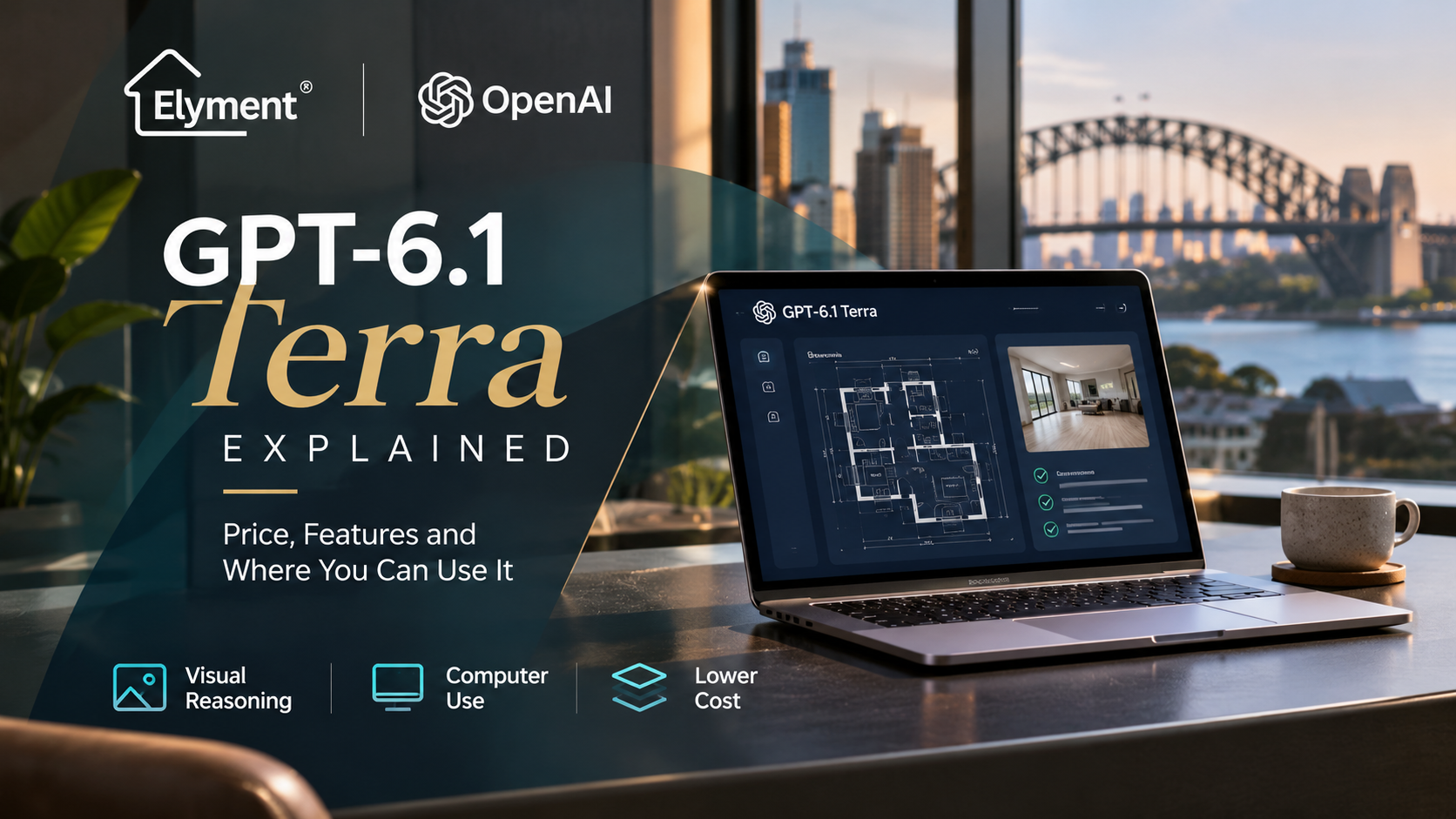
OpenAI introduced GPT-6.1 Terra on 26 October 2026 as a faster, lower-cost model for visual reasoning, computer use and writing. Sydney and NSW organisations can access it through ChatGPT Work and Codex on eligible paid plans, or through the API. Standard API pricing starts at US$1 per million input tokens and US$5 per million output tokens. It is not currently offered in standard Chat conversations.
OpenAI's New Terra Model Targets the Work That Happens on a Computer
Artificial intelligence is moving beyond the familiar exchange of questions and answers. Businesses increasingly want systems that can examine documents, interpret visual information, navigate software and complete structured tasks within existing digital environments.
OpenAI's GPT-6.1 Terra is designed around that transition.
Announced on 26 October 2026, the model represents an upgrade to the previous GPT-5.6 Terra. Its central proposition is a combination of visual understanding, computer interaction, more natural writing and lower API costs.
The distinction is important. Terra is not being positioned as OpenAI's most powerful model for every possible task. Instead, it targets the substantial volume of everyday professional work that requires an AI system to understand information and take carefully defined actions.
For Sydney businesses, this creates an opportunity to examine where AI can assist with administration, document handling, operational reporting and software-based workflows without automatically committing to a more expensive model.
OpenAI's official GPT-6.1 Terra announcement describes the model as a balance between capability, speed and cost.
What Makes GPT-6.1 Terra Different?
Terra's development is centred on three connected capabilities: understanding visual information, interacting with computer applications and communicating results clearly.
1. Visual Reasoning and Document Interpretation
The model can interpret images and visual information rather than relying exclusively on written instructions.
This is relevant to professional environments where important information is distributed across documents, screenshots, product photographs, technical drawings and application interfaces.
Potential business applications include:
- Extracting information from invoices and supporting documents.
- Comparing product photographs against catalogue entries.
- Interpreting technical drawings and identifying relevant visual details.
- Reviewing screenshots to identify interface problems.
- Organising information from scanned documents into structured records.
For a Sydney property services operator, for example, visual reasoning could assist with organising site photographs, identifying missing information in project documentation and preparing structured inspection summaries.
However, identifying information in an image is not equivalent to making a certified technical assessment. Measurements, building compliance decisions and professional approvals still require appropriate human verification.
2. Computer Use and Application Interaction
One of the more significant capabilities is computer use.
Rather than stopping after generating instructions, an appropriately configured AI workflow can interact with software interfaces and carry out a sequence of actions.
Depending on the application, tools and permissions provided, this can support activities such as:
- Opening and reviewing business documents.
- Entering extracted information into application fields.
- Moving information between approved software systems.
- Completing structured forms.
- Preparing records for human review.
- Assisting with multi-step computer-based tasks.
Consider a business receiving a large volume of supplier invoices. An AI-assisted process could read the supplied document, extract the relevant information, prepare an accounting entry and present the result for approval.
The commercial benefit is not simply that the AI writes faster. It is that several administrative steps can potentially be brought into one controlled workflow.
Computer use must still operate within defined permissions. An organisation should establish which applications the model can access, which actions it may perform and which transactions require human approval.
3. More Natural Professional Writing
Terra also improves the communication layer of AI-assisted work.
Businesses frequently need to convert unstructured information into professional outputs. These include customer correspondence, internal summaries, proposals, reports, project updates and operational instructions.
More natural writing can reduce the editing required between an initial AI output and a document that is suitable for business use.
For Sydney businesses working across customers, suppliers, contractors and professional service providers, consistent communication is particularly valuable when information passes between several people before a task is completed.
GPT-6.1 Terra Performance: What OpenAI's Tests Show
OpenAI has published benchmark results indicating improvements over GPT-5.6 Terra, particularly in coding, visual reasoning and computer-based tasks.
One notable result comes from Terminal-Bench 4.0, which evaluates an AI model's ability to complete software engineering tasks through a command-line environment.
At maximum reasoning effort, OpenAI reports that GPT-6.1 Terra achieved a 50.3% success rate, compared with 21.5% for GPT-5.6 Terra.
OpenAI has also reported a reduction in errors on its internal error-inducing prompt evaluation. At low reasoning effort, the reported error rate decreased from 53.6% to 16.7%.
These figures suggest meaningful progress, but they need to be interpreted carefully.
Benchmark performance is not a guarantee that the model will achieve the same results in a particular company's software environment. Real-world performance depends on the quality of source documents, the instructions supplied, application permissions and the complexity of the workflow.
OpenAI also acknowledges that GPT-6.1 Sol and GPT-6 Astra remain better choices for its most complex coding requirements.
For businesses, the practical question is therefore not whether Terra wins every benchmark. It is whether it can complete a particular task accurately, consistently and economically.
GPT-6.1 Terra Pricing: What Businesses Will Pay
Pricing is one of the most commercially significant parts of this release.
OpenAI has set GPT-6.1 Terra's standard API prices at 50% below those of GPT-5.6 Terra and GPT-6.1 Sol.
The published standard rates are:
Input Tokens
- Price per million tokens: US$1.00.
Cached Input Tokens
- Price per million tokens: US$0.05.
Cached Input Writes, 30-Minute Retention
- Price per million tokens: US$1.25.
Output Tokens
- Price per million tokens: US$5.00.
These figures are denominated in US dollars and relate to API consumption. They are not a monthly ChatGPT subscription fee.
How Much Could a Typical API Request Cost?
Consider an illustrative request using 100,000 input tokens and generating 10,000 output tokens.
Input
- Calculation: 100,000 × US$1 per million.
- Cost: US$0.10.
Output
- Calculation: 10,000 × US$5 per million.
- Cost: US$0.05.
Total
- Calculation: Before additional charges.
- Cost: US$0.15.
This is an illustrative token calculation, not a guaranteed price for a particular task. Actual consumption depends on the prompt, document or image inputs, reasoning requirements and generated response.
Additional Pricing Considerations
The standard token rates are not the only figures businesses need to consider.
- Prompt caching: Cached input tokens are priced at US$0.05 per million tokens, making repeated context substantially cheaper.
- Long-context requests: Prompts exceeding 272,000 input tokens attract higher rates. OpenAI specifies twice the standard input and cache rates and 1.5 times the output rate for the full request.
- Batch and Flex processing: These options are priced 50% below standard rates.
- Fast mode: Fast mode is priced at twice the standard rates.
- Regional processing: Where available, regional processing attracts a 10% premium.
- Tool usage: Certain tools, including computer use and web search, can attract separate charges.
For this reason, a business should calculate the total cost of completing a workflow rather than relying exclusively on the headline price per million tokens.
Where Can You Use GPT-6.1 Terra?
OpenAI has made GPT-6.1 Terra available through three principal access routes. The distinction between them matters because each serves a different type of user.
1. ChatGPT Work
Eligible Plus, Pro, Enterprise and Edu users can access Terra through ChatGPT Work.
This environment is relevant to professional tasks involving documents, research, structured work and computer-based activities.
For businesses, Work provides an accessible route to test the model without immediately building a custom API integration.
It is particularly useful when an organisation wants to evaluate the model against existing administrative or knowledge-based tasks before committing to a broader implementation.
2. OpenAI Codex
GPT-6.1 Terra is also available through Codex for eligible plans.
Codex provides a development-oriented environment for software engineering and computer-based technical work.
Terra's coding improvements make it relevant to routine development tasks, code review assistance and structured technical workflows.
However, organisations handling particularly complex software engineering work should evaluate whether a higher-capability model is more appropriate.
3. OpenAI API
Developers can access the model through the OpenAI API using the model identifier:
gpt-6.1-terra
This is the most flexible route for organisations that want to integrate Terra into their own applications, internal systems or automated workflows.
The API allows developers to build processes around defined business requirements, connect approved tools and determine how information moves between systems.
For computer-use and tool-calling workflows, developers should review OpenAI's Responses API documentation and the model's supported tools.
The official GPT-6.1 Terra API documentation provides the technical specifications, supported features and current pricing information.
Where It Is Not Currently Available
There is an important distinction between ChatGPT Work and the standard ChatGPT conversation experience.
According to OpenAI's release information, GPT-6.1 Terra is available in Work and Codex, not in standard Chat.
API access is also billed separately from a ChatGPT subscription. Paying for an eligible ChatGPT plan does not mean that API usage is automatically included.
Technical Specifications Developers Should Know
Beyond its headline capabilities, several technical specifications influence how Terra can be used in a production environment.
Model Identifier
- Published information:
gpt-6.1-terra
Context Window
- Published information: 1,050,000 tokens.
Maximum Output
- Published information: 128,000 tokens.
Default Reasoning Effort
- Published information: Medium.
Reasoning Options
- Published information: None, Low, Medium, High, XHigh and Max.
Image Input
- Published information: Supported.
Audio Input
- Published information: Not supported directly.
Video Input
- Published information: Not supported directly.
Computer Use
- Published information: Supported through tools.
Fine-Tuning
- Published information: Not supported.
The large context window can be useful when an application needs to process extensive documentation or maintain substantial working context.
However, a large context window should not be mistaken for unlimited memory or guaranteed accuracy. Developers still need to manage information quality, relevance and retrieval.
Another important technical distinction concerns video. The published API specification lists image input but does not list direct audio or video input. Using computer-use tools to interact with a video-editing application is different from sending a video directly to the model for native video understanding.
What GPT-6.1 Terra Could Mean for Sydney Businesses
The commercial relevance of Terra is best understood through the volume of repetitive work taking place inside business software.
Across Sydney and NSW, businesses in property services, construction operations, professional services, logistics and administration regularly process information that must be reviewed, transferred and recorded.
These activities are not always difficult individually. Their cumulative administrative burden can be significant.
Potential applications include:
- Property operations: Organising inspection photographs, preparing project summaries and identifying missing documentation.
- Renovation administration: Structuring supplier information, preparing work schedules and organising project handovers.
- Accounting support: Extracting invoice information and preparing entries for approval.
- Professional services: Organising supporting documents, summarising correspondence and preparing draft communications.
- Customer operations: Classifying enquiries, preparing responses and transferring information into approved CRM systems.
- Software development: Supporting routine coding, technical analysis and application maintenance.
None of these applications should be interpreted as permission to automate every decision.
A model can assist with preparing a property-related document, but that does not make it a substitute for a conveyancer's legal assessment. It can help organise a technical drawing, but that does not replace an engineer's or qualified contractor's professional judgement.
The most useful implementations separate information processing from decisions that carry professional, financial or safety consequences.
The Australian Privacy and Governance Considerations
For NSW organisations, selecting an AI model is only one part of the implementation decision.
The information being processed can be just as important as the model's technical capabilities.
Invoices, customer enquiries, employment records, contracts, property documents and internal communications may contain personal or commercially sensitive information.
The Office of the Australian Information Commissioner advises organisations to assess the privacy and security implications of commercially available AI products, understand who may access information submitted to those systems and establish appropriate human oversight.
The OAIC also recommends that organisations avoid entering personal information, particularly sensitive information, into publicly available generative AI tools as a matter of best practice.
Businesses should review the relevant privacy obligations, product terms, data-handling settings and access controls before introducing Terra into an operational environment.
The OAIC guidance on using commercially available AI products provides a useful starting point.
Australian businesses can also refer to the Australian Government's National AI Centre for resources on responsible AI adoption and practical business implementation.
How Businesses Should Test Terra Before Deployment
Rather than introducing a new model across an entire organisation, businesses should begin with a clearly defined workflow.
A practical evaluation process can follow five stages:
- Identify the task. Select a repetitive activity with measurable inputs and outputs, such as invoice extraction or document classification.
- Establish a baseline. Record the current processing time, error rate, manual effort and cost.
- Run controlled tests. Use representative examples and compare Terra's results against the existing process.
- Define permissions. Restrict access to the systems and information required for the task. Require human approval for consequential actions.
- Review the economics. Measure token usage, tool charges, integration costs, correction time and the quality of completed work.
This approach allows a business to distinguish between a model that produces impressive demonstrations and one that performs reliably under normal operating conditions.
It also creates a more defensible basis for deciding whether to expand the implementation.
Is GPT-6.1 Terra Worth Considering?
GPT-6.1 Terra is an important development because it brings stronger visual reasoning and computer-use capabilities together with substantially lower standard API pricing.
For organisations processing large volumes of routine digital work, that combination may make certain AI-assisted workflows more commercially practical.
However, the model's value will depend on the task, the quality of the surrounding systems and the controls established before deployment.
It is worth evaluating where a business needs an AI system to interpret information, prepare records or interact with software. It is less suitable as an unchecked authority for complex professional decisions or high-consequence approvals.
For Sydney and NSW businesses, the sensible next step is a measured operational assessment. The objective should be to identify where Terra can improve delivery, reduce administrative handling and support more consistent processes without weakening accountability.
That is ultimately a more useful measure of an AI upgrade than the model's release date or benchmark score.
ELYMENT · TECHNOLOGY · OPERATIONS
Planning Your Next Business AI Implementation?
Understand where AI can support your operational workflows, improve information handling and strengthen project delivery.
Elyment helps businesses assess technology, systems and practical implementation requirements.
Discuss Your Project With Elyment →
SYDNEY · NSW · TECHNOLOGY & BUSINESS OPERATIONS
Further Reading From Elyment
- OpenAI GPT-5.6 Sol, Terra and Luna: Model Selection for Business Workflows
- Meet OpenAI Dots: The AI Agent That Works After ChatGPT Closes
- Explore Elyment's Artificial Intelligence Articles
Sources and References
- OpenAI: Introducing GPT-6.1 Terra
- OpenAI Developers: GPT-6.1 Terra API Documentation
- Office of the Australian Information Commissioner: Guidance on Privacy and the Use of Commercially Available AI Products
- Australian Government: National AI Centre
Planning Your Next Business AI Implementation?
Understand where AI can support your operational workflows, improve information handling and strengthen project delivery. Elyment helps businesses assess technology, systems and practical implementation requirements.
Discuss Your Project With Elyment → SYDNEY · NSW · TECHNOLOGY & BUSINESS OPERATIONS