Outdoor Ceiling Fan Installation Sydney: Is Your Alfresco Sheltered?
Planning an outdoor ceiling fan installation in Sydney? Check whether your alfresco is sheltered enough to avoid moisture damage, safety risks and repair costs.
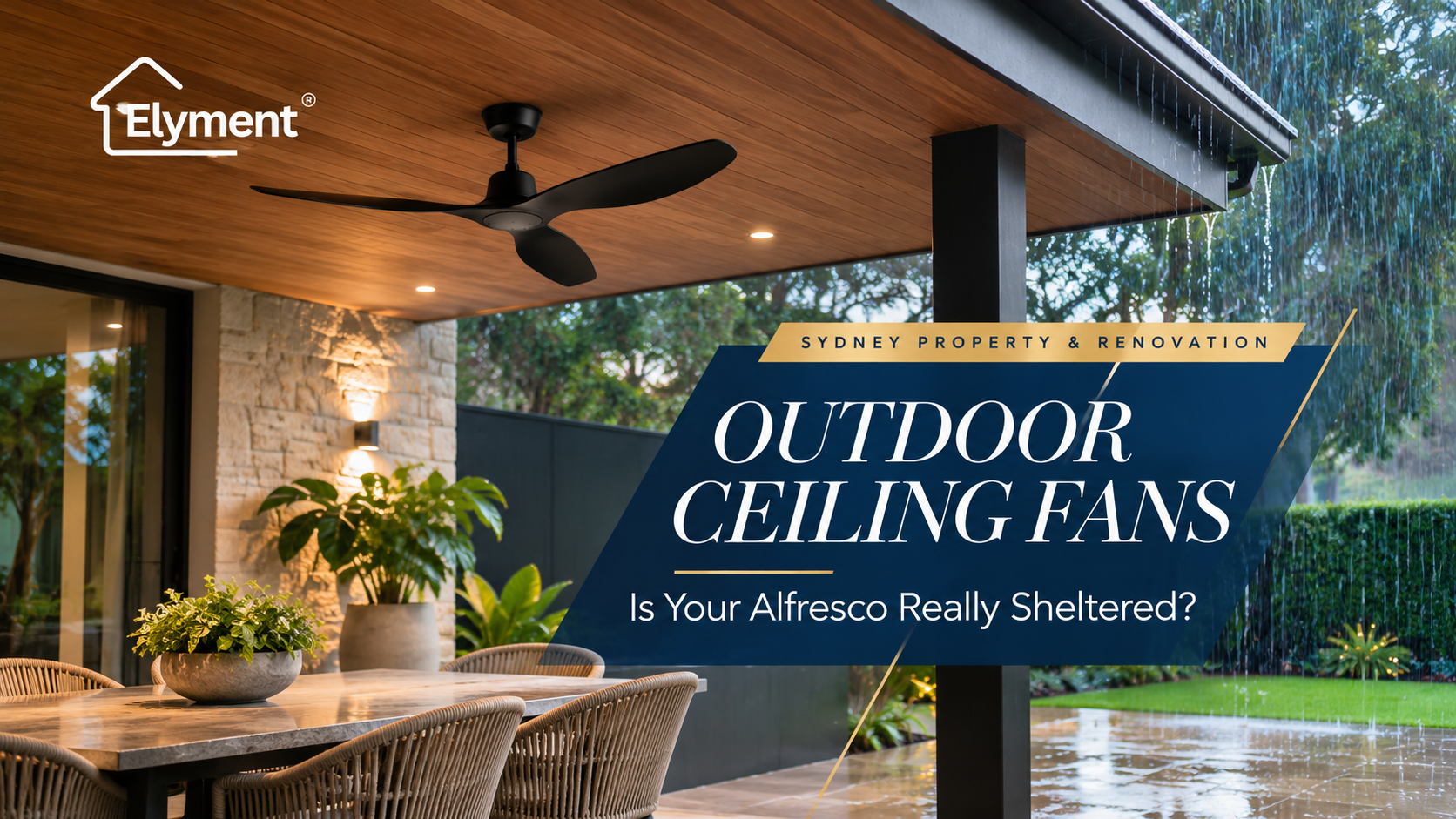
A covered alfresco area is not automatically suitable for an outdoor ceiling fan. In Sydney and NSW, suitability depends on the proposed mounting location, surrounding walls, wind-driven rain exposure, coastal conditions and the manufacturer's installation instructions for the exact model. Before purchasing an alfresco ceiling fan, provide a licensed electrician with photographs of the roof, open sides and proposed mounting position to establish whether the selected product is appropriate.
On a warm November afternoon in Sydney, a newly renovated alfresco dining area appears ready for its finishing touch: a contemporary ceiling fan mounted above the outdoor table.
The patio has a solid roof, attractive stone flooring and an uninterrupted connection to the garden. The homeowner selects a fan advertised as suitable for alfresco use and arranges installation.
There is, however, an unresolved question. Although the roof protects the dining area from vertical rainfall, the patio remains open on three sides. During severe weather, rain can travel horizontally beneath the roof and reach the proposed fan location.
The distinction between a covered area and a genuinely sheltered installation environment can determine whether the selected fan is suitable, whether its warranty conditions can be satisfied and whether the renovation proceeds without unnecessary product replacement or contractor delays.
The Roof Is Only One Part of the Protection
Outdoor living areas are an established feature of Sydney residential architecture. From suburban alfresco extensions in the Hills District to waterfront terraces on the Northern Beaches, these spaces frequently combine permanent roofing with substantial openings to maximise ventilation and natural light.
Architecturally, the arrangement creates an attractive indoor-outdoor connection. From an electrical equipment perspective, however, it introduces variable environmental exposure.
A roof may provide adequate protection from rainfall travelling vertically while offering limited protection against:
- Rain entering from exposed sides during storms.
- Wind carrying moisture beneath the roof.
- Airborne salt in coastal and waterfront environments.
- Dust and debris entering from adjacent gardens or open spaces.
- Water spray from outdoor cleaning activities.
- Moisture associated with roof leaks or condensation.
The relevant consideration is not simply whether the patio is covered. It is whether the proposed ceiling fan position satisfies the environmental limitations established by the manufacturer and the applicable electrical installation requirements.
Two Sydney Patios Can Require Different Fans
Consider two hypothetical residential renovation projects with similarly sized alfresco dining areas.
Property One: A Sheltered Patio in Castle Hill
The first property has an alfresco area incorporated beneath the main roof of the house. Two solid walls provide lateral protection, while the proposed fan position sits well inside the covered area.
The position is less exposed to wind-driven rain than the perimeter of the patio.
Subject to the exact product instructions and electrical assessment, a fan designed for sheltered alfresco environments may be appropriate.
Property Two: An Open-Sided Terrace in Manly
The second property has a roofed terrace overlooking the surrounding coastal environment. Three sides are substantially open, and the preferred fan position is relatively close to the outer roof edge.
During storms, moisture can travel beneath the roof. Salt exposure may also accelerate deterioration of materials that are not designed for coastal conditions.
Although both homeowners describe their outdoor areas as covered, the second installation may require a different product, a revised mounting location or further assessment before a ceiling fan can be installed.
Comparing Outdoor Ceiling Fan Installation Environments in Sydney
Recessed patio with solid surrounding walls
- Principal exposure concern: Humidity and occasional moisture.
- What must be established: Whether the model permits sheltered alfresco installation.
Roofed patio with several open sides
- Principal exposure concern: Wind-driven rain.
- What must be established: Whether the product permits that degree of exposure.
Coastal apartment balcony
- Principal exposure concern: Airborne salt, wind and moisture.
- What must be established: Corrosion resistance, environmental suitability and strata requirements.
Freestanding covered pergola
- Principal exposure concern: Exposure from multiple directions.
- What must be established: Whether the model permits open-sided installations and the proposed mounting arrangement.
Uncovered outdoor area
- Principal exposure concern: Direct weather exposure.
- What must be established: Explicit manufacturer approval for the environment and compliant electrical installation.
These classifications are indicative. The final suitability of an installation depends on actual site conditions rather than the suburb or architectural description alone.
What an Outdoor Ceiling Fan Rating Actually Tells You
Retailers use several descriptions to distinguish ceiling fans designed for different environments. These commonly include indoor, alfresco, coastal and IP-rated products.
These descriptions should not be treated as interchangeable.
According to Beacon Lighting's outdoor ceiling fan guidance, its alfresco models require overhead shelter and at least two solid walls, while its coastal category permits installations with one solid wall, provided the other environmental protection conditions are satisfied.
These are Beacon's published product-category conditions, not universal requirements applying to every ceiling fan sold in Australia.
Other manufacturers and individual models may establish different restrictions.
Understanding IP Ratings
An Ingress Protection rating describes the degree of protection an enclosure provides against solid particles and water under specified testing conditions.
The first numeral relates to solid-particle ingress, while the second relates to water ingress.
Examples of Outdoor Electrical Equipment IP Ratings
IP44
- Solid-particle protection: Objects of 1 mm or larger.
- Water protection: Splashing water.
IP55
- Solid-particle protection: Dust-protected.
- Water protection: Water jets.
IP65
- Solid-particle protection: Dust-tight.
- Water protection: Water jets.
IP66
- Solid-particle protection: Dust-tight.
- Water protection: Powerful water jets.
These ratings describe standardised enclosure protection. They do not independently establish suitability for every outdoor ceiling fan installation.
For example, a product may carry an IP55 rating while its manufacturer still requires a covered location and restrictions on direct exposure.
Beacon's Polis ceiling fan product specification illustrates this distinction by identifying an IP55 rating alongside separate requirements relating to shelter, surrounding walls and environmental protection.
The IP rating must therefore be considered alongside the complete installation instructions, including any conditions applying to the mounting assembly, controls, accessories and electrical connections.
Corrosion resistance is another separate consideration. A higher IP rating does not necessarily demonstrate suitability for prolonged exposure to airborne salt.
Read the Installation Manual Before Ordering the Fan
One avoidable procurement problem occurs when homeowners select a fan from its retail description without examining the manufacturer's technical documentation.
The retailer's product page may describe a model as suitable for outdoor use. The installation manual may qualify that statement with requirements relating to shelter, wall configuration, roof-edge distances, environmental exposure or mounting orientation.
Before purchasing an alfresco ceiling fan, obtain the current installation instructions for the exact model and product variant.
Identify the manufacturer's requirements for:
- Permitted indoor and outdoor installation environments.
- Minimum surrounding-wall or shelter requirements, where specified.
- Protection from rain, moisture, wind, dust and salt.
- Any required separation from exposed roof edges.
- Minimum mounting height and blade clearances.
- Ceiling angle and mounting compatibility.
- Structural support and approved mounting accessories.
- Environmental limitations applying to integrated lights and controls.
- Coastal installation and warranty conditions.
Do not assume that instructions for another fan from the same manufacturer apply to the selected product.
Where the product description and installation instructions appear inconsistent, obtain written clarification from the manufacturer before committing to the purchase.
What Photos Should You Send an Electrician Before Buying?
A photograph showing only the existing ceiling light or proposed fan mounting point provides limited information about the actual installation environment.
For an outdoor ceiling fan assessment, the electrician needs to understand the relationship between the mounting position and the surrounding architecture.
A useful preliminary site submission should include the following photographs.
Pre-Purchase Photographic Checklist for an Alfresco Ceiling Fan
Full alfresco area
- What to capture: The complete roof, floor and surrounding walls.
- Why it matters: Establishes the overall installation environment.
External elevation
- What to capture: The patio viewed from the garden or adjoining outdoor area.
- Why it matters: Shows how exposed the structure is to weather.
Open sides
- What to capture: Each open side, including screens, blinds and openings.
- Why it matters: Helps identify potential moisture entry.
Proposed mounting position
- What to capture: The ceiling location where the fan is intended to sit.
- Why it matters: Allows preliminary assessment of location and visible constraints.
Roof perimeter
- What to capture: The relationship between the mounting position and roof edges.
- Why it matters: Helps assess exposure and potential clearance restrictions.
Existing electrical fittings
- What to capture: Visible lights, switches and other relevant fittings without removing covers.
- Why it matters: Provides initial information about the existing installation.
Evidence of weather exposure
- What to capture: Visible staining, corrosion or areas that become wet during storms.
- Why it matters: Highlights environmental conditions that may not be apparent in dry weather.
Accompany the photographs with approximate ceiling height, roof dimensions, the proposed fan's diameter, its exact model number and a link to the manufacturer's installation instructions.
Where possible, explain which parts of the patio become wet during heavy rain, based on observations made safely from a protected location.
Homeowners should not climb onto roofs, remove ceiling panels, open electrical fittings or expose wiring to obtain these photographs.
Photographs support preliminary assessment. They cannot establish concealed structural support, electrical protection, wiring suitability or final installation compliance. An on-site inspection may still be necessary.
Why an Existing Outdoor Light Does Not Establish Fan Suitability
A common assumption is that an existing light fitting confirms that the ceiling location is suitable for a fan.
However, a ceiling fan introduces different mechanical loads, mounting requirements and environmental considerations.
An existing outdoor light may occupy a position that is acceptable for that particular fitting but unsuitable for the proposed ceiling fan.
Where necessary, the electrician must assess the structural support, electrical installation and clearance requirements before accepting the proposed mounting position.
Elyment's earlier analysis of replacing an existing ceiling light with a fan explains the separate structural and electrical considerations associated with using an existing connection point.
For outdoor installations, environmental suitability adds another decision that must be resolved before equipment is purchased.
The Installation Environment Can Change During a Renovation
An alfresco renovation may appear straightforward when considered on architectural drawings. However, changes made during construction can alter the degree of shelter around the proposed fan position.
These changes might include:
- Removing an existing solid wall to create a more open entertaining area.
- Replacing permanent enclosure elements with retractable blinds.
- Extending or reducing the roof overhang.
- Introducing new outdoor cabinetry that changes the preferred fan position.
- Relocating the dining area towards an exposed roof perimeter.
- Changing the ceiling design or finished floor height.
A retractable screen or outdoor blind should not automatically be counted as a permanent protective wall where the manufacturer's instructions require solid walls.
The electrician and project coordinator should therefore assess the intended completed configuration, not merely the temporary conditions visible during construction.
The same principle applies to other external electrical fittings, as discussed in Elyment's guide to outdoor power point installation considerations in Sydney.
The Coastal Exposure Question
Properties across Sydney's Eastern Suburbs, Northern Beaches and harbourfront locations may experience environmental conditions that differ considerably from more sheltered inland properties.
Airborne salt can contribute to deterioration of metal components, fasteners and decorative finishes, even where equipment is not routinely exposed to rainfall.
A coastal-rated ceiling fan may incorporate materials and protective finishes designed to improve corrosion resistance. However, coastal suitability does not necessarily mean the product can be exposed directly to rain.
For waterfront and coastal properties, owners should establish three separate aspects of suitability:
- Whether the manufacturer permits installation in the actual degree of coastal exposure.
- Whether the mounting position satisfies the required protection from wind and moisture.
- Whether any maintenance requirements or environmental warranty exclusions apply.
The decision should be based on the property itself rather than an assumed distance from the coastline.
Sydney Apartment Balconies Introduce Another Approval Question
Installing a ceiling fan beneath an apartment balcony above may involve building elements that are not entirely under the individual owner's control.
The proposed works could affect common-property concrete, external building appearance, electrical services or structural and waterproofing systems.
The NSW Government's strata renovation guidance distinguishes between cosmetic works, minor renovations and major renovations. The applicable approval pathway depends on the actual nature of the installation.
Before ordering a balcony ceiling fan, apartment owners should establish whether the proposed mounting location and electrical arrangements require approval from the owners corporation.
The distinction between individually owned finishes and shared building elements is explored further in Elyment's analysis of common-property responsibilities during Sydney renovations.
Where multiple approvals or technical assessments are required, they should be resolved before equipment is ordered and installation dates are confirmed.
Buying the Wrong Fan Creates a Project Delivery Problem
The purchase price of an unsuitable ceiling fan is only one component of the potential loss.
Consider an owner who purchases an alfresco-rated fan before confirming the environmental limitations of the selected model.
When the electrician arrives, the proposed mounting position is found to be insufficiently protected from weather exposure.
Possible consequences include:
- Returning or exchanging an opened product, subject to the retailer's conditions.
- Additional delivery and product procurement costs.
- Rescheduling the electrical contractor.
- Changing the intended mounting position.
- Revising ceiling finishes or other completed construction.
- Delaying the completion of the outdoor entertaining area.
Where the equipment has already been installed in an unsuitable environment, rectification may also involve removal, replacement and further electrical work.
The appropriate procurement strategy is to establish environmental suitability before selecting decorative finishes, control features or motor preferences.
NSW Electrical Compliance Remains Essential
Outdoor ceiling fan installation involving fixed electrical wiring is licensed electrical work in NSW.
The NSW Government's electrical licensing requirements apply regardless of the value of the work.
The electrician must assess the installation against the applicable electrical safety requirements, relevant Australian and New Zealand Wiring Rules and the equipment manufacturer's instructions.
Owners should also retain the required Certificate of Compliance for Electrical Work (CCEW), consistent with Building Commission NSW's electrical compliance guidance.
Where the renovation includes multiple ceiling fans, the model-specific control arrangements should also be coordinated. Elyment's guide to ceiling fan remote-control compatibility examines this separate operational issue.
Frequently Asked Questions
Can any outdoor ceiling fan be installed under a covered patio?
No. The fan must be suitable for the actual degree of environmental exposure. A roof alone may not satisfy the manufacturer's requirements for protection against wind, rain or salt.
Is an IP44 ceiling fan suitable for an open-sided alfresco area?
Not necessarily. IP44 indicates protection against specified solid objects and splashing water. The manufacturer's installation instructions and actual weather exposure must also be considered.
Does an IP65 or IP66 rating mean a ceiling fan can be installed anywhere outdoors?
No. A higher IP rating does not override model-specific restrictions, structural requirements, electrical installation rules or limitations relating to corrosion and mounting conditions.
Can an outdoor blind count as a protective wall?
Not automatically. If the manufacturer specifies a solid wall or permanent shelter, a retractable blind should not be assumed to satisfy that requirement without confirmation.
Can an indoor ceiling fan be installed under an alfresco roof?
An indoor-only ceiling fan should not be installed outdoors. The manufacturer must identify the product as suitable for the proposed environment.
Can an electrician assess an alfresco area from photographs?
Photographs can help identify preliminary environmental and installation constraints. They do not replace any necessary on-site assessment of structural support, electrical services and safety requirements.
Do I need a licensed electrician to install an outdoor ceiling fan in Sydney?
Yes. Ceiling fan installation involving fixed electrical wiring must be undertaken by appropriately licensed electrical personnel in NSW.
ELYMENT | SYDNEY & NSW
Assess the Outdoor Space Before Ordering the Fan
Review weather exposure, equipment requirements, renovation sequencing, contractor coordination and property approval considerations before committing to your alfresco installation.
Request an Alfresco Project Review
The Final Decision Belongs to the Location, Not the Product Label
Outdoor ceiling fan installation in Sydney should begin with an assessment of the intended environment rather than a comparison of fan designs.
A covered patio, an open-sided pergola and an exposed coastal balcony may all be described as outdoor entertaining spaces. Their equipment requirements can nevertheless differ substantially.
By examining the completed architectural configuration, reviewing the exact manufacturer's installation instructions and obtaining licensed electrical advice before purchasing equipment, property owners can reduce avoidable procurement errors and renovation delays.
The objective is not simply to install a ceiling fan beneath a roof. It is to deliver an outdoor installation appropriate for the conditions it will encounter throughout its service life.
Editorial note: Product examples illustrate manufacturer-specific installation conditions and do not constitute product endorsements or installation approval. Electrical suitability, structural requirements and applicable property approvals must be confirmed by appropriately qualified professionals.
Sources and References
- Beacon Lighting: Which Ceiling Fans Are Suitable for Outdoor Use?
- Beacon Lighting: Polis 132 cm DC Ceiling Fan Product Specification
- NSW Government: Strata Renovation Guidance
- NSW Government: Electrical Licensing Requirements
- Building Commission NSW: Electrical Compliance Requirements
Related Elyment Resources
- Ceiling Fan Installation Cost Sydney: Can a Fan Replace Your Existing Light?
- Outdoor Power Point Installation Cost Sydney
- Strata Says It Is Common Property: What That Means Before You Renovate the Floor
- One Remote, Two Ceiling Fans: What Sydney Electricians Check
ELYMENT | SYDNEY & NSW
Assess the Outdoor Space Before Ordering the Fan
Review weather exposure, equipment requirements, renovation sequencing, contractor coordination and property approval considerations before committing to your alfresco installation.
Request an Alfresco ReviewRelevant next actions
Explore the ELYMENT service most closely connected to this article.