Pet Urine Floor Removal Sydney: Repair Before Levelling
Pet urine stains in Sydney concrete or timber can cause persistent odours and flooring defects. See what to clean, seal or repair before floor levelling begins.
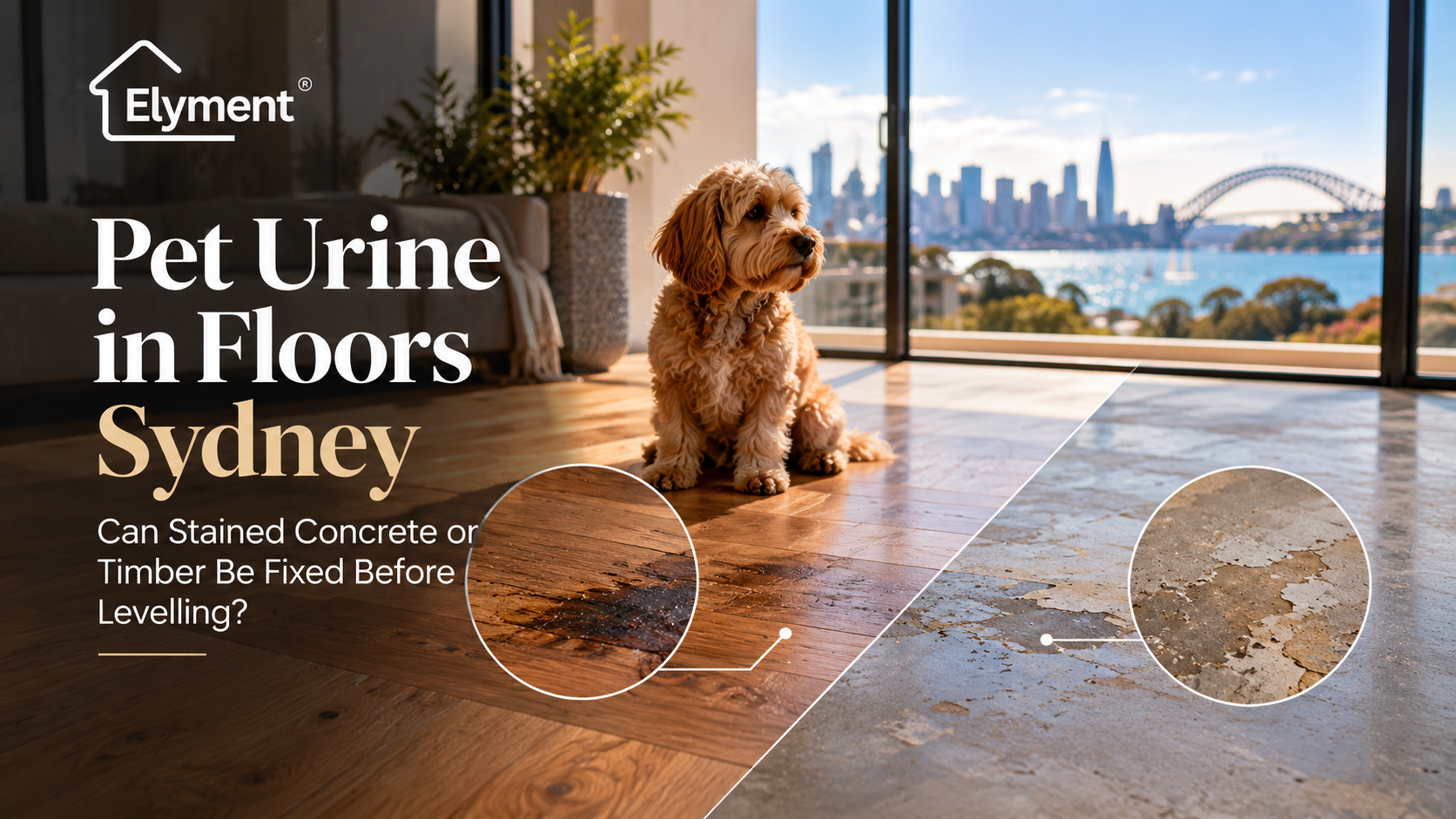
Pet urine staining does not automatically require a Sydney concrete slab or timber subfloor to be replaced. The decision depends on how far contamination has travelled, whether the material remains sound and whether the proposed levelling system can bond reliably. Concrete may be recoverable after targeted preparation; swollen or persistently contaminated timber may need selective replacement. In NSW strata properties, approvals, access and acoustic requirements can also affect the repair sequence.
ELYMENT Insights | Flooring & Property Operations | 20 October 2026
The Stain May Be Small. The Repair Boundary May Not Be.
A Sydney homeowner removes old flooring and finds a dark patch near the edge of a bedroom. There is an unpleasant smell, particularly when the room has been closed overnight. The new flooring has already been ordered, and the levelling contractor is scheduled to arrive.
What happens next is not necessarily a cleaning problem. It is a decision about how much of the existing floor can safely remain.
Pet urine can pass through carpet, underlay and flooring joints before reaching timber boards, sheet subfloors or concrete. Once there, the visible stain may no longer represent the full affected area.
The distinction matters because replacing every stained surface can be unnecessarily destructive, while retaining a contaminated substrate may leave an unresolved problem beneath an expensive new finish.
For projects involving pet urine floor removal in Sydney, the central operational question is therefore not simply how to remove the stain. It is how to establish a defensible boundary between material that can remain and material that needs further treatment or replacement.
Discolouration Is Evidence, Not a Diagnosis
A brown or black floor mark does not independently establish its cause, depth or severity. Historic moisture, timber extractives, metal reactions, old adhesives, finishes and other contaminants can create similar visual patterns.
Odour adds useful information but is not conclusive either. It may originate in flooring materials, perimeter gaps, joinery, underlay or the substrate itself.
A disciplined inspection should separate three issues:
- Appearance: Is the mark only a visible discolouration, or does it indicate damaged material?
- Contamination: Is there credible evidence of residual urine or other contamination that could affect odour or product compatibility?
- Integrity: Is the concrete, timber or sheet substrate still sufficiently sound for the intended flooring system?
These questions may require lifting affected materials, inspecting edges and carrying out appropriate tests. A moisture meter alone cannot identify pet urine or prove that an odour problem has been resolved.
This is especially important when a property is being prepared for sale, reletting or renovation completion. A visually clean floor is not necessarily a verified installation-ready substrate.
Concrete and Timber Do Not Offer the Same Repair Options
Concrete is porous, but it does not respond to urine exposure in the same way as timber or particleboard. That difference changes both the available interventions and the point at which replacement becomes necessary.
Concrete: Assess How Much Sound Material Remains
Urine-related residues may remain within the pores of a concrete slab after the floor covering is removed. Repeated exposure can make contamination more difficult to address, particularly around cracks and joints.
Where the concrete remains sound, an assessment may support controlled cleaning, targeted surface preparation or a compatible specialist treatment.
However, concrete grinding should not automatically be treated as an odour-removal solution. It removes surface material but may not reach contamination that has penetrated further into the slab.
Aggressive grinding without an appropriate assessment can also remove unnecessary concrete and introduce additional dust-control requirements.
A limited trial area may help determine whether the proposed treatment achieves an acceptable result before the method is extended across the room.
Timber: Determine Whether the Damage Is Reversible
Timber presents a different problem because it can absorb moisture through its surface, joints, end grain and exposed edges.
Solid timber boards with localised staining may sometimes be retained or refinished after suitable assessment. That does not mean refinishing will remove contamination that has penetrated deeply.
Engineered timber, plywood and particleboard require particular attention to swelling, layer separation, joint damage and remaining structural performance.
Boards that are swollen, soft, delaminated or persistently contaminated may be better candidates for selective replacement than repeated surface treatment.
The important distinction is between a cosmetic defect and a substrate that no longer performs reliably.
Related reading: How damaged timber exposed during floor removal changes the preparation scope.
Where the Repair Decision Changes
The following matrix provides a practical starting point. It is not a substitute for inspection, testing or manufacturer approval.
Localised stain on sound concrete
- Possible approach: Assess targeted cleaning and preparation.
- Critical verification: Residual contamination and product compatibility.
Persistent odour after concrete surface treatment
- Possible approach: Investigate deeper contamination or other sources.
- Critical verification: Whether further treatment is technically viable.
Stained but stable solid timber
- Possible approach: Assess retention, repair or refinishing.
- Critical verification: Penetration depth and remaining timber condition.
Swollen or delaminated timber sheet
- Possible approach: Consider selective sheet replacement.
- Critical verification: Support, fixings and replacement specifications.
Odour concentrated along walls or joints
- Possible approach: Investigate adjacent concealed materials.
- Critical verification: Extent beneath skirting and adjoining finishes.
Unknown historic flooring adhesive
- Possible approach: Pause disturbance pending material assessment.
- Critical verification: Potential hazardous-material requirements.
A successful decision does not necessarily produce completely uniform surface colour. It produces an appropriately assessed substrate capable of supporting the intended next stage without an unresolved contamination or structural concern.
The Concealed Perimeter Can Determine the Real Scope
Open floor areas are comparatively easy to inspect. The difficult locations are often where floor coverings meet fixed building elements.
In an established Sydney residence, urine exposure may extend into:
- Floorboard joints and exposed board ends
- Particleboard or plywood seams
- Skirting-to-floor junctions
- Door jambs and timber thresholds
- Carpet gripper fixing locations
- Cracks, construction joints and penetrations
- Materials beneath fixed wardrobes or cabinetry
These interfaces matter because removing only the visibly marked central patch may leave affected materials at the room perimeter.
Equally, an inspection should not become an instruction to demolish every adjoining element. Controlled access and selective opening can establish the extent of the problem before further work is authorised.
For example, a bedroom may contain a discoloured section of timber beside an external wall. The boards could be structurally sound, but the adjoining sheet substrate beneath the skirting may show swelling.
In that situation, replacing only the decorative surface would not address the weaker material below. Replacing the entire room, however, might be unnecessary if the affected section can be isolated and repaired without compromising the floor system.
The repair boundary should follow verified site conditions, available support points and the requirements of the replacement material, not simply the shape of the visible stain.
Why a Levelling Quote Cannot Resolve the Contamination Decision
Floor levelling and contamination remediation are different scopes of work.
Levelling is concerned primarily with surface geometry, substrate suitability and the performance of the specified smoothing or screed system.
Pet urine remediation is concerned with identifying, removing or appropriately managing affected materials. Completing one does not prove completion of the other.
This distinction has a technical basis. The manufacturer ARDEX Australia identifies specific substrate and system requirements for its levelling products, including additional technical considerations for timber and moisture-vulnerable concrete.
The selected levelling compound, primer, any specialist treatment and the final floor finish must form an approved, compatible system.
An odour-control product should not be placed beneath a bonded levelling system merely because it is marketed as a concrete or timber sealer.
If compatibility is uncertain, the product suppliers and relevant specialists should confirm the method before application.
Elyment's Sydney flooring preparation and levelling services address removal, substrate preparation and readiness for subsequent installation work.
For the related but separate question of sealing, see Elyment's earlier discussion of pet odour treatment and sealing before floor levelling.
The Commercial Value of a Defined Repair Boundary
Consider an illustrative 55-square-metre apartment flooring replacement in Sydney.
The owner has authorised removal, concrete preparation, levelling and a new hard flooring system. After strip-out, a small area beside a bedroom doorway shows staining and noticeable odour.
One response would be to assume the whole slab needs additional treatment. Another would be to ignore the issue because the visible area is relatively small.
Neither response establishes the actual condition.
A more controlled approach is to isolate the affected zone, inspect relevant adjoining materials and establish what needs to happen before the next flooring stage.
The original quote can then be separated into identifiable work packages:
- Authorised base scope: Existing flooring removal, normal substrate preparation and agreed levelling works.
- Investigation allowance: Local inspection, controlled opening, testing or specialist assessment where justified.
- Conditional repair scope: Selective material replacement, contamination treatment or further preparation once the condition is established.
- Release to the next trade: Verification that the receiving substrate meets the agreed installation requirements.
This approach avoids treating the entire floor area as contaminated without evidence. It also reduces the likelihood of a contractor being pressured to conceal an unresolved issue simply because installation has been scheduled.
Quotes should identify who authorises additional work, what measurements or material quantities support a variation, and which tasks remain outside the flooring contractor's scope.
NSW Safety and Strata Requirements Still Apply
A small urine-affected area does not remove the normal safety and property-management obligations associated with flooring renovation.
Concrete Grinding and Dust Control
Mechanical preparation of concrete can generate respirable crystalline silica dust. Where grinding is proposed, contractors must implement applicable risk assessments and exposure controls.
The SafeWork NSW codes of practice include guidance on working safely when cutting, drilling and grinding concrete and masonry products.
Older Floor Coverings
Older Sydney properties may contain flooring materials or adhesives that require assessment for asbestos before disturbance.
The NSW Government's asbestos guidance for adhesives and flooring materials identifies historic flooring adhesives as potential asbestos-containing materials.
Suspect materials should not be sanded, drilled or ground before appropriate assessment.
Strata Renovation Approval
In NSW strata properties, replacing carpet with timber, tile or another hard floor commonly requires approval under the applicable renovation rules.
The NSW Government strata renovation guidance identifies hard-floor installation and carpet removal associated with those works as minor renovations, with relevant approval and acoustic documentation requirements.
More substantial work involving common property or structural elements can require a different approval process.
This matters where contamination has reached materials beyond the owner's visible floor finish.
Waste Transport and Disposal
Removed timber, underlay, carpet and other demolition materials should be handled through appropriate waste-management arrangements.
The NSW Environment Protection Authority's construction and demolition waste guidance sets out responsibilities for lawful transport and disposal.
The Incoming Installer Needs More Than a Clean-Looking Floor
The practical handover should establish whether the affected zone is ready for the particular system being installed, not simply whether the room has been swept.
Before authorising levelling, the responsible project team should be able to establish:
- The location and extent of the investigated contamination
- Whether affected material was retained, treated or replaced
- Whether any continuing odour or moisture concern remains unresolved
- The condition and stability of timber, sheet flooring or concrete
- Compatibility of any treatment, primer and levelling products
- Any additional approvals or specialist sign-offs required
- The agreed responsibility for releasing the area to the next trade
Site photographs, treatment records, inspection observations and relevant test results can support that decision.
Odour observations should be documented honestly: a subjective smell check is not a laboratory clearance certificate.
Where the source or extent cannot be established, the appropriate outcome may be a documented hold rather than an unsupported assurance that the floor is ready.
Repair First, Level Second
Stained concrete and timber in Sydney homes do not always need wholesale replacement. Some surfaces can be retained following an appropriate assessment and repair. Others need selective removal because the contamination, physical damage or product compatibility cannot be satisfactorily resolved.
The distinction should be established before the levelling programme becomes irreversible.
For property owners, builders and strata managers, the strongest cost-control measure is not automatically the cheapest treatment or the smallest demolition allowance. It is a clearly defined repair boundary, an approved scope and a substrate that the next trade can reasonably accept.
Know What Needs Repair Before Levelling Begins
ELYMENT | SYDNEY PROPERTY OPERATIONS
Review floor removal requirements, damaged substrate areas, preparation sequencing and project responsibilities before committing to your next flooring stage.
Request a Flooring Project Review →
Sources and References
Technical and regulatory references
- ARDEX Australia – ARDEX K 15 Microtec
- SafeWork NSW – Codes of Practice
- NSW Government – Adhesives, Dry Powder Mixes and Asbestos
- NSW Government – Strata Renovations
- NSW Environment Protection Authority – Construction and Demolition Waste
Related Elyment resources
- Old Timber Came Up in Splinters: The Subfloor Damage That Changes a Floor Levelling Quote
- Should Pet Odour or Water Staining Under Carpet Be Sealed Before Floor Levelling Starts?
- Elyment – Flooring Services
ELYMENT | SYDNEY PROPERTY OPERATIONS
Know What Needs Repair Before Levelling Begins
Review floor removal requirements, damaged substrate areas, preparation sequencing and project responsibilities before committing to your next flooring stage.
Request a Floor ReviewRelevant next actions
Explore the ELYMENT service most closely connected to this article.