Pinholes in Self-Levelling Compound: Can You Lay Vinyl Over Them?
Can you lay vinyl over pinholes in self-levelling compound? Learn when pinholes need repair to prevent visible floor defects, adhesion issues and costly rework.
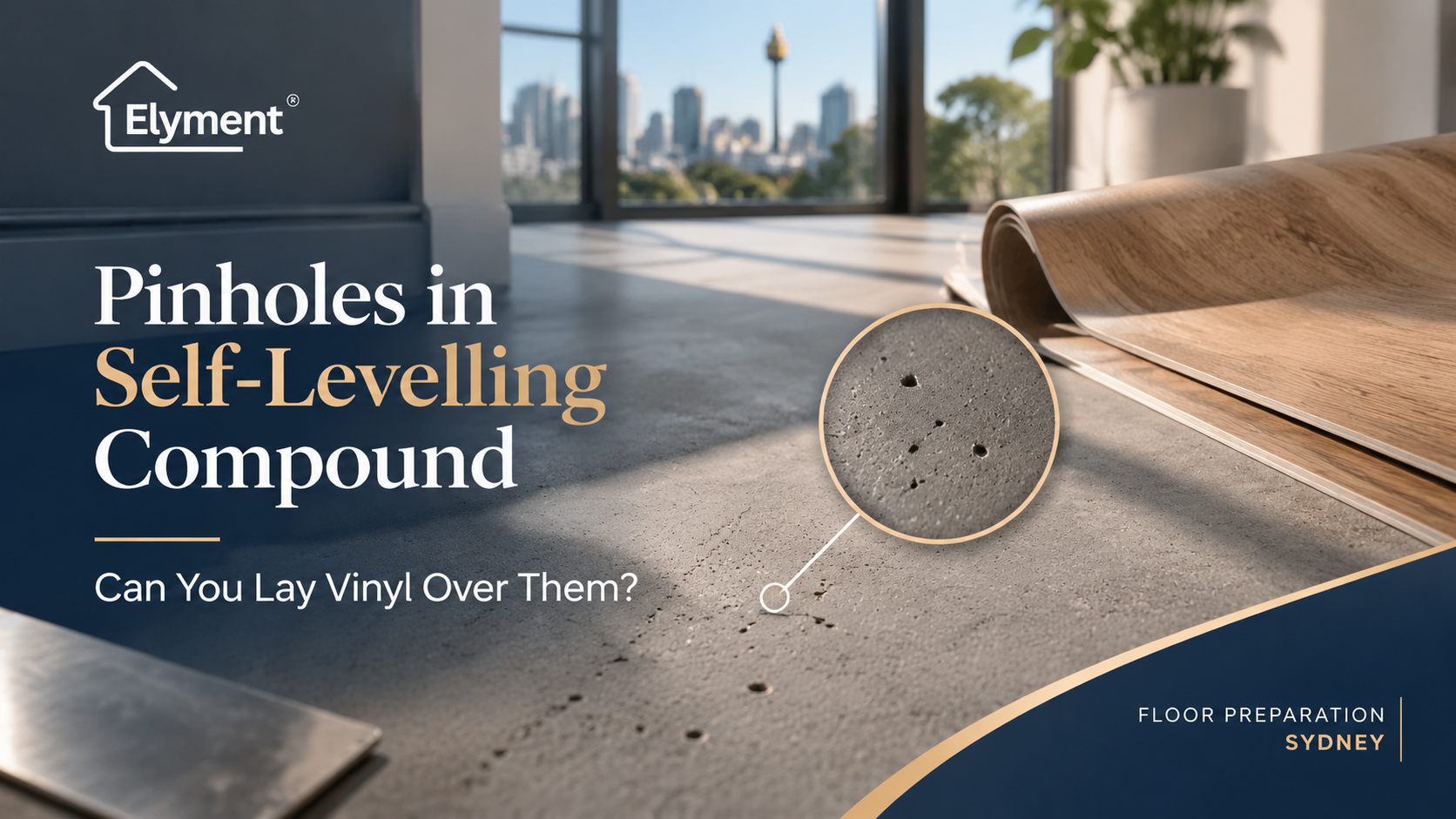
Isolated pinholes in self-levelling compound do not necessarily require the entire floor to be resurfaced before vinyl installation. However, widespread pitting, deeper cavities or weak surface material require assessment and potentially corrective preparation. For Sydney and NSW renovation projects, glue-down vinyl should only be installed once the substrate satisfies the smoothness, strength, moisture and compatibility requirements of the specified flooring, adhesive and levelling products.
ELYMENT Insights | Flooring, Property & Renovation | Sydney, NSW | 27 November 2026
A newly levelled concrete floor can appear remarkably smooth when viewed from the entrance of a room. Move closer, however, and the surface may reveal dozens of small holes resembling the marks left by trapped air escaping through wet cement.
For a Sydney property owner preparing to install glue-down vinyl, the discovery creates an immediate question: does the floor need further preparation, or can the flooring contractor proceed?
The answer depends less on the mere presence of pinholes than on their distribution, depth, surrounding material and the requirements of the finished flooring system.
A floor can be sufficiently flat when measured across a room and still lack the surface smoothness required beneath a thin, directly bonded floor covering.
Two Floors Can Be Equally Flat but Not Equally Ready for Vinyl
Floor levelling and surface smoothing are related but distinct objectives.
Levelling addresses variations in the substrate's profile, while smoothing addresses smaller surface imperfections that may interfere with adhesive application or remain visible through the finished flooring.
This distinction becomes particularly important with glue-down luxury vinyl tiles, vinyl planks and resilient sheet flooring.
Unlike some floating flooring systems, directly bonded vinyl does not normally have a separate underlay between the finished material and the prepared substrate. The condition of the underlying surface can therefore influence the final appearance more directly.
Small depressions, raised bubble rims and irregular textures may become visible through certain vinyl products under lighting or service conditions. The flooring industry commonly describes the transfer of underlying surface irregularities through a floor covering as telegraphing.
Not every microscopic pore will produce a visible defect. Nevertheless, the installer must determine whether the surface is sufficiently smooth for the particular vinyl and adhesive being used.
Isolated Pinholes Versus Widespread Surface Pitting
The first useful inspection is to distinguish individual surface imperfections from a defect affecting a substantial portion of the levelling layer.
Assessing Pinholes Before Glue-Down Vinyl Installation
Isolated, shallow pinholes
- What the installer should assess: Surface smoothness, depth and surrounding strength.
- Potential response: Acceptance if permitted by the flooring system, or localised filling.
Clusters of small pinholes
- What the installer should assess: Distribution, surface porosity and adhesive compatibility.
- Potential response: Localised smoothing or broader assessment.
Raised or broken bubble edges
- What the installer should assess: Projections and loose material.
- Potential response: Controlled surface preparation and compatible patching.
Widespread pitting
- What the installer should assess: Surface integrity, defect depth and extent.
- Potential response: Assessment before an approved skim coat or other corrective preparation.
Deep cavities with weak or powdery material
- What the installer should assess: Strength, adhesion and condition of the levelling layer.
- Potential response: Pause installation and investigate the affected material.
Pinholes accompanied by hollow or lifting areas
- What the installer should assess: Possible loss of bond beneath the compound.
- Potential response: Investigate before deciding whether removal is necessary.
There is no universal acceptable number of pinholes per square metre that can be applied to every self-levelling compound or vinyl product.
The decision must be based on the specified installation system rather than an arbitrary visual threshold.
What the Manufacturer's Instructions Actually Tell Us
The technical documentation for ARDEX K 125 provides a useful example of why product identification matters when investigating bubbles in floor leveller.
ARDEX Australia identifies K 125 as an internal smoothing and levelling compound suitable for residential and commercial applications, including preparation beneath resilient floor coverings.
Its technical data sheet identifies highly absorbent concrete as a condition that may require two primer applications to reduce the risk of bubbling and pinhole formation.
ARDEX K 125: Selected Technical Requirements
Application thickness without aggregate
- 2.5 mm to 15 mm.
Standard mixing ratio
- 4.5 litres of water per 20 kg bag.
Highly absorbent concrete
- Two primer applications may be required.
Indicative pedestrian access
- From four hours under stated conditions.
Indicative floor covering installation
- From 18 hours, subject to site conditions and flooring requirements.
Source: ARDEX K 125 technical data sheet.
These requirements apply specifically to the nominated product. They should not automatically be transferred to other levelling compounds.
Importantly, the manufacturer's guidance on preventing pinholes does not establish a blanket rule permitting installers to cover every existing pinhole with vinyl.
Where the installed compound is visibly defective, the project team should confirm an appropriate corrective method with the manufacturer or technical supplier.
Why Vinyl Adhesive Should Not Become a Repair Compound
One tempting response to minor surface defects is to assume that the vinyl adhesive will fill them during installation.
Although some adhesive may enter small depressions, this does not make standard flooring adhesive an approved substitute for substrate smoothing or patching.
Adhesive manufacturers specify application methods, trowel dimensions, coverage rates and working conditions to achieve the intended bond.
Using additional adhesive to compensate for a pitted surface may interfere with those requirements and introduce uncertainty about adhesive thickness, drying and support beneath the vinyl.
The better operational approach is to complete the required surface correction before adhesive application.
For projects involving more extensive preparation, Elyment's Sydney floor levelling services address substrate condition, surface preparation and compatibility with the intended floor covering.
How Close-Up Inspection Changes the Installation Decision
Photographs taken from standing height rarely provide enough information to assess pinholes properly.
A useful inspection record combines close-up photographs with wider images showing the distribution of defects throughout the room.
The flooring preparation team should consider:
- Defect distribution: Establish whether the holes are isolated or repeated across several sections of the pour.
- Surface profile: Identify whether the imperfections are shallow depressions, raised bubble edges or deeper cavities.
- Material condition: Check whether the surrounding compound is firm, bonded and resistant to crumbling.
- Product identification: Confirm the levelling compound, primer, adhesive and vinyl selected for the project.
- Installation readiness: Verify the applicable smoothness, moisture and surface preparation requirements before releasing the area to the vinyl installer.
Low-angle lighting can assist in identifying surface irregularities, while a measurement scale positioned beside the affected area provides context in close-up photographs.
Neither photographic inspection nor lighting alone can establish the strength or adhesion of the levelling layer.
Three Different Outcomes for a Sydney Renovation
Consider three illustrative Sydney renovation scenarios involving apartments or commercial interiors scheduled to receive glue-down vinyl.
Scenario One: A Small Number of Isolated Pinholes
The compound is firm, the surface is otherwise smooth and the imperfections are scattered across a limited area.
The flooring contractor assesses the defects against the selected vinyl and adhesive requirements. If correction is needed, an approved localised filling method may be sufficient.
There may be no technical justification for resurfacing the entire apartment.
Scenario Two: Widespread Pitting Across a Living Area
The floor satisfies the required overall flatness, but close-up inspection reveals clusters of shallow cavities throughout the main living space.
Because thin glue-down vinyl is specified, a compatible smoothing layer may be considered after confirming that the existing compound is sound and adequately bonded.
The additional preparation becomes a separate activity that must be completed before vinyl installation.
Scenario Three: Pinholes Alongside Weak and Hollow Areas
Surface defects are accompanied by loose particles, powdery sections or indications of poor bond.
In this situation, smoothing the visible holes alone would not address the underlying concern.
The installation should pause while the affected levelling layer is investigated. Partial or more extensive removal may be necessary if the compound cannot provide a reliable foundation.
These scenarios demonstrate why the same visible symptom can produce significantly different preparation scopes.
When the Flooring Programme Needs to Change
In Sydney apartment renovations, a small surface defect can become an operational issue when the vinyl installer, material delivery and building access arrangements have already been booked.
Corrective preparation may require another contractor visit, additional materials and a further drying period. Where mechanical preparation is necessary, dust management and strata access arrangements may also need to be revisited.
For occupied commercial premises, additional preparation may affect planned reopening dates or the availability of individual rooms.
The project manager should avoid treating the advertised drying time of the original compound as automatic confirmation that the substrate is ready.
Any subsequent patching or smoothing material introduces its own installation and drying requirements.
Documenting the surface condition before the vinyl contractor arrives allows the preparation scope to be resolved while scheduling options remain available.
Elyment's broader flooring preparation and renovation services in Sydney cover the relationship between removal, concrete preparation, levelling and installation-ready handover.
The Australian Standard and Vinyl Manufacturer Requirements
The Australian Resilient Flooring Association identifies AS 1884:2021 as a relevant standard for the preparation and installation of resilient floor coverings.
In addition to the applicable Australian Standard, the project team must consider the installation requirements of the selected flooring and adhesive manufacturers.
For example, Karndean's Australian and New Zealand glue-down installation guidance requires a stable, sufficiently smooth, clean and dry substrate and addresses moisture assessment and preparation requirements.
Where corrective work involves sanding or grinding cementitious materials, contractors must also manage dust exposure in accordance with their workplace health and safety obligations and relevant SafeWork NSW crystalline silica guidance.
A technically acceptable floor is not determined solely by its appearance or whether it can already support pedestrian traffic.
What If the Defect Is a Crack Rather Than a Pinhole?
Pinholes are typically small, discrete cavities. Hairline cracks are linear fractures that may have different implications for shrinkage, movement and the bond between the levelling compound and the substrate.
Where the surface exhibits cracking rather than isolated holes, the assessment should follow a different diagnostic pathway.
Elyment's analysis of hairline cracks in self-levelling floor compound after 24 hours examines when cracking may indicate shrinkage and when it requires further investigation before a floor covering is installed.
Readers investigating the original causes of bubbling can also refer to Elyment's existing guide to bubbles and pinholes in floor leveller.
The Handover Decision Before Glue-Down Vinyl
Before releasing a prepared Sydney floor to the vinyl installer, the project team should establish whether the surface has been accepted as installed, requires localised correction or needs more extensive investigation.
That decision should be documented against the actual condition of the floor and the requirements of the specified flooring system.
Where additional preparation is necessary, the responsibility for completing and reassessing the work should be resolved before adhesive application begins.
ELYMENT | FLOOR PREPARATION & PROJECT DELIVERY
Assess the Surface Before the Vinyl Goes Down
Planning glue-down vinyl installation across Sydney or NSW? Arrange a project review to assess pinholes, surface pitting, substrate condition and any additional preparation required before flooring installation.
Request a Floor Preparation Assessment
A Smooth Finish Starts Below the Vinyl
The discovery of pinholes in self-levelling compound does not automatically mean that a floor has failed. Equally, the fact that a floor is flat does not establish that every surface imperfection can be safely covered.
The appropriate response depends on whether the defect is localised, whether the underlying material remains sound and whether the prepared surface meets the requirements of the selected vinyl installation system.
For Sydney property owners, builders and renovation coordinators, resolving that question before installation is preferable to investigating visible defects after the finished floor has been bonded in place.
The objective is not an unnecessarily extensive repair. It is a substrate that is suitable for the finish it has been prepared to receive.
Sources and References
Elyment Resources
- Elyment: Sydney Floor Levelling Services
- Elyment: Flooring Preparation and Renovation Services in Sydney
- Elyment: Hairline Cracks in Self-Levelling Floor Compound After 24 Hours
- Elyment: Bubbles and Pinholes in Floor Leveller – Causes, Prevention and Repair in NSW
Manufacturer and Technical Resources
- ARDEX Australia: ARDEX K 125 Smoothing and Levelling Compound
- ARDEX K 125 Technical Data Sheet (PDF)
- Karndean: Australian and New Zealand Glue-Down Installation Guidance
Australian Standards and Regulatory Resources
- Australian Resilient Flooring Association: Relevant Standards – AS 1884:2021
- SafeWork NSW: Work Safely With Crystalline Silica and Engineered Stone
ELYMENT | FLOOR PREPARATION & PROJECT DELIVERY
Assess the Surface Before the Vinyl Goes Down
Planning glue-down vinyl installation across Sydney or NSW? Arrange a project review to assess pinholes, surface pitting, substrate condition and any additional preparation required before flooring installation.
Request a Floor AssessmentRelevant next actions
Explore the ELYMENT service most closely connected to this article.