ServiceNow Says Singapore’s Agentic AI Adoption Jumped From 22% to 51%: Why Only 10% Have Autonomous Workflows
ServiceNow says Singapore’s agentic AI adoption rose sharply, but few firms run autonomous workflows. Know the gaps in AI governance, data, trust and execution.
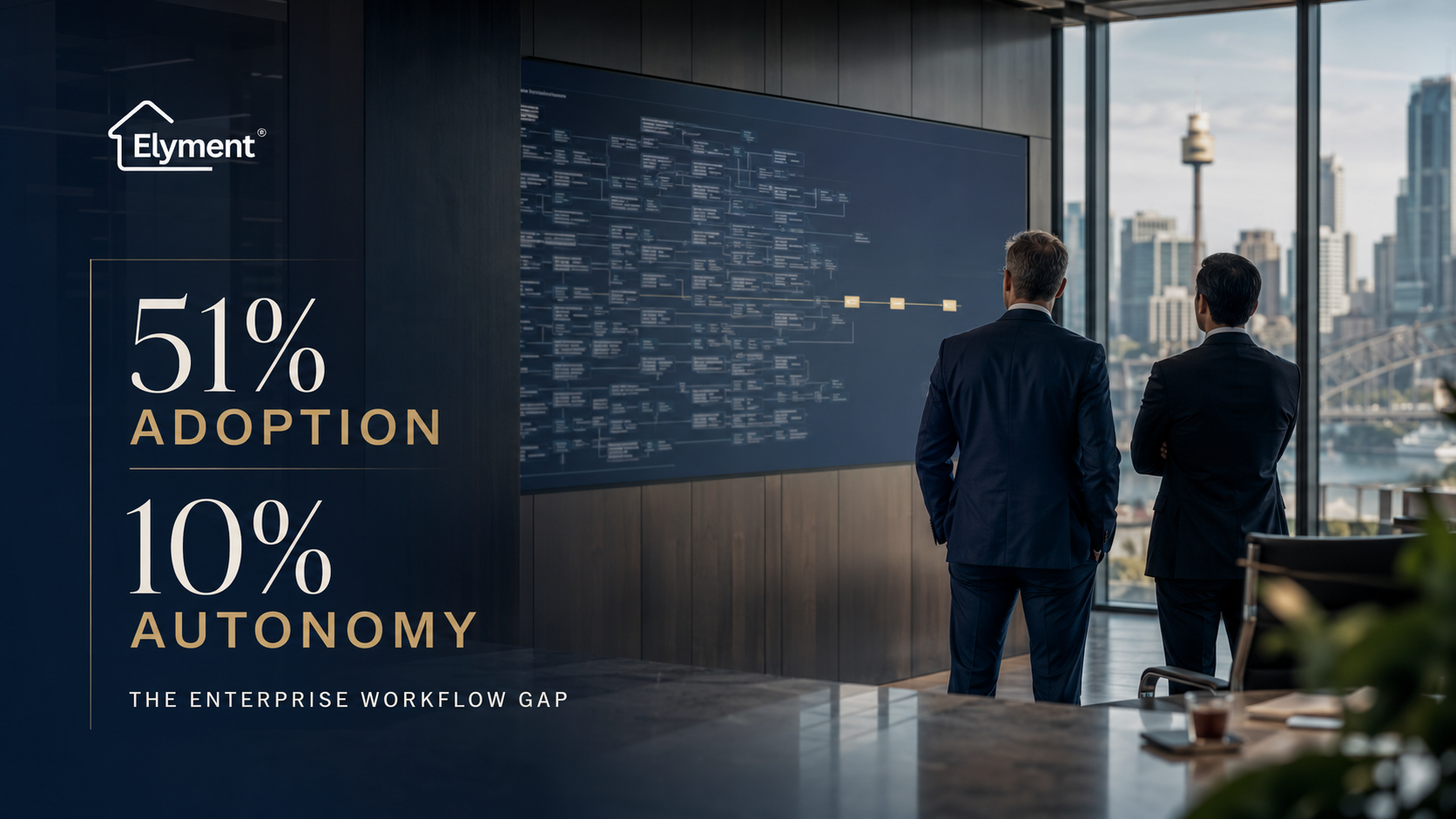
ServiceNow’s 2026 Singapore study shows the difference between owning agentic AI and redesigning work around it: adoption rose from 22% to 51%, yet only 10% of enterprises report autonomous end-to-end workflows. For Sydney and NSW organisations, the lesson is operational. The constraint is increasingly workflow ownership, data quality, approval architecture, exception handling and system integration, not access to AI models. Autonomy arrives only when the process itself is rebuilt.
Enterprise AI has reached a point where adoption statistics can become misleading.
A company can purchase an AI platform, deploy agents to employees, connect a model to internal information and automate individual tasks while leaving the underlying operating model almost completely unchanged.
That distinction is visible in ServiceNow’s 2026 Singapore Enterprise AI Maturity Index. The company says adoption of agentic AI among Singapore enterprises more than doubled from 22% in 2025 to 51% in 2026.
Yet just 10% of surveyed enterprises said they had redesigned processes so AI could complete multi-step business work end to end.
That 41-percentage-point separation is more important than the headline adoption figure.
It suggests the next enterprise AI bottleneck is not necessarily model intelligence. It is the much slower work of reconstructing how an organisation actually operates.
The 51% Figure Measures Adoption. The 10% Figure Measures Operating Change.
ServiceNow surveyed 4,500 senior leaders across 19 countries, including 200 in Singapore. Singapore’s overall AI maturity score rose to 53 out of 100, above the global average of 51 and substantially higher than its 2025 score of 34.
The more revealing numbers sit underneath that recovery.
Agentic AI adoption
- Singapore result: 51% in 2026, up from 22% in 2025
- Operational interpretation: Access to agentic capability is spreading quickly.
AI assisting individual employees
- Singapore result: 33%
- Operational interpretation: Much of the current value remains attached to individual tasks rather than whole processes.
Autonomous end-to-end workflows
- Singapore result: 10%
- Operational interpretation: Only a small cohort has fundamentally redesigned how work moves through the enterprise.
No progress on advanced AI adoption
- Singapore result: 18%
- Operational interpretation: AI maturity remains uneven despite rapid headline adoption.
Overall AI maturity
- Singapore result: 53/100
- Operational interpretation: Strong foundations do not automatically translate into operational autonomy.
ServiceNow also reports that AI budgets among Singapore organisations increased 108% year on year and now account for 15.4% of IT budgets, with spending expected to move towards roughly 20% by 2027.
Investment is therefore not the obvious constraint.
The harder question is what happens after an organisation has bought the technology.
The Autonomy Gap Begins At The Handoff
Individual AI tasks are comparatively easy to isolate.
An agent can summarise an email, extract information from a document, prepare a response, classify an enquiry or identify a missing field without fundamentally changing the organisation around it.
An autonomous workflow is different.
It must survive every handoff between the beginning of the work and the business outcome.
That usually means resolving five operating problems that an AI demonstration can avoid.
- Ownership: Someone must have authority over the entire workflow, not merely one application or department.
- Reliable state: The system must know what has happened, what is still outstanding and which record is authoritative.
- Action authority: There must be a defined difference between information an agent may read, decisions it may prepare and actions it may execute.
- Exception handling: Incomplete information, conflicting instructions, unusual customer requests and system failures need predetermined destinations.
- Evidence: The organisation needs a record of what the system did, why the workflow moved forward and where human intervention occurred.
Failure at any one of these boundaries can return the process to a human queue.
The AI may therefore be technically capable of completing 80% or 90% of the individual tasks while the business remains unable to operate the overall process autonomously.
Sydney Businesses Can Recognise The Same Pattern In Physical Operations
The problem becomes clearer when agentic AI is examined outside a software demonstration.
Consider a Sydney property or renovation operator receiving a new project enquiry.
The operational sequence might involve:
- Classifying the enquiry and property type
- Collecting photographs, plans and site information
- Checking access limitations and strata requirements
- Determining whether an inspection is required
- Coordinating a suitable time with the customer and project team
- Preparing scope information
- Obtaining pricing or supplier input
- Issuing an approved quotation
- Confirming site access
- Scheduling labour and equipment
- Managing project variations
- Collecting completion records
- Closing the project financially and operationally
AI can support almost every stage individually.
That does not mean the complete sequence is ready to run autonomously.
The quotation may sit in one system. Site photographs may arrive through another channel. Strata conditions may be buried in correspondence. Contractor availability may change outside the central schedule. A variation might require commercial approval. Completion could depend on evidence uploaded from site.
The difficult work is connecting those states without creating ambiguity about who or what is authorised to move the project forward.
This is why Elyment’s earlier analysis of AI services operating as background workers focused on queues, status and handback. Autonomous workflows take the challenge further because the objective is no longer to execute one unattended task. It is to prevent unnecessary human queues from reappearing between tasks.
The Most Expensive AI Workflow May Be The One That Keeps The Old Process
A common automation mistake is to add AI without removing anything.
The employee still receives the email. The AI also reads it.
The employee still updates the system. The AI also prepares an update.
The manager still reviews every case. The AI also produces a recommendation.
The organisation has increased computing activity without materially reducing workflow activity.
This creates what can be described as dual-running cost: the business pays for an intelligent automation layer while preserving the labour structure and waiting time of the previous process.
The economic objective should therefore not be maximum AI utilisation.
It should be fewer unnecessary touches per completed business outcome.
Useful operating metrics include:
- Human touches per completed case
- Percentage of cases completed without manual intervention
- Average waiting time between workflow stages
- Exception rate
- Correction or rollback rate
- Percentage of information manually re-entered into another system
- Cycle time from trigger to completed outcome
- Cost per completed workflow
- Percentage of exceptions resolved within the expected service level
- Completeness of the operational audit record
That outcome-based approach extends Elyment’s examination of which business automations actually produce an economic return. The autonomy question adds another layer: can the organisation retire old work steps once the new workflow proves reliable?
Process Redesign Is Different From Task Automation
An organisation moving towards autonomous operations should distinguish five increasingly consequential levels of AI deployment.
Assistance
- AI role: Summarises, searches, drafts or classifies
- Human operating model: The employee still runs the process.
Preparation
- AI role: Prepares a transaction, response, record or recommendation
- Human operating model: A person verifies and executes the next step.
Coordination
- AI role: Moves information between defined stages and systems
- Human operating model: People supervise milestones and exceptions.
Bounded execution
- AI role: Performs approved actions inside defined limits
- Human operating model: Humans retain authority over specified consequential actions.
Autonomous workflow
- AI role: Completes the normal multi-step process from trigger to outcome
- Human operating model: People govern the system, handle defined exceptions and intervene where required.
The last category does not require removing humans from the business.
It means humans no longer need to manually propel every normal case from one step to the next.
That distinction is critical.
Autonomy Needs A Contract With The Business
Before an agent is allowed to operate across an entire workflow, the organisation should be able to define six things with precision.
1. Trigger
What event starts the workflow, and how does the system know that the event is legitimate?
2. Information
Which systems and records may the workflow use, and which source takes precedence when information conflicts?
3. Decision
Which decisions can AI make independently, which are rule-based and which remain reserved for authorised people?
4. Action
What may the system actually change, send, schedule, commit, purchase, approve or record?
5. Exception
What conditions stop autonomous processing, and who receives the case when that happens?
6. Evidence
What records must exist afterwards to demonstrate what occurred?
This is an operating contract rather than simply an AI prompt.
Elyment’s analysis of Agentforce governance and production authority examines the permissions side of this issue. Workflow autonomy requires those permissions to be connected to the complete operational sequence.
Singapore’s Strong Foundations Show Why Technology Alone Is Not Enough
ServiceNow’s Singapore findings make the workflow gap particularly interesting because many underlying foundations are improving.
According to the study, 23% of Singapore organisations had replaced legacy technology systems with modern platforms, compared with 16% globally. Twenty-eight per cent had formal processes for testing, auditing and managing AI risk, compared with 20% globally. Twenty-five per cent were integrating AI workflows across business functions, compared with a 16% global figure.
Yet ServiceNow says AI-enabled workflows remain Singapore’s weakest maturity dimension.
That suggests autonomy cannot simply be purchased as the final module of an enterprise technology program.
It requires operating decisions.
Which existing step disappears?
Which team stops re-entering information?
Which approval is genuinely necessary?
Which historical approval exists only because the previous system could not reliably enforce a rule?
Which employee becomes the owner of exceptions rather than the processor of every case?
Those questions move an AI project into business transformation territory.
The NSW Governance Model Offers A Useful Discipline
Private Sydney businesses are not automatically subject to NSW Government internal AI policy. However, the public-sector approach provides a useful example of the operating discipline increasingly expected around consequential AI systems.
The NSW AI Assessment Framework is designed to assess AI across the full system lifecycle. NSW Government agencies are expected to identify ownership, assess risk, record use cases, implement controls and revisit assessments when the purpose, data, functionality or decision context changes.
NSW’s updated 2026 approach also specifically accounts for newer capabilities including agentic AI.
For private operators, the useful principle is lifecycle accountability.
A workflow that was safe when the agent could only retrieve information may need reassessment after it gains authority to update a customer record, schedule work, communicate externally or initiate a commercial action.
The Australian Signals Directorate has made a similar distinction in its guidance on careful adoption of agentic AI services, recommending incremental adoption, strict privilege controls, monitoring, identity management and human oversight.
Australia’s Voluntary AI Safety Standard and subsequent AI adoption guidance likewise emphasise accountability, risk management, data governance, testing and meaningful human control.
These frameworks matter because operational autonomy is not simply a technology state. It is an authority state.
Not Every Workflow Should Become Autonomous
The 10% figure should not be interpreted as evidence that the other 90% are necessarily behind.
Some workflows should remain deliberately human-led.
High volume, repetitive, structured inputs
- Autonomy potential: High
- Reason: Rules, performance and exceptions can usually be measured.
Clear system of record
- Autonomy potential: High
- Reason: The agent can reliably determine current state.
Actions are reversible
- Autonomy potential: Higher
- Reason: Errors can be contained and corrected.
Frequent unusual judgement calls
- Autonomy potential: Lower
- Reason: Exception handling may become the dominant activity.
Irreversible financial, legal or safety consequences
- Autonomy potential: Lower or tightly bounded
- Reason: Human authority or deterministic controls may remain appropriate.
Fragmented or unreliable source data
- Autonomy potential: Low until corrected
- Reason: Autonomy can amplify existing information problems.
Mature AI operations are therefore not measured by the percentage of human involvement removed.
They are measured by whether the right work is delegated at the right level of authority.
A Practical 90-Day Path From Assistance To Autonomous Workflow
Organisations do not need to redesign the entire enterprise at once.
A contained operating-model program can move one suitable process towards greater autonomy while producing evidence for the next deployment.
- Days 1–15: Choose the workflow, not the AI tool. Select one process with meaningful volume, identifiable delays, measurable outcomes and an accountable business owner.
- Days 15–30: Reconstruct how the work actually happens. Compare documented procedures with system records, emails, spreadsheets, manual workarounds and the real sequence followed by staff.
- Days 30–45: Define the autonomy boundary. Record triggers, information sources, decisions, permitted actions, human approvals, prohibited actions and escalation conditions.
- Days 45–60: Repair the workflow infrastructure. Resolve duplicate records, unreliable integrations, missing status fields and unnecessary handoffs before adding more reasoning capability.
- Days 60–75: Run in controlled parallel. Allow the system to process representative work while staff compare decisions, exceptions and outcomes without immediately removing existing controls.
- Days 75–90: Remove proven redundant work. Once evidence supports the change, stop duplicating manual steps that no longer create value. Keep humans at defined exception and authority points rather than retaining the entire historical workflow.
This is where many AI projects either begin producing genuine operational leverage or remain permanently stuck as sophisticated assistants.
ServiceNow’s Most Important Finding Is Not The Adoption Surge
ServiceNow says organisations in Singapore that had previously redesigned work processes around AI were nearly four times more likely to report significant productivity and efficiency gains than those that simply added AI onto existing ways of working.
The company also highlights Standard Chartered’s redesign of colleague onboarding, which is expected to reduce onboarding effort for hiring managers by 35% and deliver approximately 20% productivity gains across HR teams.
The important part of that example is sequencing.
The organisation examined the journey, identified where human judgement was genuinely required and redesigned roles and workflow responsibilities before treating AI as the solution.
That is a fundamentally different project from giving employees another assistant.
Redesign the Work Before Expanding the Agent
Review process ownership, systems, data, approval boundaries, exception handling, governance requirements and delivery metrics before assisted AI becomes autonomous workflow execution.
What The Singapore Benchmark Means For Sydney
Singapore and Sydney are different markets, and ServiceNow’s Singapore percentages should not be treated as Australian adoption statistics.
They are still a useful enterprise warning.
The technology layer can move faster than the operating model around it.
Sydney and NSW organisations can acquire agents, modernise applications and increase AI budgets without materially changing the speed at which a customer request, project decision, compliance task or operational issue moves through the business.
The next competitive divide may therefore be less about who has agentic AI and more about who has converted it into dependable operational capacity.
That requires something more difficult than deploying another model.
It requires deciding how work should move, which historic handoffs should disappear, where authority belongs, how exceptions return to people and what evidence is required when the workflow completes.
Singapore’s jump from 22% to 51% shows how quickly agentic AI can spread.
The 10% autonomous-workflow figure shows why genuine enterprise transformation will take longer.
The technology is increasingly ready to perform the work. The larger project is redesigning the organisation so that it can safely let the work move.
Sources and References
- ServiceNow: Singapore Enterprise AI Maturity Index 2026
- Elyment: AI Services Operating as Background Workers
- Elyment: Which Business Automations Actually Produce an Economic Return
- Elyment: Agentforce Governance and Production Authority
- NSW Government: NSW AI Assessment Framework
- Australian Signals Directorate: Careful Adoption of Agentic AI Services
- Australian Government: Voluntary AI Safety Standard
- Elyment: Contact and AI Workflow Review
Redesign the Work Before Expanding the Agent
Review process ownership, systems, data, approval boundaries, exception handling, governance requirements and delivery metrics before assisted AI becomes autonomous workflow execution.
Book an AI Workflow Review