SpaceX Starship Upper-Stage Catch: Flight 15 Explained
Find out how SpaceX caught Starship's upper stage after orbit, how its chopsticks work and what the manoeuvre means for safer, faster rocket recovery on return.
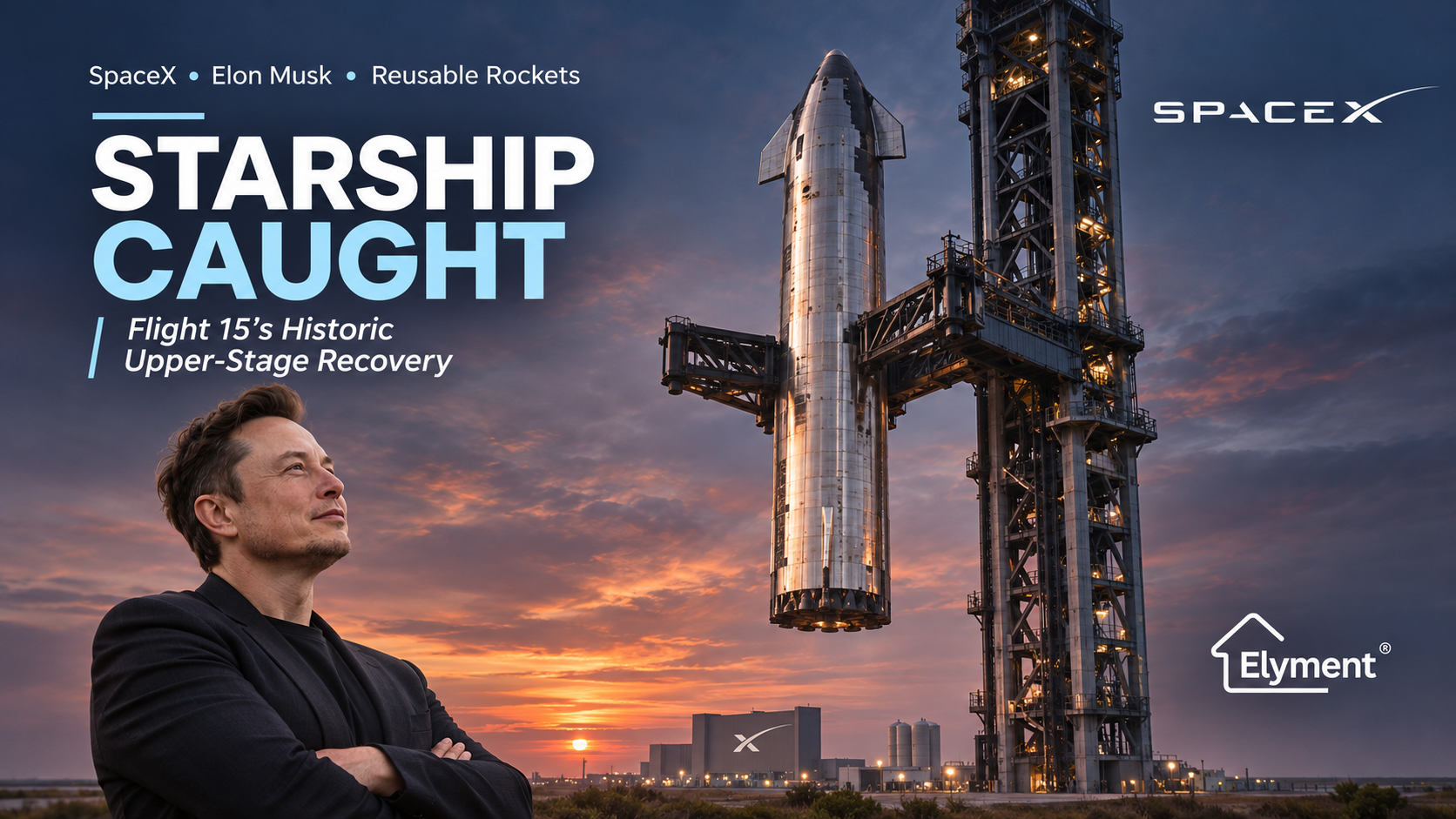
SpaceX’s Flight 15 achieved the first tower catch of a Starship upper stage when Ship 42 returned to Starbase, Texas, on 14 November 2026 after about 22.5 hours and 14 Earth orbits. The planned Super Heavy booster catch was aborted, so this was not a full two-stage recovery. For Sydney and NSW, the milestone is relevant to a growing aerospace ecosystem built around engineering, advanced manufacturing and satellite systems.
ELYMENT Insights | Technology, Infrastructure & Business | Sydney, NSW | 16 November 2026
For years, SpaceX has pursued an unusually ambitious approach to rocket recovery: instead of landing a spacecraft on conventional legs or recovering it from the ocean, bring it back to the launch tower and catch it with two enormous mechanical arms.
On 14 November 2026, that concept reached an important new milestone. SpaceX successfully caught Starship’s upper stage after an approximately 22.5-hour journey that included orbital flight, atmospheric re-entry and a controlled return to its Texas launch site.
The spacecraft was Ship 42, returning from Starship Flight 15. Its arrival between the arms of the Mechazilla launch tower marked the first successful tower recovery of a Starship upper stage.
However, the result needs to be understood accurately. SpaceX did not achieve its planned double catch. The Super Heavy first-stage booster failed to complete its return and was diverted towards the Gulf of Mexico. The upper stage succeeded where the booster did not.
The Planned Double Catch Was Only Half Completed
Starship is a two-stage launch system. Its lower section, Super Heavy, supplies the thrust required to lift the vehicle away from Earth. The upper section, known as Ship, continues the journey into orbit and is designed to return independently.
For Flight 15, SpaceX wanted both stages to return to the same launch facility and be caught by the mechanical arms of its Mechazilla tower.
The mission had three important objectives:
- Recover and catch the Super Heavy booster.
- Deliver 26 next-generation Starlink V3 satellites into orbit.
- Return and catch the Starship upper stage after its orbital journey.
The satellite deployment and Ship recovery were achieved. The booster recovery was not.
Flight 15 mission results
- Mission component: Super Heavy Booster 22
- Intended outcome: Return and tower catch.
- Flight 15 result: Catch aborted; diverted to Gulf of Mexico.
- Mission component: Ship 42
- Intended outcome: Orbital flight and tower recovery.
- Flight 15 result: Successfully caught at Starbase.
- Mission component: Starlink V3 payload
- Intended outcome: Deploy 26 satellites.
- Flight 15 result: Deployment completed.
The distinction matters because recovering an upper stage from orbit is a different engineering challenge from recovering a booster that returns shortly after launch.
What Happened to Super Heavy During the First Landing Attempt?
Starship Flight 15 launched from SpaceX's Starbase facility in South Texas at approximately 4:47 pm Central Time on Friday, 13 November.
After approximately two minutes, Super Heavy separated from Ship and began its return sequence.
The booster was expected to perform its boostback manoeuvre, correct its trajectory and return to the launch tower for a controlled catch.
That sequence did not proceed as planned.
SpaceX reported that early indications pointed to the booster ending its boostback burn prematurely following a low-fuel-mass alarm. The resulting trajectory placed the vehicle outside the required position for a safe tower recovery.
Importantly, SpaceX later clarified that the guidance, navigation and control system had behaved as intended. It recognised that the booster was not in the correct position and automatically initiated an abort.
Rather than continue towards the launch tower, Booster 22 diverted towards an offshore contingency location in the Gulf of Mexico. Its flight termination system subsequently destroyed the vehicle before splashdown.
The precise underlying cause remained under investigation in the initial post-flight reporting.
This was a significant operational distinction. The recovery attempt failed, but the automatic safety response prevented an incorrectly positioned booster from continuing towards the launch infrastructure.
How Ship 42 Returned From Orbit
While Super Heavy's return ended offshore, Ship 42 continued its mission.
After separation, the upper stage completed its orbital insertion and deployed 26 Starlink V3 satellites. It then continued travelling around Earth, completing approximately 14 revolutions before beginning its return to Texas.
The spacecraft spent approximately 22.5 hours in flight before reaching its landing site.
The final sequence involved several demanding engineering stages.
1. Preparing for atmospheric re-entry
Starship began its re-entry sequence with a short firing of one of its six Raptor engines. Aerospace America reported that the engine operated for approximately 10 seconds during the re-entry burn.
This manoeuvre reduced the spacecraft's orbital velocity and adjusted its trajectory towards the planned return corridor.
The spacecraft then encountered the upper atmosphere, where aerodynamic heating became a major concern.
2. Surviving the heat of re-entry
Atmospheric re-entry exposes a spacecraft to extreme temperatures. Starship relies on a thermal protection system containing approximately 18,000 hexagonal ceramic heat-shield tiles.
These tiles protect the vehicle's stainless-steel structure from the intense heating generated during atmospheric descent.
During Flight 15, cameras provided views of the spacecraft as heated gas flowed around its windward surface.
SpaceX had reviewed observations from ground-based tracking cameras and satellite imagery before the landing attempt. The available information indicated that the heat shield was in a suitable condition for the return.
That was an important development, although a successful re-entry does not automatically establish that every tile can be reused without inspection or replacement.
3. The return trajectory towards Starbase
Ship 42 followed a return path across Baja California and northern Mexico before passing north of South Padre Island in Texas.
It then performed a manoeuvre that redirected its approach towards Starbase from over the Gulf of Mexico.
This positioning was essential. The spacecraft needed to reach the launch tower with the correct orientation, speed and alignment for the final recovery.
4. The belly-flop and landing burn
One of Starship's most distinctive manoeuvres is its belly-flop descent.
Instead of immediately pointing vertically towards the ground, the spacecraft descends in a largely horizontal orientation. Its aerodynamic surfaces help control its movement and reduce speed during the final approach.
As it neared the launch facility, Ship 42 initiated its landing sequence and fired its engines to rotate towards an upright position and control its descent.
The vehicle then approached the tower within the required recovery corridor.
5. The moment the chopsticks secured Ship 42
Mechazilla's two enormous mechanical arms, commonly known as the chopsticks, were positioned to receive the returning spacecraft.
The arms are designed to catch the vehicle at dedicated structural attachment points rather than relying on conventional landing legs.
As Ship 42 completed its final descent, it aligned with the tower's recovery system. The mechanical arms secured the spacecraft, bringing the upper stage back to the same launch facility from which it had departed the previous day.
The successful catch took place at approximately 3:20 pm local Texas time on Saturday, 14 November.
For SpaceX, this was the first successful catch of a Starship upper stage after an orbital journey.
Why Catching Ship Is Different From Catching Super Heavy
SpaceX had already demonstrated that its launch tower could catch Super Heavy boosters on three previous occasions.
Flight 15 introduced a more demanding recovery objective.
The upper stage travels into orbit, remains in space for an extended period and must survive atmospheric re-entry before returning to the tower.
Its recovery therefore involves several additional challenges:
- Orbital trajectory management.
- Thermal protection during atmospheric re-entry.
- Precise aerodynamic control.
- Engine relighting and landing manoeuvres.
- Accurate positioning relative to the launch tower.
- Structural alignment during the final catch.
Recovering a vehicle after orbital flight also creates a different inspection and maintenance requirement. The spacecraft must be assessed for thermal damage, structural stress, engine condition and other effects of its return.
The achievement is therefore more than a successful landing demonstration. It gives SpaceX an opportunity to study how an orbital spacecraft behaves when returned directly to its launch infrastructure.
What This Changes for Starship Reusability
Rocket reusability is not simply about recovering a vehicle. It is about recovering it safely, inspecting it, completing necessary maintenance and preparing it for another flight without excessive cost or delay.
Traditional recovery methods can involve ocean landings, specialised recovery vessels, transport operations and additional handling before a vehicle reaches an inspection facility.
A successful tower catch offers a different operating model.
The spacecraft returns directly to the launch site, where engineering teams can begin inspection and maintenance activities within the same infrastructure environment.
In principle, this could reduce recovery logistics and simplify the process between missions.
The longer-term advantages could include:
- Reduced dependence on offshore recovery operations.
- Direct access to the recovered vehicle.
- More controlled inspection and maintenance processes.
- Potentially shorter turnaround times.
- Greater launch frequency if the wider system becomes reliable.
However, these benefits depend on more than the tower catch itself. The heat shield, engines, structural components, ground systems and maintenance processes must all support repeatable operations.
The Sydney and NSW Connection: A Growing Aerospace Ecosystem
Although Flight 15 took place in Texas, the engineering milestone has relevance beyond the United States.
New South Wales has an established aerospace and space technology ecosystem involving research institutions, engineering businesses, advanced manufacturing and satellite development.
The NSW Government identifies aerospace design and engineering, space technologies, satellite systems, research and development, manufacturing and mission operations among the state's capabilities.
Sydney is described by Investment NSW as an anchor for Australia's advanced and connected space ecosystem.
The state also has a broader defence and aerospace sector with reported annual gross value added of approximately $3.4 billion and more than 22,700 workers. These figures cover the broader sector rather than the space industry alone.
There are also developments in local spacecraft manufacturing. The Australian Space Agency has reported on the planned Optimus Factory at UTS Tech Lab in Sydney, a facility envisaged to produce up to 20 spacecraft annually.
For NSW businesses, the opportunity is not necessarily to manufacture an entire launch vehicle. It can exist across specialised components, testing, materials, satellite systems, software, engineering services and supply-chain support.
These industries depend on the same fundamental disciplines visible in large aerospace programmes: quality assurance, documented processes, technical verification, coordinated delivery and reliable handovers.
For a broader view of how operational dependencies affect modern businesses, Elyment has also examined the hidden operational costs of poorly designed automation.
What Flight 15 Still Did Not Prove
Despite the successful upper-stage recovery, several important milestones remain outstanding.
1. Full recovery of both stages in one mission
The first objective was to recover both Super Heavy and Ship at the launch site. Only Ship completed the planned tower catch.
A successful double catch remains an important milestone for the complete Starship launch system.
2. Rapid refurbishment and repeat flights
Recovering a spacecraft does not establish that it can be prepared for another mission quickly.
SpaceX must demonstrate how much inspection, repair and replacement work is required before Ship can fly again.
As of the initial post-flight reporting, the programme had not demonstrated rapid reflight of a Ship vehicle.
3. Long-term heat-shield durability
One successful re-entry is not sufficient evidence that the thermal protection system can withstand repeated missions with minimal maintenance.
SpaceX still needs to establish the durability of the tiles, their attachment systems and the wider thermal protection structure over multiple flights.
4. Orbital refuelling
Starship's planned lunar missions require the spacecraft to receive additional propellant in orbit.
That requires a separate demonstration involving orbital rendezvous, transfer systems and the handling of cryogenic propellants.
Flight 15 did not demonstrate this capability.
5. Crewed operations
The successful catch also does not establish that Starship is ready to transport astronauts.
Crew accommodation, life-support systems, operational safety and the wider requirements of human spaceflight remain separate development challenges.
6. Commercial launch economics
SpaceX's long-term ambitions depend on frequent launches and substantially reduced recovery and refurbishment costs.
A single successful catch cannot establish the economics of an operational launch service.
The programme will need repeated recoveries, shorter turnaround periods and dependable operations before its full commercial potential can be assessed.
The Operational Lesson: Recovery Is Only One Part of Delivery
Flight 15 demonstrates an important distinction between achieving a technical milestone and delivering a complete operational system.
The upper stage completed its return. The booster did not. The tower recovery system performed its intended role for Ship, but the overall mission did not achieve every planned objective.
For complex engineering programmes, this is an important distinction. Individual components can perform successfully while the complete delivery system remains dependent on unresolved interfaces, technical constraints and operational risks.
Businesses managing complex workflows face a comparable management challenge. Successful execution of one task does not guarantee that the entire process is ready for production.
Elyment has explored related questions in its reporting on operational controls and failure management and the coordination of people and automated systems.
The broader principle is straightforward: complex systems need clearly defined responsibilities, verified interfaces, controlled recovery procedures and evidence that each stage works reliably.
What Comes Next for Starship?
The next phase of Starship development will be judged by what happens after recovery.
Engineering teams must examine Ship 42, assess its thermal protection system, review its engines and determine the maintenance required before another flight.
At the same time, SpaceX must continue investigating the Super Heavy booster abort and demonstrate that both stages can return successfully during the same mission.
Further progress will also depend on orbital refuelling, crew-system development and the ability to reduce the time and resources required between flights.
These are not minor details. They determine whether Starship becomes a regularly reusable launch system or remains a technically impressive experimental vehicle requiring substantial work after every mission.
Build Better-Controlled Projects and Operations
ELYMENT PROPERTY & OPERATIONAL INSIGHTS
From physical project delivery to compliance and technology-enabled workflows, review the dependencies, approvals and operational requirements that determine successful outcomes.
The Bottom Line
SpaceX's first successful Starship upper-stage catch is a significant engineering milestone. Ship 42 returned from orbit, survived atmospheric re-entry and was secured by the Mechazilla tower's mechanical arms.
But Flight 15 was not the first complete recovery of both stages. Super Heavy diverted offshore, and the programme still needs to demonstrate rapid refurbishment, repeat flights, orbital refuelling and reliable operational performance.
For Sydney and NSW, the achievement also provides a useful view of the growing importance of aerospace engineering, advanced manufacturing and integrated technical systems.
The catch proved that Starship can return from orbit to its launch tower. The next challenge is proving that it can do so repeatedly, economically and with the reliability required for an operational launch system.
Sources and Further Reading
- Associated Press: SpaceX's Starship returns from orbit and is captured by launch pad arms
- Aerospace America: SpaceX achieves first Starship tower catch
- Space.com: What's next for Starship after Flight 15?
- NSW Government: Defence and aerospace in NSW
- Australian Space Agency: Sydney spacecraft manufacturing facility
ELYMENT PROPERTY & OPERATIONAL INSIGHTS
Build Better-Controlled Projects and Operations
Review your project requirements, operational dependencies, compliance considerations and delivery processes. Build more reliable systems with clear responsibilities and structured project coordination.
Discuss Project