Stencil Concrete Removal Sydney: Can a Textured Driveway Be Prepared for a Plain Resurface Without Replacing the Slab?
Learn how stencil concrete driveways in Sydney can be prepared for a plain resurface, covering removal risk, surface damage and when slab replacement is needed.
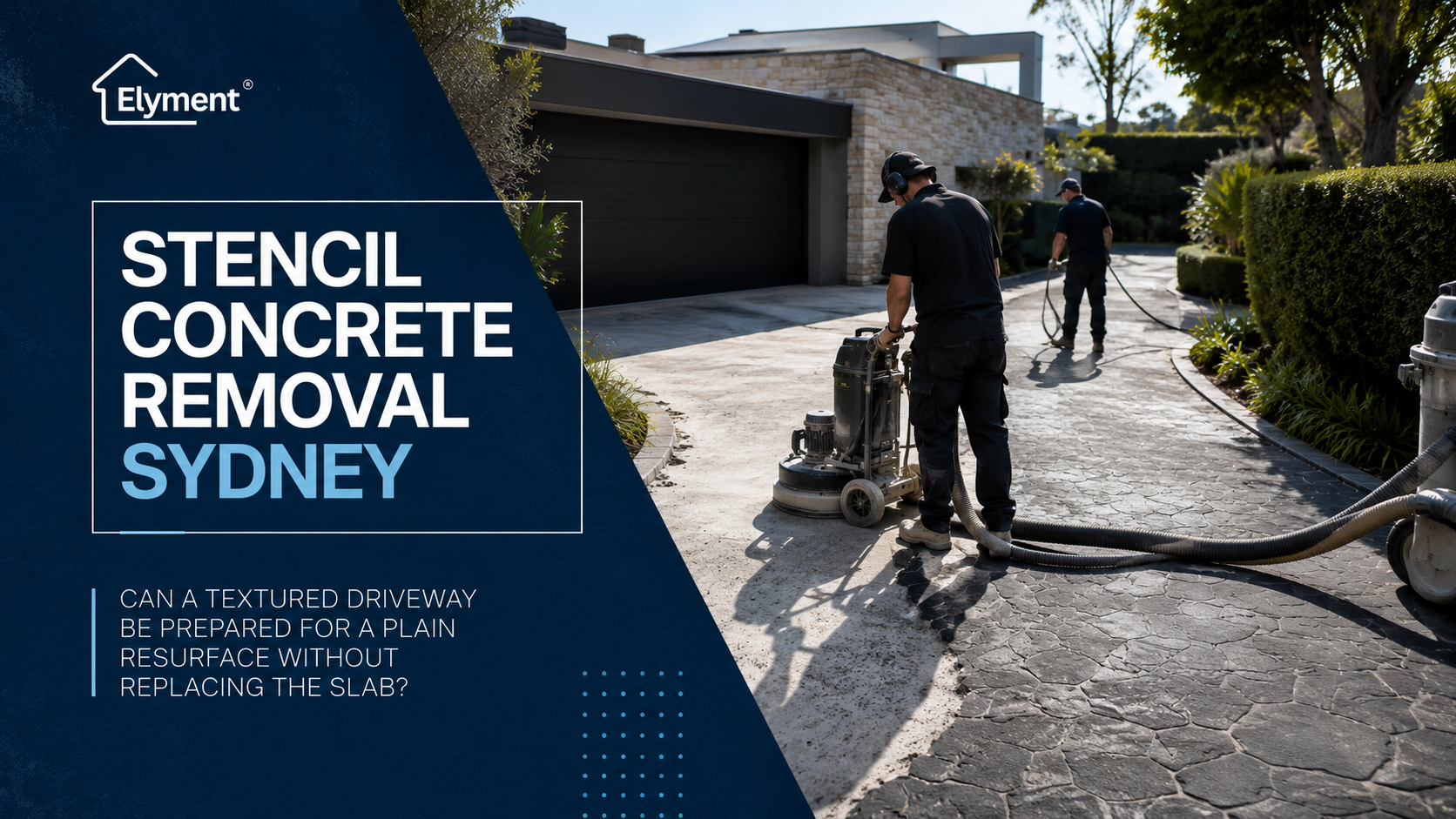
A textured stencil-concrete driveway in Sydney can often be prepared for a plain resurfacing system without replacing the structural slab, provided the concrete underneath is sound, stable and correctly drained. The critical work is removing the decorative profile, sealer and weak surface material without damaging levels, movement joints, driveway edges or falls. In NSW, silica controls, waste handling, approvals and the specification of the replacement surface also need to be resolved before grinding begins.
The Driveway May Look Like One Surface, but It Is Really Several Systems
An ageing stencil driveway can create the impression that the decorative surface and the structural concrete beneath it are the same thing. That assumption is one reason owners are sometimes presented with an unnecessarily binary choice: keep the old pattern or demolish the driveway.
In many projects, a third option exists. The decorative system can potentially be mechanically removed or reduced while the underlying concrete slab remains. The exposed substrate can then be repaired and prepared for a compatible plain resurfacing system.
Whether that approach works depends on how the original driveway was constructed. "Stencil concrete" is not one universally identical product. The visible finish may involve a coloured surface hardener, textured overlay, sprayed material, sealer, patterned relief or a combination of treatments.
This distinction matters because the contractor needs to establish where the decorative finish stops and where the concrete that should remain begins. Removing a failing sealer is one task. Removing several millimetres of heavily textured material is another. Trying to grind an integrally formed or deeply profiled surface into a flat substrate may require a substantially different preparation strategy.
The same principle appears throughout professional substrate preparation before seamless finishes: the visible finish cannot be specified properly until the condition of the substrate beneath it is understood.
A Plain Resurface Is Less Forgiving Than the Old Pattern
Decorative stencil patterns are visually busy. They can conceal small ridges, colour changes, surface repairs and differences in texture that become immediately obvious once the design brief changes to a plain contemporary finish.
This means "remove the stencil" is not a sufficiently detailed scope. Project teams need to define the actual handover condition required by the resurfacing contractor.
A plain finish may require the preparation team to address:
- Raised stencil lines and pattern ridges
- Old sealers and bond-breaking coatings
- Weak or delaminating decorative topping
- Colour-hardener residue
- Localised spalling and impact damage
- Oil, tyre and chemical contamination
- Previous patching materials
- Cracks and control joints
- Driveway edges and garage thresholds
- Surface falls toward drainage points or the street
The objective is not necessarily to make the old driveway visually perfect after grinding. It is to create the correct mechanical condition for the resurfacing system that follows.
Elyment has previously examined why concrete grinding marks need to be judged against the next finish. The same principle applies outdoors. A newly ground driveway should be assessed by soundness, profile, cleanliness and compatibility rather than appearance alone.
The First Decision Should Be Whether the Structural Slab Deserves to Stay
Before machinery arrives, the project needs to separate cosmetic deterioration from structural or geometric failure.
- Item: Faded colour, worn sealer and shallow texture
- What it may indicate: The decorative finish may be the principal problem
- Likely project direction: Potentially suitable for controlled surface removal and resurfacing
- Item: Sound slab with pronounced stencil ridges
- What it may indicate: More mechanical preparation may be required to create a uniform substrate
- Likely project direction: Trial grinding or removal should establish achievable profile and depth
- Item: Localised cracking or spalling
- What it may indicate: Repair may be possible if movement and deterioration are limited
- Likely project direction: Repair and resurfacing may remain practical after investigation
- Item: Widespread hollow or delaminating topping
- What it may indicate: The decorative layer cannot reliably support another system
- Likely project direction: Unsound material should be removed back to a competent substrate
- Item: Significant slab settlement or displacement
- What it may indicate: The problem extends beyond the decorative surface
- Likely project direction: Structural, drainage or replacement options may need review
- Item: Repeated water ponding caused by slab geometry
- What it may indicate: The existing falls may be unsuitable
- Likely project direction: Resurfacing alone should not be treated as an automatic drainage solution
This is where the proposed stencil-concrete project differs from Elyment's earlier analysis of resurfacing versus full pebblecrete removal.
The relevant decision here is not primarily which alternative has the lower headline cost. It is whether the existing slab can technically perform as the base for the new system.
Why a Trial Area Can Be More Valuable Than a Bigger Grinder
Stencil removal becomes commercially risky when an entire driveway is priced on the assumption that every square metre will behave the same way.
A controlled trial area can reveal information that photographs cannot:
- How hard the decorative material is
- How quickly the pattern can be mechanically reduced
- Whether sealer penetrates more deeply than expected
- Whether the old topping releases cleanly or fractures unpredictably
- The appearance and condition of the concrete underneath
- Whether aggregate becomes exposed before sufficient pattern removal is achieved
- What tooling sequence is likely to be required
- How edge areas will need to be detailed
- Whether the target resurfacing profile is realistically achievable
The trial also gives the resurfacing contractor an opportunity to confirm whether the prepared area is suitable for the proposed primer, base coat or external resurfacing product before full-scale removal commits the project.
On larger Sydney driveways, this can be a useful commercial hold point. It separates investigation from production and allows the scope to be adjusted while only a small area has been disturbed.
The Removal Sequence Should Protect the Driveway Geometry
Mechanical preparation is not simply a race to expose grey concrete. Driveways are functional surfaces. They need to move vehicles, connect to garages, shed water and transition correctly at edges.
A disciplined preparation sequence would commonly involve the following stages.
- Survey the existing driveway. Record cracking, joints, drainage paths, garage thresholds, gates, adjacent paving, garden edges and the interface with the vehicle crossing.
- Establish the replacement system. The required preparation profile should be determined by the resurfacing specification rather than selected after grinding is complete.
- Complete a trial preparation area. Confirm achievable removal depth, production rate, tooling response and substrate condition.
- Mechanically remove incompatible material. Grinding, abrasive preparation or other suitable equipment can progressively reduce the stencil system while controlled extraction or other required dust-management measures are maintained.
- Detail edges and interfaces separately. Large machinery cannot resolve every garage edge, drain, wall junction, expansion joint or narrow return without additional controlled work.
- Repair the exposed substrate. Cracks, spalls, damaged edges and unsuitable historic patches should be addressed according to the replacement system and the underlying cause.
- Complete a substrate handover. Before resurfacing, the parties should confirm that the surface is sound, clean, suitably profiled and ready for the specified system.
- Apply and protect the new system. Primers, resurfacing layers, sealers and curing or traffic restrictions should follow the selected manufacturer's requirements.
Do Not Grind Away the Fall While Trying to Grind Away the Pattern
One of the most important differences between interior floor preparation and driveway preparation is drainage.
An interior floor may be assessed against a datum for flatness or level. A driveway typically relies on intentional falls. Removing material indiscriminately from high visual areas can alter those relationships.
Sydney's driveway environment makes the issue particularly practical. Water may need to move away from a garage, toward a drainage channel, across a graded driveway or toward an approved discharge arrangement.
Elyment's earlier analysis of drainage problems on ageing Sydney driveways demonstrates why the surface finish and drainage geometry cannot be treated as unrelated scopes.
Before aggressive grinding, teams should understand:
- The direction of existing falls
- Known ponding locations
- The height beneath garage doors and gates
- Drain and channel levels
- The thickness the new resurfacing system will add
- Whether feathered transitions are permitted by the selected product
- How the private driveway meets the vehicle crossing or public road reserve
A driveway can be beautifully resurfaced and still be a poor project if the new build-up creates a water trap, threshold conflict or awkward vehicle transition.
The New Finish Determines How Much of the Old Finish Must Disappear
Owners sometimes assume every trace of the original stencil must be ground away until the slab resembles newly placed concrete.
That may not be necessary, and excessive removal can create new problems.
The correct endpoint is normally determined by the new system's requirements. A thicker external resurfacing build may tolerate minor visual variation in the prepared substrate provided the remaining surface is sound, mechanically suitable and within the system's allowable thickness. A thinner decorative coating may require considerably more uniform preparation.
This is also why the resurfacing contractor should ideally be involved before removal is completed. The preparation team should not have to guess what another trade will consider acceptable.
Key questions include:
- Does all existing sealer need to be removed?
- What surface profile does the new system require?
- How much residual pattern can the resurfacing build accommodate?
- Can the product be used at the required external thickness?
- How should existing control and movement joints be treated?
- Are crack-isolation or repair materials compatible with the finish?
- What moisture, weather and substrate-temperature limits apply?
- How long must the driveway remain closed to vehicles?
Movement Joints Should Not Disappear Under the New Look
The visual objective may be a seamless plain driveway, but the concrete beneath it still moves.
Existing control joints, expansion joints and active cracks should be identified during preparation rather than simply obscured by the new surface. The correct treatment depends on the function of the joint and the selected resurfacing system.
Filling or coating over a moving location merely to improve appearance can transfer cracking into the finished surface. Equally, cutting new lines into the driveway without understanding the slab can create unnecessary damage.
A professional handover should therefore record where joints exist and how they are intended to continue through, terminate within or interact with the new system.
Silica Controls Are Part of the Production Plan in NSW
Concrete grinding creates more than a finishing issue. Concrete contains crystalline silica, and mechanical grinding can generate respirable crystalline silica if the work is not properly controlled.
Current SafeWork NSW guidance for cutting, drilling and grinding concrete and masonry treats grinding of crystalline silica substances as a regulated processing activity. The work needs appropriate risk assessment and controls, with additional requirements where processing is assessed as high risk.
On a suburban driveway, that has practical consequences for how the job is organised. Dust cannot simply be allowed to migrate toward neighbouring houses, parked vehicles, landscaping, open garages or workers from other trades.
Project planning may need to address:
- Effective dust extraction or other compliant suppression controls
- Tool and vacuum suitability
- Work-area isolation
- Worker training and respiratory protection requirements
- Clean-up methods that do not redistribute hazardous dust
- Management of slurry where wet methods are used
- Appropriate risk documentation for the work being undertaken
These controls affect labour, equipment and production rate. They belong in the scope before the price is finalised, not as an informal adjustment once grinding has started.
The Driveway Boundary Can Change the Approval Question
A privately owned driveway does not automatically mean every part of the visible surface is entirely within the owner's property.
The vehicle crossing between the property boundary and the roadway commonly occupies the road reserve. The NSW Planning Portal notes that building, repairing or modifying a driveway or vehicle crossing can require approval from the relevant roads authority under the applicable process.
Owners planning works near that boundary should review the NSW guidance on driveway and vehicle-crossing approvals and confirm local council requirements where the scope extends into the crossing or road reserve.
This does not mean every private driveway resurfacing project requires a new approval. It means the project boundary should be checked before work alters an area controlled by another authority.
Strata Driveways Need an Ownership Check Before a Surface Change
The same physical work can have a different approval pathway in a townhouse, villa or strata development.
NSW Government guidance identifies driveways as areas that can form part of common property, depending on the scheme. Where resurfacing alters common property, the owners corporation, strata plan and by-laws become part of the project review.
The NSW strata renovation rules distinguish between cosmetic, minor and major renovation pathways, while the exact approval required depends on the proposed work and the scheme.
For a shared driveway, project planning may therefore need to establish:
- Whether the driveway is common property
- Who is authorised to commission the work
- Whether a resolution or by-law process applies
- Working-hour and noise restrictions
- How vehicle access will be maintained or temporarily closed
- Resident notification requirements
- Responsibility for future maintenance of the new surface
In a strata setting, technically sound grinding can still become a poorly delivered project if access and authority are unresolved.
Removing Only the Surface Still Creates a Waste Stream
Preserving the slab reduces the scale of demolition, but it does not remove waste-management obligations.
Grinding residue, removed topping, broken repair material and other construction debris need an appropriate disposal pathway. The NSW Environment Protection Authority's construction and demolition waste guidance states that construction waste must be taken to a place that can lawfully accept it.
The practical advantage of retaining a sound slab is that the project avoids generating the volume of broken concrete associated with full slab demolition. It can also reduce excavation, truck movements, reconstruction and disruption.
Those benefits, however, should result from the slab being worth retaining, not from avoiding necessary replacement of a failed structure.
Where the Quote Usually Changes
Stencil removal is difficult to price accurately from square metres alone. Two driveways of the same size can demand very different preparation effort.
- Item: Texture depth
- Why it matters: Deeper relief requires more removal and may expose aggregate before the pattern disappears
- Item: Old sealer
- Why it matters: Hard or penetrating coatings can change tooling and production rates
- Item: Driveway size and shape
- Why it matters: Large open areas behave differently from narrow paths, returns and detailed edges
- Item: Cracks and spalling
- Why it matters: Repairs can become a separate stage after the surface is exposed
- Item: Drainage correction
- Why it matters: Low spots and poor falls can turn a surface project into a geometry project
- Item: Access and slope
- Why it matters: Machine control, waste movement and equipment setup become harder on constrained sites
- Item: Edges and thresholds
- Why it matters: Detail work is slower than production grinding across open concrete
- Item: Final resurfacing specification
- Why it matters: Thin and highly uniform finishes generally demand more exact preparation
For NSW residential building work, owners should also ensure the commercial documentation matches the real scope. NSW Fair Trading provides guidance on home building contracts, including written-contract requirements that apply according to project value and the type of residential building work being undertaken.
What a Proper Preparation Handover Should Show
The most important project milestone may occur before any new surface is visible. It is the point where the removal contractor says preparation is complete and the resurfacing contractor accepts the substrate.
A useful handover record can include:
- Photographs of the original stencil condition
- Records of the trial preparation area
- Confirmation of the areas mechanically prepared
- Notes on cracks, joints and repairs
- Documentation of any remaining stains or contamination
- Confirmation that loose or unsound surface material has been addressed
- The condition of driveway edges, drains and thresholds
- Confirmation that drainage geometry has not been unintentionally altered
- Acceptance of the final surface profile by the resurfacing contractor
- The primer, resurfacing and curing requirements that follow
This handover separates responsibility between stages. It reduces the chance of a later coating problem being blamed on "the concrete" when the real issue was unresolved preparation, contamination or incompatibility.
When Slab Replacement Becomes the More Rational Option
Retaining existing concrete should not become an objective at any cost. There are circumstances where preparation cannot solve the underlying problem.
Full or partial slab replacement deserves serious consideration where there is:
- Widespread settlement or differential movement
- Major displaced cracking
- Severe concrete deterioration
- Extensive delamination extending into the structural substrate
- Drainage geometry that cannot reasonably be corrected with the resurfacing system
- Failed or unstable base conditions beneath the concrete
- Repeated structural movement likely to telegraph through the new finish
- A major redesign requiring different driveway levels or geometry
A decorative resurfacer is a finishing system, not a substitute for structural remediation. Where movement or deterioration is significant, appropriate engineering or specialist assessment may be required before the owner commits to another surface treatment.
Review the Existing Slab Before Removing More Concrete Than Necessary
DRIVEWAY PREPARATION · SURFACE REMOVAL · PROJECT DELIVERY
Assess stencil depth, slab condition, falls, cracks, joints, driveway interfaces and resurfacing requirements before mechanical preparation locks the project into the wrong scope.
Request a Driveway Project Review
The Commercial Lesson for Sydney Property Owners
An outdated stencil pattern does not automatically mean an outdated concrete slab. Where the slab remains sound, stable and appropriately graded, controlled removal of the decorative surface can provide a practical path to a cleaner plain finish without the disruption of full concrete replacement.
The risk lies in treating the project as cosmetic grinding.
The contractor needs to know what layer is being removed, how much material can safely be taken away, what profile the new system requires, how existing falls and joints will be protected and what the resurfacing contractor will accept at handover.
For Sydney owners, builders and strata managers, the strongest sequence is to investigate first, trial the removal method, preserve functional geometry, mechanically prepare only as far as required, document the substrate and then install the replacement system against a defined specification.
That approach changes stencil concrete removal from demolition into controlled asset preparation. The objective is not to save the slab simply because it is already there. It is to retain it when the evidence shows that it can still do its structural job beneath a new surface.
Sources and References
- Substrate preparation before seamless finishes
- Concrete grinding marks need to be judged against the next finish
- Resurfacing versus full pebblecrete removal
- Drainage problems on ageing Sydney driveways
- SafeWork NSW guidance for cutting, drilling and grinding concrete and masonry
- NSW guidance on driveway and vehicle-crossing approvals
- NSW strata renovation rules
- NSW Environment Protection Authority construction and demolition waste guidance
- NSW Fair Trading guidance on home building contracts
Review the Existing Slab Before Removing More Concrete Than Necessary
Assess stencil depth, slab condition, falls, cracks, joints, driveway interfaces and resurfacing requirements before mechanical preparation locks the project into the wrong scope.
Request a Driveway ReviewRelevant next actions
Explore the ELYMENT service most closely connected to this article.