Surge Protection Sydney: Safety Switches vs Appliance Protection
Does a safety switch protect your appliances from power surges? Learn when surge protection installation in Sydney is needed to prevent damage and repair costs.
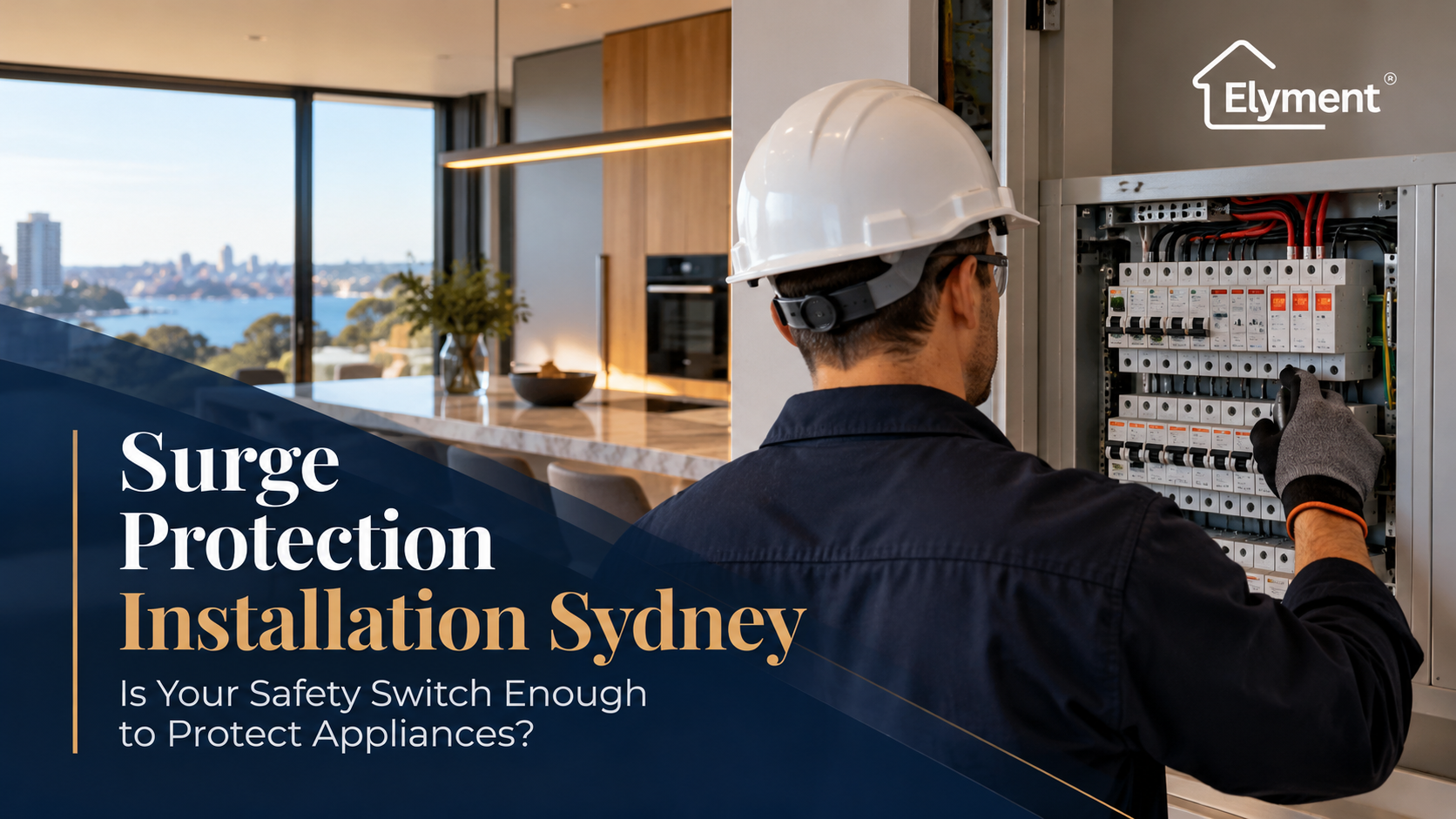
A safety switch does not provide the same protection as a surge-protection device. In Sydney homes, safety switches primarily reduce electric shock risks, circuit breakers protect electrical circuits against excessive current, and surge-protection devices help limit damaging voltage spikes. Whole-house surge protection is generally installed at the switchboard by a licensed electrician. Installation costs depend on switchboard condition, earthing, device selection and any additional electrical work required. No system guarantees protection from direct lightning strikes.
ELYMENT Insights | Property Infrastructure & Electrical Safety | Sydney, NSW | 27 October 2026
The Electrical Protection Gap Inside Modern Sydney Homes
A Sydney homeowner replaces an ageing air conditioning system, installs a new television and upgrades several kitchen appliances.
The house has a switchboard fitted with safety switches and circuit breakers. The electrical installation appears functional, and the owner assumes the appliances are protected against electrical problems.
However, there is an important distinction between protecting people from electric shock, protecting electrical circuits from excessive current and protecting equipment against transient voltage spikes.
These are different electrical risks requiring different protective functions.
A safety switch may operate correctly during an earth-leakage fault while doing little to prevent a damaging voltage surge from reaching electronic equipment.
Similarly, a circuit breaker can protect wiring against overloads and short circuits without providing dedicated protection against the brief overvoltage events that can damage sensitive electronics.
For Sydney property owners, the relevant question is not simply whether the switchboard contains safety devices.
It is whether the electrical installation provides protection appropriate to the actual risks and equipment connected to the property.
Three Protective Devices, Three Different Responsibilities
Safety switches, circuit breakers and surge-protection devices are sometimes discussed as though they perform interchangeable functions.
They do not.
Each addresses a different electrical condition. Some modern switchboard devices combine functions, but the protection provided still depends on the actual device specifications.
Safety Switches, Circuit Breakers and Surge-Protection Devices Compared
- Safety Switch (RCD)
- Primary Function: Detects certain current imbalances associated with earth leakage and disconnects electricity to reduce electric shock risks.
- What It Does Not Guarantee: Does not provide dedicated protection against transient voltage surges or prevent every possible electric shock.
- Circuit Breaker
- Primary Function: Protects electrical circuits against excessive current caused by overloads or short circuits.
- What It Does Not Guarantee: Does not normally protect sensitive electronics against brief voltage spikes.
- Surge-Protection Device (SPD)
- Primary Function: Limits transient overvoltages by diverting surge current through an appropriately designed protective path.
- What It Does Not Guarantee: Cannot guarantee immunity from lightning damage, prolonged overvoltage, brownouts or every electrical supply disturbance.
The distinction is particularly important when evaluating an older switchboard.
A property may have circuit breakers without adequate residual-current protection. Another may have RCDs protecting its circuits but no dedicated surge protection.
Some combination devices, known as RCBOs, incorporate residual-current and overcurrent protection. Their presence does not automatically mean surge protection is included.
The NSW Government's residential electrical safety guidance explains the role of safety switches and the importance of having appropriate protection across household circuits.
A switchboard inspection by a licensed electrician is the appropriate way to establish what protection is installed and whether further work is warranted.
What Whole-House Surge Protection Actually Means
Whole-house surge protection generally refers to a surge-protection device installed at the property's main electrical switchboard.
Its purpose is to reduce the transient overvoltage reaching connected electrical circuits.
These short-duration voltage spikes can originate from several sources, including:
- Lightning activity affecting nearby electrical infrastructure.
- Electrical network switching operations.
- Faults or disturbances involving power distribution equipment.
- Switching of certain electrical loads within an installation.
The expression "whole-house" can nevertheless create unrealistic expectations.
A single switchboard-mounted device does not necessarily protect every electrical or electronic pathway entering a property.
Telecommunications connections, antenna cables, external equipment and other conductive pathways may require separate consideration.
Properties with solar panels, battery storage, substantial air conditioning equipment or sophisticated home automation may also require a more detailed assessment.
The correct protection arrangement depends on the installation, exposure and manufacturer's technical requirements.
Why One Surge Protector May Not Be the Complete Solution
Surge protection is sometimes treated as a single-product purchase.
Electrical protection can be more complicated, particularly where a property contains high-value electronic equipment.
Surge-protection devices are commonly classified into three categories.
Type 1: Higher-Energy Surge Protection
Type 1 devices are designed to handle specified high-energy surge currents associated with lightning exposure.
They may form part of a coordinated protection arrangement where the property's lightning exposure or electrical infrastructure justifies that level of protection.
A Type 1 device should not be interpreted as a guarantee against damage from a direct strike.
Type 2: Switchboard-Level Protection
Type 2 devices are commonly considered for residential distribution boards.
They are designed to limit specified transient overvoltages associated with electrical switching and induced surge events.
The electrician must determine whether a particular Type 2 device is appropriate for the installation and how it should coordinate with existing protective devices.
Type 3: Protection Near Sensitive Equipment
Type 3 devices provide additional protection closer to connected equipment.
Depending on the product, these may include specialised point-of-use protection systems or suitable surge-protected power outlets.
They can be relevant for computers, entertainment equipment and other sensitive electronics.
However, point-of-use devices should be selected with regard to the overall installation and the manufacturer's requirements.
Effective surge management may therefore involve coordinated layers of protection rather than simply installing the device with the highest advertised rating.
The Electrical Contractors Association's technical guidance on surge-protection installation discusses device placement, protective arrangements and the importance of correct installation.
The Switchboard Assessment That Should Come Before Pricing
A surge protector installation cost in Sydney cannot always be established accurately from a product price or a photograph of the switchboard.
Before specifying equipment, a licensed electrician should assess the existing electrical installation.
The assessment should consider several practical factors.
- Switchboard Condition: Whether the enclosure, wiring, connections and existing protective devices are suitable for the proposed installation.
- Available Space: Whether the switchboard has sufficient capacity for the selected device and any associated protective equipment.
- Earthing and Bonding: Whether the electrical installation's protective earthing arrangements are suitable and compliant.
- Supply Configuration: Whether the property has a single-phase or three-phase supply and how that affects device selection.
- Existing Protection: The arrangement of RCDs, RCBOs, circuit breakers and any previously installed surge-protection equipment.
- Additional Equipment: Whether solar, batteries, EV charging, external circuits or sensitive electronics require further assessment.
A professionally specified installation should also address device ratings, manufacturer requirements, suitable backup protection and the arrangement of connecting conductors.
These are electrical design and installation considerations, not tasks for a homeowner to undertake.
The outcome may be a straightforward switchboard installation.
Alternatively, the inspection may reveal electrical defects that should be addressed before additional protection is installed.
Surge Protector Installation Cost Sydney: What Changes the Quote?
Published Sydney electrician pricing guides place some straightforward switchboard-mounted surge-protection installations in an indicative range of approximately $350 to $1,000.
This is a broad market guide, not a standardised price, confirmed Elyment quotation or guarantee of what a particular property will cost.
More extensive work can cost substantially more.
The installed price depends on the condition of the existing electrical infrastructure as much as the surge-protection device itself.
Surge Protection Installation Cost Factors
- Existing Switchboard
- Potential Impact: An older or crowded enclosure may require modifications.
- Question to Ask: Is the current switchboard suitable for the proposed device?
- Device Specification
- Potential Impact: Different protection types, ratings and configurations affect equipment costs.
- Question to Ask: Which device is being supplied, and why was it selected?
- Earthing Arrangements
- Potential Impact: Defective or unsuitable earthing may require remedial work.
- Question to Ask: Has the existing earthing system been assessed?
- Three-Phase Supply
- Potential Impact: A different device configuration may be needed.
- Question to Ask: Does the quotation match the property's supply arrangement?
- Additional Protection
- Potential Impact: Sub-boards, data connections or specialised equipment may require extra protective measures.
- Question to Ask: What equipment and pathways are outside the quoted scope?
- Access and Scheduling
- Potential Impact: Difficult access, isolation requirements or occupied-site restrictions can increase labour.
- Question to Ask: Are attendance, isolation, testing and compliance documentation included?
A cheaper quotation may represent a perfectly appropriate installation where the existing switchboard is in good condition.
However, it may also exclude switchboard alterations, earthing repairs or additional protective equipment.
Comparing quotations therefore requires more than comparing their total prices.
Property owners should request the proposed device specification, installation scope, exclusions and applicable GST treatment before accepting the work.
Why Renovation Timing Can Change the Economics
Electrical upgrades are often considered separately from other renovation activities.
In practice, the timing of electrical work can affect cost, access and overall project delivery.
Consider a Sydney homeowner planning a kitchen renovation alongside new air conditioning and an EV charger.
Each installation may involve electrical assessments, circuit planning or switchboard access.
If the homeowner requests surge protection only after the other work is complete, another electrician attendance and scheduled power isolation may be necessary.
Reviewing surge protection during the earlier electrical design stage can allow the electrician to assess the switchboard as part of a broader installation plan.
This does not mean every electrical upgrade requires surge protection.
It means the assessment can be coordinated before the project reaches its final stages.
Related electrical planning issues are explored in Elyment's guide to EV charger installation costs in Sydney, including switchboard suitability, electrical infrastructure and access.
For properties incorporating solar equipment or broader efficiency upgrades, energy upgrade planning and coordination may also form part of the renovation scope.
The operational advantage is improved sequencing and fewer unexpected changes late in the project.
Strata Properties Introduce Another Layer of Coordination
Surge protection in a standalone Sydney house may involve relatively straightforward access to a privately controlled switchboard.
Apartment buildings can present a different situation.
Depending on the building's electrical configuration, a proposed installation may involve equipment associated with common property.
In some strata schemes, relevant switchboards or electrical infrastructure may be located in shared service areas.
This raises practical questions about access, responsibility, approval and the permitted scope of work.
Before arranging installation, the owner should establish:
- Which switchboard supplies the apartment.
- Whether the relevant electrical infrastructure is lot property or common property.
- Whether approval or notification is required under the scheme's by-laws and applicable NSW strata requirements.
- Whether electrical isolation could affect neighbouring lots or common services.
- Who will be responsible for ongoing inspection and future device replacement.
The NSW Government's strata renovation guidance outlines how different renovation activities may require approvals and how common-property considerations affect proposed work.
Approval requirements must be assessed against the actual installation. Not every electrical alteration follows the same approval pathway.
For apartment owners, the first step may therefore be confirming installation authority rather than selecting a surge protector.
NSW Electrical Compliance Is Not an Optional Extra
Switchboard surge-protection installation is electrical wiring work.
In NSW, electrical wiring work must be performed by, or under the supervision of, an appropriately licensed electrician.
Homeowners should not attempt switchboard alterations themselves.
A licensed electrician must assess the proposed work against applicable requirements, including the relevant Australian and New Zealand electrical installation standards.
These include AS/NZS 3000, commonly known as the Wiring Rules.
Surge-protection equipment must be selected and installed appropriately for the electrical system and manufacturer specifications.
An additional consideration for Sydney property owners in 2026 is electrical compliance documentation.
From 1 July 2026, NSW requires Certificates of Compliance for Electrical Work, commonly called CCEWs, to be submitted through the Building Commission NSW eCert portal.
The certificate records that the relevant electrical installation work has been tested and complies with applicable requirements.
The electrician can provide the customer with a copy of the submitted certificate.
Further information is available through Building Commission NSW's electrical compliance requirements.
For owners comparing installation quotations, confirmation of appropriate licensing, electrical testing and compliance documentation should be part of the decision.
The Limits of Protection During Lightning and Network Faults
Surge-protection devices are designed to reduce specified transient overvoltages.
They are not designed to eliminate every electrical disturbance.
In particular, an SPD should not be presented as guaranteed protection against a direct lightning strike.
A severe strike can involve extremely high-energy electrical effects and multiple possible paths through a structure.
Dedicated lightning protection systems involve additional engineering considerations, including risk assessment, interception, bonding and earthing.
Surge-protection devices also have limitations when dealing with prolonged abnormal supply voltage.
This distinction matters because voltage spikes, sustained overvoltage and low-voltage supply conditions are different electrical problems.
A property experiencing repeated appliance failures, unusual voltage behaviour or unexplained electrical interruptions needs an appropriate investigation rather than an assumption that surge protection alone will resolve the issue.
Insurance policies should also be reviewed separately.
Installing surge protection does not automatically establish insurance coverage, remove exclusions or guarantee that future damage claims will be accepted.
What Should Happen After Installation?
Surge protection is not simply a device that can be installed and forgotten indefinitely.
Protective components can be affected by surge events and may eventually require replacement.
Many devices include status indicators showing whether the protective module remains operational.
The meaning of those indicators varies by manufacturer and model.
The installing electrician should explain the selected device's inspection and replacement requirements.
A sensible project handover should identify:
- The manufacturer and model of the installed surge protector.
- The device's location within the electrical installation.
- The meaning of its operating status indicators.
- Any recommended inspection or maintenance requirements.
- Whether replacement modules are available.
- The completed electrical compliance documentation.
The required installation testing and verification should be performed by the licensed electrician using appropriate methods.
Testing the installation does not mean deliberately subjecting household equipment to damaging surge conditions.
The objective is to verify that the electrical installation and selected protective equipment meet their applicable requirements.
Making the Right Electrical Upgrade Decision
For Sydney property owners, surge protection is best considered within the wider condition of the electrical installation.
A relatively modern switchboard with suitable earthing and spare capacity may support a straightforward installation.
An older property may require remedial electrical work before a surge-protection device can be appropriately installed.
A strata apartment may require additional investigation into electrical infrastructure, access and approvals.
Properties with solar equipment, extensive electronics or specialised electrical systems may need a coordinated protection assessment.
The appropriate solution should therefore be determined by an electrician's assessment, not by the assumption that every household requires the same product.
Where electrical work forms part of a wider property improvement project, Elyment's property renovation and project coordination services provide a broader pathway for reviewing scope, timing and contractor requirements.
The Property Owner's Final Consideration
A safety switch remains an essential electrical safety measure.
Its value should not be confused with the different role of surge protection.
Circuit breakers, safety switches and surge-protection devices contribute different functions within an electrical installation.
The practical objective is not to purchase the greatest number of protective devices.
It is to identify the property's actual electrical risks, install appropriate protection and maintain the system correctly.
For homeowners considering surge protection Sydney-wide, the most useful starting point is a licensed electrician's assessment of the switchboard, connected equipment and existing electrical infrastructure.
That assessment can distinguish between a simple installation, an electrical upgrade and protection measures that may not be justified for the property.
Planning an Electrical Upgrade as Part of Your Renovation?
ELYMENT PROPERTY SERVICES
Review renovation requirements, contractor coordination, electrical compliance considerations and project scheduling before work begins. Specialist electrical assessments and installation must be completed by appropriately licensed trades.
Sources and References
NSW Government and Electrical Compliance References
- NSW Government: Electrical Safety in the Home
- Residential electrical safety guidance covering safety switches and appropriate electrical protection.
- Building Commission NSW: Electrical Compliance Requirements
- Information about electrical compliance obligations, Certificates of Compliance for Electrical Work and the eCert submission process.
- NSW Government: Strata Renovations
- Guidance on strata renovation approvals, common-property considerations and requirements affecting apartment owners.
Electrical Industry Guidance and Standards
- Electrical Contractors Association: Correct Installation of Surge-Protection Devices
- Technical guidance concerning surge-protection device selection, installation arrangements and protective coordination.
- Australian/New Zealand Standard AS/NZS 3000 — Electrical Installations (Wiring Rules)
- Australian and New Zealand electrical installation standard covering requirements relevant to electrical safety and installation practices.
Related Elyment Property and Electrical Resources
- EV Charger Installation Cost Sydney: Why Quotes Vary
- Elyment Energy Upgrade Planning and Coordination
- Elyment Property Renovation and Project Coordination Services
- Contact Elyment Property Services
ELYMENT PROPERTY SERVICES
Planning an Electrical Upgrade as Part of Your Renovation?
Review your property's renovation requirements, electrical compliance considerations, contractor coordination and project schedule before work begins. Elyment can help clarify the broader project scope and coordinate next steps involving appropriately licensed electrical specialists.
Discuss Your Property ProjectElectrical assessments, installation and certification must be undertaken by appropriately licensed professionals.