Synthetic Sports Turf Replacement Sydney: Reuse or Rebuild?
Replacing synthetic sports turf in Sydney? Learn when shockpads and drainage bases can be reused, and what checks prevent drainage problems or expensive rework.
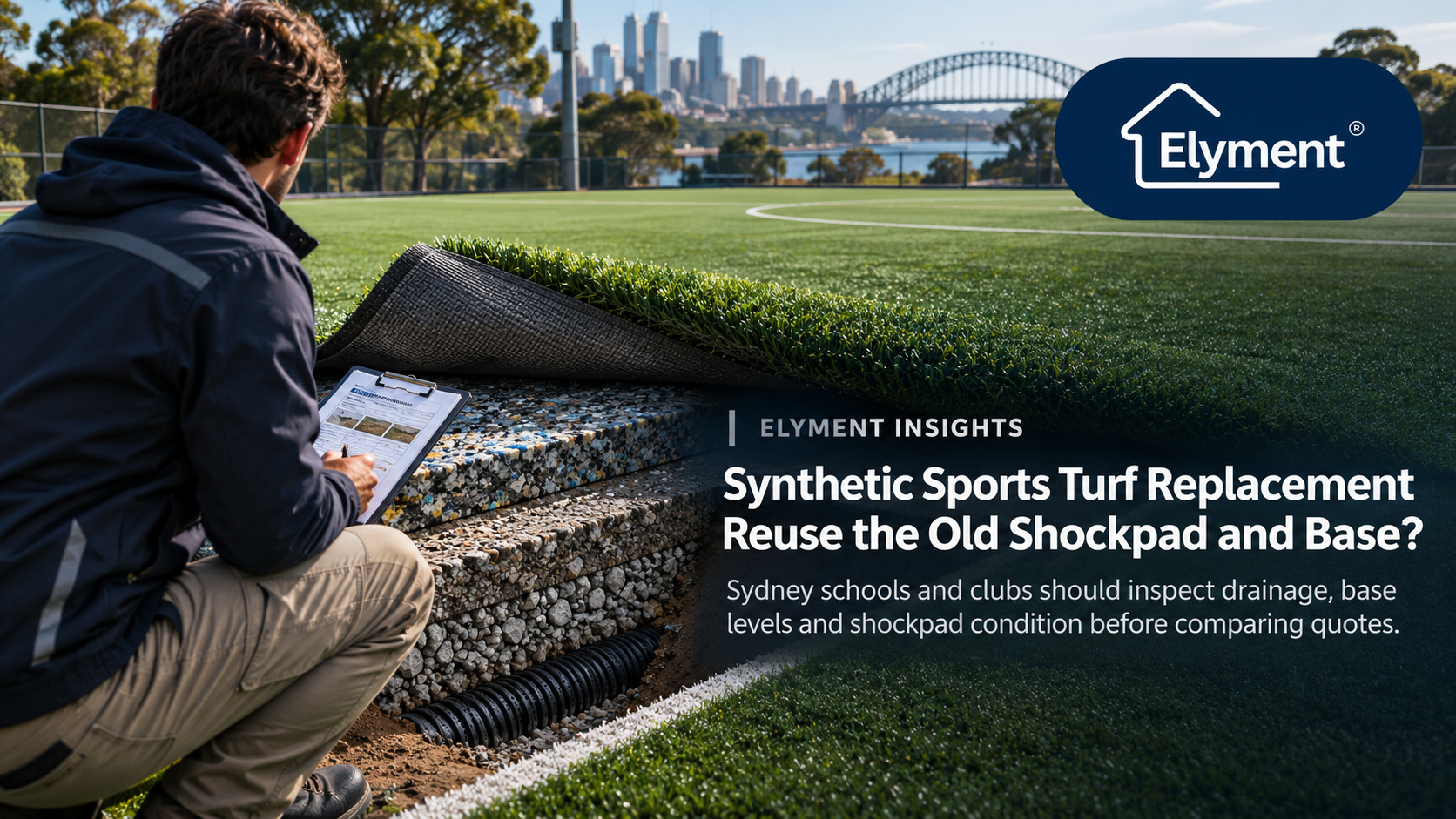
A Sydney school or club can sometimes replace only the synthetic carpet and retain an existing shockpad, base and drainage system, but age alone cannot establish suitability. The layers need to be investigated, tested against the proposed sport and replacement system, and checked for level, porosity, drainage function and outlet condition. If evidence is incomplete, retention should be priced as a conditional option, not assumed as a guaranteed saving.
ELYMENT Insights | Property, Renovation & Infrastructure | Sydney, NSW | 15 November 2026
A Surface Replacement Can Hide a Much Larger Infrastructure Decision
When an artificial sports field reaches the end of its useful playing life, the most visible problem is usually the synthetic carpet. Fibres become worn, seams deteriorate, infill becomes displaced and the playing surface no longer delivers the consistency expected by schools, sporting clubs or facility operators.
However, the carpet is only one component of the installation.
Below it may sit a resilient shockpad, a compacted aggregate base, asphalt, geotextile membranes, drainage pipes, collection chambers and perimeter restraints. These components represent a substantial part of the original construction investment.
Replacing everything without investigating the existing structure can create unnecessary demolition, excavation, transport and material costs. Equally, installing new turf over a deteriorating supporting system can transfer existing problems into an expensive replacement project.
For Sydney schools, councils and sporting clubs, the commercial decision is therefore not simply whether the old turf can be removed. It is whether the infrastructure underneath can reliably support another surface lifecycle.
The distinction matters when preparing a capital works budget. A surface-only replacement, a partial reconstruction and a complete field rebuild are three different projects, even if each contractor describes the work as synthetic turf replacement.
What Can Actually Be Retained?
A typical synthetic sports field contains several layers with different responsibilities. Their condition should be considered independently rather than treating the entire installation as one asset.
- Synthetic carpet
- Primary function: Provides the playing surface and fibre structure.
- What must be assessed: Wear, fibre condition, backing, seams and compatibility with the replacement specification.
- Shockpad
- Primary function: Provides resilience and contributes to the required playing characteristics.
- What must be assessed: Thickness, resilience, movement, deterioration and performance with the proposed turf.
- Aggregate or asphalt base
- Primary function: Provides structural support, stability and surface geometry.
- What must be assessed: Settlement, contamination, cracks, porosity, compaction and level tolerances.
- Drainage infrastructure
- Primary function: Collects and directs water away from the playing area.
- What must be assessed: Blockages, pipe condition, collection chambers, outlets and drainage performance.
- Perimeter edging
- Primary function: Retains the construction layers and controls the field boundary.
- What must be assessed: Structural integrity, alignment, height and compatibility with the finished surface.
The NSW Government's 2025 synthetic turf sports fields guideline recognises that synthetic sports surfaces are engineered systems involving the carpet, supporting base and, where specified, shockpad and drainage infrastructure.
That makes a component-by-component assessment more useful than an assumption that everything beneath the visible turf must either stay or go.
The Shockpad Is Not Automatically Reusable Because It Still Looks Intact
Of all the components underneath an existing synthetic sports surface, the shockpad deserves particular attention.
Its purpose is not simply to provide a soft layer beneath the carpet. It contributes to the resilience and playing characteristics of the complete sports surface.
An old shockpad can appear physically intact while its performance varies considerably across the field. Areas receiving repeated sporting activity may have experienced different levels of compression and deterioration from sections close to the perimeter.
For this reason, a visual inspection from the corners of the pitch is not sufficient evidence for retaining the entire resilient layer.
What should the contractor inspect?
- Physical condition: Look for cracking, tearing, deterioration, compression and separation between sections.
- Thickness consistency: Identify areas where the existing pad has compressed or varies significantly in thickness.
- Movement: Check whether prefabricated sections have shifted, separated or moved beneath the existing carpet.
- Bonding and joints: Establish whether the shockpad is adequately bonded to the base or whether the seams require appropriate securing.
- Performance: Determine whether the existing pad can satisfy the requirements of the proposed replacement surface and intended sport.
Sport and Recreation Victoria's Artificial Grass for Sport Guide specifically addresses this issue in its resurfacing section. It recommends checking the existing shockpad against the requirements of the new design and notes that performance testing of the combined pad and replacement surface may be necessary through an approved testing facility.
The guide also identifies movement in inadequately secured prefabricated pads as a potential problem. Where sections are unsuitable, replacement material should match the required thickness, resilience and density as closely as practicable.
If uncertainty remains about the suitability of the existing shockpad, retaining it should not be treated as an acceptable default.
Read the Sport and Recreation Victoria Artificial Grass for Sport Guide for its resurfacing and replacement guidance. Although it is a Victorian publication rather than NSW regulation, it provides useful technical considerations for sports-field renewal projects.
Drainage: The Infrastructure That Can Make or Break the Replacement
A sports field can have a relatively even-looking surface and still contain drainage problems that become apparent only during sustained rainfall.
For Sydney facilities, the condition of drainage infrastructure is particularly important when a school or club is trying to maintain field availability through periods of wet weather.
Water may move through the turf construction into a drainage layer before reaching collection pipes, pits and nominated discharge points. If one part of that system is restricted, the replacement carpet will not automatically resolve the problem.
What needs to be checked?
- Drainage pipes: Inspect accessible sections and determine whether pipes are obstructed, damaged or affected by sediment.
- Collection chambers: Confirm that silt collection chambers and inspection points exist, remain accessible and can be maintained.
- Rodding access: Identify whether rodding eyes or other suitable inspection access points are available.
- Discharge outlets: Establish where collected water is directed and whether the receiving system is functioning.
- Soakaways: Where present, assess their operating efficiency and suitability for the proposed drainage arrangement.
- Surface falls: Identify low areas and whether the existing profile directs water towards the intended collection points.
The Sport and Recreation Victoria resurfacing guide recommends checking existing drains against the applicable requirements. It identifies rodding and standard drain testing as possible investigation methods, alongside inspections of collection chambers and soakaways.
The important distinction is between a drainage system that physically exists and one that has been demonstrated to function.
For public synthetic sports fields, NSW Government guidance also places emphasis on stormwater management, containment of synthetic material and suitable filtration arrangements. These considerations should be incorporated into the proposed design where the relevant project and planning pathway require them.
Read the NSW EPA guidance on synthetic turf in sports fields for further context on stormwater, environmental and planning considerations.
Base Levels: Why Installing New Turf Can Expose an Old Construction Problem
Retaining an existing base is often an attractive option because the original construction may have involved substantial excavation, imported aggregate, compaction, drainage installation and asphalt works.
However, the condition of that base cannot be established from the appearance of the old carpet.
Once the surface is removed, contractors may discover local settlement, uneven aggregate, contaminated drainage layers, asphalt deterioration or areas that no longer meet the level requirements of the replacement system.
Three investigations are particularly important.
1. Level and surface geometry survey
The contractor should establish existing levels across the field and compare them with the requirements of the proposed system.
Particular attention should be given to:
- Low points and localised depressions.
- Changes in crossfall and longitudinal falls.
- Settlement around high-use areas.
- Transitions at the perimeter and adjoining surfaces.
- Levels around drainage channels, pits and field edges.
2. Base stability and material condition
Where the field uses an unbound aggregate construction, the contractor should assess whether the material remains stable and whether the upper layer requires re-levelling and recompaction.
Trial excavations can help establish the thickness and condition of the underlying sub-base. They can also identify contamination caused by finer materials migrating through the construction.
For asphalt bases, the exposed surface should be assessed for cracks, unevenness and drainage permeability. Appropriate testing may be needed to identify areas where water cannot pass through the intended system.
3. Finished height and perimeter compatibility
One proposed resurfacing method involves retaining existing layers, adding crushed stone to correct low spots and installing a new surface system above them.
While this approach may reduce demolition and disposal requirements, it changes the finished playing level.
That can affect:
- Existing spoon drains and drainage channels.
- Perimeter kerbs and retaining edges.
- Access transitions and surrounding pathways.
- Sports equipment and inset fittings.
- Ball bounce characteristics where relevant, particularly on tennis facilities.
A new layer cannot be considered a successful correction if it creates a different problem at the perimeter or compromises the intended playing characteristics.
Surface-Only Replacement Versus Rebuilding the Supporting Layers
Once the existing construction has been investigated, the project team should be able to compare different scopes of work.
Three broad approaches are worth pricing separately.
- Option 1: Surface-only replacement
- Typical scope: Remove the existing carpet, inspect and retain the shockpad, prepare the existing base and install the replacement turf.
- When it may be appropriate: When the retained shockpad and supporting construction have demonstrated suitability for the new system.
- Option 2: Partial reconstruction
- Typical scope: Replace or repair selected shockpad sections, regulate the base, correct local defects and undertake nominated drainage repairs before installing new turf.
- When it may be appropriate: When the main infrastructure remains serviceable but certain areas require remedial work.
- Option 3: Full reconstruction
- Typical scope: Remove unsuitable resilient layers, reconstruct the required base and drainage components and install a new complete sports surface system.
- When it may be appropriate: When the existing infrastructure cannot reliably support the proposed replacement system.
The cheapest initial quotation is not necessarily the lowest-cost project over its operating life.
For example, a surface-only proposal may look attractive because it excludes extensive excavation and new drainage infrastructure. However, if the underlying base subsequently requires major correction, the project may face additional mobilisation, material costs and delays.
Conversely, a full reconstruction may include unnecessary work if the existing base and drainage system are demonstrably suitable.
The objective is to establish which components genuinely need replacement, rather than choosing the smallest or largest scope by default.
What Sydney Schools and Clubs Should Ask Before Comparing Quotes
Contractors should be asked to assess the same underlying conditions before their prices are compared.
Otherwise, one quotation may allow for surface replacement only while another includes substantial base repairs, drainage testing and shockpad replacement.
The resulting price difference may reflect completely different project assumptions.
Questions to include in the tender or request for quotation
1. What is the existing construction? Can the contractor identify the carpet, shockpad, base materials and drainage arrangement?
2. How will the shockpad be assessed? Does the proposed inspection include representative areas across the field and performance testing where necessary?
3. Will the existing drainage system be tested? Does the scope include inspection of pipes, collection chambers, rodding access and discharge points?
4. Will the base be surveyed? Are levels, falls, settlement and surface tolerances documented?
5. What happens if the existing layers fail inspection? Are replacement rates, repair allowances and variations clearly defined?
6. Does the proposed turf suit the intended sport? Has compatibility with the retained shockpad and supporting base been established?
7. What evidence will be provided at handover? Will the client receive inspection records, test results, as-built information and relevant warranties?
Schools and clubs should also ask contractors to identify any exclusions involving drainage upgrades, perimeter repairs, equipment fittings, access arrangements and disposal.
For an existing field that has undergone several previous upgrades, original construction drawings and maintenance records may be incomplete. Contractors should therefore explain how unknown conditions will be investigated before the final scope is agreed.
The Procurement Problem: A Low Initial Price Can Create an Unclear Final Budget
Sports-field replacement projects frequently involve several parties: the facility owner, school or club management, project managers, specialist sports-surface contractors, designers and testing providers.
When these responsibilities are not defined early, the project can develop gaps between inspection, removal, reconstruction and final installation.
For example, a turf contractor may assume that the existing drainage system is suitable, while the asset owner expects the contractor to identify and rectify any underlying defects.
Another contractor may include new shockpad installation, while a competing quotation assumes the original resilient layer will remain.
Neither price is meaningful until the assumptions are reconciled.
A more reliable procurement process should separate the following:
- Initial investigation and condition assessment.
- Surface removal and disposal.
- Shockpad inspection, testing and replacement allowances.
- Base preparation and localised reconstruction.
- Drainage testing, repairs and upgrades.
- Replacement turf supply and installation.
- Independent performance testing and practical completion.
Where the existing structure cannot be fully assessed before the surface is lifted, the contract should establish a formal inspection hold point.
At that stage, the project team can review the exposed construction, document any defects and approve the next scope before additional reconstruction work proceeds.
This reduces the risk of uncontrolled variations and makes it easier to explain changes to school leadership, club committees, council representatives and funding stakeholders.
NSW Planning and Environmental Considerations Cannot Be Ignored
Sports-field resurfacing is not exclusively a construction decision.
For public synthetic sports fields, NSW has introduced more detailed guidance addressing planning, design, construction, operation and environmental management.
The NSW Department of Planning, Housing and Infrastructure published its Synthetic Turf Sports Fields in Public Open Space Guideline for Decision-Makers in 2025.
The guidance addresses issues including:
- Stormwater management and drainage design.
- Migration of synthetic fibres and infill materials.
- Environmental management during construction and operation.
- Maintenance planning and asset management.
- Material selection and end-of-life considerations.
Its accompanying assessment addendum also addresses relevant upgrades to existing synthetic sports fields where the work is undertaken through the specified development-without-consent planning pathways.
This does not mean every school or privately managed sports-field resurfacing project follows the same approval process. The applicable requirements depend on the land, ownership, project scope and planning pathway.
Before work is awarded, the responsible project team should confirm whether council consultation, environmental assessment or other approvals are required.
Retaining existing infrastructure should also be considered alongside any environmental improvements required by the replacement design. A functioning old drainage arrangement is not automatically suitable for a new system if its environmental controls or operating requirements have changed.
Project Sequencing Matters as Much as the Construction Method
For a Sydney school or sporting club, the practical cost of replacement also includes the period during which the facility cannot operate normally.
A project that extends into a school term, scheduled competition period or major club programme may create additional operational pressure.
Rather than scheduling the entire project around an assumed installation duration, the delivery programme should include defined investigation and decision stages.
1. Preliminary assessment: Collect available construction drawings, maintenance records, warranties and previous repair information.
2. Replacement design: Confirm the intended sport, surface specification, performance requirements and expected use.
3. Initial investigation: Survey accessible areas, drainage infrastructure and existing surface levels.
4. Controlled surface removal: Remove the existing carpet while protecting infrastructure intended for retention.
5. Condition verification: Inspect the exposed shockpad, base and drainage system. Complete any nominated tests.
6. Scope approval: Confirm which components will remain, which require repairs and which must be replaced.
7. Reconstruction and installation: Complete approved remedial works and install the new sports surface.
8. Testing and handover: Verify the completed system, document defects and provide maintenance information.
The schedule should also allow for weather contingencies, equipment access, testing availability and the time needed to obtain approval for additional work.
For larger projects, independent specialist oversight and construction hold points can help ensure that the work is consistent with the approved design.
What a Complete Handover Should Include
A newly installed synthetic sports surface should not be treated as complete simply because the carpet has been laid and the field is visually presentable.
The project owner should receive evidence that the replacement system meets its agreed requirements.
A practical handover package should consider:
- Final surface and level survey information.
- Shockpad and supporting-layer inspection records.
- Drainage inspection and testing results.
- Relevant sports-surface performance test documentation.
- Records of repaired or replaced infrastructure.
- Product information and applicable warranties.
- Cleaning, grooming and ongoing maintenance requirements.
- Defect reporting and responsibility during the defects period.
The NSW Government guideline recommends clear project documentation, quality controls, independent specialist oversight and testing at relevant stages of delivery.
For schools and clubs making a substantial infrastructure investment, these records also provide a useful baseline for the next maintenance and replacement cycle.
The Better Replacement Decision Is Based on Evidence, Not Assumptions
Keeping the existing shockpad and drainage base can be a sensible way to avoid unnecessary reconstruction. However, reuse should be supported by evidence that the existing layers remain suitable for the proposed playing surface.
The shockpad must retain the required performance. The base must provide the necessary stability and levels. The drainage system must continue to operate effectively and meet the requirements of the replacement design.
Where those conditions are satisfied, a surface-only replacement may provide a practical route forward.
Where they are not, partial repairs or complete reconstruction may offer a more reliable long-term outcome.
For Sydney schools, sporting clubs and property operators, the most important step is to establish the condition of the infrastructure before comparing contractor prices.
The best quotation is not necessarily the one that replaces the fewest layers. It is the one that clearly demonstrates what can be retained, what needs to change and how the completed field will perform.
SYDNEY PROPERTY & PROJECT DELIVERY
Plan Your Next Renovation or Infrastructure Project With Confidence
Understanding existing conditions before work begins can help reduce unnecessary reconstruction, improve contractor coordination and create a clearer project delivery plan.
Speak with Elyment about renovation planning, physical works, project reviews and operational support across NSW.
Sources and References
1. NSW Department of Planning, Housing and Infrastructure (2025)
Synthetic Turf Sports Fields in Public Open Space Guideline for Decision-Makers
2. Sport and Recreation Victoria
Artificial Grass for Sport Guide
3. NSW Environment Protection Authority (EPA)
Synthetic Turf Used in Sports Fields
SYDNEY PROPERTY & PROJECT DELIVERY
Plan Your Next Project With Confidence
From renovation planning and physical works to contractor coordination and operational reviews, Elyment helps bring greater clarity to complex property projects.
Discuss Your ProjectRelevant next actions
Explore the ELYMENT service most closely connected to this article.