Synthetic Turf Removal Sydney: How Are Sand and Rubber Infill Removed Before an Old Football Pitch Is Lifted?
Learn how sand and rubber infill are removed before synthetic turf is lifted in Sydney reducing all disposal risks, cleanup costs and site contamination issues.
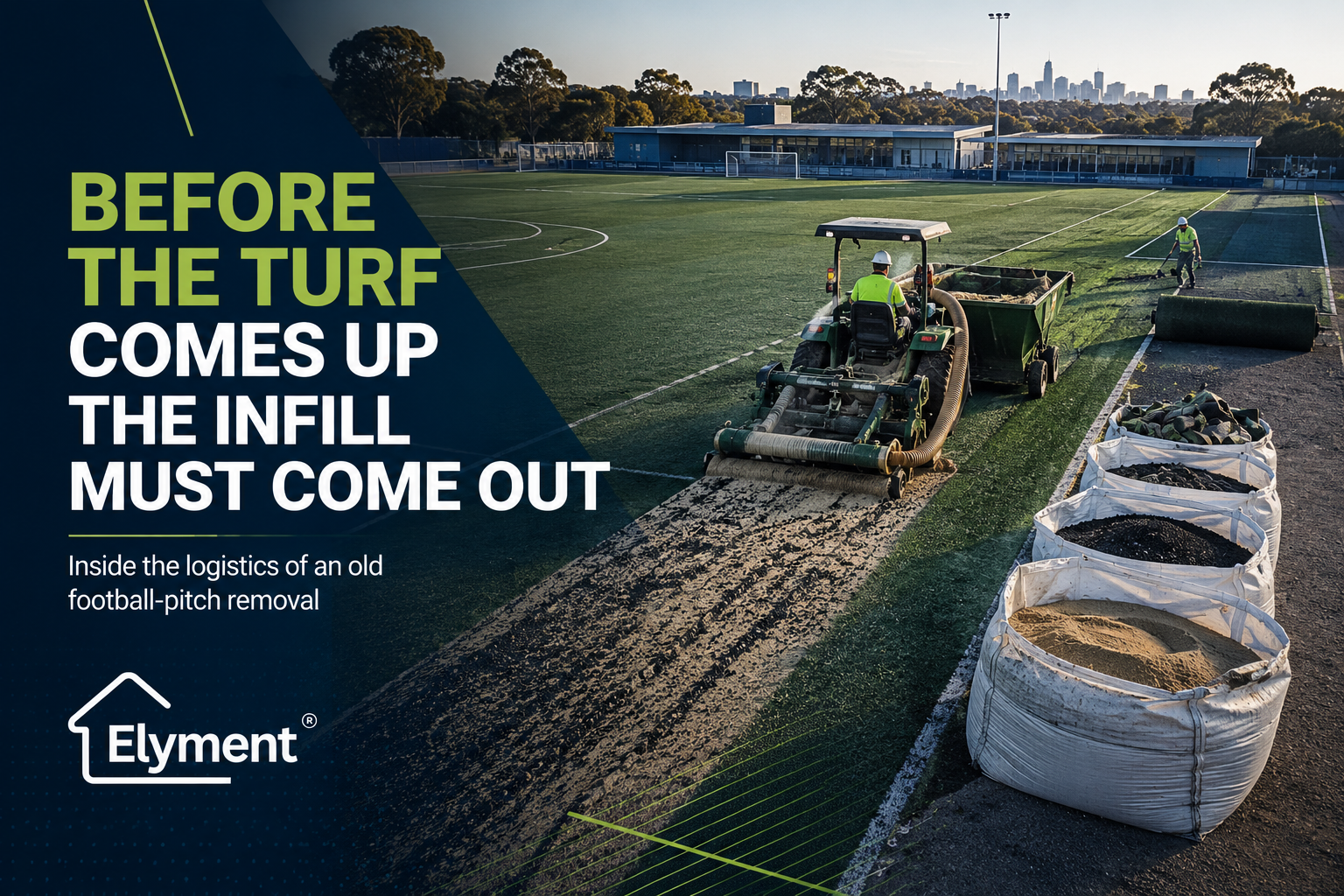
On an old Sydney football pitch, sand and rubber infill are typically extracted before the synthetic carpet is cut and rolled because the infill adds substantial weight, contaminates adjoining work areas and complicates recycling or disposal. The practical NSW sequence is to identify the turf system, isolate drains and boundaries, mechanically loosen and collect infill, separate recoverable material, then lift the turf while protecting the shockpad, base and drainage system for whatever surface comes next.
A worn synthetic football field can look like one surface ready to be rolled up. Operationally, it is closer to a layered infrastructure system.
Above the supporting base may sit synthetic carpet, stabilising sand, performance infill, line markings, seams, backing systems, a shockpad, drainage infrastructure and perimeter details. By the time a Sydney football pitch reaches refurbishment or replacement, these layers may also contain years of fines, organic material, broken fibres and displaced infill.
That makes the first question on a removal project more important than it sounds: should the contractor start cutting the turf, or should the loose material inside it come out first?
On larger sports-field projects, separating the infill before the carpet is lifted can materially change handling weight, transport efficiency, contamination control, recycling options and the condition in which the underlying asset is handed over. It turns synthetic turf removal from an indiscriminate strip-out into a controlled deconstruction programme.
The Pitch Is Not One Material
A typical synthetic football system has several components performing different jobs. The precise build-up varies by product, generation, age and original design, so a removal contractor should not assume that every field contains the same quantity or type of sand, rubber or resilient layer.
- Synthetic carpet
- Role during use: Provides the playing surface and fibre structure.
- Why it matters during removal: Must ultimately be cut, separated and rolled or otherwise processed for removal.
- Stabilising sand
- Role during use: Adds ballast and supports the carpet system.
- Why it matters during removal: Creates significant weight and can be difficult to recover once mixed into demolition waste.
- Performance infill
- Role during use: Supports playing characteristics and fibre behaviour.
- Why it matters during removal: May consist of rubber crumb or another specified material and should be identified before recovery or disposal decisions are made.
- Shockpad
- Role during use: Provides resilience beneath some field systems.
- Why it matters during removal: May be retained, tested, repaired or removed depending on the replacement design.
- Base
- Role during use: Provides levels, structural support and drainage performance.
- Why it matters during removal: Damage can create a much larger reconstruction scope than the turf removal itself.
- Drainage and perimeter infrastructure
- Role during use: Controls water movement and contains the playing surface.
- Why it matters during removal: Needs protection from loose fibres, rubber, sand and demolition debris.
This is why an old pitch should be investigated before demolition begins. Drawings, maintenance records, previous resurfacing information and a physical inspection can all help determine what is actually being removed.
The same principle appears across broader renovation work. Elyment's guidance on planning removal around the replacement finish explains why demolition should be designed backwards from the condition required by the following trade.
Why Remove the Infill Before Rolling the Turf?
The main advantage is separation.
If synthetic carpet is cut and rolled while still carrying large amounts of sand, rubber and accumulated debris, those materials become harder to control. Rolls become heavier, loose material can spill during handling, transport loads become less efficient and clean material streams can become mixed.
Removing as much recoverable infill as practicable while the carpet remains flat provides a better working platform for specialist extraction equipment. It can also make the later turf-lifting stage more predictable.
- Lower handling weight: Less ballast remains trapped inside each turf section.
- Cleaner material streams: Sand, performance infill and synthetic carpet have a better chance of remaining separately manageable.
- Reduced migration: Loose rubber, fibres and sand can be contained before heavy demolition movement begins.
- Better transport planning: Project teams can estimate turf, infill and mixed-residue loads separately.
- Clearer waste decisions: Material can be assessed before it is mixed with backing, soil, concrete or other demolition waste.
Complete recovery should not be assumed. Older fields can contain compacted material, broken fibres, organic contamination and infill that has migrated deep into the pile or perimeter. The objective is controlled separation, not a promise that every grain or particle can be recovered.
A Football-Pitch Removal Is Reverse Construction
A disciplined programme effectively dismantles the original field in reverse. The exact plant and sequence depend on field size, access, specification and the intended destination of the materials, but a project may follow the stages below.
- Identify the existing system.
- Confirm the carpet construction, approximate age, infill type, shockpad arrangement, seams, drainage interfaces and underlying base where records are available.
- Establish containment and access.
- Define vehicle routes, field entry points, stockpile locations, bagging or bulk collection areas, stormwater protection and exclusion zones before extraction starts.
- Loosen compacted infill.
- Appropriate brushing or specialist machinery may be used to bring material out of the carpet pile so that it can be collected more effectively.
- Extract the loose material.
- Depending on the system, specialist mechanical collection, vacuum recovery, screening or combined extraction equipment may collect sand, rubber and fines while the turf remains installed.
- Separate and contain recovered materials.
- Recovered material should be kept in defined streams where practicable rather than immediately combining everything into a general demolition load.
- Cut seams and turf sections.
- Once the field has been sufficiently stripped of loose infill, carpet can be separated into sections sized around the lifting method, available machinery, gate widths and transport plan.
- Lift, roll and remove the synthetic carpet.
- Turf sections can then be mechanically or manually rolled, secured and moved through the nominated loading route without treating the underlying base as disposable demolition ground.
- Assess the layer underneath.
- The shockpad, asphalt, bound base, unbound base, drainage and levels should be inspected against the specification for the replacement field.
The important distinction is sequencing. Extraction, turf removal, base investigation and reconstruction are connected stages, but they are not the same scope.
Sand and Rubber Should Not Automatically Become One Waste Stream
Removing infill is only useful if the project team has decided what will happen to it afterwards.
That decision should be made before machinery starts filling bags, bins or stockpiles. NSW waste obligations require generators to correctly classify waste and ensure it goes to facilities authorised to accept the relevant material.
The NSW EPA Waste Classification Guidelines provide the framework for determining how waste is classified. A contractor should not declare old sports-field infill recyclable, hazardous or suitable for reuse merely from its appearance.
- Relatively clean sand
- Project question: Is there an approved recovery or reuse pathway?
- Operational consequence: Keep separated and protected from mixed demolition waste while suitability is determined.
- Rubber or other performance infill
- Project question: What material is it, what condition is it in and will the nominated receiver accept it?
- Operational consequence: Confirm the receiving pathway before bulk transport.
- Mixed infill and fines
- Project question: Can it practically be separated or does it require classification as a mixed waste stream?
- Operational consequence: May change processing, disposal and transport requirements.
- Synthetic carpet
- Project question: Can the carpet be accepted by a recovery pathway in its actual condition?
- Operational consequence: Residual sand, contamination, backing type and roll dimensions can affect acceptance.
- Shockpad
- Project question: Is it being retained, reused, independently assessed or removed?
- Operational consequence: Do not demolish a potentially reusable layer simply because the carpet is being replaced.
This approach reflects a wider removal principle: material separation is easiest before different waste classes and construction layers become mixed together.
The Base May Be More Valuable Than the Surface Being Removed
A removal contractor can finish the visible demolition quickly and still leave the project in a worse position if the supporting field construction has been damaged.
The existing base may represent a major portion of the original sports-field investment. If it can support the proposed replacement system, preserving it can reduce excavation, imported material, drainage reconstruction and programme time. If it cannot, the project needs evidence of that condition before the next scope is priced.
During turf lifting, machinery movements therefore need to account for:
- existing falls and drainage geometry;
- shockpad condition and whether it forms part of the retained system;
- soft or locally failed areas of the base;
- perimeter channels and drainage pits;
- irrigation or services where present;
- vehicle loading limits over areas not designed as haul roads;
- the finished tolerance required by the replacement sporting surface.
The removal phase should therefore finish with an inspection, not simply an empty field.
NSW Is Treating Synthetic Sports Fields as an Environmental Management Issue
Synthetic turf is no longer assessed only by playing hours and maintenance cost. NSW planning policy now gives greater attention to environmental impacts, plastic migration, end-of-life considerations and the management of synthetic sporting surfaces.
The NSW Department of Planning, Housing and Infrastructure has published guidance for synthetic turf sports fields following work that included an independent review by the NSW Chief Scientist and Engineer.
The guidance recognises the potential for rubber infill and synthetic fibres to migrate from fields into surrounding environments. For a removal project, this has a practical implication: containment becomes particularly important when extraction, cutting and machinery movements disturb material that has previously been held within the turf pile.
Field boundaries, pits, kerbs, drains and adjacent landscape zones should therefore form part of the removal plan rather than being treated as areas to clean after the work is finished.
The NSW EPA also notes that environmental issues associated with synthetic sporting fields sit within NSW pollution and planning frameworks. For councils, schools, clubs and asset managers, the decommissioning stage deserves the same documentation discipline as installation.
Sydney Logistics Can Cost More Than the First Day of Cutting
A full-size sports pitch occupies a large footprint, but large area does not necessarily mean easy access.
Sydney fields can sit behind schools, residential streets, club buildings, retaining walls, shared pedestrian paths or narrow maintenance gates. An extraction machine that performs efficiently on the field may still be useless if it cannot reach the work zone.
The pre-start review should consider:
- gate clearances for extraction and rolling equipment;
- truck and bin positions;
- distance between the field and loading area;
- whether machinery can travel over surrounding paths or natural turf;
- school, community or club operating hours;
- neighbouring residential noise constraints;
- pedestrian separation around active facilities;
- temporary storage for recovered infill;
- wet-weather access and ground protection;
- how many loads can practically leave the site each day.
These constraints echo a broader Sydney demolition reality examined in Elyment's analysis of how access and waste pathways can change a removal quote.
Square metres describe the surface. They do not describe the entire job.
The Quote Should Show the Sequence, Not Just a Rate Per Square Metre
A single line reading "remove synthetic turf" hides too many assumptions for a substantial football-field project.
A more useful scope separates the operations that create different labour, plant, transport and disposal exposures.
- Site mobilisation
- What should be clarified: Access, inductions, barriers, temporary protection and plant delivery.
- Infill extraction
- What should be clarified: Area, expected material type, equipment method and realistic recovery standard.
- Material containment
- What should be clarified: Bulk bags, bins, covered stockpiles or another nominated system.
- Turf cutting and uplift
- What should be clarified: Section size, seam treatment, rolling method and loading.
- Shockpad treatment
- What should be clarified: Retain, investigate, repair or remove.
- Waste and recovery transport
- What should be clarified: Material stream, receiver, expected loads and acceptance conditions.
- Base clean-down
- What should be clarified: Required condition before inspection or reconstruction.
- Handover survey
- What should be clarified: Levels, drainage, defects, photographs and responsibility for remediation.
This separation also helps when the project changes. If testing shows that a shockpad can remain, the team can understand the saving. If the base fails inspection, reconstruction can be priced as a new condition rather than being confused with the original turf-removal allowance.
What Can Change the Programme Once Removal Starts?
Old sports fields rarely behave exactly like drawings.
Several conditions can change productivity after work begins:
- infill compacted more heavily than anticipated;
- greater residual sand quantities than estimated;
- wet infill increasing handling difficulty;
- failed seams causing turf to separate unpredictably;
- turf backing breaking down during rolling;
- unexpected repairs from earlier resurfacing campaigns;
- shockpad bonded differently across sections of the field;
- base deterioration revealed only after the carpet is removed;
- drainage defects previously concealed by the playing surface;
- receiving facilities rejecting material that does not meet agreed acceptance criteria.
A sensible programme therefore includes decision points rather than assuming that extraction can run continuously from one end of the pitch to the other without inspection.
The Replacement Surface Should Be Decided Before Decommissioning
The required handover is different if an old pitch is becoming another synthetic football field, a natural turf field, a multi-sport surface or a substantially reconstructed facility.
If the replacement system intends to use the existing base or shockpad, demolition tolerances need to protect those components. If the whole field construction is being replaced, the removal method may prioritise production differently.
That is why Elyment's broader flooring removal and substrate preparation approach treats removal as one stage within a defined handover sequence rather than an isolated demolition activity.
For a sporting facility, the same principle applies at a much larger scale. The end condition should be written before the first machine crosses the pitch.
Questions Asset Managers Should Resolve Before Awarding the Work
- What synthetic turf system is currently installed?
- Is the performance infill rubber, an alternative material or a mixture from successive maintenance cycles?
- Is the recovered infill intended for reuse, recycling, processing or disposal?
- Has the receiving facility confirmed its acceptance requirements?
- Is a shockpad present, and is it part of the retained asset?
- What field infrastructure must remain undamaged?
- How will loose fibres and infill be prevented from reaching drains and surrounding land?
- Where can bulk material be stored without obstructing the facility?
- What happens if the base fails inspection once exposed?
- Who signs off the condition before the replacement-field contractor takes possession?
These questions move the procurement conversation away from a headline demolition rate and towards project certainty.
REMOVAL · LOGISTICS · PROJECT DELIVERY
Review the Removal Sequence Before the Pitch Is Lifted
Align infill extraction, site access, waste pathways, base protection and replacement-surface requirements before machinery is mobilised.
The Practical Takeaway for Sydney Projects
Synthetic turf removal on an old football pitch should not begin with the assumption that the carpet is the only material being demolished.
Sand and rubber infill can influence almost every operational decision that follows: plant selection, lifting weight, environmental containment, recycling feasibility, transport, waste classification, labour productivity and the condition of the underlying field.
For Sydney councils, schools, clubs, facility managers and contractors, the better sequence is to understand the system first, establish containment, recover the infill in controlled streams, lift the carpet methodically and inspect the underlying infrastructure before the replacement works are released.
The visible milestone may be an empty football pitch. The more important project outcome is an empty pitch whose materials, drainage, base and next construction stage remain under control.
Sources and References
- Elyment: Planning removal around the replacement finish
- NSW EPA: Waste Classification Guidelines
- NSW Department of Planning, Housing and Infrastructure: Synthetic turf for sports fields
- Elyment: How access and waste pathways can change a removal quote
- Elyment: Flooring removal and substrate preparation
- Elyment: Contact
Review the Removal Sequence Before the Pitch Is Lifted
Align infill extraction, material recovery, site access, waste pathways, base protection and replacement-surface requirements before machinery is mobilised.
Review Your ProjectRelevant next actions
Explore the ELYMENT service most closely connected to this article.