Tesla Roadster Upside Down: How the Rocket-Assisted Flip Worked
Watch a Tesla Roadster drive upside down on a ceiling, flip and land on rockets. Explore engineering challenges, safety risks and questions raised by the stunt.
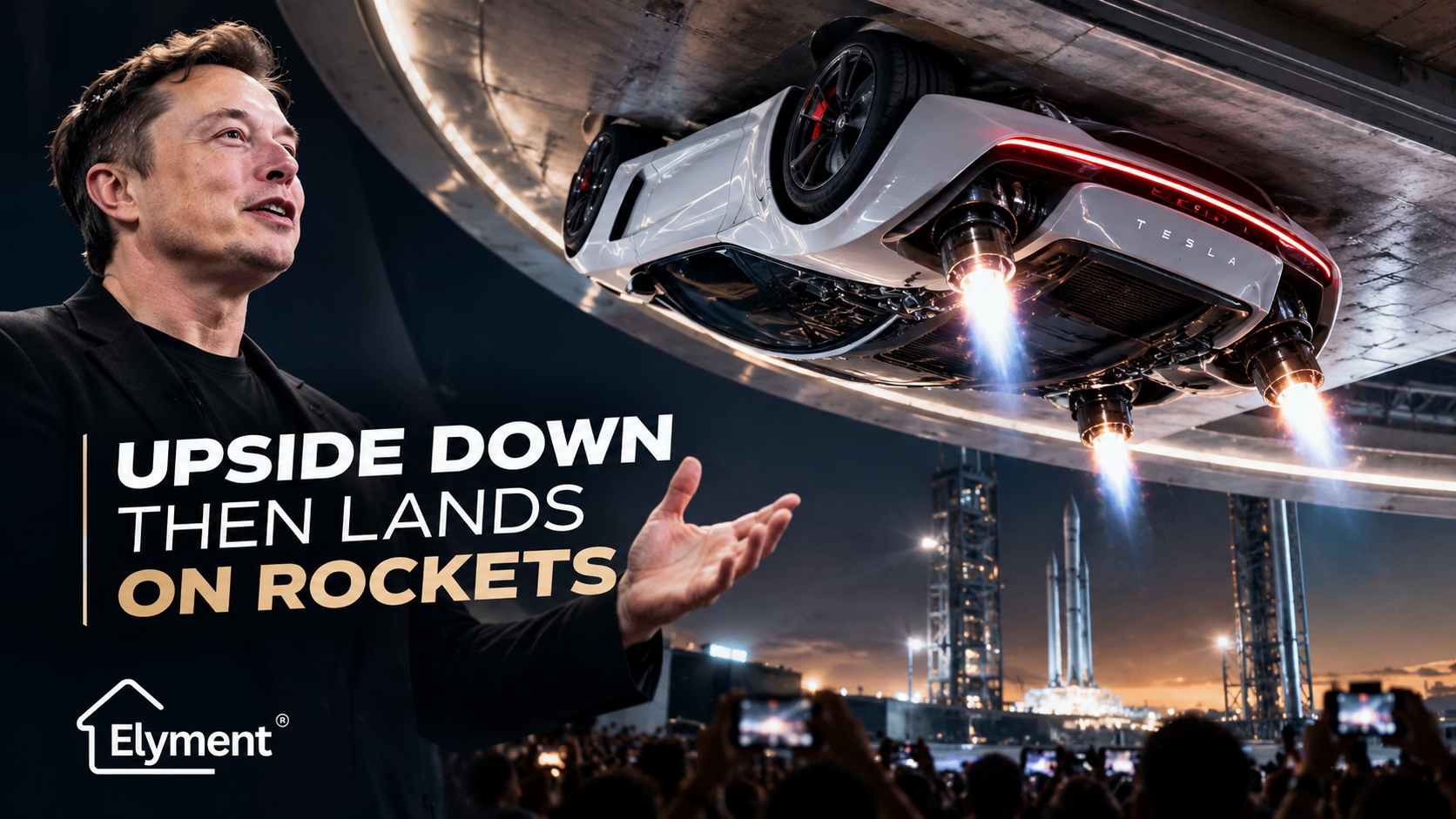
On 15 October 2026, Tesla demonstrated its redesigned Roadster driving upside down along a purpose-built inverted ramp before using compressed-air thrusters to rotate and land. The spectacle combined active suction with SpaceX-inspired propulsion, but it did not establish ordinary road-use approval or production readiness. For Sydney and NSW, the demonstration raises questions about vehicle certification, engineered test environments and the infrastructure required to operate unconventional mobility technologies safely.
For a Few Seconds, Tesla Turned the Rules of Driving Upside Down
The car approached a towering curved structure, climbed upwards and continued along an inverted surface with its wheels above its body. Then it left the structure, rotated through the air and descended towards the ground.
It did not fall uncontrolled. A system of compressed-air thrusters helped correct its orientation and manage the landing.
At Tesla's 15 October 2026 Roadster unveiling at SpaceX's testing facility near McGregor, Texas, the company demonstrated something considerably more ambitious than another electric supercar acceleration record.
The redesigned Roadster performed manoeuvres that conventional road vehicles cannot execute. A second demonstration involved lifting the vehicle over a line-up of Tesla models using its propulsion system.
The footage immediately attracted attention because it appeared to dissolve the boundary between a performance car, a stunt vehicle and a small aircraft.
Yet the engineering story is more precise than the headlines suggest.
The Roadster was not travelling across an ordinary building ceiling. It was operating on a specially constructed demonstration structure. Nor was it landing on conventional combustion rockets. Tesla used a combination of mechanically generated suction and cold-gas propulsion.
That distinction is central to understanding both the achievement and its limitations.
As reported by TechCrunch's coverage of the unveiling, the vehicle represents a collaboration between Tesla and SpaceX engineers, with production currently targeted for 2028.
The Engineering Was Not Magic. It Was Controlled Pressure.
Tesla's demonstration relied on two different technologies performing two different jobs.
First, suction kept the car attached to the inverted track
Conventional performance cars generate aerodynamic downforce as air moves around their bodies. But aerodynamic downforce depends substantially on vehicle speed.
A fan-driven suction system approaches the problem differently.
By extracting air from beneath the car and maintaining a lower-pressure region, the system allows surrounding atmospheric pressure to press the vehicle towards the surface.
With sufficient pressure difference, effective sealing and structural capacity, this force can help maintain tyre contact even when the vehicle is inverted.
Tesla describes its technology as a multi-mode suction system.
The engineering challenge extends beyond producing suction. The system must respond to surface changes, maintain an effective pressure differential and preserve sufficient force for steering, braking and vehicle stability.
Independent technical analysis published by Electrek identifies the relationship between fan-generated downforce, underbody sealing and the vehicle's unconventional handling capabilities.
Then compressed air managed the airborne movement
Once the Roadster left the inverted structure, suction could no longer maintain contact with the track.
A different system became responsible for the manoeuvre.
Cold-gas thrusters release pressurised gas through nozzles to generate reaction forces. Those forces can produce changes in vehicle translation and rotation depending on the direction, magnitude and duration of each discharge.
Tesla said its Rocket configuration uses ten thrusters and substantial onboard compressed-air storage.
Unlike a conventional chemical rocket, the system does not depend on burning fuel in the thruster to produce thrust.
The visible achievement was an integrated sequence: maintain inverted contact, transition into free flight, control rotation, reduce the landing impact and return the vehicle to the ground.
Completing that sequence once is an engineering milestone. Demonstrating repeatable reliability across unpredictable conditions is a different task.
Three Roadsters, Three Very Different Promises
Tesla has outlined three configurations of its next-generation Roadster. Treating their capabilities as interchangeable would create a misleading picture of what buyers may eventually receive.
Roadster Configuration Comparison
Performance
- Announced technology: Two seats, active aerodynamics and a multi-mode suction system.
- Important distinction: Described by Tesla as road-ready, subject to applicable market approval.
Thrust
- Announced technology: Two seats with rear-mounted cold-gas thrusters for enhanced acceleration.
- Important distinction: Its performance claims and local road-use eligibility require confirmation.
Rocket
- Announced technology: Single-seat configuration with multiple cold-gas thrusters capable of airborne manoeuvres.
- Important distinction: Invite-only configuration, not currently approved for ordinary public-road operation.
This separation matters commercially.
A performance system capable of a dramatic demonstration is not necessarily the same system a manufacturer can deliver at scale, maintain through a dealership network or certify for everyday public-road use.
The Roadster therefore represents three product propositions rather than one universal flying-car capability.
What the Demonstration Proves, and What It Does Not
The televised manoeuvre demonstrated that Tesla could coordinate its vehicle, control software, specially prepared structure and propulsion hardware to complete an extraordinary sequence under controlled conditions.
That is meaningful evidence of technical progress.
It is not proof that the same system is ready for unrestricted consumer use.
Several questions remain relevant to engineers, regulators, insurers and potential customers.
- Repeatability: Can the manoeuvre be completed consistently across repeated operating cycles?
- Surface dependency: How do suction performance and underbody sealing respond to uneven, contaminated or damaged surfaces?
- Stored-energy management: How are compressed-air vessels, pressure limits, recharge cycles and component fatigue managed?
- Fault handling: What happens if a thruster, fan, seal, sensor or control component fails during a manoeuvre?
- Occupant protection: What additional testing would be required for a human occupant during extreme acceleration or airborne rotation?
- Maintenance: What inspection intervals, specialist tools and replacement components would sustained operation require?
These are not claims that Tesla's demonstration failed.
They distinguish a successful prototype exercise from evidence of a mature commercial operating system.
Tesla's reported production target of 2028 remains a forward-looking commitment rather than confirmation that the vehicle has completed every applicable certification or durability programme.
Sydney Presents an Entirely Different Regulatory Environment
The images from Texas may be global, but the practical implications of operating a vehicle with comparable capabilities depend on local law, infrastructure and site controls.
In Australia, the Road Vehicle Standards framework establishes the approval pathways for vehicles entering the Australian market.
Relevant Australian Design Rules govern road-vehicle safety and other compliance matters.
A manufacturer's demonstration overseas does not provide automatic approval to operate the same configuration on NSW public roads.
For substantially modified or non-standard vehicles, NSW Government vehicle registration guidance also explains the role of technical assessment and certification.
A purpose-built demonstration in a controlled venue raises a separate set of obligations.
Under the NSW Government Event Starter Guide, organisers may need permission from a landowner, engineering certification for temporary structures, appropriate insurance, risk assessments and other activity-specific approvals.
SafeWork NSW also recognises stunt work as a significant hazard requiring effective risk management.
Consider a hypothetical automotive technology demonstration proposed for an industrial venue in Western Sydney.
Before any physical test could proceed, the organiser would need to establish the suitability of the venue, the relevant permission and approval pathway, the status of the vehicle, the required specialist engineering and safety controls, and the allocation of operational responsibility.
The distinction is important: a private test site is not automatically an unrestricted environment, and an engineered demonstration structure is not simply another piece of temporary event equipment.
The Most Difficult Work May Happen Before the Car Moves
The public sees the manoeuvre. The engineering team must manage the conditions that make it possible.
A comparable high-energy vehicle demonstration would require extensive preparation beyond the vehicle itself.
1. Define the operating envelope. Establish the intended manoeuvre, environmental limits, stopping conditions and failure responses before finalising the demonstration programme.
2. Verify structural performance. Have suitably qualified engineers assess the temporary track, foundations, fixings, dynamic loading and load paths.
3. Control the test surface. Assess surface geometry, traction, contamination, transitions and the characteristics required by the vehicle's operating system.
4. Separate people from hazards. Design exclusion areas, specialist access controls, emergency arrangements and suitable monitoring procedures.
5. Sequence commissioning. Establish inspection, test, authorisation and operational hold points instead of assuming a single successful rehearsal provides unrestricted approval.
6. Plan recovery and reinstatement. Define how equipment is isolated, moved and recovered after normal operation or an unsuccessful test, including any required site repairs.
For Sydney property and infrastructure operators, the wider lesson concerns the relationship between ambitious technology and the physical environment supporting it.
A test programme can only perform within the verified capabilities of its supporting infrastructure.
This principle also applies to ordinary commercial property works, although at a very different level of risk. Elyment has previously examined how site access and preparation affect Sydney flooring project delivery.
The connection is not that renovation work resembles a rocket-assisted stunt. It is that successful physical operations depend on planning the environment before executing the visible task.
Tesla Has Moved Beyond the Launch-Date Story
Elyment previously examined the Roadster's long-awaited return to the stage and subsequently reported the postponement of its unveiling to 15 October.
Those developments concerned scheduling, customer expectations and programme readiness.
The successful demonstration creates a different set of questions.
Tesla has now shown the public unusual vehicle behaviour that can be examined against a real demonstration rather than a promotional promise.
The next milestones concern product maturity.
- Confirmation of the final production specification for each Roadster configuration.
- Evidence of repeatable performance, reliability and applicable safety validation.
- Clear statements about which systems are intended for public-road operation and which are limited to controlled environments.
- Confirmation of Australian availability, applicable certification, servicing arrangements and customer deliveries.
The distinction also matters for Tesla's wider commercial strategy.
A dramatic Roadster can strengthen the company's reputation for engineering ambition without necessarily contributing substantial vehicle volume.
By contrast, the business case for a commercial vehicle involves utilisation, infrastructure and operating cost. Elyment's earlier analysis of the Tesla Semi and its implications for freight operations provides a useful comparison between technological ambition and practical deployment.
What Sydney Property and Infrastructure Teams Should Take From It
The Roadster demonstration is not evidence that Sydney buildings will soon need upside-down vehicle lanes or that rocket-assisted cars are ready for public traffic.
It is evidence of how quickly an advanced engineering system can move beyond familiar categories.
Technology that combines mechanical adhesion, stored-pressure propulsion, sophisticated control systems and unconventional vehicle movements creates responsibilities that extend beyond conventional automotive design.
The physical environment, site access, emergency planning, structural interfaces, operational controls and approval process all become part of the system.
For NSW operators, the most transferable principle is to distinguish between what has been demonstrated, what can be reliably repeated and what has been authorised for a particular use.
The commercial risk emerges when those stages are treated as interchangeable.
After the Flip, the Real Test Begins
Tesla's upside-down Roadster demonstration was extraordinary because it brought together technologies rarely seen operating in a passenger-car platform.
The car travelled along an inverted surface, transitioned into free flight and used compressed-air propulsion to return to the ground.
That achievement deserves technical attention without being mistaken for completed certification, mass-production readiness or general permission to operate such a vehicle in public.
For Tesla, the challenge now is turning an impressive controlled demonstration into clearly defined products with credible operating limits.
For Sydney and NSW, the broader lesson is that the infrastructure and compliance system supporting innovation can be as consequential as the machine itself.
Complex Projects Need More Than an Ambitious Design
Sydney & NSW | Project Delivery
Plan renovation works, site readiness, contractor coordination, compliance requirements and operational delivery with a structured project review from Elyment Property Services.
Sources and References
Tesla Roadster News and Technical Analysis
- TechCrunch: Tesla Reveals SpaceX-Powered Roadster That Flies and Falls With Style
- Electrek: An Updated Technical Look at Tesla's Next-Generation Roadster
Australian Government and NSW Regulatory Guidance
- Australian Government: Road Vehicle Standards Laws
- NSW Government: Modified and Non-Standard Vehicles
- NSW Government: Event Starter Guide — Safety and Security
Related Elyment Articles and Services
- Why Did This Sydney Flooring Job Need Access Planning Before Floor Levelling Could Even Start?
- Tesla Roadster Finally Gets Its Moment After Nearly Nine Years: The Electric Supercar Returns on 1 October 2026
- Tesla Roadster Reveal Delayed to 15 October 2026
- Tesla Semi Is Finally Here: Can It Transform Global Freight?
- Elyment Property Services: Contact
Complex Projects Need More Than an Ambitious Design
Plan renovation works, site readiness, contractor coordination, compliance requirements and operational delivery with a structured project review from Elyment Property Services.
Request a Project ReviewRelevant next actions
Explore the ELYMENT service most closely connected to this article.